On this page
How to identify it
- Adults are usually about 2 to 3 feet long; Georgia says females can reach nearly 3 feet and males are generally around 2 feet, with a record of just over 47 inches, while Alabama's account gives a maximum of about 43 inches. The body is thin, with smooth, shiny scales. The Florida Museum gives most adults as about 20 to 30 inches (51 to 76 cm), with a record of 47.5 inches (120.7 cm).[8][6][7][13]
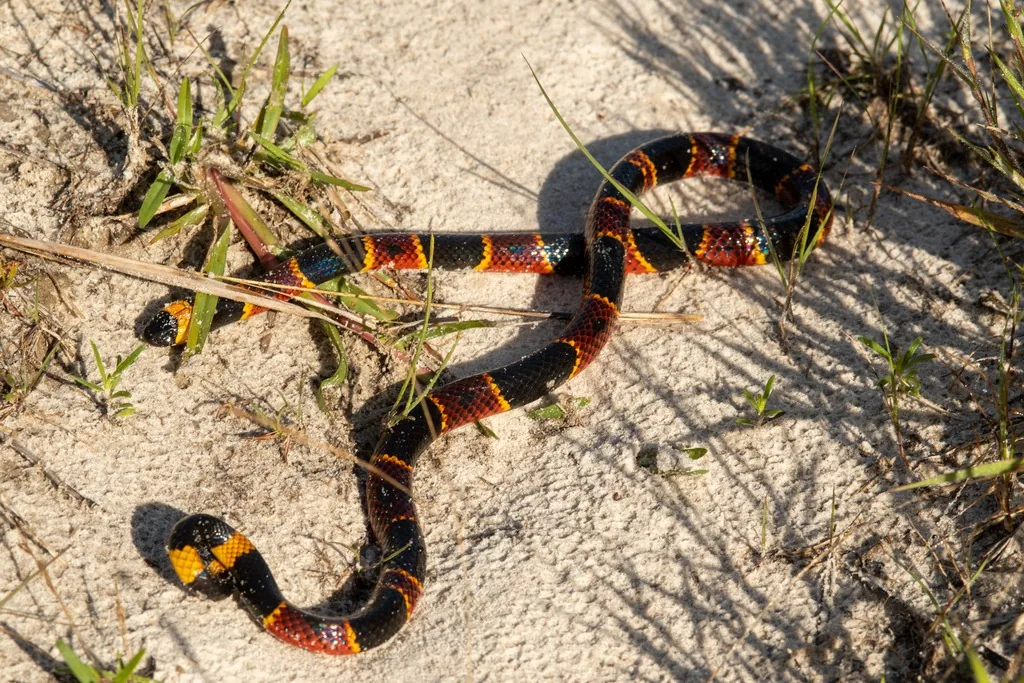
- Broad red and black rings are separated by narrow yellow rings, so red touches yellow. The rings go all the way around the body, and the red rings are usually flecked with black.[5][6][8][2][7]
- The small, blunt head is barely wider than the neck, with a black snout followed by a broad yellow band behind the eyes. The tiny black eyes have round pupils, and the tail is banded only in black and yellow. The Florida Museum notes the tiny eyes are black like the rest of the snout, which makes them hard to see, and that young snakes are colored the same as adults.[5][6][8][13]
- It is not a pit viper and has no facial pit. Its short fangs are fixed at the front of the upper jaw.[2][6][7]
- Hatchlings are patterned like adults and about 8 inches long.[6]
Look-alikes
| Look-alike | How to tell them apart |
|---|---|
| Scarlet kingsnake | A harmless snake with a red snout, whose yellow rings touch only black rings, never red. The Florida Museum adds that its rings fully encircle the body, as on the coral snake.[5][6][2][13] |
| Scarletsnake | Also harmless, with a red, pointed snout and red blotches outlined in black; the bands don't circle the body, leaving a plain white or cream belly. The Florida Museum describes its red snout as somewhat pointed and its unpatterned belly as cream white.[6][5][13] |
Where it lives
It lives east of the Mississippi River from southeastern North Carolina through parts of South Carolina and Georgia, all of Florida, and southern Alabama and Mississippi to the southeastern tip of Louisiana. Records within that range are patchy: in Georgia it is mainly a Coastal Plain snake with a population along the Flint River in the lower Piedmont, in Mississippi it lives in sandy pinewoods of the southeastern counties, and North Carolina lists it as state Endangered and one of its most rarely encountered animals. The Texas coral snake (Micrurus tener) is a separate species. The Florida Museum lists confirmed records from counties throughout Florida and from Key Largo in the upper Florida Keys.[7][6][8][5][10][13]
Biology and life cycle
Georgia describes well-drained, sandy soil with open ground, such as longleaf pine stands, sandhills and pine flatwoods, and says it does not tolerate low-lying areas or wet soils; Alabama's account lists loose soils from hardwood forests to pine flatwoods. It shelters in gopher tortoise burrows, rotten logs and stump holes. The Florida Museum describes a wider range of habitats in Florida, from dry, well-drained flatwoods and scrub to low, wet hammocks and the borders of swamps, and says it has even been seen climbing live oak trunks.[6][7][13]
It is secretive and semi-burrowing, spending most of its time in loose soil or leaf litter, under debris, or underground. Mississippi notes it turns up in yards and gardens of houses near good habitat. The Florida Museum also says it is occasionally found in suburban neighborhoods where development pushes into good habitat.[6][7][8][1][13]
Activity times are given differently: mostly by day (Mississippi, and several studies cited by the Florida Museum), mostly early morning and late afternoon to evening (Alabama), or any time of day or night with peaks at dawn and dusk (Georgia).[8][7][6][13]
It eats almost only other reptiles, mainly small snakes, skinks and legless lizards, which it finds by probing through leaf litter and loose soil. The Florida Museum says it feeds almost exclusively on lizards and small snakes, foraging slowly along the ground with its head probing into the leaf litter.[6][7][8][13]
It is the only venomous snake in the U.S. that lays eggs. Clutch sizes differ by source: 3 to 10 is typical in Georgia, 2 to 13 (usually 4 to 7) in Alabama's account, and around 4 to 13 white, elongate, leathery eggs in Florida, laid underground or in leaf litter. The young hatch in late summer, August or September, after 70 to 90 days.[6][7][8][13]
If it is touched, grabbed or pinned, it will bite; North Carolina says that left alone it poses no threat.[8][5]
When approached it usually flees. The Florida Museum describes a defensive display: it flattens the hind part of its body, hides its head beneath its coils and waves its tail, drawing an attack away from the head.[13]
Damage and signs
- Coral snakes are not a structural or garden pest; the concern is a bite, and North Carolina says a bite would probably require handling or restraining the snake with bare hands or feet.[5]
- Pets get bitten too. At a Florida veterinary hospital, 92 dogs and cats were given antivenom after coral snake exposure; 6% of the dogs and none of the cats died.[12]
Health risk
A coral snake bite is a medical emergency even if it looks minor: Poison Control notes there may be no obvious puncture marks. The venom mainly attacks the nerves. Early signs are often tingling and mild weakness, which can progress to paralysis and respiratory failure, and symptoms may be delayed up to 12 to 13 hours. Get emergency care at once; Poison Control (1-800-222-1222) works with hospital staff on antivenom.[9][10][1]
Control
Prevention
Never touch or handle any snake. Wear boots and long pants outdoors, wear leather gloves when handling brush and debris, and stay away from leaf piles where you can.[1]
If you see a brightly banded snake and aren't sure what it is, leave it alone and let it move off. In North Carolina it is state listed as Endangered and may not be captured, killed, harmed or kept without a permit.[6][5]
Keep them out
Seal openings 1/8 inch and larger around foundations, doors, pipes and utility lines to keep snakes out of buildings.[3]
Sanitation
Keep vegetation mowed and remove debris that shelters snakes and their prey near the house.[3]
When to call a professional
Snakes are protected in most states and should never be killed indiscriminately. ICWDM advises moving any trapped venomous snake only with snake tongs, never by hand; North Carolina's Wildlife Commission does not send staff to trap and remove snakes.[2][3][5]
Red touches yellow: using the rhyme carefully
The familiar rhyme, red touching yellow means a coral snake and red touching black means a harmless snake, holds true most of the time in the United States.[2][8]
ICWDM notes the rhyme does not apply to snakes in Mexico, and North Carolina's Wildlife Commission says it should never be used in tropical America.[2][5]
Unusual color patterns occur (Alabama says regularly), and Georgia notes people often misremember the rhyme. The safe rule is to leave any snake alone unless you are completely sure of its identity. The Florida Museum likewise says the rhymes hold true most of the time in Florida but unusual color variations occasionally break the rule, and that whether the resemblance of the harmless lookalikes is true mimicry is still debated.[7][6][13]
If someone is bitten
Get emergency medical help right away; don't wait for symptoms. Don't drive yourself, because a bite can make you dizzy or faint. Poison Control can advise by phone at 1-800-222-1222.[1][9]
Stay calm and keep still. Remove rings, watches and tight clothing before swelling starts, wash the bite with soap and water, and cover it with a clean, dry dressing.[1][9]
Don't try to catch, kill or pick up the snake; a photo from a safe distance can help.[1][9]
Skip tourniquets, electric shock, cutting, sucking out venom, ice and soaking the wound, and don't take alcohol or pain relievers such as aspirin or ibuprofen.[1][9]
Antivenom and what to expect
Antivenom is the specific treatment, given alongside airway support when breathing weakens.[10][9]
In a review of 387 eastern coral snake cases handled by Florida poison centers from 1998 to 2010, 56.3% of patients had no reported systemic symptoms; the most common effects were pain, tingling, nausea and vomiting. North American Coral Snake Antivenin was given in 65% of cases, and about 18% of those patients had an adverse reaction. The authors note the antivenom has been hard to get because production was stopped for many years.[11]
Where the sources disagree
Habitat: Georgia says it does not tolerate low-lying areas or wet soils, while the Florida Museum lists low, wet hammocks and the borders of swamps among its Florida habitats.[6][13]
Size: the Florida Museum gives a record of 47.5 inches (120.7 cm); Georgia says just over 47 inches, and Alabama's account gives a maximum of about 43 inches.[13][6][7]
Common questions
- Do coral snakes have to chew to inject venom?
- Sources disagree. The Mississippi and Georgia wildlife agencies call that folklore: the short, fixed front fangs can inject venom quickly, and a coral snake can bite anywhere on the body. A medical review describes delivery as a chewing mechanism that needs prolonged contact, and Alabama notes it chews its prey vigorously. Either way, treat any bite as an emergency.[8][6][10][7]
- Are coral snakes aggressive?
- No. They are shy and secretive, usually flee, and bite almost only when someone touches, grabs or pins them.[5][8]
- How can I tell a coral snake from a scarlet kingsnake?
- Look at where the red rings sit: on a coral snake red touches yellow, while on the harmless kingsnake each red ring is bordered by black. The coral snake's snout is black, not red.[2][5][6]
Sources
- U.S. Centers for Disease Control and Prevention, NIOSH, “Venomous Snakes at Work (reviewed September 23, 2026).” www.cdc.gov/niosh/outdoor-workers/about/venomous-snakes.html (accessed 2026-11-12)
- Internet Center for Wildlife Damage Management, “Snakes: Identification.” icwdm.org/species/reptiles/snakes/ (accessed 2026-11-12). Run by university wildlife damage specialists (maintained at the University of Wisconsin-Stevens Point); species modules are based on Prevention and Control of Wildlife Damage (University of Nebraska Cooperative Extension, 1994).
- Internet Center for Wildlife Damage Management, “Snake Damage Prevention and Control Methods.” icwdm.org/species/reptiles/snakes/snake-damage-prevention-and-control-methods/ (accessed 2026-11-12). Run by university wildlife damage specialists (maintained at the University of Wisconsin-Stevens Point); species modules are based on Prevention and Control of Wildlife Damage (University of Nebraska Cooperative Extension, 1994).
- iNaturalist, “Micrurus fulvius taxon page (order and family).” www.inaturalist.org/taxa/73867 (accessed 2026-11-12)
- North Carolina Wildlife Resources Commission, “Eastern Coral Snake (species page).” www.ncwildlife.gov/species/eastern-coral-snake (accessed 2026-11-12)
- Georgia Department of Natural Resources, Wildlife Resources Division, “Eastern Coral Snake, Micrurus fulvius (Venomous Snakes Fact Sheet Series).” gadnrle.org/sites/default/files/wrd/pdf/fact-sheets/Venomous%20Snakes%20-%20Eastern%20Coral%20Snake.pdf (accessed 2026-11-14)
- Alabama Department of Conservation and Natural Resources (Outdoor Alabama), “Eastern Coral Snake, Micrurus fulvius (D. H. Nelson, species account).” outdooralabama.com/venomous-snakes/eastern-coral-snake (accessed 2026-11-14)
- Mississippi Department of Wildlife, Fisheries, and Parks, “Coral snake, Micrurus fulvius (Venomous Snakes of Mississippi).” www.mdwfp.com/venomous-snakes-mississippi/coral-snake (accessed 2026-11-12)
- Poison Control (National Capital Poison Center), “Everything you need to know about snakebites.” www.poison.org/articles/snakebites-in-march (accessed 2026-11-12)
- StatPearls Publishing (NCBI Bookshelf), via PubMed, “Beaird D, Lee VR, Coral Snake Toxicity, StatPearls (updated January 11, 2026).” pubmed.ncbi.nlm.nih.gov/30085573/ (accessed 2026-11-12). Cited from the PubMed summary.
- Clinical Toxicology, via PubMed, “Wood A et al. (2013), Review of Eastern coral snake (Micrurus fulvius fulvius) exposures managed by the Florida Poison Information Center Network: 1998-2010, Clinical Toxicology 51(8):783-788.” pubmed.ncbi.nlm.nih.gov/23962099/ (accessed 2026-11-12). Cited from the PubMed abstract.
- Toxins, via PubMed, “Sullivan JM, Aasen TL, Fisher CJ, Schaer M (2024), Retrospective evaluation of clinical and clinicopathologic findings, case management, and outcome for dogs and cats exposed to Micrurus fulvius (eastern coral snake): 92 cases (2021-2022), Toxins 16(6):246.” pubmed.ncbi.nlm.nih.gov/38922141/ (accessed 2026-11-12). Cited from the PubMed abstract.
- Florida Museum of Natural History, University of Florida, “Harlequin Coralsnake (Micrurus fulvius), Florida Snake ID Guide.” www.floridamuseum.ufl.edu/florida-snake-id/snake/harlequin-coralsnake/ (accessed 2026-11-14)