The short answer
- Look at its size first. A light brown roach about 1/2 inch long with two dark stripes behind the head is most likely a German cockroach, which Kentucky calls by far the most common roach in homes and which doesn't live outdoors. A large one, around 1 to 1 1/2 inches, is more likely an American, oriental, smokybrown or wood roach that came in from outside.[1][2]
- A big outdoor roach is often just a stray. UC IPM says indoor chemical control is warranted only when a population is established, not for an incidental intruder or two. A small German roach, or any roach out in daylight, is a stronger sign that more are hiding: Texas A&M says daytime sightings usually mean there are a lot of them.[3][2]
- Tonight, check with a flashlight and set sticky traps in cupboards and around the fridge, stove and sink. Clean up crumbs, dishes and spills, and fix any leaks, before reaching for a spray.[3][5][8]
Related profiles on this site
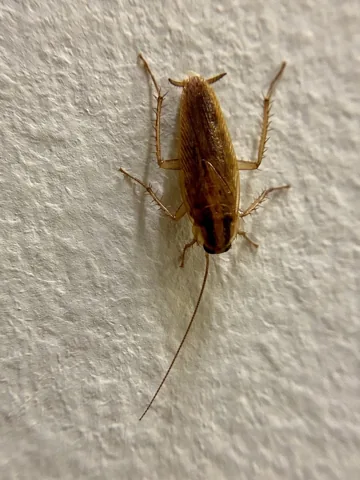 German Cockroach
Blattella germanica
The German cockroach is the most common cockroach living indoors in California and perhaps worldwide, especially in apartment buildings, and it has the fastest reproductive cycle of the common pest cockroaches. Penn State and Kentucky call it the most common cockroach in homes, apartments and other buildings, and Kentucky says it does not live outdoors.
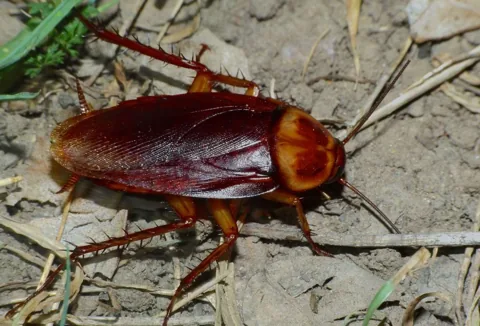 American Cockroach
Periplaneta americana
The American cockroach is the largest of the common pest cockroaches. It prefers warm, humid places and readily lives outdoors, in sewers, storm drains and water meter boxes, coming indoors to forage. Kentucky, Penn State and Minnesota all describe it as the largest cockroach commonly found in buildings.
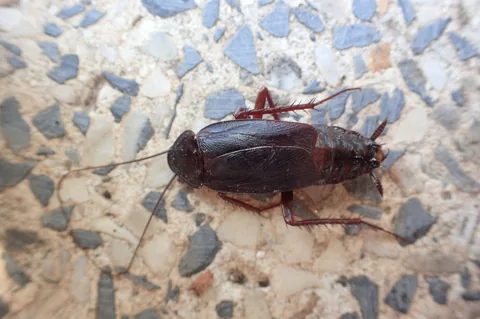 Oriental Cockroach
Blatta orientalis
The oriental cockroach, often called a water bug and sometimes a black beetle, lives in cool, dark, damp places such as basements, crawl spaces, drains and water meter boxes. It usually lives outdoors or in those damp spots and wanders into buildings at night, mostly staying at ground level.
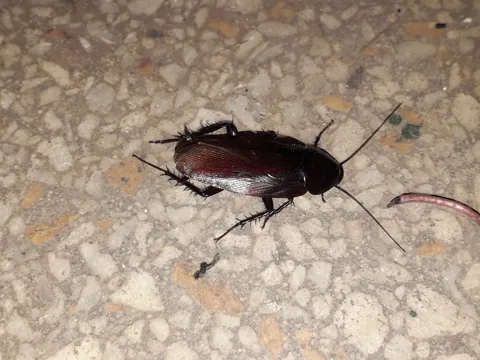 Smokybrown Cockroach
Periplaneta fuliginosa (now also placed in Validiblatta)
The smokybrown cockroach is a large, dark, winged roach of the humid South. It is the most common cockroach in suburban Southern neighborhoods with mature hardwood trees, where it lives in tree holes, attics, crawl spaces and sheds and comes out at night.
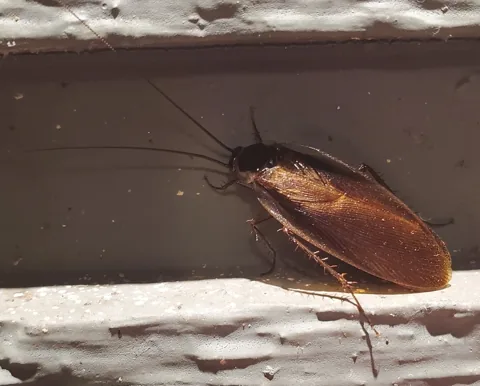 Wood Cockroaches
Parcoblatta species (e.g., P. pennsylvanica)
Wood cockroaches are native species of forest leaf litter, logs and other damp places full of decaying material. They come indoors only by accident, dry out and die within days, and don't feed or breed inside, so they are a nuisance only.
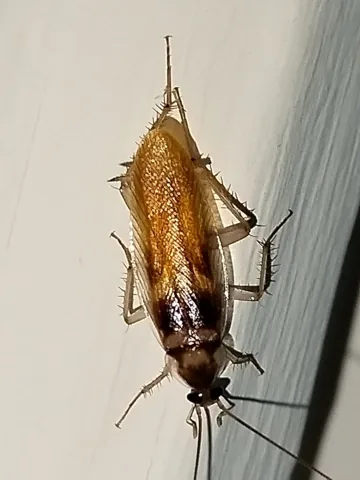 Brownbanded Cockroach
Supella longipalpa
The brownbanded cockroach is a small indoor species that prefers warmer, drier spots than the German cockroach. It hides around appliances, behind wall decorations, in furniture and often near the ceiling, rather than mainly in kitchens and bathrooms.
Which cockroach was it?
Kentucky Extension counts 69 cockroach species in North America and says only a handful infest buildings. If you caught it, or can catch the next one on a sticky trap, compare it with these. The types of cockroaches guide has photos and the rest of the list.[1]
- German cockroach (small, indoors): light brown, about 1/2 inch long, with two dark stripes along the shield behind the head (Kentucky); Texas A&M gives 1/2 to 5/8 inch. Kentucky says it does not occur outdoors, and Rutgers says seeing German cockroaches during the daytime is typically a sign of a severe infestation.[1][2][4]
- American cockroach (large): Kentucky calls it the largest roach commonly found in homes, about 1 1/2 inches, reddish brown with a pale yellow band around the edge of the area behind the head. It prefers dark, moist places such as basements, crawl spaces and floor drains and, in warmer months, outdoors around yards and trash containers.[1]
- Oriental cockroach (large, black): shiny black or dark brown and about 1 inch long, with very short wings on the female. Kentucky says it favors cool, dark, damp places such as sewers, crawlspaces, cellars and basements and usually stays at ground level.[1]
- Smokybrown cockroach (large, dark brown): uniformly shiny dark brown and 1 to 1.5 inches long, slightly smaller than an American cockroach. University of Tennessee says it is often seen at night and is attracted to lights; Texas A&M lists it among the roaches that live mostly outdoors.[6][2]
- Wood cockroach (about 1 inch, near woods): brownish, with males that fly well and both sexes drawn to lights. Kentucky says they cannot survive indoors and arrive in spring and summer or in firewood; Penn State says they dry out and die within a few days and do not feed or reproduce indoors.[1][7]
Does one cockroach mean an infestation?
Not always, and the type matters more than the count. UC IPM calls the German cockroach the most persistent and troublesome species and says it lives and breeds indoors, and Texas A&M says the American, oriental and smokybrown cockroaches live mostly outdoors and may move indoors in search of food or water.[3][2]
Time of day is the next clue. Kentucky says roaches are more active at night and generally stay hidden in cracks and dark spots during the day; Texas A&M says that if you see cockroaches during the day, it usually means there are a lot of them around.[1][2]
A big roach that came up a drain or under a door on a summer night is a different problem from a small roach on the counter at noon. For the first, UC IPM says indoor insecticide use isn't warranted for an incidental intruder or two; the fix is closing the way in. For the second, plan on a full search.[3]
Is the food it touched safe?
EPA's child care IPM training says cockroaches can make people sick because they carry germs that cause food-borne illness, and that they ruin stored food by feeding, defecating and carrying germs, and contaminate eating utensils and surfaces.[10]
A 2020 review in Environmental Health Insights found that about a quarter of the microorganisms isolated from cockroaches are food-borne pathogens, and concluded that roaches could be an important reservoir and mechanical vector. The same review notes that their role in human infections is still poorly understood and has been debated for years.[12]
- The practical steps from the fact sheets: store food in the refrigerator or airtight containers, and wash dishes, pots, pans, utensils and pet bowls right after use instead of leaving them out overnight. Connecticut's Agricultural Experiment Station says the concern is roaches walking over food and preparation surfaces.[9]
Allergies and asthma
EPA says proteins in cockroach feces and saliva can cause allergic reactions or trigger asthma symptoms in some people, and that cockroach allergens likely play a significant role in asthma in many urban areas. One stray isn't the concern here; a lasting infestation is. The cockroach allergens and asthma article covers the research and how to lower exposure.[11]
- For people with asthma, EPA suggests keeping counters, sinks, tables and floors clean and free of clutter, and choosing pest control methods that pose less risk, since insecticides can harm people as well as pests.[11]
How to check for more tonight
Kentucky says roaches leave their hiding places at night to search for food, so check after dark. UC IPM suggests using a flashlight to inspect cracks, the undersides of counters, the area around the water heater and other dark places; a small mirror on a long handle helps in hard-to-see spots.[3]
Kentucky says roaches prefer dark, secluded places near food, warmth and moisture, which is why a bright flashlight helps during inspections.[1]
Set sticky traps. Minnesota Extension says to put them tight against edges where walls meet floors, and in cupboards and around refrigerators, stoves and sinks, to confirm you have cockroaches. Texas A&M adds that sticky cards near doors and behind laundry appliances show where roaches are getting in.[5][2]
- Read the traps after a few nights. Texas A&M says sticky cards are most useful for monitoring and less effective as control, though they can catch low numbers of the larger roaches.[2]
What to do next
Cut off food and water first. NPIC suggests fixing leaks, removing clutter, keeping the kitchen and sink clean every night, vacuuming cracks and crevices at least weekly, sealing pet food and water overnight, and keeping garbage and recycling in bins with tight lids.[8]
Close the way in. NPIC recommends sealing cracks and crevices around cabinets, backsplashes, windows and doors. Rutgers says sealing gaps around plumbing fixtures also helps against American cockroaches.[8][4]
If traps show a German cockroach population, use baits rather than sprays. Kentucky says most householders get better results with bait formulations, which contain a slow-acting insecticide with a food attractant, and Rutgers says total-release aerosols (bug bombs) are not effective and should be avoided. The gel bait guide covers placement.[1][4]
- If it was a big outdoor roach and the traps stay empty, focus on drains, gaps under doors and damp spots in the basement or crawl space. The American and oriental cockroach guide and the wood cockroach guide go step by step.[1]
When to call a pro
UC IPM says professional pest control is often required for serious indoor infestations and other large or complex cockroach problems. Minnesota Extension also recommends hiring a pest management service when pesticides are needed, and says apartment infestations call for treating the infested unit and the units next to it.[3][5]
- Kentucky says many householders can solve a cockroach problem on their own with the steps in its fact sheet, and notes that pest control companies set up their cockroach service in different ways, so ask what a company's cockroach service includes.[1]
Common questions
- I saw one roach in daylight. Is that bad?
- Usually, yes. Texas A&M says that seeing cockroaches during the day usually means there are a lot of them around, and Rutgers says daytime German cockroach activity is typically a sign of a severe infestation.[2][4]
- Can a cockroach come in from outside?
- Many do. Texas A&M says American, oriental and smokybrown cockroaches live mostly outdoors but may move indoors in search of food or water, and Penn State says wood cockroaches come in by accident through foundation cracks, around windows and doors, on firewood or after being drawn to porch lights.[2][7]
- Should I set off a bug bomb?
- No. Rutgers says total-release aerosols are not effective and should be avoided, and Kentucky recommends baits for most householders instead.[4][1]
- Can a roach make my family sick?
- It can carry germs. EPA says cockroaches carry germs that cause food-borne illness and can make asthma and allergies worse in sensitive people; a 2020 review adds that how often they actually cause human infections is still debated.[10][12]
Photo credits
- German Cockroach: (c) Sandra H Statner, some rights reserved (CC BY) — via iNaturalist, CC BY 4.0
- American Cockroach: (c) Steve Kerr, some rights reserved (CC BY) — via iNaturalist, CC BY 4.0
- Oriental Cockroach: (c) Jorge Íñiguez, some rights reserved (CC BY) — via iNaturalist, CC BY 4.0
- Smokybrown Cockroach: (c) Eduardo Luis Beltrocco, some rights reserved (CC BY) — via iNaturalist, CC BY 4.0
- Wood Cockroaches: (c) Whitney Mattila, some rights reserved (CC BY) — via iNaturalist, CC BY 4.0
- Brownbanded Cockroach: Sinaloa Silvestre, public domain (CC0), via iNaturalist
Sources
- University of Kentucky Entomology, “ENTFACT-614: Cockroach Elimination in Homes and Apartments (M. F. Potter).” entomology.mgcafe.uky.edu/ef614 (accessed 2026-11-14)
- Texas A&M AgriLife Extension, “Cockroaches: Biology and Management, ENTO-037.” extensionentomology.tamu.edu/wp-content/uploads/sites/3/2017/12/Cockroach-Biol-and-Mngmt_ENTO-037_2017.pdf (accessed 2026-11-14)
- University of California Statewide IPM Program, “Pest Notes: Cockroaches, Publication 7467 (revised December 2019).” ipm.ucanr.edu/legacy_assets/PDF/PESTNOTES/pncockroaches.pdf (accessed 2026-11-14)
- Rutgers Cooperative Extension, “FS1327: Cockroach Species in New Jersey and Their Control Strategies.” extension.rutgers.edu/fs1327 (accessed 2026-11-14)
- University of Minnesota Extension, “Cockroaches.” extension.umn.edu/insects-infest-homes/cockroaches (accessed 2026-11-14)
- University of Tennessee Entomology and Plant Pathology, “The Smokybrown Cockroach, Insec(tc)ure Vol. 3 Issue 10/11 (October 21, 2022).” epp.tennessee.edu/wp-content/uploads/sites/267/2023/11/2022-10SmokybrownV3I10.pdf (accessed 2026-11-14)
- Penn State Extension, “Wood Cockroaches (M. J. Skvarla; updated January 2026).” extension.psu.edu/wood-cockroaches (accessed 2026-11-14)
- National Pesticide Information Center (Oregon State University and U.S. EPA), “Cockroaches.” npic.orst.edu/pest/roach.html (accessed 2026-11-14)
- The Connecticut Agricultural Experiment Station, “Cockroaches (Order Blattodea) fact sheet.” portal.ct.gov/-/media/CAES/DOCUMENTS/Publications/Fact_Sheets/Entomology/Cockroaches_Blattodea.pdf (accessed 2026-11-14)
- U.S. Environmental Protection Agency, “Module 6: Managing Cockroaches in Child Care Centers (Integrated Pest Management for Child Care Settings).” www.epa.gov/sites/default/files/documents/Module06.pdf (accessed 2026-11-14)
- U.S. Environmental Protection Agency, “Asthma Triggers: Gain Control (Cockroaches and Pests).” www.epa.gov/asthma/asthma-triggers-gain-control (accessed 2026-11-14)
- Environmental Health Insights (PubMed abstract, PMID 32425541), “Cockroaches and Food-borne Pathogens (Donkor ES, Environmental Health Insights, 2020).” pubmed.ncbi.nlm.nih.gov/32425541/ (accessed 2026-11-14)