The short answer
- The look: you usually can't tell them apart by eye. Both are light brown to yellowish brown with two dark stripes running lengthwise on the shield behind the head, and even experts have trouble telling a dead specimen apart.[1][2][3][7]
- Flight: Asian cockroaches are accomplished fliers. German cockroaches have full wings but rarely or never fly and can't sustain flight.[1][2][3]
- Where they live: German cockroaches live mainly indoors, in kitchens and bathrooms. Asian cockroaches live outdoors in leaf litter, mulch and grassy areas and come inside in small numbers at night.[1][2][3][7][12]
- Light at dusk: Asian cockroaches become active at dusk, fly to light reflecting off pale walls, doors and windows, and rest on lamp shades, TV screens and lit walls. A roach that flies in toward a light in the Southeast is likely Asian.[1][11]
Profiles on this site
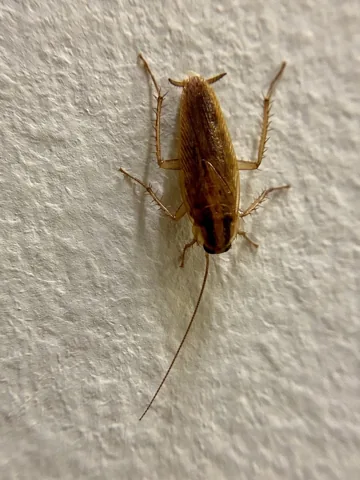 German Cockroach
Blattella germanica
The German cockroach is the most common cockroach living indoors in California and perhaps worldwide, especially in apartment buildings, and it has the fastest reproductive cycle of the common pest cockroaches. Penn State and Kentucky call it the most common cockroach in homes, apartments and other buildings, and Kentucky says it does not live outdoors.
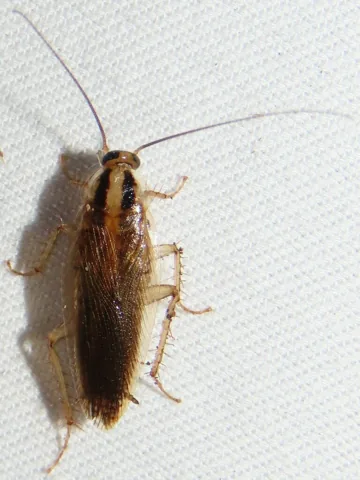 Asian Cockroach
Blattella asahinai
The Asian cockroach is a close relative of the German cockroach that lives outdoors in leaf litter, mulch and grassy areas. It flies well and is drawn to lights at dusk, so it shows up indoors in the evening, but treating inside the house doesn't control it.
Side by side: German cockroach and Asian cockroach
Each line gives the German cockroach (Blattella germanica) first, then the Asian cockroach (Blattella asahinai).[2][1]
- Size: German cockroach adults are 1/2 to 5/8 inch long. Texas A&M says the Asian cockroach is identical in appearance for practical purposes, so size won't separate them.[2][3][1]
- Color and markings: both are light brown to yellowish brown, and in both the shield behind the head (the pronotum) carries two dark lengthwise stripes.[2][3][7]
- Wings and flight: German adults are fully winged but rarely fly; Penn State says they do not fly, and Texas A&M says they are incapable of sustained flight. Asian adults are accomplished fliers.[2][3][1]
- Where found: German cockroaches can't tolerate cold and live mainly indoors, near food, water and dark shelter in kitchens and bathrooms. Asian cockroaches live mainly outside in leaf litter and grassy areas, mulch under shrubs and gardens.[2][3][4][1][7][12]
- When you see them: German cockroaches hide in dark, warm, narrow cracks close to food and water. Asian cockroaches become very active at dusk, fly to lit walls, doors and windows, and follow the light from room to room as lights are switched off.[4][1]
- Season: in Florida the Asian cockroach is a pest during peak adult numbers in early spring and summer, with some adults present all year.[1]
- Nymphs and egg cases: Asian egg cases and young nymphs are smaller, and late Asian nymphs are pale along the edges of the abdomen, where German nymphs are slightly pigmented.[1][7]
- Offspring: Asian females produce an average of 3.7 egg cases with about 37.5 eggs in each, about 80 offspring in a lifetime, which Texas A&M says is significantly fewer than the German cockroach. German egg capsules hold up to 48 eggs (usually 30 to 48), and females usually produce four to eight.[1][14][3]
- Damage: German cockroaches contaminate food in kitchens and other food areas. Asian cockroaches have been seen feeding on crops such as lettuce, cabbage, roses and strawberries, and dense populations can be a nuisance around homes.[4][1][10]
Where the Asian cockroach occurs
The Asian cockroach was first collected in North America in Florida in 1986 and has since spread through the southeastern United States, with field populations studied in Alabama and North Carolina. The German cockroach occurs in buildings worldwide.[1][10][11][13][8]
Outdoors, where it occurs, the Asian cockroach tends to be the main cockroach species, and Texas A&M reports more than 250,000 per acre in damp leaf litter and mulch in parts of Tampa.[1]
German cockroaches are not found in natural habitats at all; genetic work shows they evolved from the Asian cockroach about 2,100 years ago, probably by adapting to human settlements in India or Myanmar.[8]
Sources differ on whether they are even separate species. Texas A&M and the other research cited here treat them as two species, while a 2025 study in ZooKeys found a COI genetic distance of only 0.92% and downgraded the Asian cockroach to a subspecies of the German cockroach.[1][9][7]
How to confirm which one you have
Texas A&M says the only truly reliable lab method is analysis of the waxy layer of the exoskeleton by gas chromatography, and a 2025 study found DNA (COI) sequencing works. For a homeowner, behavior and location are the useful clues.[1][7]
- Note where you saw it. Roaches in kitchen and bathroom cracks, around appliances and food, point to German cockroaches.[2][3][4]
- Note when and how it arrived. Roaches that fly in at dusk toward lit doors, windows and lamps, and gather on lamp shades or TV screens, point to Asian cockroaches.[1][11]
- Check outdoors. Asian cockroaches live in leaf litter, pine straw and mulch around the house; German cockroaches don't live outside in cold climates.[1][12][2]
- Look at nymphs if you find them: pale abdomen edges suggest Asian, slightly pigmented edges suggest German.[1][7]
- If you need a name for a specimen, Texas A&M AgriLife's urban entomology program offers an insect sample submission form; your county extension office can also help.[1]
Why the difference matters for control
German cockroaches breed indoors, so control happens inside: Texas A&M says exterior pesticide applications are unneeded for them. Asian cockroaches breed outside, and because only a few enter a house at night, indoor insecticide applications have been completely ineffective.[2][1]
- Asian cockroaches are susceptible to the commonly used insecticides, and outdoor treatments have worked in field tests: scatter (granular) baits, and a beta-cyfluthrin spray and fipronil granules applied at label rates in Dothan, Alabama.[1][13][11]
- In lab tests, Asian and German cockroaches had similar sensitivity to lambda-cyhalothrin.[16]
- In the lab the two can mate and produce fertile hybrids that fly and carry the German parent's insecticide resistance, but Texas A&M says this seldom if ever happens in nature because the two behave so differently.[1][17]
What to do for each
Follow label instructions for any pesticide and apply it only as directed.[2]
- German cockroaches: start with sanitation (remove food, water and hiding places), then use gel baits in small pea-sized placements where roaches live, bait stations where they need to be tamper-resistant, dusts or sprays as the situation calls for. Heavy infestations usually need follow-up visits.[2]
- German cockroaches: check boxes and bags as they come in, since German roaches are carried in with groceries, luggage and other goods.[2]
- Asian cockroaches: work outdoors where they breed. Treat leaf litter, mulch and grassy areas with an outdoor product labeled for cockroaches, such as a granular scatter bait.[1][13][11]
- Asian cockroaches: mulch choice can help. In lab tests, adults and nymphs showed little preference for cypress mulch and topsoil, while they favored oak leaf litter, pine straw and rubber mulch.[12]
- Asian cockroaches: because they fly to light, the few that come in at dusk are drawn to lit walls, doors and windows; spraying inside the house won't stop more from coming.[1]
Allergies and asthma
Body parts and droppings from cockroaches can trigger asthma attacks in some people. MedlinePlus advises keeping food in containers and out of bedrooms, and CDC advises removing food and water sources, cleaning up crumbs and spills, storing food in airtight containers, keeping trash closed and sealing cracks around cabinets, baseboards and plumbing.[5][6]
Asian cockroaches mostly stay outdoors, but a Mayo Clinic study found the Asian cockroach shares allergens mainly with the German cockroach, and its authors said people sensitive to German cockroaches should be aware of possible exposure to Asian cockroach allergens indoors and outdoors where Asian cockroaches are numerous.[15]
Common questions
- Do German cockroaches fly?
- Rarely. Adults have full wings, but Penn State says they do not fly and Texas A&M says they can't sustain flight. A small striped roach flying to a light is more likely an Asian cockroach.[3][2][1]
- Can Asian cockroaches infest my house like German cockroaches?
- They can invade homes, but they mainly live and breed outdoors, and only a few come in at night. That is why indoor treatments don't control them.[1]
- Where do Asian cockroaches live in the US?
- In the Southeast. First found in Florida in 1986, they have spread through the southeastern states, with populations studied in Alabama and North Carolina.[1][10][11][13]
- Can German and Asian cockroaches interbreed?
- In the lab, yes, and the hybrids can fly and carry German insecticide resistance. In nature it seldom if ever happens because they live in different places.[1][17]
- Are Asian cockroaches an allergy risk?
- They share allergens mainly with the German cockroach, and researchers said German-cockroach-sensitive people should be aware of exposure where Asian cockroaches are numerous.[15]
Photo credits
- German Cockroach: (c) Sandra H Statner, some rights reserved (CC BY) — via iNaturalist, CC BY 4.0
- Asian Cockroach: kcthetc1, public domain (CC0), via iNaturalist
Sources
- Texas A&M AgriLife, Urban and Structural Entomology Program, “Asian Cockroach, Blattella asahinai.” urbanentomology.tamu.edu/urban-pests/cockroaches/asian/ (accessed 2026-11-14)
- Texas A&M AgriLife, Urban and Structural Entomology Program, “German Cockroach, Blattella germanica.” urbanentomology.tamu.edu/urban-pests/cockroaches/german/ (accessed 2026-11-14)
- Penn State Extension, “German Cockroaches.” extension.psu.edu/german-cockroaches (accessed 2026-11-14)
- University of California Statewide IPM Program, “Pest Notes: Cockroaches.” ipm.ucanr.edu/home-and-landscape/cockroaches/ (accessed 2026-11-14)
- MedlinePlus, U.S. National Library of Medicine, “Asthma (Medical Encyclopedia).” medlineplus.gov/ency/article/000141.htm (accessed 2026-11-14)
- Centers for Disease Control and Prevention, “Controlling Asthma.” www.cdc.gov/asthma/triggers.html (accessed 2026-11-14)
- ZooKeys (PMC12409335), “Cai et al. 2025, On the species status of Blattella germanica and Blattella asahinai, and other morphologically similar species, ZooKeys 1250:155-188.” pmc.ncbi.nlm.nih.gov/articles/PMC12409335/ (accessed 2026-11-14)
- Proceedings of the National Academy of Sciences (PubMed 38768340), “Tang et al. 2024, Solving the 250-year-old mystery of the origin and global spread of the German cockroach, PNAS 121(22).” pubmed.ncbi.nlm.nih.gov/38768340/ (accessed 2026-11-14)
- Journal of Economic Entomology (PubMed 37478414), “Peterson, Hu and Appel 2023, Differential development and survival of Blattella asahinai and Blattella germanica at six constant temperatures, J Econ Entomol 116(5).” pubmed.ncbi.nlm.nih.gov/37478414/ (accessed 2026-11-14)
- Environmental Entomology (PubMed 26314061), “Matos and Schal 2015, Electroantennogram responses and field trapping of Asian cockroach with blattellaquinone, Environ Entomol 44(4).” pubmed.ncbi.nlm.nih.gov/26314061/ (accessed 2026-11-14)
- Journal of Economic Entomology (PubMed 27122494), “Matos and Schal 2016, Laboratory and field evaluation of Zyrox Fly Granular Bait against Asian and German cockroaches, J Econ Entomol 109(4).” pubmed.ncbi.nlm.nih.gov/27122494/ (accessed 2026-11-14)
- Journal of Economic Entomology (PubMed 23448047), “Snoddy and Appel 2013, Mulch preferences of the Asian cockroach, J Econ Entomol 106(1).” pubmed.ncbi.nlm.nih.gov/23448047/ (accessed 2026-11-14)
- Journal of Economic Entomology (PubMed 24665717), “Snoddy and Appel 2014, Field and laboratory efficacy of three insecticides for population management of the Asian cockroach, J Econ Entomol 107(1).” pubmed.ncbi.nlm.nih.gov/24665717/ (accessed 2026-11-14)
- Journal of Economic Entomology (PubMed 1842796), “Atkinson, Koehler and Patterson 1991, Reproduction and development of Blattella asahinai, J Econ Entomol 84(4).” pubmed.ncbi.nlm.nih.gov/1842796/ (accessed 2026-11-14)
- International Archives of Allergy and Applied Immunology (PubMed 2242929), “Helm et al. 1990, Shared allergenic activity in Asian, German, American and Oriental cockroach species, Int Arch Allergy Appl Immunol 92(2).” pubmed.ncbi.nlm.nih.gov/2242929/ (accessed 2026-11-14)
- Comparative Biochemistry and Physiology Part C (PubMed 10661713), “Valles, Koehler and Brenner 1999, Comparative insecticide susceptibility and detoxification enzyme activities among pestiferous Blattodea, Comp Biochem Physiol C 124(3).” pubmed.ncbi.nlm.nih.gov/10661713/ (accessed 2026-11-14)
- Genome (PubMed 18469987), “Ross 1993, Hybridization studies on Blattella germanica and B. asahinai, Genome 36(2).” pubmed.ncbi.nlm.nih.gov/18469987/ (accessed 2026-11-14)