The short answer
- Body shape: seen end-on, a rat snake's body is loaf-shaped rather than round. A racer is long and slender, with a slimmer body and head than a black rat snake.[3][4][2][6]
- Scales: rat snake scales are weakly keeled, each with a faint ridge. Racer scales are smooth, and adult southern black racers are glossy black.[3][5][2][6][4]
- Belly and lips: an adult rat snake usually has a white chin and throat and a belly checkered with black toward the front. A southern black racer has a white chin and throat but a uniformly dark body; Florida Museum describes its belly as grayish to black without markings. Rat snakes may show black vertical lines on the lips, which racers lack.[1][3][4][6]
- Behavior: a racer is fast and usually bolts for cover. A rat snake is a skilled climber and, when threatened, may take a kinked posture and stay still.[4][6][3][5][2]
Snakes on this page
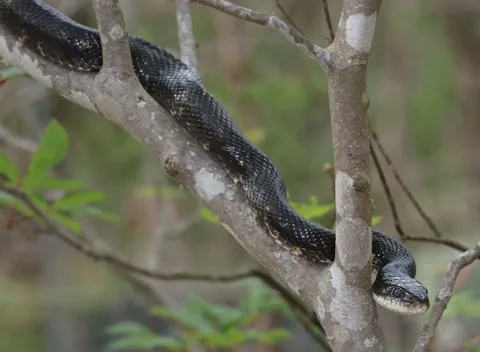 Rat snakes
Pantherophis obsoletus (western ratsnake) and P. alleghaniensis (eastern ratsnake)
Rat snakes are big, nonvenomous constrictors that Missouri's conservation department describes as common and often seen around homes and farm buildings, where they hunt rodents. Missouri calls them widely considered beneficial, though they also climb after bird eggs and chicks.
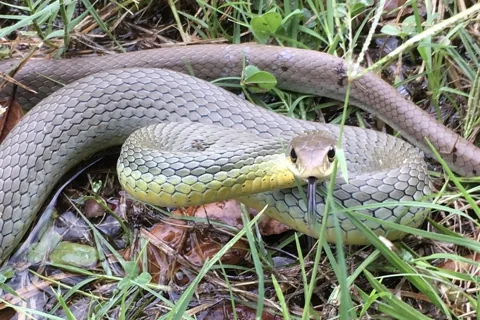 North American Racer
Coluber constrictor
The racer is a long, slim, nonvenomous snake known for its speed and keen eyesight. It is active by day and often seen streaking across roads and yards; in the Southeast the familiar form is the glossy black southern black racer.
Side by side
These are two different snakes. Rat snakes are in the genus Pantherophis: Missouri has the western ratsnake (P. obsoletus), and east of the Mississippi River the eastern or central ratsnake (P. alleghaniensis) takes over. The racer is one species, Coluber constrictor, with several regional forms, including the southern black racer.[1][3][2]
- Length, rat snake: adults 42 to 72 inches (3 1/2 to 6 feet), occasionally to 86 inches, in Missouri; 3 to 5 feet, some over 6 feet, per the Savannah River Ecology Lab; Florida Museum gives 42 to 72 inches with a record of 101 inches.[1][3][5]
- Length, racer: adults 23 to 50 inches, occasionally to 75, in Missouri; Florida Museum gives 20 to 56 inches with a record of 72; SREL says southern black racers typically reach 4.5 feet. A very large black snake is more likely a rat snake.[2][6][4]
- Build: rat snake, a loaf-shaped cross-section and a thicker body and head than a racer. Racer, slender body with a proportionately long tail and a head only slightly wider than the neck.[3][4][2][6]
- Scales: rat snake, weakly keeled, in 25 to 27 rows at midbody per Florida Museum. Racer, smooth, in 17 rows at midbody.[3][5][6][2]
- Color above: rat snakes are usually shiny black, sometimes with dark blotches still showing or red skin between the side scales; on the Coastal Plain of Florida, Georgia and the Carolinas they can be yellow to greenish with four dark stripes. Southern black racers are glossy black to bluish black; the eastern yellow-bellied racer can be tan, brown, olive, blue, gray or nearly black.[1][3][4][2]
- Chin and belly: rat snake, white upper lip, chin and throat, and a white belly that may be checkered with black toward the front. Southern black racer, white chin and throat with a uniformly dark body and a grayish to black belly without markings; the yellow-bellied racer has a yellow, ivory or light blue-gray belly.[1][4][6][2]
- Eyes: both have round pupils. Florida Museum describes the racer's eyes as large and prominent, and Missouri says racers are highly visual, often raising their heads above the grass to look around.[5][6][2]
- Food: rat snakes eat rodents, small rabbits, bats, bird eggs and small birds, killing prey by constriction. Despite the name constrictor, racers are not constrictors: they run down prey and swallow it alive, eating rodents, lizards, small snakes, frogs, birds and insects.[1][2][4]
- Daily activity: racers are active by day. Rat snakes hunt in the daytime in spring and fall but become nocturnal in hot weather, and SREL notes that rat snakes are seen more often in spring and fall while racers peak in summer.[2][1][3][4]
Behavior: climb and freeze or run
Rat snakes are excellent climbers. They are often seen in trees, barns, abandoned buildings and other structures while hunting rodents or birds, and Missouri notes they can get into buildings that aren't sealed well, turning up along beams in barns and attics and between the walls of homes.[1][3]
A threatened rat snake may take a kinked posture and remain motionless. Florida Museum says that when approached, eastern ratsnakes may either flee for shelter or stay still to avoid detection.[3][5]
Racers depend on speed and agility to escape, and when alarmed they try to get away quickly, especially through tall grass or brush. They also climb into small trees or bushes, but speed is their main defense.[2][4][6]
Cornered, both act tough. Both vibrate their tails, which can make a buzzing sound in leaf litter, strike, and smear a foul-smelling musk. Missouri says a captured racer struggles violently and bites; Florida Museum says rat snakes typically calm down quickly if held.[1][2][5][6][4]
A tail buzz doesn't mean rattlesnake. MU Extension lists black racers and rat snakes among the harmless snakes that often vibrate their tails when threatened.[8][6][5]
MU Extension notes one exception to snakes not chasing people: the male black racer, which may chase larger animals, including humans, when defending its breeding territory. Florida Museum says racers are not aggressive and strike only in defense as a last resort.[8][6]
Young snakes: both are blotched
Young rat snakes and young racers are both patterned, which is why SREL says juvenile racers resemble young rat snakes. Neither looks like its black parent at first.[4][3]
Young rat snake: gray or tan with distinct dark brown or black blotches on the back and sides, and a black band between the eyes that angles down toward the mouth. Missouri says the color normally changes to a more uniform black after a year or two. Florida Museum adds a sandy-gray belly with dark square blotches.[1][5]
Young racer: tan or gray with closely spaced gray, brown or reddish-brown blotches down the back and smaller alternating spots on the sides. Florida Museum notes the blotches fade into a solid-colored tail, a useful clue. Missouri says most or all of the spots are gone by the third season; Florida Museum says the adult pattern has fully replaced it after about two years.[2][6][4]
Other clues on a small snake: a young racer still has smooth scales and large eyes, and a young rat snake still has weakly keeled scales.[2][6][5][3]
Around homes, barns and chickens
The rat snake is the one more likely to be inside. Missouri says western ratsnakes shelter in brush piles, hollow trees, farm buildings and old houses where mice are plentiful, and SREL says rat snakes frequently turn up in barns and other structures. Racers use open, edge habitat: prairies, pastures, old fields, brushy areas and forest edges, and SREL lists suburban edges.[1][3][2][4]
Rat snakes are the chicken snake. Florida Museum lists "chicken snake" among the eastern ratsnake's common names, and Missouri says rat snakes climb trees to raid bird nests, including bird boxes, for eggs and young. MDC adds that their benefits far outweigh the occasional theft of a few hens' eggs or baby chickens.[5][1][8]
Racers eat birds and their eggs too, among many other prey, but SREL found lizards and snakes made up over 85% of stomach contents by volume in South Carolina racers.[6][4][2]
Both help with rodents. Missouri calls the rat snake a natural rodent control, and MU Extension says rat snakes eat rats, mice and voles. Mississippi State says black racers, along with kingsnakes and indigo snakes, commonly eat other snakes, including venomous ones.[1][8][7]
How to confirm which one you have
Keep your distance and use a photo. Mississippi State says that unless you are skilled at snake identification, treat every snake as if it were venomous and avoid contact with its head.[7]
From a photo, check in this order: body shape (loaf-shaped and thicker, or slim), scale texture (faint ridges or smooth and glossy), belly (checkered toward the front, or plain), and what the snake did when you came near (froze in kinks or climbed, or shot away).[3][4][5][6][1]
Both have round pupils: Florida Museum lists a round pupil for each, and MU Extension says venomous pit vipers have elliptical, catlike pupils.[5][6][8]
If the snake is blotched and you're not sure it's harmless, compare it with the copperhead and the other blotched lookalikes before going near it; our copperhead lookalike guide covers those field marks.[1][3][4]
What to do for each
Outdoors, leave either one alone. Mississippi State says killing a snake usually serves very little practical purpose, and a racer in the yard will typically leave on its own; snakes eat rats, mice, insects and moles.[7][6]
Make the yard less inviting: keep the lawn mowed, especially around the house, remove brush, junk and debris, store firewood away from the house, and cut the rodent supply by keeping garbage in sealed cans.[7][8]
Seal buildings the way you would for mice, since snakes don't gnaw their way in. Sources differ on the gap size: ICWDM says to seal openings 1/8 inch and larger, MU Extension and Mississippi State say a quarter inch. Use mortar on masonry, sheet metal or fine-mesh hardware cloth on wood, and caulk around pipes and wires.[9][8][7]
For a coop or yard area, ICWDM describes a snake-proof fence of heavy galvanized 1/4-inch mesh hardware cloth 36 inches tall. Rat snakes climb, so closing openings in the coop itself matters as much as the fence.[9][1][3]
Skip repellents. Mississippi State reports that several home remedies were tested on black rat snakes and none of them worked; our snake-exclusion guide covers the details.[7]
Check the law before you kill or move one. Georgia DNR says Georgia's native nonvenomous snakes are protected by state law. South Carolina DNR says all native reptiles and amphibians in that state are protected, with protections that vary by species. Ask your state wildlife agency.[10][11]
Bites
Neither snake is venomous, but both will bite if grabbed or pinned. Florida Museum says virtually all bites occur when the snakes are intentionally molested.[1][2][5][6]
MedlinePlus says most snake species are harmless and their bites are not life threatening, but even the bite of a nonvenomous snake can sometimes cause significant injury, particularly to children.[12]
If you aren't sure what bit someone, treat it as a possible venomous bite: MedlinePlus says to call 911 or the local emergency number and not wait for symptoms. The Poison Help line, 1-800-222-1222, reaches the local poison control center from anywhere in the United States.[12]
Common questions
- Is a black racer just a young black rat snake?
- No. They are different snakes: rat snakes are Pantherophis and racers are Coluber constrictor. Both start out blotched and turn black as they grow, which adds to the mix-up.[1][2][4][3]
- What is the quickest way to tell them apart?
- Look at the body and the belly. A rat snake is thicker, loaf-shaped in cross-section and has a belly checkered toward the front. A racer is slim and round with a plain belly and smooth, glossy scales.[3][4][1][6]
- Which one gets into chicken coops?
- Usually the rat snake. It climbs well and raids nests and bird boxes for eggs and young; Florida Museum lists chicken snake among its common names. Racers do eat birds and eggs but mostly eat lizards and snakes in the Southeast.[1][5][4][6]
- Will a black racer chase me?
- Usually it runs away. MU Extension notes that a male black racer may chase larger animals, including people, while defending its breeding territory; Florida Museum says racers are not aggressive and strike only as a last resort.[8][6][2]
- Are either of them venomous?
- No. Both are nonvenomous with round pupils, though both bite in self-defense when handled.[1][2][5][6]
Photo credits
- Rat snakes: (c) hr_dragonfly, some rights reserved (CC BY) — via iNaturalist, CC BY 4.0
- North American Racer: Brady Reed, public domain (CC0), via iNaturalist
Sources
- Missouri Department of Conservation, “Western Ratsnake (field guide).” mdc.mo.gov/discover-nature/field-guide/western-ratsnake (accessed 2026-11-14)
- Missouri Department of Conservation, “Eastern Yellow-Bellied Racer and Southern Black Racer (field guide).” mdc.mo.gov/discover-nature/field-guide/eastern-yellow-bellied-racer-southern-black-racer (accessed 2026-11-14)
- Savannah River Ecology Laboratory, University of Georgia, “Rat Snake (Pantherophis alleghaniensis).” srelherp.uga.edu/snakes/rat-snake/ (accessed 2026-11-14)
- Savannah River Ecology Laboratory, University of Georgia, “Southern Black Racer (Coluber constrictor).” srelherp.uga.edu/snakes/black-racer/ (accessed 2026-11-14)
- Florida Museum of Natural History, Florida Snake ID Guide, “Eastern Ratsnake.” www.floridamuseum.ufl.edu/florida-snake-id/snake/eastern-ratsnake/ (accessed 2026-11-14)
- Florida Museum of Natural History, Florida Snake ID Guide, “North American Racer.” www.floridamuseum.ufl.edu/florida-snake-id/snake/north-american-racer/ (accessed 2026-11-14)
- Mississippi State University Extension, “Reducing Snake Problems Around Homes.” extension.msstate.edu/publications/reducing-snake-problems-around-homes (accessed 2026-11-14)
- University of Missouri Extension, “Snakes and Their Control (G9450).” extension.missouri.edu/publications/g9450 (accessed 2026-11-14)
- Internet Center for Wildlife Damage Management, “Snake Damage Prevention and Control Methods.” icwdm.org/species/reptiles/snakes/snake-damage-prevention-and-control-methods/ (accessed 2026-11-14)
- Georgia Department of Natural Resources, Wildlife Resources Division, “What to Do When You See a Snake.” georgiawildlife.com/dnr-what-do-when-you-see-snake-3 (accessed 2026-11-14)
- South Carolina Department of Natural Resources, “Reptile and Amphibian FAQs.” www.dnr.sc.gov/wildlife/herps/faqs.html (accessed 2026-11-14)
- MedlinePlus (National Library of Medicine), “Snake bites.” medlineplus.gov/ency/article/000031.htm (accessed 2026-11-14)