The short answer
- Pattern: a garter snake has three light stripes running the length of the body, one down the middle of the back and one along each side. A water snake has dark crossbands or blotches across the back instead of stripes.[1][5][8][3][9][10]
- Build: garter and ribbon snakes are slender. Water snakes are heavy-bodied, with keeled scales that make them feel rough.[5][2][10][4][9]
- Where you see it: garter snakes turn up in lawns, gardens and grassy spots, often near water but not always. Water snakes live in or right next to water and often bask on branches, logs or rocks at the edge, dropping into the water when disturbed.[1][8][10][9]
- Neither is venomous. The snake to rule out near water is the cottonmouth, which has vertical cat-like pupils where water snakes have round ones.[5][7][9]
Snakes on this page
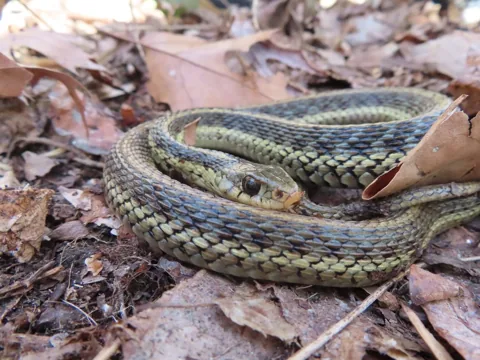 Garter snakes
Thamnophis sirtalis
The common gartersnake is a slender, striped snake that the Missouri Department of Conservation calls harmless, and it is one of the snakes people meet most often in yards and gardens. It may bite and smear a foul-smelling musk if grabbed, but it moves away when left alone.
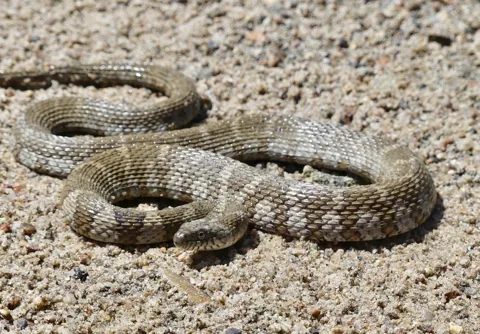 Common Watersnake
Nerodia sipedon
Water snakes are stout, nonvenomous snakes in the genus Nerodia that live in and around fresh water. This page centers on the common or northern watersnake, the most common watersnake in Missouri, and the banded watersnake of the southeastern Coastal Plain.
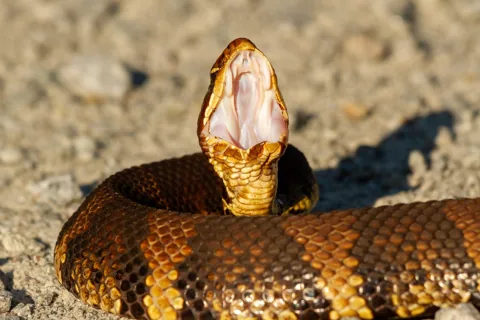 Cottonmouth
Agkistrodon piscivorus (the Florida cottonmouth, A. conanti, is now treated as a separate species)
The cottonmouth, also called the water moccasin, is a venomous pit viper of southeastern wetlands. Its bite is dangerous, but it is not aggressive: it either tries to escape or holds its ground with an open-mouthed warning display, and research indicates it rarely bites unless stepped on or picked up.
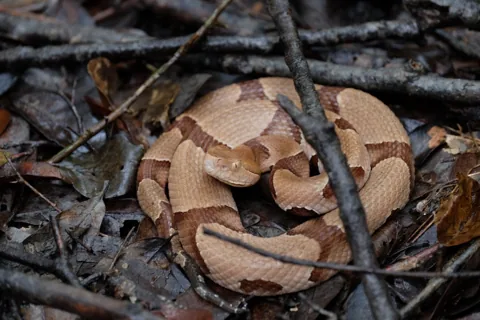 Copperhead
Agkistrodon contortrix
The copperhead is a stout, well-camouflaged pit viper and one of the venomous snakes people most often meet, even in towns. Researchers describe it as the least toxic North American pit viper, but bites still cause pain and swelling that can last weeks, and any bite needs prompt medical care.
Side by side
The common garter snake is Thamnophis sirtalis, and the ribbon snakes are close relatives in the same genus. The water snakes most people meet are the northern (common) watersnake, Nerodia sipedon, and in the Southeast the banded or southern watersnake, Nerodia fasciata.[1][2][3][4][9]
- Length of a garter snake: usually 18 to 26 inches. SREL gives occasional snakes up to 49 inches; Missouri Department of Conservation and the Florida Museum give 54 inches as the top end.[1][8][5]
- Length of a water snake: northern watersnakes run 24 to 55 inches by SREL's figures and 24 to 42 inches by Connecticut DEEP's. Banded watersnakes run 24 to 48 inches (SREL) or about 22 to 42 inches (Florida Museum).[3][10][4][7]
- Body shape: the Florida Museum calls garter snakes slender and ribbon snakes extremely slender. Water snakes are described as heavy-bodied (SREL, Connecticut DEEP) or stout-bodied (Florida Museum).[5][6][4][10][7]
- Back pattern, garter: three light stripes, usually yellow but sometimes green, brown, blue or white, on a black, brown, olive, greenish brown or gray body. A dark checkerboard of spots often shows between the stripes, and some garter snakes have no stripes at all.[1][5][8]
- Back pattern, water snake: tan, gray, brown or reddish with dark crossbands or blotches. On the northern watersnake the bands on the front of the body break into alternating blotches farther back. Older water snakes often darken until the pattern is hard to see.[3][9][10][4][7]
- Belly: garter snakes have a plain whitish, light yellow or greenish belly, which Missouri notes can carry two rows of faint black spots. The northern watersnake's belly is cream or yellow with orange, red, brown or black half-moon spots.[1][5][8][9]
- Head and lips: both have round pupils. The garter snake's upper lip scales have thin black vertical lines along their edges; the ribbon snake's are plain white. The banded watersnake has a dark stripe from the eye to the corner of the jaw.[5][6][7][1][4]
- Scales: both have keeled scales, each with a raised ridge down the center.[5][3][10]
- Habitat, garter: meadows, marshes, woodland edges and grassy spots, especially moist ones near ponds, ditches and streams. SREL says they may travel far from water and are among the most often encountered snakes in suburbs where there is cover.[1][5][8]
- Habitat, water snake: lakes, ponds, marshes, rivers, streams, swamps and ditches. Connecticut DEEP says watersnakes are always found in or near water.[3][4][10][7]
- Food: garter snakes eat earthworms, frogs, toads, salamanders, tadpoles and fish, and sometimes slugs, snails and insects. Water snakes feed mostly on fish and amphibians.[8][5][1][3][4][7]
- Activity: garter snakes are mainly active by day. In Missouri they are out from March to early November and may appear on mild winter days. Banded watersnakes are active day and night, and the Florida Museum describes the southern watersnake as mostly nocturnal.[8][1][4][7]
- Young: both bear live young in late summer. Missouri gives garter snake litters of 4 to 85, usually about 24, and northern watersnake litters of 6 to 99, averaging 27.[8][9][10]
Ribbon snakes: the garter snake's look-alike
Ribbon snakes have the same three stripes as garter snakes and live in the same wet, grassy places, so most people lump them together. SREL and the Florida Museum separate them by a few details.[2][6][1]
- Build and tail: ribbon snakes are thinner, with a long, thin tail.[2][6][1]
- Lips: the ribbon snake's upper lip scales are plain white or pale, with no black bars. Garter snakes have thin vertical black lines on the lip scales.[2][6][8][1]
- Side stripe position: on a garter snake the side stripes sit on scale rows 2 and 3 above the belly; on a ribbon snake they sit on rows 3 and 4.[1][2][5][6]
- Face: the Florida Museum points to a distinct white spot in front of each eye on the eastern ribbonsnake.[6]
- Behavior: ribbon snakes are semiaquatic and often swim near the shoreline. The Florida Museum says they rarely bite, while garter snakes will readily bite if grabbed.[2][6][5]
How each one behaves when you get close
Garter snakes usually flee for cover. Cornered, they may strike and vibrate the tail tip, and if grabbed or pinned they bite and release a foul-smelling musk from glands at the base of the tail. The Florida Museum says they are not aggressive and that virtually all bites happen when someone handles or harasses the snake.[5][8]
Water snakes bask on banks, logs and branches over the water. Connecticut DEEP says the slightest disturbance sends a basking watersnake into the water. If captured, Missouri says they bite hard and smear a foul-smelling musk, and Connecticut DEEP adds that they can chew on an attacker.[3][9][10]
A cornered water snake may flatten its head, which the Florida Museum shows in its photos. Poison control notes that many nonvenomous snakes flatten their heads so that they look more triangular when threatened, so head shape alone is a poor way to judge a snake.[7][13]
Neither species chases people. The Florida Museum says both garter snakes and southern watersnakes avoid direct contact with people and pets.[5][7]
Why neither one is venomous
CDC's NIOSH page on venomous snakes in the United States covers rattlesnakes, copperheads, cottonmouths and coral snakes. Garter, ribbon and water snakes are not among them. Missouri lists both garter snakes and watersnakes in the family Colubridae, which it labels nonvenomous snakes, and the Florida Museum labels the garter snake, eastern ribbonsnake and southern watersnake non-venomous.[11][8][9][5][6][7]
Their bites still deserve care. Merck's veterinary manual says nonvenomous snakebites cause only local injury, usually rows of small shallow tooth marks rather than fang marks. MedlinePlus notes that even a nonvenomous snake bite can sometimes cause significant injury, particularly to children.[14][12]
The look-alike that matters near water is the cottonmouth. The Florida Museum says cottonmouths have vertical, cat-like pupils and eyes that can't be seen when the head is viewed from above, while watersnakes have round pupils and visible eyes. Missouri adds that cottonmouths are heavier, with a chunky head and a pit between the nostril and eye. See our cottonmouth and copperhead pages for the full comparison.[7][9]
Range helps too. Connecticut DEEP points out that cottonmouths do not occur in Connecticut and reach only as far north as southern Virginia, yet northern watersnakes there are still mistaken for them and killed.[10]
How to confirm what you saw
Take a photo from a safe distance rather than picking the snake up. MedlinePlus gives the same advice for bites: note the color, shape and size, and do not trap or handle the snake.[12][10]
- Stripes or bands: lengthwise stripes point to a garter or ribbon snake; crossbands or blotches point to a water snake (or to a copperhead or cottonmouth, so check further).[1][5][3][9]
- Eyes: round pupils on both garter and water snakes. Vertical pupils mean a pit viper.[5][7]
- Belly, if you can see it: plain on garter snakes, half-moon spots on the northern watersnake.[5][9]
- Where it was: a snake swimming or basking at the water's edge is most likely a water snake. The Florida Museum says harmless watersnakes far outnumber cottonmouths in the same habitats in Florida.[10][7]
- Some water snakes have stripes: the saltmarsh snake, found along coasts in brackish and salt water, often has dark lengthwise stripes.[7]
- For an ID you can't settle, Connecticut DEEP points people to a field guide or its snake identification pages; most state wildlife agencies and museums run similar guides.[10]
What to do about each
Both snakes eat animals people rarely want more of. Missouri says garter snakes help keep populations of their prey in check, and that watersnakes improve fishing by cutting fish disease spread and overpopulation and by feeding game fish.[8][9]
Leave a snake in the yard or at the pond alone; it will usually move on. Connecticut DEEP strongly discourages killing any snake and advises against handling a watersnake you can't positively identify, since copperheads also visit wet areas in spring and fall.[10][7]
To make a yard less attractive to snakes in general, Mississippi State Extension suggests removing cover such as weedy growth, board and firewood piles, rock piles and leaf piles, and keeping the lawn mowed around the house. Close openings into the house larger than a quarter inch.[15]
Connecticut DEEP notes that watersnakes can be a nuisance in fish hatcheries and farm ponds. They winter in earthen dams, muskrat burrows and similar spots and come out around April.[10]
Skip snake repellents. Mississippi State says none are registered for snake control, and home remedies tested on rat snakes, mothballs and sulfur among them, did not work. A snake that gets indoors can be swept into a box with a broom and released away from the house.[15]
Bites and pets
Wash any snake bite gently with soap and water. If you are not sure what bit you, call poison control at 1-800-222-1222; they can help work out whether the snake was venomous and what to do next.[13]
If there is any chance the snake was a cottonmouth or copperhead, treat it as an emergency: keep the person calm, keep the bitten area at heart level and get to an emergency room.[11][12]
For pets, Merck's veterinary manual says nonvenomous bites cause local injury with pain, and that a dead snake brought in with the animal, head intact, helps the vet identify it. Don't try to catch or kill a live one.[14][13]
Common questions
- Is a garter snake a water snake?
- No. Garter snakes are in the genus Thamnophis and the water snakes in Nerodia. Garter snakes often live near water, which is where the mix-up starts, but they have stripes where water snakes have bands.[1][3][9]
- Can a garter snake bite hurt you?
- Garter snakes are nonvenomous and the Florida Museum says they are not dangerous to people or pets, but they will bite if grabbed. Wash a bite with soap and water.[5][13]
- Are water snakes aggressive?
- No, though they defend themselves hard. Missouri says they bite viciously and smear musk if captured, while the Florida Museum says they avoid people and nearly all bites happen when someone handles the snake.[9][7]
- How do I know it's not a cottonmouth?
- Look at the eyes: water snakes have round pupils, cottonmouths vertical ones. Cottonmouths also have a pit between the nostril and eye and a chunkier head.[7][9]
- Why are there garter snakes in my garden?
- Gardens give them cover and food. Missouri says they often live in yards and gardens near homes and eat earthworms, slugs and amphibians.[8]
Photo credits
- Garter snakes: (c) Mila C., some rights reserved (CC BY) — via iNaturalist, CC BY 4.0
- Common Watersnake: (c) Aiva Noringseth, some rights reserved (CC BY) — via iNaturalist, CC BY 4.0
- Cottonmouth: (c) Joshua Liverman, some rights reserved (CC BY) — via iNaturalist, CC BY 4.0
- Copperhead: Brady Reed, public domain (CC0), via iNaturalist
Sources
- Savannah River Ecology Laboratory, University of Georgia, “Eastern Garter Snake (Thamnophis sirtalis).” srelherp.uga.edu/snakes/eastern-garter-snake/ (accessed 2026-11-14)
- Savannah River Ecology Laboratory, University of Georgia, “Eastern Ribbon Snake (Thamnophis sauritus).” srelherp.uga.edu/snakes/eastern-ribbon-snake/ (accessed 2026-11-14)
- Savannah River Ecology Laboratory, University of Georgia, “Northern Watersnake (Nerodia sipedon).” srelherp.uga.edu/snakes/northern-watersnake/ (accessed 2026-11-14)
- Savannah River Ecology Laboratory, University of Georgia, “Banded Watersnake (Nerodia fasciata).” srelherp.uga.edu/snakes/banded-watersnake/ (accessed 2026-11-14)
- Florida Museum of Natural History, “Common Gartersnake.” www.floridamuseum.ufl.edu/florida-snake-id/snake/common-gartersnake/ (accessed 2026-11-14)
- Florida Museum of Natural History, “Eastern Ribbonsnake.” www.floridamuseum.ufl.edu/florida-snake-id/snake/eastern-ribbonsnake/ (accessed 2026-11-14)
- Florida Museum of Natural History, “Southern Watersnake.” www.floridamuseum.ufl.edu/florida-snake-id/snake/southern-watersnake/ (accessed 2026-11-14)
- Missouri Department of Conservation, “Eastern Gartersnake (Red-Sided Gartersnake).” mdc.mo.gov/discover-nature/field-guide/eastern-gartersnake-red-sided-gartersnake (accessed 2026-11-14)
- Missouri Department of Conservation, “Northern Watersnake (Midland Watersnake).” mdc.mo.gov/discover-nature/field-guide/northern-watersnake (accessed 2026-11-14)
- Connecticut Department of Energy and Environmental Protection, “Northern Watersnake.” portal.ct.gov/deep/wildlife/fact-sheets/northern-watersnake (accessed 2026-11-14)
- CDC, National Institute for Occupational Safety and Health, “Venomous Snakes.” www.cdc.gov/niosh/outdoor-workers/about/venomous-snakes.html (accessed 2026-11-14)
- MedlinePlus, U.S. National Library of Medicine, “Snake bites.” medlineplus.gov/ency/article/000031.htm (accessed 2026-11-14)
- Poison Control, National Capital Poison Center, “Everything you need to know about snakebites.” www.poison.org/articles/snakebites-in-march (accessed 2026-11-14)
- Merck Veterinary Manual, “Snakebites in Animals.” www.merckvetmanual.com/toxicology/snakebite/snakebites-in-animals (accessed 2026-11-14)
- Mississippi State University Extension, “Reducing Snake Problems Around Homes.” extension.msstate.edu/publications/reducing-snake-problems-around-homes (accessed 2026-11-14)