The short answer
- Snout color: the coral snake's snout is black, followed by a wide yellow band behind the eyes. The scarlet kingsnake's snout is red.[1][2][8][6]
- What the yellow rings touch: on a coral snake the narrow yellow rings sit between red and black, so red touches yellow. On a scarlet kingsnake each yellow ring touches only black, and black rings keep red and yellow apart.[1][2][8][12]
- Size: most adult coral snakes are about 20 to 30 inches long; most scarlet kingsnakes are 14 to 20 inches.[1][2][5]
- Color alone is not proof. SREL says pattern irregularities are natural and snake ID should never rest on color alone, and the Florida Museum says unusual color variants occasionally break the rhyme. If you are not sure, leave the snake alone.[4][1][8]
Profiles on this site
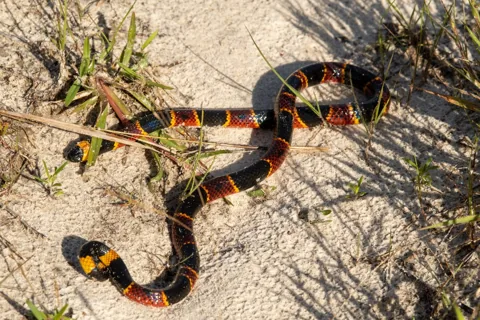 Eastern Coral Snake (Harlequin Coralsnake)
Micrurus fulvius
The eastern coral snake (Micrurus fulvius), also called the harlequin coralsnake, is a slender, brightly ringed venomous snake related to cobras. It is secretive and rarely seen, and bites are rare, nearly always happening when someone picks one up or pins it.
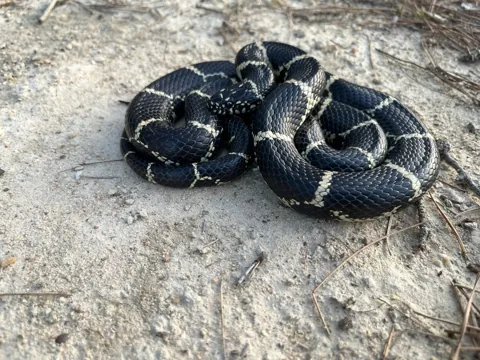 Kingsnakes
Lampropeltis getula
Kingsnakes are glossy, nonvenomous snakes that kill prey by constriction. The eastern kingsnake eats rodents, birds, lizards, turtle eggs and other snakes, and Missouri's conservation department says kingsnakes are immune to the venom of copperheads, cottonmouths and rattlesnakes.
Side by side: coral snake and scarlet kingsnake
Each line gives the eastern (harlequin) coral snake first, then the scarlet kingsnake.[1][2]
- What they are: the coral snake is an elapid, a relative of cobras and mambas, and one of three elapids native to the United States. The scarlet kingsnake is a harmless constrictor that was long treated as a subspecies of the eastern milk snake and is now its own species, Lampropeltis elapsoides.[8][4][5][2]
- Length: most adult coral snakes run about 20 to 30 inches (SREL gives 2 to 2.5 feet and Mississippi 2 to 3 feet), with record lengths near 4 feet. Most scarlet kingsnakes are 14 to 20 inches, with a Florida record of 29.1 inches.[1][4][10][2][5]
- Ring order: coral snakes have broad red and black rings separated by narrow yellow rings, and the red rings usually carry black flecks. Scarlet kingsnakes have red, black and yellow (sometimes white) rings in which black rings separate red from yellow.[1][10][2][12]
- Head: the coral snake's small, rounded head is black from the snout to behind the eyes, then crossed by a wide yellow band. The scarlet kingsnake's small head has a red snout.[1][4][8][2]
- Belly: on both snakes the rings run all the way around the body, so the belly repeats the pattern on the back.[1][4][2][7]
- Tail: the coral snake's tail is banded only in black and yellow, with no red.[1][8]
- Teeth: coral snakes have small fixed fangs at the front of the upper jaw. Scarlet kingsnakes kill their prey by constriction.[1][10][2]
- Food: coral snakes eat almost only lizards and small snakes, killed with venom. Scarlet kingsnakes eat lizards, especially skinks, and small snakes, and larger ones take small mammals.[1][2][5]
- Time of day: several studies suggest coral snakes are mainly active by day; scarlet kingsnakes appear to be mostly nocturnal and surface on warm, humid nights in spring and early summer.[1][4][2][5]
- Eggs: coral snakes lay about 3 to 13 eggs (SREL gives 3 to 12, the Florida Museum 4 to 13); scarlet kingsnakes lay 3 to 9.[4][1][5]
Where you'll meet them
Range overlap is wide in the Southeast, so location alone won't sort them.[4][5]
- Eastern coral snake: southeastern North Carolina south through Florida and west to southeastern Louisiana, most common in Florida and the Coastal Plain. It favors sandhills, pine flatwoods and other places with deep, sandy soil for burrowing, and spends much of its life underground or under logs and leaf litter.[4][8][9][1]
- Scarlet kingsnake: Virginia south through Florida and west to Louisiana, mostly in the Coastal Plain. It lives in pine woods under bark, in rotting logs and under debris, and climbs well enough to turn up in trees and on buildings.[5][7][2]
- Both show up in the open after rain: SREL says coral snakes come to the surface mostly in spring and fall, especially after heavy rains, and scarlet kingsnakes cross roads after rain soaks the soil.[4][5]
- Coral snakes are occasionally found in suburban neighborhoods next to natural habitat, though both snakes are secretive and seldom seen.[1][4][2]
- Texas and the Southwest have their own coral snakes: Poison Control lists the Texas coral snake and the Sonoran (Arizona) coral snake along with the eastern species.[13][4]
Other red, yellow and black snakes
The scarlet kingsnake isn't the only harmless snake in coral snake colors.[1][13]
- Scarletsnake: also harmless, about 14 to 20 inches, with a red, somewhat pointed snout and red blotches outlined in black. Its blotches stop at the sides, leaving a plain cream-white belly. It is mostly a burrower and feeds mainly on reptile eggs.[1][3][8][5]
- Scarletsnake vs scarlet kingsnake: SREL says the scarletsnake has a longer, pointed snout and a plain light belly, while the scarlet kingsnake has a blunter snout and bands that usually circle the whole body.[5][3]
- Milk snakes in Texas: Texas Parks and Wildlife names the Louisiana and Mexican milk snakes and the Texas scarlet snake as harmless snakes with the same red, black and yellow colors, and says their bands stop at ground level instead of circling the body.[11]
- Poison Control also lists kingsnakes, shovel-nosed snakes and milk snakes as the coral snake's nonvenomous look-alikes in the US.[13]
The 'red touches yellow' rhyme and where it fails
The rhyme is widely taught, but the museum and wildlife agencies cited here also say where it breaks down.[1][8][6]
- The rhyme: 'red touches yellow, kill a fellow; red touches black, venom lack' is meant for the native US coral snakes and their harmless look-alikes. The Florida Museum says it holds true most of the time in Florida, while North Carolina's Wildlife Commission says coral snakes are so rarely met there that the rhyme is of little use.[1][13][10][12][6]
- It fails outside the US. Poison Control says it does not apply to non-native coral snakes, and in Central or South America a snake with red touching black might be venomous. North Carolina's Wildlife Commission says it should never be used in tropical America.[13][6]
- It fails on odd individuals. The Florida Museum says unusual color variants occasionally break the rule, and SREL says color variation and pattern irregularities are natural.[1][4]
- People mix it up. Georgia DNR says misremembering the rhyme often causes confusion about which snake is harmless, and advises leaving alone any snake you can't easily identify.[8]
- Check the snout too. The black snout of the coral snake against the red snout of the scarlet kingsnake and scarletsnake is a second mark that wildlife agencies use alongside ring order.[1][6][8]
How to confirm what you saw
You can usually settle it from a photo without getting close.[14][1]
- Photograph it from a safe distance. NIOSH says a photo can help identify the snake and may speed treatment if someone is bitten.[14]
- On the photo, look at the snout first, then at what touches each yellow ring, then at whether the rings cross the belly.[1][2][3]
- Ask an expert: the Florida Museum invites people to email its herpetology staff with snake ID questions or photos.[1]
- Don't pick it up to check. Poison Control advises leaving a coral snake alone, and the Florida Museum says virtually all coral snake bites happen when people deliberately handle or bother the snake.[13][1]
Why the difference matters
One of these snakes can cause a life-threatening bite and the other can't, though both are best left alone.[13][2]
- Coral snake venom blocks nerve impulses. Untreated bites can lead to paralysis, including of the breathing muscles.[13][6][4]
- A coral snake bite can fool you. The bite marks are easy to miss and may not hurt, and symptoms often hold off for hours before progressing quickly, so Poison Control says every suspected bite should be seen in a hospital and watched for at least 24 hours.[13][15]
- Bites are rare. Coral snakes are not aggressive and usually try to flee; when cornered they may hide the head under their coils and wave the tail. North Carolina's Wildlife Commission says it has no record of a coral snake bite on a person in the state's recorded history.[1][6][13]
- The scarlet kingsnake is not dangerous to people or pets. If grabbed it may strike, vibrate its tail and release foul-smelling musk.[2]
- Chewing isn't required. Poison Control says coral snakes tend to hang on and chew for a few seconds, but the Florida Museum and Mississippi's wildlife department both say the fixed front fangs can deliver venom without any chewing.[13][1][10]
If someone is bitten
These steps are from CDC/NIOSH, MedlinePlus and Poison Control.[14][15][13]
- Treat any bite from a red, yellow and black snake as an emergency even if it looks minor and doesn't hurt. Call 911 or your local emergency number; Poison Control is at 1-800-222-1222, free and open 24 hours.[15][13]
- Don't drive yourself, because the bite can make you dizzy or pass out. MedlinePlus suggests calling the emergency room ahead so antivenom can be ready.[14][15]
- Keep the person calm and still, remove rings, watches and tight clothing before swelling starts, and loosely splint the limb. NIOSH says to rest it in a neutral position of comfort; MedlinePlus says at heart level.[14][15]
- Skip the old remedies: no tourniquet, ice, cutting or sucking out venom, and no electric shock.[13][14][15]
- Coral snake antivenom is no longer being made and supplies are shrinking, so hospitals work with their regional poison center to find it.[13]
Dogs and cats
Pet guidance here is from the Merck Veterinary Manual.[16]
- Merck Veterinary Manual says a venomous snakebite needs prompt veterinary care, and owners should do no first aid beyond keeping the animal quiet and limiting its activity.[16]
- With coral snake bites in pets, pain and swelling are minimal and nerve signs take over: weakness in all four legs, drooling, fast or shallow breathing, a stumbling gait and muscle twitching. Merck says vets watch bitten animals for at least 48 hours after an elapid bite.[16]
- A nonvenomous snake such as a kingsnake causes only local injury, usually several shallow tooth marks with some pain. Don't try to catch the snake; Merck says a dead snake can be brought in if the head is left intact.[16]
What to do about each
Both snakes are shy, secretive and rarely seen.[1][2]
- Coral snake: back away and let it go; it will usually head for cover. In North Carolina the eastern coral snake is state listed as endangered and may not be captured, killed or kept without a permit.[1][6][13]
- Scarlet kingsnake: leave it. It is harmless, rarely seen and spends most of its time in rotting logs and under bark.[2][7][5]
- Any snake you can't name: Georgia DNR's advice is to leave it alone, especially one that isn't easy to identify.[8]
Common questions
- Is a scarlet kingsnake venomous?
- No. The Florida Museum calls it non-venomous and not dangerous to people or pets; it kills its prey by constriction.[2][5]
- What's the fastest way to tell a coral snake from a kingsnake?
- Look at the head and the yellow rings. A black snout and red touching yellow mean coral snake; a red snout and black between the red and yellow mean scarlet kingsnake.[1][2][8]
- Does 'red touches yellow' work everywhere?
- No. It holds most of the time for native coral snakes in Florida, but Poison Control says it doesn't apply to coral snakes outside the US, and odd color variants occasionally break it even in Florida.[13][1][6]
- Can a coral snake bite be painless?
- Yes. MedlinePlus says coral snake bites may be painless at first and major symptoms may not appear for hours, which is why every suspected bite needs a hospital.[15][13]
- Is a milk snake the same as a kingsnake?
- They are close relatives in the same genus. SREL says the scarlet kingsnake was long counted as a milk snake subspecies before genetic work split it off as its own species.[5]
Photo credits
- Eastern Coral Snake (Harlequin Coralsnake): (c) Court Harding, some rights reserved (CC BY) — via iNaturalist, CC BY 4.0
- Kingsnakes: (c) Matthew Lumsden, some rights reserved (CC BY) — via iNaturalist, CC BY 4.0
Sources
- Florida Museum of Natural History, “Harlequin Coralsnake (Florida Snake ID Guide).” www.floridamuseum.ufl.edu/florida-snake-id/snake/harlequin-coralsnake/ (accessed 2026-11-14)
- Florida Museum of Natural History, “Scarlet Kingsnake (Florida Snake ID Guide).” www.floridamuseum.ufl.edu/florida-snake-id/snake/scarlet-kingsnake/ (accessed 2026-11-14)
- Florida Museum of Natural History, “Scarletsnake (Florida Snake ID Guide).” www.floridamuseum.ufl.edu/florida-snake-id/snake/scarletsnake/ (accessed 2026-11-14)
- University of Georgia Savannah River Ecology Laboratory (SREL Herpetology), “Eastern Coral Snake (Micrurus fulvius).” srelherp.uga.edu/snakes/eastern-coral-snake/ (accessed 2026-11-14)
- University of Georgia Savannah River Ecology Laboratory (SREL Herpetology), “Scarlet Kingsnake (Lampropeltis elapsoides).” srelherp.uga.edu/snakes/scarlet-kingsnake-eastern-milksnake/ (accessed 2026-11-14)
- North Carolina Wildlife Resources Commission, “Eastern Coral Snake (species page).” www.ncwildlife.gov/species/eastern-coral-snake (accessed 2026-11-14)
- North Carolina Wildlife Resources Commission, “Scarlet Kingsnake (species page).” www.ncwildlife.gov/species/scarlet-kingsnake (accessed 2026-11-14)
- Georgia Department of Natural Resources, Wildlife Resources Division, “Eastern Coral Snake, Micrurus fulvius (Venomous Snakes Fact Sheet Series).” gadnrle.org/sites/default/files/wrd/pdf/fact-sheets/Venomous%20Snakes%20-%20Eastern%20Coral%20Snake.pdf (accessed 2026-11-14)
- Alabama Department of Conservation and Natural Resources (Outdoor Alabama), “Eastern Coral Snake, Micrurus fulvius.” outdooralabama.com/venomous-snakes/eastern-coral-snake (accessed 2026-11-14)
- Mississippi Department of Wildlife, Fisheries, and Parks, “Coral Snake (Venomous Snakes of Mississippi).” www.mdwfp.com/venomous-snakes-mississippi/coral-snake (accessed 2026-11-14)
- Texas Parks and Wildlife Department, “Snakes (Hunter Education: Preparation and Survival).” tpwd.texas.gov/education/hunter-education/online-course/preparation-and-survival/snakes (accessed 2026-11-14)
- Internet Center for Wildlife Damage Management, “Snakes: Identification.” icwdm.org/species/reptiles/snakes/ (accessed 2026-11-14)
- Poison Control (National Capital Poison Center), “Are coral snakes poisonous?.” www.poison.org/articles/coral-snake-bite-treatment-203 (accessed 2026-11-14)
- U.S. Centers for Disease Control and Prevention, NIOSH, “Venomous Snakes at Work.” www.cdc.gov/niosh/outdoor-workers/about/venomous-snakes.html (accessed 2026-11-14)
- MedlinePlus, U.S. National Library of Medicine, “Snake bites (Medical Encyclopedia).” medlineplus.gov/ency/article/000031.htm (accessed 2026-11-14)
- Merck Veterinary Manual, “Snakebites in Animals.” www.merckvetmanual.com/toxicology/snakebite/snakebites-in-animals (accessed 2026-11-14)