The short answer
- Tail: a groundhog's tail is short and bushy, covered in fur, about 4 to 7 inches long. A muskrat's tail is long, scaly, nearly hairless and flattened side to side, slightly shorter than its head and body together.[1][3][2][7][6]
- Burrow: a groundhog digs on land, and its main entrance, 10 to 12 inches across, has a large mound of fresh dirt beside it. A muskrat digs into stream banks, pond banks and dams, with entrances under the water.[1][4][3][6][9]
- Size: groundhogs are the heavier animal, 4 to 14 pounds by the Missouri Department of Conservation's figures; muskrats weigh 1½–4 pounds.[3][1][7]
Animals on this page
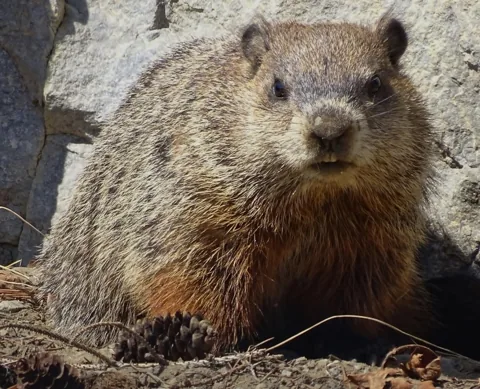 Groundhog (woodchuck)
Marmota monax
The groundhog, or woodchuck, is a burrowing member of the squirrel family found across eastern and central North America. It feeds on garden vegetables and clover by day and digs extensive burrows that can undermine foundations, sidewalks and pools.
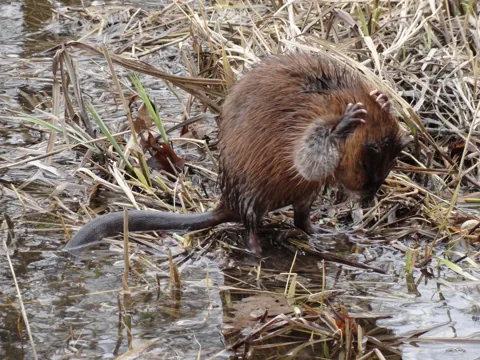 Muskrat
Ondatra zibethicus
The muskrat is a common native rodent of marshes, ponds and streams. Its burrows dug into banks, dams and levees can cause leaks, muddy water and cave-ins, and Missouri's conservation department warns that tunneling into a dam can even lead to complete dam failure. It also eats crops and plants near water.
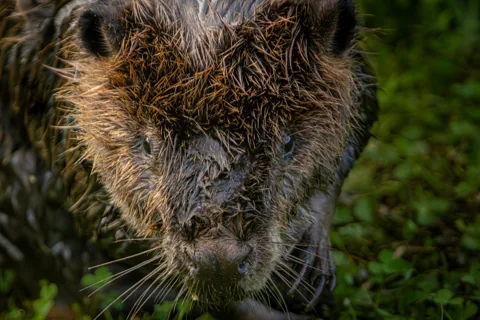 Beaver (American beaver)
Castor canadensis
The beaver is North America's largest rodent, a mostly aquatic animal that builds dams and lodges and cuts trees for food and building. Its ponds create valuable wetlands, but dams can flood roads, yards and fields, and beavers can fell ornamental trees near water.
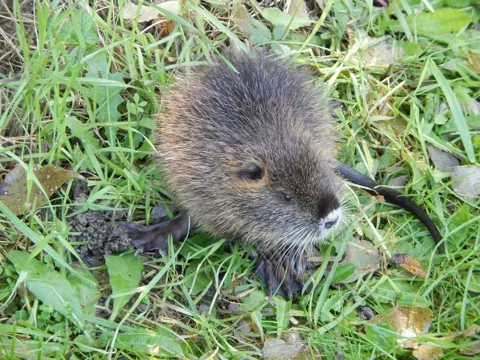 Nutria (coypu)
Myocastor coypus
Nutria are large, semi-aquatic rodents from South America, first brought to the U.S. in 1899 for the fur trade. Now invasive, they strip marsh plants down to the roots and dig burrows that weaken levees, banks, roads and buildings.
Side by side
Both are rodents, but they live differently. The groundhog, a large relative of squirrels, hibernates in a dry-land burrow; the muskrat is semi-aquatic, does not hibernate, and lives in bank dens or lodges built in shallow water.[3][2][9][7]
- Length: groundhog 16–27 inches total, with a 4–7 inch tail (MDC); Penn State gives a head and body of 16 to 20 inches plus a tail of 4 to 7 inches. Muskrat 16–25 inches total, with a 7–11 inch tail (MDC); Penn State gives 22 to 25 inches including an 11-inch tail.[3][1][7][6]
- Weight: MDC gives groundhogs 4–14 pounds, Penn State 5 to 10 pounds for males and Kansas State 5 to 12 pounds. MDC gives muskrats 1½–4 pounds.[3][1][4][7]
- Tail: groundhog tail short, bushy and somewhat flattened, covered with dark brown fur. Muskrat tail long, narrow, scaly and practically hairless, flattened vertically (side to side); it moves in a snakelike pattern when the animal swims.[1][3][2][7][6]
- Fur and feet: groundhogs are grizzled brownish gray, the coarse back fur often with a yellowish or reddish cast, and have long, curved claws on the front feet for digging. Muskrats have short front legs with small feet and large, partly webbed hind feet built for swimming.[1][3][2][7][6]
- Burrow site: groundhogs dig in fields and pastures, along fence rows and stone walls, at the edges of woods, near building foundations, under sheds and sometimes along gullies and streams. Muskrats burrow into stream banks, earthen dikes and dams, or build houses of vegetation in shallow water.[1][3][2][6][7]
- Entrance: the groundhog's main entrance is 10 to 12 inches across with a mound of excavated dirt, often beside a stump or rock; one to three smaller side entrances are dug from below and have no mound. Muskrat entrances are under water, which Penn State puts at a few inches to three feet below the waterline, and USDA Wildlife Services says they are typically no larger than 5 to 6 inches across.[1][3][4][6][9]
- Tunnel: groundhog burrows are mostly 25 to 30 feet long and 2 to 5 feet deep, with at least two entrances. Muskrat houses and burrows lead from underwater entrances to living chambers above the water.[2][6]
- Food: groundhogs eat green plants such as clover, alfalfa, grasses and garden crops like peas, beans and squash. Muskrats eat mostly the roots and stems of aquatic plants such as cattails, but also legumes, grasses, grains and garden crops that grow near water, and occasionally crayfish and freshwater mussels.[1][2][3][6][7]
- Activity: groundhogs are active in daylight, often seen sitting beside the burrow in early morning and late afternoon, and they hibernate from about late October to February or March. USDA Wildlife Services says muskrats are mainly nocturnal and do not hibernate, though in severe winter weather they stay in their dens.[3][1][2][9]
- Other signs: Penn State lists muddy water, floating vegetation and pellet-sized droppings on shoreline rocks as signs of a muskrat den nearby, and USDA notes runs or trails leading from just below the water surface. A muskrat's dragging tail sometimes leaves a line between its tracks in the mud.[6][9][7]
- Climbing and swimming: groundhogs can climb trees and swim, so seeing one near water does not rule it out. Connecticut DEEP says they climb 15 feet or more to escape an enemy and are good swimmers.[2][1]
Beavers and nutria: the bigger bank diggers
Beaver: much larger, 26–90 pounds, with a broad, horizontally flattened (top to bottom) tail. It cuts trees and builds dams, lodges of branches or dens in high banks, and the entrance is usually under water.[10][13][9]
- Nutria: an introduced rodent of 15–25 pounds, between beaver and muskrat in size, with a long, round, sparsely haired tail and white muzzle and whiskers. Beavers and muskrats have black whiskers and flattened tails.[10][7][13]
- Burrow size: USDA Wildlife Services says beaver and nutria burrow entrances can be 14 to 20 inches across, against 5 to 6 inches for a muskrat.[9]
- Muskrat houses can be confused with beaver lodges, but muskrats build theirs of soft, nonwoody plants, and USDA notes muskrats do not build dams or cut down trees the way beavers do.[7][9]
- Overlap: the Internet Center for Wildlife Damage Management says nutria, beaver and muskrat ranges overlap in many areas and their damage can look alike. Nutria burrows undermine levees, dikes and roadbeds and sometimes run under buildings; beaver bank dens can collapse banks along farm and shoreline property.[12][11]
How to confirm which one it is
Find where the hole starts. A dirt mound at an open entrance on dry ground is the groundhog's mark; an entrance you can only see below the waterline, often found by walking the bank when the water is clear, points to a muskrat.[1][3][6][9]
- Measure the opening: about 10 to 12 inches for a groundhog's main entrance, 5 to 6 inches or less for a muskrat, and 14 to 20 inches for beaver or nutria.[1][9]
- Watch at the right time. A groundhog will often be out in daylight sitting by its burrow; a muskrat is more likely to be out at night, swimming with its tail moving in a snakelike pattern.[3][1][9][7]
- Get a photo of the tail. Fur-covered and short means groundhog; long, thin and scaly means muskrat; broad and paddle-shaped means beaver; long and round means nutria.[1][7][10][13]
- Check the season. Groundhog holes that stay sealed through winter fit a hibernating woodchuck; a muskrat does not hibernate, so waterline damage can continue through the year.[2][9]
Why it matters: different damage, different fix
Groundhog burrows undermine foundations, pools and sidewalks, and holes in pastures are a hazard to horses and riders. They also eat garden and field crops.[5][1][2]
- Muskrat tunnels in earthen dams can cause leaks or even complete dam failure, and erosion from their burrows causes cave-ins along banks. Missouri's conservation department calls the dam itself the part of a pond most sensitive to muskrat damage.[8][6][9]
- Both can harm dams: MDC notes groundhogs are also unwelcome where earthen dams hold back lake water, and Penn State lists dikes among the places groundhog damage occurs. Use the burrow and tail clues before choosing a fix.[3][1]
- Rules vary by state. Missouri, for example, classifies the muskrat as a furbearer with a prescribed trapping season, and Penn State notes Pennsylvania does not allow groundhogs to be relocated to other properties because they are a potential rabies vector. Check your state wildlife agency before trapping, moving or killing either animal.[8][7][1]
If it's a groundhog
Fence gardens with heavy poultry wire or 2-inch woven mesh at least 3 feet high. Bury the bottom edge 12 inches with the lower 6 inches bent outward in an L, because groundhogs dig under fences.[1][2]
- Groundhogs also climb fences. Connecticut DEEP suggests a 1-foot extension bent outward at the top, a loosely built fence that bends as they climb, or an electric wire 4 to 6 inches above the ground.[2]
- Live traps set at the burrow entrance or the damage site, baited with apples or other fresh fruit, are the usual next step; see the trapping guide below and your state's rules first.[4][1]
- After trapping, exclude groundhogs from under sheds and porches with galvanized wire mesh so another one doesn't move in. Abandoned groundhog burrows are often reused by skunks, foxes, rabbits and other animals.[2][3]
If it's a muskrat
Riprap the bank or dam with coarse stone or gravel in a layer about 6 inches thick, from 1 foot above to 3 feet below the water level. It also protects the bank from wave action.[6][8]
- Or lay 1- or 2-inch galvanized wire flat against the bank from 1 foot above to at least 3 feet below the water level, fastened every few feet.[6][8]
- For a pond dam, Missouri's conservation department describes a concrete core: a trench along the fill, cut about 3 feet below water level and filled to 1 foot above it with concrete.[8]
- USDA Wildlife Services suggests drawing a farm pond down at least 2 feet below normal when muskrats are damaging it. Penn State calls trapping the most effective control once damage has started; check your state's season and permit rules first.[9][6][8]
Handling and health
Tularemia can spread to people who handle infected animals, including when hunting or skinning rabbits, muskrats, prairie dogs and other rodents. CDC advises gloves when handling these animals and says not to drink untreated surface water.[14][15]
- Wisconsin's health department groups muskrat-sized and larger rodents, such as muskrats, beavers and woodchucks, separately in its rabies-exposure flowchart and asks whether the animal is available for testing.[17]
- If one of these animals bites you, CDC says to wash the wound with soap and water for 15 minutes and seek medical care urgently; a healthcare provider or health department decides whether rabies vaccine is needed.[16]
Common questions
- Is the hole in my pond bank from a groundhog or a muskrat?
- Look for the entrance. A muskrat's entrance is under the water, usually no larger than 5 to 6 inches. A groundhog's main entrance is on dry ground above the water, 10 to 12 inches across, with a mound of fresh dirt.[6][9][1]
- Do muskrats have a tail like a rat?
- It is long, scaly and nearly hairless, but flattened vertically (side to side), which helps the muskrat swim. A groundhog's tail is short and furry.[7][6][1]
- Can groundhogs swim?
- Yes. Connecticut DEEP calls them good swimmers, and they sometimes dig along streams, so a groundhog near water is possible. Its burrow still opens above the water with a dirt mound.[2][3][1]
- Is it a muskrat or a beaver?
- A beaver is much bigger, 26–90 pounds against 1½–4 for a muskrat, with a broad flat tail held horizontally. Beavers cut trees and build stick lodges; muskrat houses are made of soft plants.[10][7][9]
- Can I move a groundhog or muskrat somewhere else?
- It depends on your state. Pennsylvania, for example, does not allow groundhogs to be relocated to other properties, and Missouri sets a trapping season for muskrats. Check with your state wildlife agency first.[1][8]
Photo credits
- Groundhog (woodchuck): (c) cornwallcen, some rights reserved (CC BY) — via iNaturalist, CC BY 4.0
- Muskrat: Robert McLeod, public domain (CC0), via iNaturalist
- Beaver (American beaver): (c) Alex Stach, some rights reserved (CC BY) — via iNaturalist, CC BY 4.0
- Nutria (coypu): (c) Luca Fornasari, some rights reserved (CC BY) — via iNaturalist, CC BY 4.0
Sources
- Penn State Extension, “Woodchucks (wildlife damage control fact sheet).” extension.psu.edu/woodchucks (accessed 2026-11-14)
- Connecticut Department of Energy and Environmental Protection, “Woodchuck (fact sheet, rev. 6/22).” portal.ct.gov/deep/wildlife/fact-sheets/woodchuck (accessed 2026-11-14)
- Missouri Department of Conservation, “Woodchuck (Groundhog) (Field Guide).” mdc.mo.gov/discover-nature/field-guide/woodchuck-groundhog (accessed 2026-11-14)
- Kansas State University Agricultural Experiment Station and Cooperative Extension Service, “Woodchucks, Urban Wildlife Damage Control (L-865, 1992).” bookstore.ksre.ksu.edu/download/woodchucks_L865 (accessed 2026-11-14)
- Internet Center for Wildlife Damage Management, “Woodchuck Damage Identification.” icwdm.org/species/rodents/woodchucks/woodchuck-damage-identification/ (accessed 2026-11-14)
- Penn State Extension, “Pond and Lake Wildlife: Muskrats.” extension.psu.edu/pond-and-lake-wildlife-muskrats (accessed 2026-11-14)
- Missouri Department of Conservation, “Common Muskrat (Field Guide).” mdc.mo.gov/discover-nature/field-guide/common-muskrat (accessed 2026-11-14)
- Missouri Department of Conservation, “Muskrat Control.” mdc.mo.gov/wildlife/nuisance-problem-species/muskrat-control (accessed 2026-11-14)
- USDA APHIS Wildlife Services, “Muskrat (Ondatra zibethicus), Wildlife Damage Management Technical Series.” www.aphis.usda.gov/sites/default/files/Muskrat-WDM-Technical-Series.pdf (accessed 2026-11-14)
- Missouri Department of Conservation, “American Beaver (Field Guide).” mdc.mo.gov/discover-nature/field-guide/american-beaver (accessed 2026-11-14)
- Internet Center for Wildlife Damage Management, “Beaver Damage Identification.” icwdm.org/species/rodents/beavers/beaver-damage-identification/ (accessed 2026-11-14)
- Internet Center for Wildlife Damage Management, “Nutria Damage Identification.” icwdm.org/species/rodents/nutria/nutria-damage-identification/ (accessed 2026-11-14)
- California Department of Fish and Wildlife, “Nutria (Invasive Species).” wildlife.ca.gov/Conservation/Invasives/Species/Nutria (accessed 2026-11-14)
- Centers for Disease Control and Prevention, “How Tularemia Spreads.” www.cdc.gov/tularemia/causes/index.html (accessed 2026-11-14)
- Centers for Disease Control and Prevention, “Preventing Tularemia.” www.cdc.gov/tularemia/prevention/index.html (accessed 2026-11-14)
- Centers for Disease Control and Prevention, “Rabies Prevention and Control.” www.cdc.gov/rabies/prevention/index.html (accessed 2026-11-14)
- Wisconsin Department of Health Services, “Large Rodents: Is the Animal Available for Testing? (rabies prevention flowchart).” www.dhs.wisconsin.gov/node/4504 (accessed 2026-11-14)