On this page
How to identify it
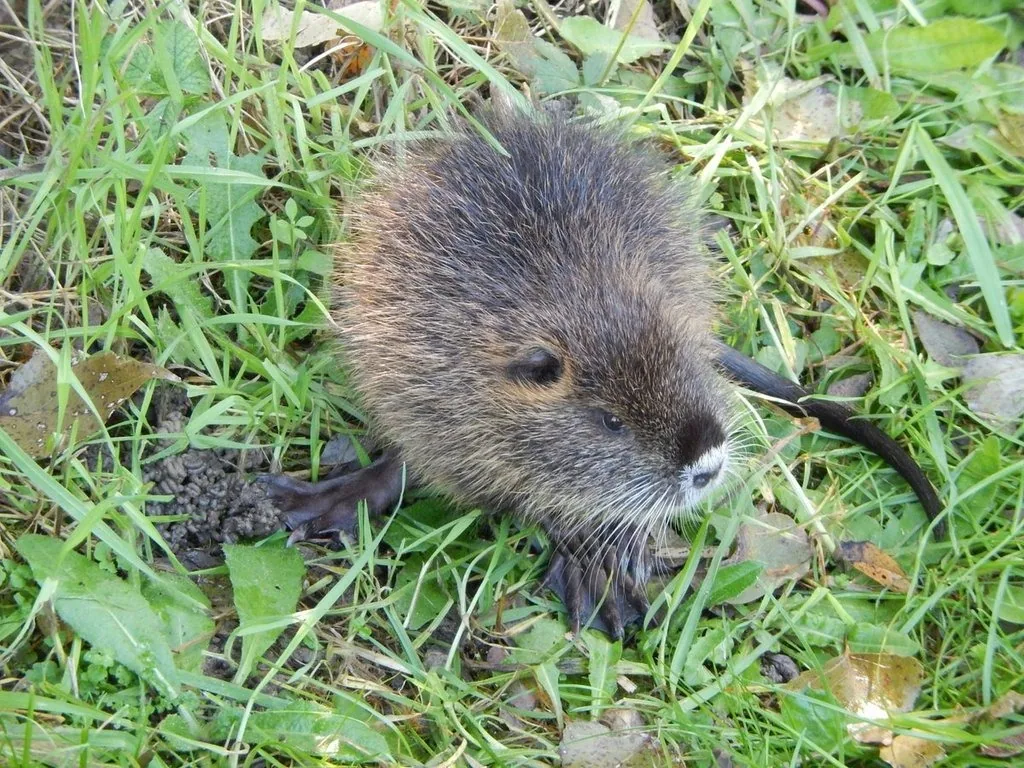
- A robust, arched body with a long, round, thinly haired tail. Sources give different sizes: ICWDM gives a body about 24 inches long, a 13- to 16-inch tail and an average weight of about 12 pounds; California Fish and Wildlife says adults typically reach 2 feet and 15 to 20 pounds with a 1- to 1.5-foot tail; Maryland DNR says they can top 20 pounds and reach 37 inches.[4][2][5]
- The large front teeth are yellow-orange to orange-red on the outside.[4]
- Fur is dense gray underfur covered by long, glossy guard hairs ranging from dark brown to yellow-brown.[4][6]
- Four of the five toes on each hind foot are webbed, and on land nutria often drag the chest and look hunched.[4]
- Droppings are dark green or black, about 2 inches long and half an inch thick, with deep grooves running their length.[4]
- A white muzzle and long white whiskers set nutria apart; California Fish and Wildlife notes beavers and muskrats have black whiskers and no white muzzle.[2][6]
Look-alikes
| Look-alike | How to tell them apart |
|---|---|
| Beaver | Beavers have a broad, flat tail and black whiskers; nutria have a long, round, thinly haired tail and white whiskers. An adult nutria is about a third the size of an adult beaver, and the two are easily confused when swimming.[4][2][7] |
| Muskrat | Muskrats are much smaller, with a tail flattened side to side. Nutria feeding platforms of piled plants are often mistaken for muskrat houses.[7][8] |
Where it lives
Counts differ: USDA Wildlife Services says nutria are established in 17 states, Maryland DNR says 16, and California Fish and Wildlife says they have been found in 30 states and are established in as many as 18, including Washington and Oregon. A reproducing population turned up in California's San Joaquin Valley in 2017. ICWDM puts the densest U.S. populations in southwest Louisiana and southeast Texas, and extreme cold limits their spread northward.[1][5][2][4]
Biology and life cycle
Nutria breed year-round and can have about 3 litters a year. Sources differ on maturity: as early as 5 months (ICWDM), 4 to 6 months with a first litter by 8 months (California), or 4 to 9 months for males and 3 to 9 months for females (Maryland). Maryland gives a 130-day gestation and an average litter of 4 to 5; California gives 2 to 13 young per litter.[8][2][5]
Young are born fully furred and active, and can swim and eat plants shortly after birth.[8]
They live in burrows dug into steep, vegetated banks or taken over from other animals; tunnels are usually 4 to 6 feet long but can reach 150 feet.[8][1]
Nutria are mostly active at dusk and night, and they are almost entirely plant eaters, eating about a quarter of their body weight each day.[8]
Most wild nutria live less than 3 years; they keep small home ranges, and daily movements are usually under 600 feet.[8]
Damage and signs
- Burrowing is the biggest problem: tunnels weaken levees, dams, stream banks, roadbeds and canals, which can collapse when soil is soaked or carries heavy loads.[3][1]
- They burrow under buildings, causing uneven settling of foundations, and chew into foam floats under docks so they lean or sink.[3]
- Nutria eat the roots, rhizomes and tubers of marsh plants, not just the leaves. That destroys the root mats holding a wetland together, and wind and waves can then erode the bare soil into open water.[1][9][3]
- Sugarcane and rice are the main crops damaged, and they also eat garden vegetables, dig up lawns and golf courses, and girdle fruit, nut and shade trees.[3][1]
Health risk
USDA Wildlife Services says nutria can serve as a reservoir for tularemia, and CDC says people can catch tularemia through the skin when handling infected rodents. A study of farmed coypus (nutria) in China found Giardia types that also infect people. Cornered or captured nutria are aggressive and can badly bite and scratch pets and people. Wear rubber gloves when handling a nutria, dead or alive, and wash your hands afterward.[1][10][11][8][9]
Control
Prevention
Noise, water spray and other harassment work only briefly, and problem animals soon return; WDFW says large dogs that are awake at night can keep nutria out of an area.[9][12]
Keep them out
Fence gardens and lawns. ICWDM suggests a 4-foot fence of 2-inch mesh with an apron buried at least 6 inches and reaching 12 inches out; WDFW says nutria don't climb, so a 3-foot wire fence works if it extends 12 inches below ground or has a 24-inch L-shaped apron on the surface.[12][9]
A single electric wire 6 inches above the ground has kept nutria out; use hardware cloth tubes around seedlings and sheet metal shields on trees and wooden or foam structures.[12]
Riprap, gabions, bulkheads or sheet piling can protect banks from burrowing but are costly and usually reserved for high-value sites.[12]
To keep nutria from burrowing into an earth embankment, WDFW describes a wire or stone barrier running from 1 foot above to 3 feet below the normal water level.[9]
Sanitation
Clear brush piles, thickets and weeds near water, drain standing water from ditches, and flatten steep banks: ICWDM says to slopes under 45 degrees, WDFW says 3:1 or less.[12][9]
Traps and physical control
No repellents are registered for nutria, and WDFW says no fumigants are registered either.[12][9]
When to call a professional
Trapping and shooting are the main removal methods, and the only registered toxicant is a Restricted Use Pesticide for certified applicators; contact your state wildlife agency or USDA Wildlife Services for help.[12][1]
Invasive, but legal status varies by place
In some places nutria are protected furbearers and a permit may be needed to remove damaging animals; elsewhere they are unprotected invasive animals that can be taken at any time by legal means.[4]
Night shooting is illegal in many states without a permit, and cable restraints aren't legal everywhere, so check local rules first.[12]
USDA Wildlife Services led the first large-scale effort to eradicate a mainland nutria population, on Maryland's Delmarva Peninsula, and helps with nutria control in Gulf Coast states.[1]
Washington lists nutria as a Prohibited Aquatic Animal Species (WAC 220-12-090). Live-trapped nutria must be euthanized, not released; live traps need no permit, but all other traps need a special trapping permit (RCW 77.15.192 and 77.15.194; WAC 220-417-040), and moving nutria anywhere in the state requires a permit.[9]
Nutria are restricted in California and can't be imported, transported or possessed without a permit; California Fish and Wildlife asks people to report sightings.[2]
Maryland classifies nutria as invasive, and as of 2020 all known populations had been removed from more than a quarter million acres of the Delmarva Peninsula.[5]
Oregon also treats nutria as invasive; ODFW says they live west of the Cascades from northern California to southern British Columbia and are still spreading.[6]
Common questions
- Is a nutria a beaver or a giant rat?
- Neither. It's a separate South American rodent sometimes called coypu, nutria-rat or swamp beaver. Its long, round tail sets it apart from a beaver's flat paddle tail.[4]
- Why are nutria such a problem in marshes?
- They eat marsh plants down to the roots, breaking up the root mats that hold the soil, so wind, waves and tides can wash damaged marsh away into open water.[1][9][3]
- Can I trap nutria in my yard?
- It depends on where you live. Some areas treat nutria as unprotected invaders, while others require permits, so check with your state wildlife agency first.[4][1]
Sources
- USDA APHIS Wildlife Services, “Operational Activities: Nutria.” www.aphis.usda.gov/operational-wildlife-activities/nutria (accessed 2026-11-12)
- California Department of Fish and Wildlife, “Nutria (Invasive Species).” wildlife.ca.gov/Conservation/Invasives/Species/Nutria (accessed 2026-11-12)
- Internet Center for Wildlife Damage Management, “Nutria Damage Identification.” icwdm.org/species/rodents/nutria/nutria-damage-identification/ (accessed 2026-11-12). Run by university wildlife damage specialists; species modules are based on Prevention and Control of Wildlife Damage (University of Nebraska Cooperative Extension, 1994).
- Internet Center for Wildlife Damage Management, “Nutria: Identification.” icwdm.org/species/rodents/nutria/ (accessed 2026-11-12). Run by university wildlife damage specialists; species modules are based on Prevention and Control of Wildlife Damage (University of Nebraska Cooperative Extension, 1994).
- Maryland Department of Natural Resources, “Nutria.” dnr.maryland.gov/wildlife/Pages/plants_wildlife/nutria.aspx (accessed 2026-11-12)
- Oregon Department of Fish and Wildlife, “Nutria.” myodfw.com/wildlife-viewing/species/nutria (accessed 2026-11-12)
- USDA APHIS Wildlife Services, “Muskrats, Wildlife Damage Management Technical Series (J. E. Miller, January 2018).” www.aphis.usda.gov/sites/default/files/Muskrat-WDM-Technical-Series.pdf (accessed 2026-11-12)
- Internet Center for Wildlife Damage Management, “Nutria Biology.” icwdm.org/species/rodents/nutria/nutria-biology/ (accessed 2026-11-12). Run by university wildlife damage specialists; species modules are based on Prevention and Control of Wildlife Damage (University of Nebraska Cooperative Extension, 1994).
- Washington Department of Fish & Wildlife, “Living with wildlife: Nutria.” wdfw.wa.gov/species-habitats/invasive/myocastor-coypus (accessed 2026-11-12)
- Centers for Disease Control and Prevention, “How Tularemia Spreads.” www.cdc.gov/tularemia/causes/index.html (accessed 2026-11-12)
- Pathogens 2021;10(2):179, via PubMed, “Occurrence and Multi-Locus Analysis of Giardia duodenalis in Coypus (Myocastor coypus) in China (2021).” pubmed.ncbi.nlm.nih.gov/33562408/ (accessed 2026-11-12)
- Internet Center for Wildlife Damage Management, “Nutria Damage Prevention and Control Methods.” icwdm.org/species/rodents/nutria/nutria-damage-prevention-and-control-methods/ (accessed 2026-11-12). Run by university wildlife damage specialists; species modules are based on Prevention and Control of Wildlife Damage (University of Nebraska Cooperative Extension, 1994).
- iNaturalist, “Myocastor coypus taxon page (order and family).” www.inaturalist.org/taxa/43997 (accessed 2026-11-12)