On this page
How to identify it
- Weights vary by source. ICWDM says adults usually weigh 35 to 50 pounds with a few over 100, Connecticut DEEP gives 30 to 65 pounds, and the Missouri Department of Conservation gives 26 to 90 pounds.[1][2][5][6]
- The tail is broad, flat, scaly and nearly hairless; beavers use it as a rudder and slap it on the water as a warning.[1][2]
- Large, bright orange front teeth grow throughout life and are kept sharp by gnawing.[1][2]
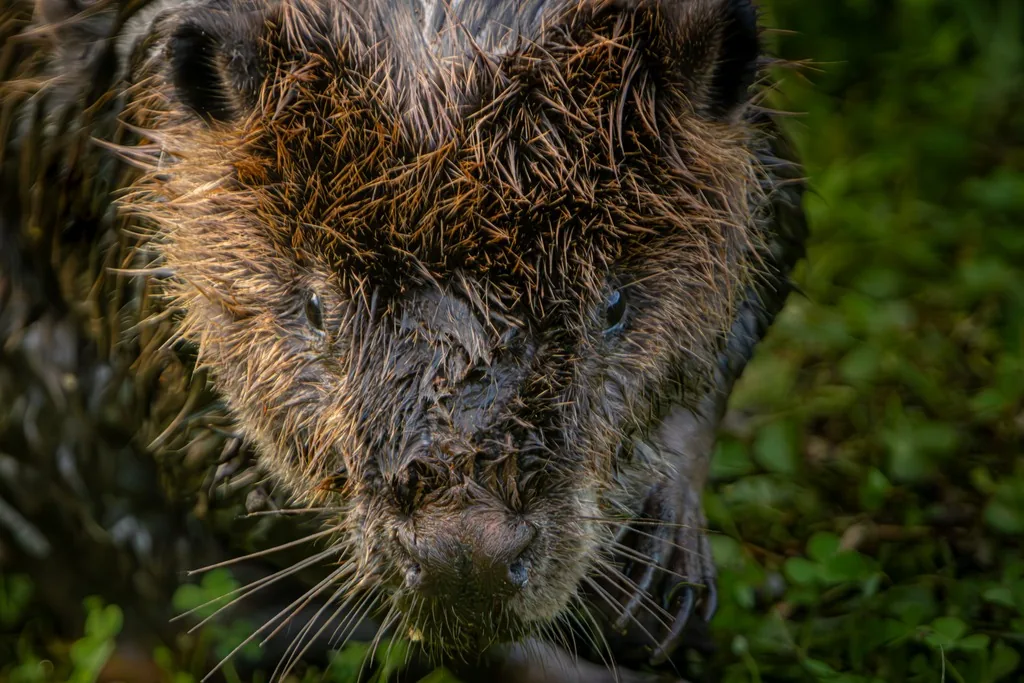
- Fur is dense and gray underneath with coarse outer hair, most often reddish brown; the webbed hind feet are much larger than the front feet.[1]
- Signs include trees cut down or gnawed near water, dams, lodges, flooding, and caches of branches stored underwater near an active lodge.[1][7][2]
Look-alikes
| Look-alike | How to tell them apart |
|---|---|
| Muskrat | Much smaller, usually 2 to 4 pounds, with a long, narrow tail flattened from side to side that moves like a snake when it swims.[6] |
| Nutria | An introduced rodent of 15 to 25 pounds, between a muskrat and a beaver in size, with a round tail that trails behind it when it swims.[6] |
Where it lives
Found across most of North America, except the far arctic tundra, parts of peninsular Florida and deserts without flowing water.[2][1]
Biology and life cycle
Beavers live in family colonies and defend their territory. ICWDM puts a colony at about 4 to 8 animals; Connecticut describes an adult pair with 2 to 4 kits and 2 to 4 yearlings, and New York says 4 to 6, sometimes up to 12.[7][5][8]
They pair for life and have one litter a year after winter mating. ICWDM gives 3 or 4 young after about 105 days; Connecticut gives 2 to 5 kits born in May or early June after 100 to 110 days.[7][5]
Young leave the colony at about 2 years old and often start new colonies in nearby ponds.[7]
They build lodges in ponds or dig dens into stream banks, and use them for raising young, sleeping, shelter and food storage.[7]
Beavers don't hibernate; they are most active from late afternoon to shortly after daybreak and usually stay in the lodge or den by day.[9]
Poplar and aspen are favorite foods, and willow and birch are also used; tree cutting and dam building increase as winter approaches.[7][3]
In Missouri's faster, more variable streams, beavers usually dig dens in high banks and build dams less often than they do farther north and west.[6]
Damage and signs
- Dams can flood roads, homes, septic systems, cropland and timber, especially along low-gradient streams with culverts or narrow spots.[4][2]
- They plug ditches, drain pipes and culverts, and burrowing can collapse stream banks, dikes and levees.[4][2]
- Beavers cut or girdle trees, including valuable ornamental trees near ponds and streams, and falling trees can hit buildings, power lines and people.[4][7]
- Their ponds also have benefits, creating wetlands that help wildlife, filter water and slow floodwaters downstream.[3][9]
Health risk
Beavers can carry germs that matter to people, though screening studies suggest most are uncommon. In Utah, 2 of 40 tested beavers had Giardia and 8 of 73 had Leptospira antibodies, and the authors still advise protective gear when handling them; in California, 18 dead beavers showed Baylisascaris roundworm disease in half, plus single cases of tularemia and Giardia. CDC says to boil or filter lake and river water before drinking it and to wear gloves when handling sick or dead animals. Rabies is rare in rodents, but beavers and groundhogs test positive at rates similar to bats and raccoons, so see a doctor promptly after any bite.[10][11][12][13][14][15]
Control
Prevention
Flow devices such as pond levelers or fenced pipes let water pass through a dam or culvert, giving longer-term flood relief without killing beavers.[2][3][9]
Flow pipes work best when some tree damage is tolerated, the pond stays at least 4 feet deep for winter, and standing water won't threaten roads or septic systems.[9]
Keep them out
Protect valuable trees near water with heavy-gauge fencing. Connecticut recommends mesh openings no larger than 2 by 4 inches, set 6 inches from the trunk and 4 feet high, and says chicken wire won't stop them.[5][9][3][2]
Fence culverts and irrigation ditches to keep beavers from plugging them.[9][3]
Traps and physical control
Breaching or removing dams may prompt beavers to move, but they rebuild quickly, removal can cause sudden downstream flooding, and some states require permits.[9][3]
Pesticides
No toxicants or chemical repellents are registered for beavers. Connecticut adds that no repellents are known to work and harassment generally won't make beavers leave.[9][5]
When to call a professional
Trapping is often the most effective option but takes skill and specialized traps; check your state wildlife agency's rules first, and leave trapping and relocation to professionals.[9][2]
Legal status varies by state
The legal status of beavers differs from state to state. Some states protect them except during furbearer trapping seasons; others treat them as pests that can be removed when causing damage.[1][2]
Rules also cover dam removal, shooting, relocation and certain trap types, so ask your state wildlife agency and local officials what is allowed before acting.[9][2][3]
Removing beavers from one property often brings only temporary relief, because beavers from nearby land move in unless they are managed too.[9]
Connecticut: beavers are trapped in a regulated winter season with mandatory pelt tagging, and DEEP may authorize trapping outside the season when beavers threaten public health and safety or damage crops. Relocating them isn't considered a workable option there.[5]
Connecticut also treats any flow device at a culvert, and any change to a dam including breaching or removal, as regulated wetland work that needs local inland wetlands commission approval.[5]
Missouri lists the beaver as a furbearer that trappers may take during its trapping season.[6]
Minnesota lets a landowner, manager or occupant take a beaver causing damage without a license or permit, but a Conservation Officer must be notified within 24 hours, and poison, artificial lights and motor vehicles aren't allowed.[16]
Colorado lets a landowner or their agent hunt, trap or take beavers without a permit on private property that is being damaged.[17]
Common questions
- How do I stop beavers from cutting down my trees?
- Wrap the trunks of valuable trees near the water with hardware cloth or woven wire fencing, leaving room for growth and making it tall enough that beavers can't reach over.[3][9]
- Can I just tear out a beaver dam?
- Check with your state wildlife agency first, since some states require permits. Beavers often rebuild fast, and sudden removal can flood areas downstream.[9][3]
- Is it legal to trap or relocate beavers?
- It depends on the state. Some allow removal of damaging beavers anytime, others only in furbearer season, and relocation is often regulated.[1][2][3]
Sources
- Internet Center for Wildlife Damage Management, “Beavers: Identification.” icwdm.org/species/rodents/beavers/ (accessed 2026-11-13). Run by university wildlife damage specialists (maintained at the University of Wisconsin-Stevens Point); species modules are based on Prevention and Control of Wildlife Damage (University of Nebraska Cooperative Extension, 1994).
- USDA APHIS Wildlife Services, “Beavers, Wildlife Damage Management Technical Series (J. D. Taylor, G. K. Yarrow and J. E. Miller, 2017).” www.aphis.usda.gov/sites/default/files/Beaver-WDM-Technical-Series.pdf (accessed 2026-11-13)
- University of Nebraska-Lincoln Extension, “Beavers (Backyard Farmer resource).” byf.unl.edu/beavers (accessed 2026-11-13)
- Internet Center for Wildlife Damage Management, “Beaver Damage Identification.” icwdm.org/species/rodents/beavers/beaver-damage-identification/ (accessed 2026-11-13). Run by university wildlife damage specialists (maintained at the University of Wisconsin-Stevens Point); species modules are based on Prevention and Control of Wildlife Damage (University of Nebraska Cooperative Extension, 1994).
- Connecticut Department of Energy and Environmental Protection, “Beaver (wildlife fact sheet).” portal.ct.gov/deep/wildlife/fact-sheets/beaver (accessed 2026-11-13)
- Missouri Department of Conservation, “American Beaver (Field Guide).” mdc.mo.gov/discover-nature/field-guide/american-beaver (accessed 2026-11-13)
- Internet Center for Wildlife Damage Management, “Beaver Biology.” icwdm.org/species/rodents/beavers/beaver-biology/ (accessed 2026-11-13). Run by university wildlife damage specialists (maintained at the University of Wisconsin-Stevens Point); species modules are based on Prevention and Control of Wildlife Damage (University of Nebraska Cooperative Extension, 1994).
- New York State Department of Environmental Conservation, “Beaver.” dec.ny.gov/nature/animals-fish-plants/beaver (accessed 2026-11-13)
- Internet Center for Wildlife Damage Management, “Beaver Damage Prevention and Control Methods.” icwdm.org/species/rodents/beavers/damage-prevention-and-control-methods/ (accessed 2026-11-13). Run by university wildlife damage specialists (maintained at the University of Wisconsin-Stevens Point); species modules are based on Prevention and Control of Wildlife Damage (University of Nebraska Cooperative Extension, 1994).
- J Wildl Dis 2022;58(4):902-908, via PubMed, “Health screening of American beavers (Castor canadensis) in Utah, USA (Roug et al., 2022).” pubmed.ncbi.nlm.nih.gov/35917403/ (accessed 2026-11-13)
- Animals 2025;15(3):338, via PubMed, “Postmortem findings in free-ranging North American beavers (Castor canadensis) reveal potential threats to California's freshwater ecosystems (Gonzales-Viera et al., 2025).” pubmed.ncbi.nlm.nih.gov/39943108/ (accessed 2026-11-13)
- U.S. Centers for Disease Control and Prevention, “About Giardia.” www.cdc.gov/giardia/about/index.html (accessed 2026-11-13)
- U.S. Centers for Disease Control and Prevention, “About Tularemia.” www.cdc.gov/tularemia/about/index.html (accessed 2026-11-13)
- J Wildl Dis 2023;59(4):734-742, via PubMed, “Rabies in rodents and lagomorphs in the USA, 2011-20 (Hareza et al., 2023).” pubmed.ncbi.nlm.nih.gov/37846914/ (accessed 2026-11-13)
- U.S. Centers for Disease Control and Prevention, “About Rabies.” www.cdc.gov/rabies/about/index.html (accessed 2026-11-13)
- Minnesota Department of Natural Resources, “Taking a nuisance animal.” www.dnr.state.mn.us/livingwith_wildlife/taking.html (accessed 2026-11-13)
- Colorado Parks and Wildlife, “Nuisance wildlife.” cpw.state.co.us/nuisance-wildlife (accessed 2026-11-13)
- Global Biodiversity Information Facility (GBIF), “Castor canadensis Kuhl, 1820 (GBIF Backbone Taxonomy).” api.gbif.org/v1/species/2439838 (accessed 2026-11-13)
- iNaturalist, “Castor canadensis taxon page (order and family).” www.inaturalist.org/taxa/43794 (accessed 2026-10-06)