The short answer
- Color: a mink is brown all over, chocolate brown to black, with only a white chin and scattered white spots on the throat, chest or belly. A weasel is brown on the back with a white, yellowish or tan underside.[1][6][14][2][5][15]
- Size: an adult mink runs about 18 to 27 inches long including the tail and weighs about 1 1/2 to 3 1/4 pounds. A long-tailed weasel is about 11 1/2 to 17 1/2 inches and weighs ounces, not pounds; the least weasel is about mouse-sized.[6][1][2][3]
- Winter coat: a white animal with a black tail tip in winter is a weasel. Mink accounts describe only a brown coat.[10][2][15][1][6][14]
- Water: mink need permanent water such as a stream, pond, lake or marsh. North Carolina's wildlife agency says to suspect mink only if a natural body of water is close by. Weasels use woods, fencerows, fields and thickets as well as streamsides, and least weasels use pastures and stubble fields.[7][1][14][2][5][3]
Animals on this page
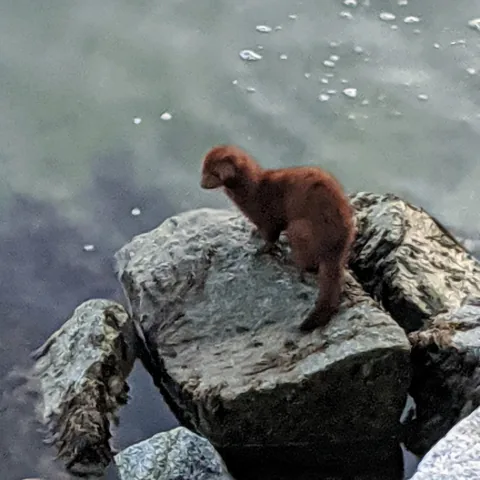 American Mink
Mustela vison (also placed in Neovison or Neogale)
The American mink is a semi-aquatic member of the weasel family that lives near streams, ponds, lakes and marshes. It rarely causes problems, but a mink that gets into a poultry house can kill many birds in one night.
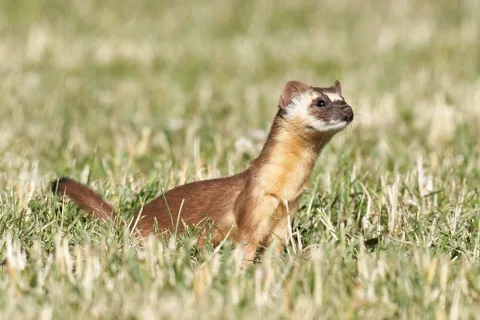 Weasels (long-tailed weasel and relatives)
Neogale frenata (listed as Mustela frenata in many sources); also short-tailed and least weasels (Mustela species)
Weasels are small, long-bodied predators that live on mice, rats and other small animals and are rarely seen. Most people only learn weasels are around when one gets into a poultry house at night and kills chickens.
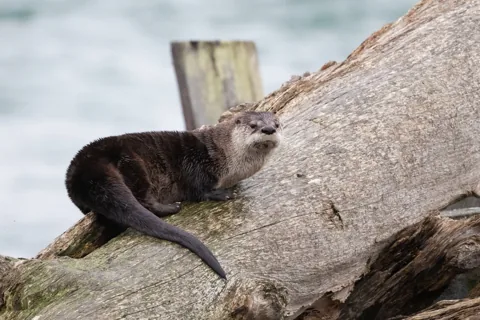 River otter (North American river otter)
Lontra canadensis
The North American river otter is a sleek, playful member of the weasel family that lives along rivers, lakes, marshes and coasts. Most of the time it is a welcome sight, but otters can raid fish ponds and hatcheries and den under docks and houses near water.
Side by side
The weasel column covers the long-tailed weasel unless another species is named, because ICWDM calls it the most abundant and widespread of the three North American weasels.[10]
- Scientific names: the mink is listed as Neogale vison by Missouri Department of Conservation (MDC), Neovison vison by ICWDM and Mustela vison by North Carolina and MU Extension. Weasels are Mustela frenata (long-tailed), Mustela erminea (short-tailed) and Mustela nivalis (least).[1][6][14][5][10]
- Length: mink, 18 to 24 inches including the tail (ICWDM) or 20 to 27 inches for males (MDC), females about three-quarters the size of males. Long-tailed weasel, 13 1/2 to 17 1/2 inches for males and 11 1/2 to 15 1/2 inches for females. Least weasel, 5 3/4 to 9 3/4 inches.[6][1][2][3]
- Weight: mink, 1 1/2 to 3 pounds (ICWDM) or 1 1/2 to 3 1/4 pounds for males (MDC). Long-tailed weasel, 6 to 9 1/2 ounces for males and 2 1/2 to 4 1/2 ounces for females. Least weasel, 1 1/4 to 2 ounces.[6][1][2][3]
- Color: mink, rich chocolate brown to black all over with a white patch on the chin or chest and scattered white on the belly. Long-tailed weasel in summer, dark brown above and yellowish white below with a white chin. Least weasel in summer, brown above and white below, with white on the chin and toes.[6][14][1][2][3]
- Tail: mink, somewhat bushy, 5 to 7 inches (ICWDM) or 7 to 9 inches (MDC), brown at the base and darkening to black at the tip. Long-tailed weasel, well furred, about half the length of the head and body, with a black tip. Short-tailed weasel, black tip. Least weasel, very short at 3/4 to 1 1/2 inches, with no prominent black tip.[6][1][14][2][10][3]
- Feet: mink have five clawed toes with a short or slight web between them. Weasel feet are not described as webbed, though ICWDM says weasels climb trees and swim well.[1][14][11]
- Habitat: mink are shoreline animals along streams, rivers, ponds, marshes, swamps and lakes. Long-tailed weasels prefer woodlands, brushy fencerows and thickets along watercourses; least weasels live in low, sparse cover such as pastures, stubble fields and marshy spots, and sometimes in barns full of mice.[7][1][2][5][3]
- Dens: mink often take over muskrat dens, bank burrows, log jams and old beaver lodges. Weasels use old burrows of moles, ground squirrels, mice or woodchucks, rock piles and tree roots; MDC says least weasels can enter holes in the ground less than an inch across.[7][1][2][5][3]
- Food: mink eat about as much from the water as from land, including fish, frogs, crayfish, muskrats, mice, rabbits, birds and eggs. Weasels feed mostly on rodents such as mice, rats and voles, plus rabbits, shrews, moles, small birds and eggs.[7][1][2][5]
- When active: mink are active mainly at night, all year. Weasels do not hibernate; ICWDM says they are more active by day in summer than in winter, and North Carolina's agency says they are generally active both day and night.[7][14][11][15]
The white winter coat
Weasels can turn white; mink are described only in brown. MDC, ICWDM and North Carolina all describe the mink as brown with a little white on the chin, chest or belly, and none of them mention a winter color change. The weasel accounts do.[1][6][14][10][2]
How often weasels go white depends on the source and on how far north you are. ICWDM says flatly that all weasels have a white winter coat. North Carolina's agency says long-tailed weasels in more northern climates molt to white except for the black tail tip. MDC says long-tailed weasels in Missouri are paler in winter and only sometimes all white in northern Missouri, and that least weasels there, at the south edge of their range, usually stay brown.[10][15][2][3]
The tail tip helps year-round. A white or brown weasel with a black-tipped tail is a long-tailed or short-tailed weasel; the least weasel's short tail lacks the black tip, though MDC says a few black hairs may show at the very end.[10][2][3]
MU Extension notes that white winter weasel fur is the fur known as ermine.[5]
Where each one lives
ICWDM says mink are found throughout North America except the desert Southwest and tundra areas.[6]
The long-tailed weasel is the most widespread weasel; some in parts of Kansas, Oklahoma, Texas and New Mexico have a dark face mask and are called bridled weasels. ICWDM places the short-tailed weasel in Canada, Alaska and the northeastern, Great Lakes and northwestern states, and the least weasel in Canada, Alaska and the northeastern and Great Lakes states. MDC adds that least weasels reach only Missouri's northern counties.[10][3][2]
Water isn't a perfect dividing line. ICWDM lists marshes and riparian woodlands among weasel habitats, and North Carolina's agency says long-tailed weasels appear partly tied to the vicinity of water. But a mink's one basic need is permanent water, so a raid far from any stream, pond or marsh points away from mink.[11][15][7][14]
Poultry raids: mink or weasel?
Both kill poultry, but not often. MDC says damage by long-tailed weasels and mink is rare, and MU Extension says both species seldom cause damage but may kill poultry or other domestic fowl. Weasels are usually around a farm for years before anyone notices them, ICWDM says, until a chicken is killed.[4][5][12]
Mink sign: ICWDM says mink kill by biting through the skull or neck and that closely spaced pairs of canine tooth marks mark a mink kill. North Carolina's agency describes small bite marks at the back of the head or neck, or the head or neck missing entirely. Mink take prey up to the size of a chicken, duck, rabbit or muskrat.[8][14]
Weasel sign: ICWDM says weasels raid poultry houses at night and kill or injure birds by biting them in the head or neck. Because both go for the head and neck, distance to water is often the better clue: North Carolina's agency says to suspect mink only if a natural body of water is close by.[12][8][14]
Piles of dead birds: ICWDM says mink sometimes kill far more than they can eat when a coop is full of chickens and may lay the dead birds neatly in a pile, and North Carolina's agency says mink may leave many uneaten carcasses. MDC disagrees in part, saying mink do not kill wantonly and usually carry food to a den, caching the surplus. Weasels also kill more than they can eat at times and store the extra, according to ICWDM and North Carolina.[8][14][1][11][15]
Rule out other killers. North Carolina's agency says raccoons commonly take only the head of a chicken. ICWDM says rats usually eat parts of the body and drag carcasses into holes or hidden spots, and suggests rats may have killed more poultry than weasels have.[14][12]
Tracks and other signs
Mink tracks show up in soft mud along waterways. MDC gives a mink front track of about 1 inch and a hind track of 1 to 2 inches, with five toes though often only four show, and loping track groups 10 to 24 inches apart.[6][1]
Long-tailed weasel tracks are about half the size of mink tracks: front 1/4 to 3/4 inch and hind 1/2 to 1 inch, per MDC. Weasels bound: MDC describes squared clusters of prints 12 to 18 inches apart, while ICWDM says the hind feet land almost exactly in the front-foot prints and the stride is normally about 10 inches.[2][10]
Weasel scats are long, dark and slender and are often left in prominent places such as on rocks or along trails, MDC says.[2]
Both have strong-smelling anal musk glands. MDC says the mink's odor is considered by many to be worse than a weasel's or even a skunk's; ICWDM notes that mink cannot spray musk the way skunks do.[1][6][10]
The other mix-up: river otter
MDC names the river otter, along with the long-tailed weasel, as the animal most likely to be confused with a mink. It says otters are much larger, up to 53 inches long, with a tail that is thick at the base, flat underneath and tapering to the tip, and fully webbed toes. A mink's tail is not thick at the base or flat, and its toes have only a short web.[1]
Legal status differs by state
Mink and weasels are regulated differently from state to state, and even differently from each other. Before trapping, shooting or moving either one, check with your state wildlife agency. A few examples from agency pages:[4][14][16]
Missouri: MDC says the Wildlife Code classifies the long-tailed weasel and mink as furbearers and that damage-causing weasels may be shot or trapped out of season without a permit, under 3 CSR 10-4.130, with restrictions. MDC's long-tailed weasel page says fur was harvested in the past but weasels may no longer be trapped in Missouri. The two pages read differently, so check the current Code. MDC lists both Missouri weasels as species of conservation concern.[4][2][3]
North Carolina: the Wildlife Resources Commission lists both mink and long-tailed weasel as furbearers with trapping seasons. Mink can be trapped in season or with a depredation permit outside it, and relocating live mink is illegal there.[14][15]
Oregon: the Department of Fish and Wildlife lists mink as a furbearer and weasel among its unprotected mammals.[16]
What to do about either one
The fix is the same for both: keep them out. MDC, MU Extension and ICWDM say to close every opening larger than 1 inch in poultry houses and other buildings, using half-inch hardware cloth or similar mesh. North Carolina's agency puts it as openings smaller than one square inch, so predators can't reach through and grab birds.[4][5][13][14]
ICWDM's mink guidance also suggests 1-inch mesh poultry netting around chicken yards and over ventilation openings. If least weasels live in your area, remember MDC's note that they can use holes less than an inch across; the half-inch mesh the other sources recommend is the safer choice.[9][3][4][5]
Take away what draws them in. MU Extension says weasels are attracted to brushy cover and to mice and rats, so clear brush near farm buildings and control rodents.[5]
Skip mothballs and repellents. MDC says no fumigants or repellents are known to work for weasels or mink and that the naphthalene in mothballs is toxic and its vapor harmful to people.[4][5]
Weasels do a lot of good. MDC, ICWDM and North Carolina all describe them as heavy predators of mice and rats; MDC notes least weasels are apparently poisoned secondarily by poisons set out to kill rodents.[2][12][15][3]
If removal is needed, MDC says a local conservation agent can often refer you to a trapper. Follow your state's rules on seasons, permits and trap types.[4]
Common questions
- Is a mink a kind of weasel?
- It's in the weasel family, Mustelidae, but it isn't one of the three animals called weasels in North America. North Carolina's wildlife agency notes the mink is also known as the water weasel.[10][14]
- Do mink turn white in winter?
- The mink accounts from MDC, ICWDM and North Carolina describe only a brown coat. Weasels are the ones that turn white in winter, mainly in the north, keeping a black tail tip on long-tailed and short-tailed weasels.[1][6][14][10][15]
- What killed my chickens and left them piled up?
- A mink is a strong suspect if water is nearby; ICWDM says mink may lay dead chickens neatly in a pile. Weasels also kill more than they eat at times. Raccoons often take only the head, and rats tend to eat part of the body and drag carcasses away.[8][14][11][12]
- How small a hole can a weasel get through?
- Agencies advise closing anything over 1 inch to stop long-tailed weasels and mink, and MDC says least weasels can enter holes less than an inch across. Half-inch hardware cloth covers both.[4][5][3]
- Can I trap a mink or weasel that's killing my birds?
- It depends on your state. Missouri lets damage-causing weasels be shot or trapped out of season without a permit, North Carolina requires a depredation permit for mink outside the trapping season, and Oregon lists weasel as an unprotected mammal. Check with your state wildlife agency first.[4][14][16]
Photo credits
- American Mink: Quillipede, public domain (CC0), via iNaturalist
- Weasels (long-tailed weasel and relatives): (c) benjchristensen, some rights reserved (CC BY) — via iNaturalist, CC BY 4.0
- River otter (North American river otter): Adam Jackson, public domain (CC0), via iNaturalist
Sources
- Missouri Department of Conservation, “American Mink (field guide).” mdc.mo.gov/discover-nature/field-guide/american-mink (accessed 2026-11-14)
- Missouri Department of Conservation, “Long-Tailed Weasel (field guide).” mdc.mo.gov/discover-nature/field-guide/long-tailed-weasel (accessed 2026-11-14)
- Missouri Department of Conservation, “Least Weasel (field guide).” mdc.mo.gov/discover-nature/field-guide/least-weasel (accessed 2026-11-14)
- Missouri Department of Conservation, “Weasel Control.” mdc.mo.gov/wildlife/nuisance-problem-species/weasel-control (accessed 2026-11-14)
- University of Missouri Extension, “Controlling Nuisance Weasels in Missouri, G9528 (reviewed May 2025).” extension.missouri.edu/publications/g9528 (accessed 2026-11-14)
- Internet Center for Wildlife Damage Management, “Mink: Identification.” icwdm.org/species/carnivores/minks/ (accessed 2026-11-14)
- Internet Center for Wildlife Damage Management, “Mink Biology.” icwdm.org/species/carnivores/minks/mink-biology/ (accessed 2026-11-14)
- Internet Center for Wildlife Damage Management, “Mink Damage Identification.” icwdm.org/species/carnivores/minks/mink-damage-identification/ (accessed 2026-11-14)
- Internet Center for Wildlife Damage Management, “Mink Damage Prevention and Control Methods.” icwdm.org/species/carnivores/minks/mink-damage-prevention-and-control-methods/ (accessed 2026-11-14)
- Internet Center for Wildlife Damage Management, “Weasels: Identification.” icwdm.org/species/carnivores/weasels/ (accessed 2026-11-14)
- Internet Center for Wildlife Damage Management, “Weasel Biology.” icwdm.org/species/carnivores/weasels/weasel-biology/ (accessed 2026-11-14)
- Internet Center for Wildlife Damage Management, “Weasel Damage Identification.” icwdm.org/species/carnivores/weasels/weasel-damage-identification/ (accessed 2026-11-14)
- Internet Center for Wildlife Damage Management, “Weasel Damage Prevention and Control Methods.” icwdm.org/species/carnivores/weasels/weasel-damage-prevention-and-control-methods/ (accessed 2026-11-14)
- North Carolina Wildlife Resources Commission, “Mink.” www.ncwildlife.gov/species/mink (accessed 2026-11-14)
- North Carolina Wildlife Resources Commission, “Long-tailed Weasel.” www.ncwildlife.gov/species/long-tailed-weasel (accessed 2026-11-14)
- Oregon Department of Fish and Wildlife, “Furbearer trapping and hunting.” myodfw.com/node/734 (accessed 2026-11-14)