On this page
How to identify it
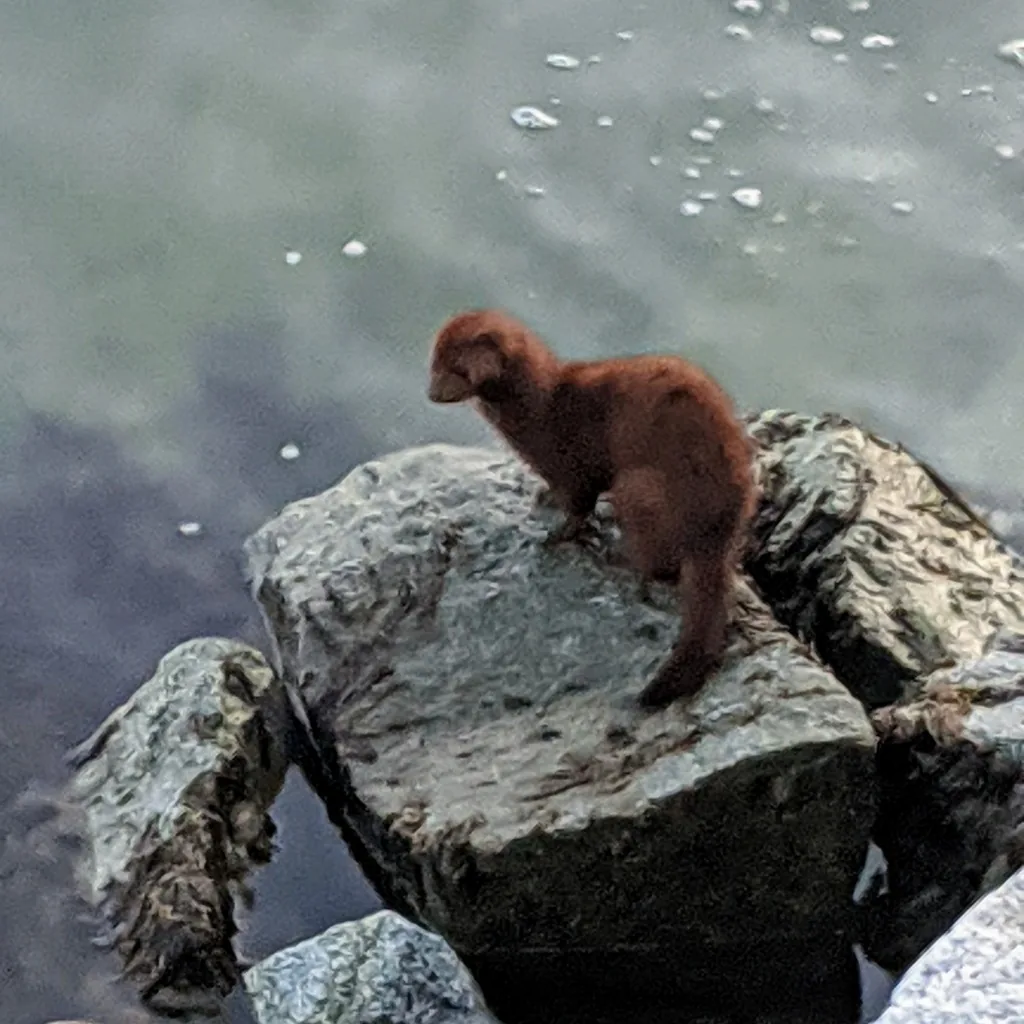
- A long, slender animal about 18 to 24 inches long including a somewhat bushy 5- to 7-inch tail, weighing about 1.5 to 3 pounds. Females are about three-quarters the size of males.[1]
- Glossy fur is rich chocolate brown, darkening to black at the tail tip, usually with a white patch on the chin or chest.[1][5]
- Short, sturdy legs, a flattened head with small eyes and ears, a pointed nose, and slight webbing between the toes.[5]
- It can release a strong musk when disturbed but cannot spray it like a skunk.[1]
Look-alikes
| Look-alike | How to tell them apart |
|---|---|
| Weasels | Weasels have yellowish to dark brown backs and white undersides, while mink are brown all over and live mainly near water.[6][1] |
| Raccoon (as a poultry killer) | Raccoons commonly remove only the head of chickens, while mink kills show small bite marks at the back of the head or neck.[5] |
Where it lives
Mink live throughout North America except the desert Southwest and tundra. North Carolina's wildlife agency finds them statewide but most common in coastal marshes and swamps, and Missouri's Department of Conservation calls them statewide but generally scarce.[1][5][3]
Biology and life cycle
Mink need permanent water such as a stream, river, pond, marsh, swamp or lake. They usually move into abandoned muskrat dens but also use ground squirrel and rabbit burrows and cavities in brush and rock piles.[2]
They are active mainly at night and year-round, though they may stay in a den for a day or more during severe cold or heavy snow.[2]
They breed from late January to late March. Because implantation is delayed, pregnancy lasts 40 to 75 days, and one litter of about 3 to 6 young is born in late April or early May. The family stays together until late summer.[2]
They are strictly carnivorous and take mice and rats, frogs, fish, rabbits, reptiles, crayfish, muskrats, squirrels, insects, birds and eggs, getting about as much food on land as in the water.[2]
Males travel widely, sometimes covering many miles of shoreline.[2]
They swim well and can climb trees.[5]
Damage and signs
- Mink occasionally kill poultry, attacking animals up to the size of a chicken, duck or rabbit, usually by biting through the skull or neck.[4][5]
- Like other weasel-family predators, they may kill far more than they can eat in a full poultry house, sometimes stacking dead birds in a neat pile.[4][5]
- They can take many young of ground-nesting waterfowl and game birds where nesting cover is limited.[4]
- Mink do not damage structures, plants or lawns.[4]
Health risk
ICWDM says mink are not considered a disease threat to people. A 2019 study of invasive American mink in Chile found otherwise for that population: pathogenic Leptospira bacteria turned up in 22 of the kidney samples tested and Cryptosporidium in 3 fecal samples. Like other wild mammals, a mink could carry rabies, which spreads through bites and scratches; CDC says to wash the wound and get medical care right away after any bite.[4][7][8]
Control
Prevention
Frightening devices, repellents and toxicants are not effective or available for mink.[9]
Keep them out
Keep poultry and other small livestock in secure pens, closing every opening larger than 1 inch with half-inch hardware cloth or similar mesh.[3][6][5]
Cover chicken yards and ventilation openings with small-mesh poultry netting; mink don't gnaw, but they will use rat burrows and gnawed holes.[9]
Traps and physical control
Foothold and body-gripping traps set in mink travel lanes work best. Trapping rules apply, and Missouri's Department of Conservation says a local conservation agent can put you in touch with a trapper.[9][3]
Cage traps baited with fresh meat or fish are less reliable, but leaving them wired open for a few days first helps; they are the safer choice where pets roam.[9][3]
Legal status varies by state
ICWDM says mink are protected furbearers in most states, with regulated seasons, but most states let landowners control furbearers that are damaging property.[1]
Missouri classifies mink as furbearers. The 2026-27 trapping season runs November 15, 2026 to February 28, 2027 with a trapping permit. For animals causing damage, the Department points owners to the Code's property-protection rule, which lets damage-causing weasels be shot or trapped out of season without a permit, with restrictions.[10][6][3]
North Carolina requires a depredation permit outside the trapping season and prohibits relocating live mink.[5]
Minnesota lets a landowner, manager or occupant take a mink that is causing damage without a license or permit, but a Conservation Officer must be told within 24 hours. A trapped animal may be destroyed or moved 10 to 15 miles away with the landowner's permission.[11]
Check with your state wildlife agency before using any lethal control.[1]
Wisconsin allows mink to be taken only by trapping or snaring, bans killing a trapped mink with a firearm or spear, and makes it illegal to damage or destroy a mink den.[12]
Oregon lists mink as a furbearer with a statewide season of November 15 to March 31. Weasels, by contrast, are unprotected mammals there, as they are in Wisconsin.[13][12]
Missouri also bans dogs for hunting aquatic furbearers, including mink, and in towns of 10,000 or more people allows only cage or foot-enclosing traps within 150 feet of a home.[10]
Common questions
- How can I tell if a mink killed my chickens?
- Look for closely spaced pairs of canine tooth marks on the skull or neck, several dead birds, sometimes piled, and a pond or stream nearby.[4][5]
- Will a mink eat fish from my pond?
- It can. Fish are one of many foods mink eat, and ICWDM says the best mink habitat is water with plenty of fish, frogs and other aquatic animals.[2]
- Can I relocate a mink I trap?
- It depends on the state. North Carolina forbids relocating live mink, while Minnesota allows moving a nuisance animal 10 to 15 miles with the landowner's permission. Check your state wildlife agency's rules first.[5][11]
Sources
- Internet Center for Wildlife Damage Management, “Mink: Identification.” icwdm.org/species/carnivores/minks/ (accessed 2026-11-13). Run by university wildlife damage specialists (maintained at the University of Wisconsin-Stevens Point); species modules are based on Prevention and Control of Wildlife Damage (University of Nebraska Cooperative Extension, 1994).
- Internet Center for Wildlife Damage Management, “Mink Biology.” icwdm.org/species/carnivores/minks/mink-biology/ (accessed 2026-11-13). Run by university wildlife damage specialists (maintained at the University of Wisconsin-Stevens Point); species modules are based on Prevention and Control of Wildlife Damage (University of Nebraska Cooperative Extension, 1994).
- Missouri Department of Conservation, “Weasel Control.” mdc.mo.gov/wildlife/nuisance-problem-species/weasel-control (accessed 2026-11-13)
- Internet Center for Wildlife Damage Management, “Mink Damage Identification.” icwdm.org/species/carnivores/minks/mink-damage-identification/ (accessed 2026-11-13). Run by university wildlife damage specialists (maintained at the University of Wisconsin-Stevens Point); species modules are based on Prevention and Control of Wildlife Damage (University of Nebraska Cooperative Extension, 1994).
- North Carolina Wildlife Resources Commission, “Mink.” www.ncwildlife.gov/species/mink (accessed 2026-11-13)
- University of Missouri Extension, “Controlling Nuisance Weasels in Missouri, G9528 (reviewed May 2025).” extension.missouri.edu/publications/g9528 (accessed 2026-11-13)
- Vector Borne Zoonotic Dis 2019;19(12):908-914, via PubMed, “Zoonotic Pathogens in the American Mink in Its Southernmost Distribution (Ramírez-Pizarro et al., 2019).” pubmed.ncbi.nlm.nih.gov/31390318/ (accessed 2026-11-13)
- U.S. Centers for Disease Control and Prevention, “About Rabies.” www.cdc.gov/rabies/about/index.html (accessed 2026-11-13)
- Internet Center for Wildlife Damage Management, “Mink Damage Prevention and Control Methods.” icwdm.org/species/carnivores/minks/mink-damage-prevention-and-control-methods/ (accessed 2026-11-13). Run by university wildlife damage specialists (maintained at the University of Wisconsin-Stevens Point); species modules are based on Prevention and Control of Wildlife Damage (University of Nebraska Cooperative Extension, 1994).
- Missouri Department of Conservation, “Mink: Trapping (2026-2027 season).” mdc.mo.gov/hunting-trapping/seasons/mink-trapping (accessed 2026-11-13)
- Minnesota Department of Natural Resources, “Taking a nuisance animal.” www.dnr.state.mn.us/livingwith_wildlife/taking.html (accessed 2026-11-13)
- Wisconsin Department of Natural Resources, “Trapping Regulations.” dnr.wisconsin.gov/topic/Trap/regulations/OnlineTrappingRegulations (accessed 2026-11-13)
- Oregon Department of Fish and Wildlife, “Furbearer trapping and hunting.” myodfw.com/node/734 (accessed 2026-11-13)
- Global Biodiversity Information Facility (GBIF), “Mustela vison Schreber, 1777 (GBIF Backbone Taxonomy).” api.gbif.org/v1/species/5218823 (accessed 2026-11-13)
- iNaturalist, “Neogale vison taxon page (order and family).” www.inaturalist.org/taxa/1264432 (accessed 2026-10-06)