The short answer
- Crush a dropping (with gloves, or a stick). Bat droppings (guano) crumble easily and show shiny bits of undigested insects, and they are never white or chalky. Bird droppings carry white chalky material and leave white stains.[1][3][5]
- Note when it's noisy. Bats are night animals: they get noisy before leaving the roost at dusk and when coming back at dawn. Starlings, house sparrows and pigeons are active in daylight, so their noise, nests and comings and goings happen by day.[3][1][5]
- Look for a nest. House sparrows and starlings stuff cavities with messy piles of grass, plant fibers, string, feathers and trash. Bats bring in no bedding; their signs are guano piles under the roost and dark body-oil and urine stains around the gap they use.[5][6][1][3]
- Chimney chatter in summer is usually chimney swifts, birds that cling to the inside of chimneys and whose young twitter loudly. They are federally protected; starlings and house sparrows are not.[9][10][7][6]
Animals on this page
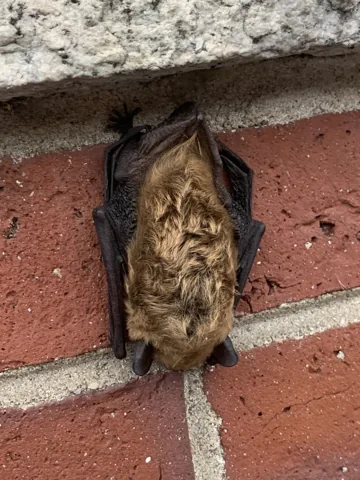 Bats (big brown bat and little brown bat)
Eptesicus fuscus and Myotis lucifugus (shown: big brown bat)
Bats are flying, insect-eating mammals that sometimes roost in attics, walls and other parts of buildings. They are valuable insect eaters, but colonies leave droppings, urine stains and odor.
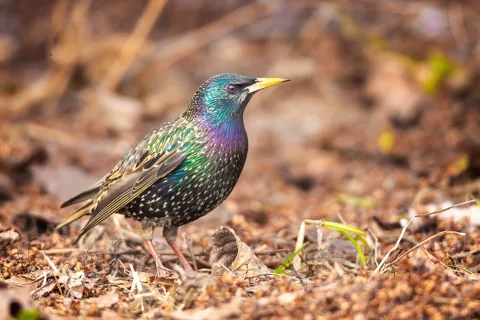 European starling
Sturnus vulgaris
The European starling is a stocky, short-tailed, non-native bird that now lives across most of North America. Pairs nest in building cavities and vents in spring, and fall and winter flocks of thousands foul roost sites with noise and droppings. The Missouri Department of Conservation lists it as invasive.
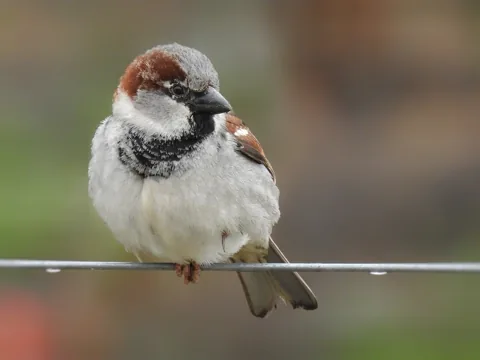 House sparrow (English sparrow)
Passer domesticus
The house sparrow is a small, chunky, non-native bird that thrives wherever people build farms, towns and cities. It packs messy nests into any sheltered gap on buildings, leaves droppings where it roosts, and drives native birds from nest boxes.
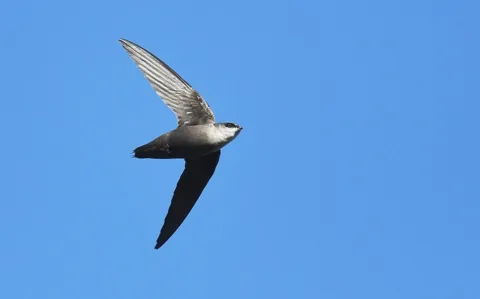 Chimney swift
Chaetura pelagica
Chimney swifts are small, cigar-shaped birds that spend most of their time flying and nest inside open chimneys. They are a federally protected migratory bird, so an active nest has to be left alone; the fix is a chimney cap once the birds have gone.
Side by side
Which animals: in houses, the bats are usually little brown and big brown bats, the species Delaware says are most likely to use buildings for maternity colonies. The birds are most often European starlings and house sparrows in eaves, vents and wall cavities, and chimney swifts in open masonry chimneys.[14][5][6][9]
- Droppings: bat guano is segmented, elongated and crumbly, crushes into shiny insect bits and never has the white chalky material of bird droppings. Bird droppings leave white stains on the building and below nests and roosts.[3][1][5]
- Where droppings pile up: bat guano collects on the ground or ledge right below the roost entry and can build up between walls, floors and ceilings; heavy buildups stain ceilings and siding and can make ceilings collapse. Bird droppings build up under nests and roosts, and starling droppings can corrode supports.[1][3][7]
- Sounds: bats make sounds from vocalizing, grooming, scratching and crawling in attics, behind walls and between floors, loudest on hot days, before the dusk exit and at the dawn return. Birds are heard in daylight: a sharp repeated cheep from house sparrows, squawking from starlings, and loud twittering from chimney swift young.[3][5][8][9]
- When you see them: bats leave at night to hunt insects, so you rarely see them except at dusk as they come out. Starlings and house sparrows fly in and out of the opening by day; chimney swifts look like a flying cigar and dive into the chimney, and in fall flocks swirl over a big chimney before dropping in at dusk to roost.[1][5][9]
- Entry gaps: bats can squeeze through openings as small as 1/4 inch per UC IPM, or about 3/8 inch, the width of a dime, per ICWDM; the gap they use shows dark rub marks from body oil and urine. House sparrows need openings greater than 3/4 inch, which is the size Iowa State and Illinois Extension say to close.[1][3][2][6][7]
- Nest material: house sparrows fill the space with a haphazard pile of dried plant fibers decorated with feathers, string, paper and plastic; starlings fill the cavity with a messy mass of plant fibers. Chimney swifts build their nests on the vertical walls inside chimneys. Bats make no nest; with bats you find guano, sometimes mixed with wood fibers torn loose by bats crawling over rough surfaces.[6][5][10][3]
- Smell: a large or long-term bat colony gives off a pungent, musty, acrid odor you can sometimes smell from outside, worse in damp weather. Bird sites are more often noticed by nests, noise and white stains.[3][5]
- Season: female bats gather in spring to give birth, and pups can't fly until about August in Ohio; in the North bats may hibernate from September through May, and many leave for warmer areas or hibernation roosts in winter. Starlings nest from April to August; chimney swifts nest from May through August and leave for South America in October.[1][13][4][6][9]
- Legal status: bats are protected by state law in many states (all of Ohio's bat species are; New Jersey protects its native nongame wildlife). Chimney swifts are protected under the federal Migratory Bird Treaty Act. Starlings and house sparrows are non-native and not protected by it.[13][15][10][11][7][6]
How to confirm which one you have
Do the crush test from a distance with a tool, not your bare hands, and don't stir up dust: CDC says the histoplasmosis fungus is found in soil and in bird or bat droppings, and most outbreaks followed work that disturbed contaminated soil or droppings.[1][17][18]
- Watch at dusk. When bats start leaving to feed, watch the building to see where they come out; a daytime walk-around then shows the holes or cracks they are using.[1]
- Look for stains and droppings below openings. Bats urinate and defecate as they leave, spotting siding, windows and anything under the exit, and guano under an opening is a good pointer to the roost. Bird activity shows as nest material at the hole and white streaks.[3][1][5]
- Watch by day for birds. Starlings, sparrows and pigeons are active in daylight, so you can usually see them carrying nest material in and out of a vent, soffit gap or dormer crevice.[5][6]
- For a chimney, listen in summer: loud twittering from the flue between May and August, with birds diving in at dusk, points to chimney swifts.[9][10]
Why the difference matters
The fix and the calendar are different. Bats are removed by exclusion: let them leave and keep them from getting back in. Pest birds are handled by removing nests and closing openings, and protected birds by waiting until they are done nesting.[1][2][6][5][10]
- Pup season traps bats inside. One-way exclusion devices put up during the maternity season let adults out but trap flightless young, which then starve, cause odor and fly problems, and mothers may try to reach them through the living space.[2][13]
- States set the window. New Jersey says to exclude bats only from April 1 to April 30 and August 1 to October 15; Delaware says no complete exclusions between May 15 and August 31; Ohio's guidelines also restrict exclusions from October 15 through March 31 if any bats are present. Check your state wildlife agency before you start.[15][14][13]
- Protected birds and their nests: the Migratory Bird Treaty Act bars taking protected birds without authorization, and USFWS says destroying a nest with viable eggs or nestlings is illegal and that moving a nest needs authorization. NCWRC says a federal permit is always required to remove chimney swifts, and that shutting out adults leaves the young to die.[11][12][10]
- Starlings and house sparrows are exempt from federal and state protection as non-native nuisance birds, so their nests can be removed and their openings closed at any time.[6][7][5]
What to do for each
Bats, outside the pup season: find every opening, seal the secondary gaps (ICWDM: gaps of 1/4 by 1 1/2 inches and openings 5/8 by 7/8 inch or larger), put one-way exits on the active holes, then seal those once the bats are out. The full steps are in our bat exclusion guide.[2][1]
- Bats during the pup season: block every way into the living space now, and wait for the state window to do the exclusion.[2][15][14]
- Starlings and house sparrows: remove nests and close openings bigger than 3/4 inch, and enclose crevices under dormers. Expect them to rebuild in the same spot, so check again.[6][7][5]
- Chimney swifts: leave them until they migrate in fall, skip chimney cleaning while they nest from May through August, then cap the chimney with a manufactured stainless steel screen so they can't nest there next year.[9][10][5]
- Cleanup: wait until the animals are out, then follow our bird and bat droppings cleanup guide; ICWDM says decontamination of an active bat roost should only follow exclusion or the bats' departure for hibernation.[3][1]
Health: bats, rabies and droppings
Don't touch bats. CDC says bat bites can be tiny and you may not know you were bitten; wash any bite or scratch with soap and water and get medical help right away, and report any contact with a bat to your health department.[16]
- If you find a bat in your home, CDC says to contact animal control or your health department so the bat can be captured safely and tested for rabies.[16]
- CDC says histoplasmosis spreads from bird and bat droppings mixed into soil, and most outbreaks followed disturbing soil contaminated with droppings. Don't sweep or shovel dry droppings; see our cleanup guide.[18][17]
Common questions
- I hear scratching in the attic at night. Bats or birds?
- Night sounds, especially right before dusk and around dawn, point to bats, though rats, mice and squirrels also scratch. Starlings and sparrows are active in daylight. Check the droppings: crumbly with shiny insect bits means bats.[3][5][1]
- Can I just close the hole when I see bats leave?
- Not during pup season. Flightless young left inside will die, and mothers may try to get to them through the house. Use one-way exits in your state's allowed window.[2][13][15]
- Can I remove a bird nest from my vent?
- If it's a starling or house sparrow nest, yes: they are not protected. If it's a native bird, USFWS says destroying a nest with viable eggs or nestlings is illegal.[6][7][12]
- What's twittering in my chimney every summer?
- Most likely chimney swift young. Swifts are federally protected; wait until they leave in fall, then cap the chimney.[9][10][5]
Photo credits
- Bats (big brown bat and little brown bat): (c) Thomas Irvine, some rights reserved (CC BY) — via iNaturalist, CC BY 4.0
- European starling: (c) egorbirder, some rights reserved (CC BY) — via iNaturalist, CC BY 4.0
- House sparrow (English sparrow): (c) Esteban Poveda, some rights reserved (CC BY) — via iNaturalist, CC BY 4.0
- Chimney swift: Chrissy McClarren and Andy Reago, public domain (CC0), via iNaturalist
Sources
- University of California Statewide IPM Program, “Pest Notes: Bats (Publication 74150).” ipm.ucanr.edu/home-and-landscape/bats/ (accessed 2026-11-14)
- Internet Center for Wildlife Damage Management, “Bats: Identification.” icwdm.org/species/other-mammals/bats/ (accessed 2026-11-14)
- Internet Center for Wildlife Damage Management, “Bat Damage Identification.” icwdm.org/species/other-mammals/bats/bat-damage-identification/ (accessed 2026-11-14)
- Internet Center for Wildlife Damage Management, “Bat Biology.” icwdm.org/species/other-mammals/bats/bat-biology/ (accessed 2026-11-14)
- University of Nebraska-Lincoln Extension, “G2024: Urban Pest Birds: Controlling Damage.” extensionpubs.unl.edu/publication/g2024/html/view (accessed 2026-11-14)
- Iowa State University Extension and Outreach, Natural Resource Stewardship, “Nuisance Birds: Damage Management (last reviewed July 1, 2019).” naturalresources.extension.iastate.edu/encyclopedia/nuisance-birds-damage-management (accessed 2026-11-14)
- University of Illinois Extension, “European Starlings (Invasive Species).” extension.illinois.edu/invasives/european-starlings (accessed 2026-11-14)
- Missouri Department of Conservation, “European Starling (Field Guide).” mdc.mo.gov/discover-nature/field-guide/european-starling (accessed 2026-11-14)
- Missouri Department of Conservation, “Chimney Swift (Field Guide).” mdc.mo.gov/discover-nature/field-guide/chimney-swift (accessed 2026-11-14)
- North Carolina Wildlife Resources Commission, “Chimney Swifts (wildlife damage control guidance).” ncwildlife.gov/media/2294/download (accessed 2026-11-14)
- U.S. Fish and Wildlife Service, “Migratory Bird Treaty Act of 1918.” www.fws.gov/law/migratory-bird-treaty-act-1918 (accessed 2026-11-14)
- U.S. Fish and Wildlife Service, “Migratory Bird Permit Memorandum MBPM-2-02: application of the MBTA to the take of migratory bird nests (January 15, 2025).” www.fws.gov/sites/default/files/documents/2025-01/mbpm-2-nest-memorandum-2025.pdf (accessed 2026-11-14)
- Ohio Department of Natural Resources, Division of Wildlife, “Bat Exclusion Guidelines.” dam.assets.ohio.gov/image/upload/ohiodnr.gov/documents/wildlife/permits/Bat-Exclusion-Guidelines.pdf (accessed 2026-11-14)
- Delaware Department of Natural Resources and Environmental Control, Division of Fish and Wildlife, “Best Management Practices for Bat Exclusions.” documents.dnrec.delaware.gov/fw/conservation/bats/Best%20Management%20Practices%20for%20Bat%20Exclusions%20-%20Dec%202010.pdf (accessed 2026-11-14)
- New Jersey Division of Fish and Wildlife, Endangered and Nongame Species Program, “Nuisance Wildlife Control Guidelines for Bats (updated February 13, 2019).” nj.gov/dep/fgw/ensp/pdf/bat_control.pdf (accessed 2026-11-14)
- Centers for Disease Control and Prevention, “Preventing Rabies from Bats.” www.cdc.gov/rabies/exposure/animals/bats.html (accessed 2026-11-14)
- Centers for Disease Control and Prevention, “How People Get Histoplasmosis.” www.cdc.gov/histoplasmosis/causes/index.html (accessed 2026-11-14)
- Centers for Disease Control and Prevention, “About Histoplasmosis.” www.cdc.gov/histoplasmosis/about/index.html (accessed 2026-11-14)