The short answer
- Size: the pigeon is the largest, about 12 inches long and about 12 ounces. A starling is about 8 inches (robin-sized) and about 3 ounces. A house sparrow is 5 to 6 1/2 inches and weighs less than an ounce.[1][5][6][3][7]
- Look: a typical pigeon is gray with two dark bars on each wing, a white rump and a dark band at the tail tip. A starling is a stocky, short-tailed black bird, glossy green-purple up close, with a long pointed bill and white speckles in fall and winter. A house sparrow is brown and gray; the male has a black throat bib.[5][1][6][3][7]
- Nest: pigeons pile sticks and straw on a flat, sheltered ledge; starlings nest inside cavities, sometimes with a fan-shaped spray of droppings on the wall below the hole; house sparrows stuff a messy wad of grass, string, paper and feathers into a crevice or small cavity.[1][2][5][7]
Birds on this page
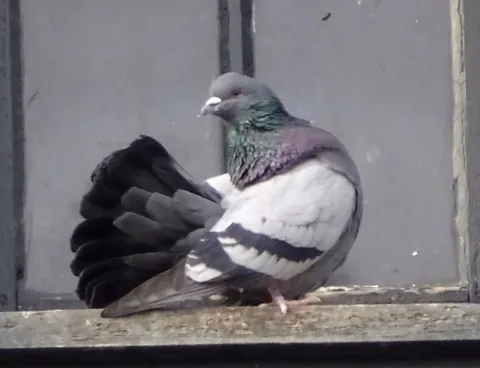 Pigeon (feral rock pigeon)
Columba livia
Feral pigeons are non-native birds that depend on people for food and nesting sites. Flocks on ledges, eaves and rooftops leave heavy, acidic droppings that deface buildings and clog gutters, and dried droppings can carry fungi and bacteria that cause lung infections.
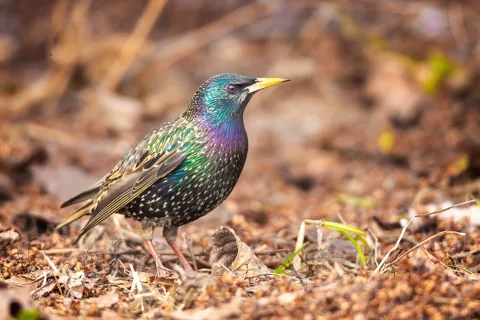 European starling
Sturnus vulgaris
The European starling is a stocky, short-tailed, non-native bird that now lives across most of North America. Pairs nest in building cavities and vents in spring, and fall and winter flocks of thousands foul roost sites with noise and droppings. The Missouri Department of Conservation lists it as invasive.
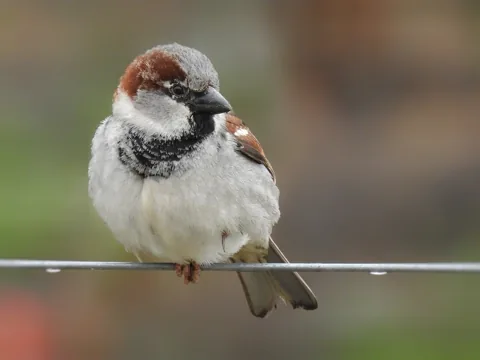 House sparrow (English sparrow)
Passer domesticus
The house sparrow is a small, chunky, non-native bird that thrives wherever people build farms, towns and cities. It packs messy nests into any sheltered gap on buildings, leaves droppings where it roosts, and drives native birds from nest boxes.
Side by side
All three are non-native birds that live close to people. Missouri's Department of Conservation calls house sparrows, rock pigeons and European starlings among the most common birds that share human habitats, and University of Nebraska-Lincoln Extension covers the three together in one guide to managing invasive birds.[7][1]
- Length: pigeon about 12 inches (UNL) or 12 1/2 inches (Missouri Department of Conservation). Starling about 8 inches (UNL, Illinois Extension) or 8 1/2 inches (MDC). House sparrow 5 to 6 1/2 inches (UNL) or 6 1/4 inches (MDC).[1][5][3][6][7]
- Weight: UNL gives about 12 ounces for pigeons, about 3 ounces for starlings and less than an ounce for house sparrows.[1]
- Pigeon colors: the wild type has a dark head, breast and shoulders, a light gray body, two dark wing bars, a white rump and a dark band at the tail tip, with pink feet. Many color forms exist, from all white to all black, rusty, spotted or mottled brown.[5][1]
- Starling colors: from a distance it looks black; up close the plumage is glossy greenish or purplish black. After the fall molt the whole bird is speckled with white spots, which wear off toward spring. Young starlings are brownish gray with a brown bill. Both sexes have pinkish red legs.[6][3][1]
- House sparrow colors: the male is chestnut brown above with a gray crown, a whitish gray cheek, a black throat and upper breast, and often a single white wing bar. The female is tan with a pale eyebrow and a yellowish bill and no black bib; young males look like females.[7][1]
- Shape and bill: the starling is chunky and short-tailed with a long, sharp-pointed bill, yellow in spring and summer and darker brownish in winter. The male house sparrow's bill is black and the female's yellowish. A pigeon, like other doves, can drink with its bill down, without tilting its head back.[6][3][1][7][5]
- Voice: pigeons make a soft, throaty cooing. House sparrows give a sharp, repeated cheep (MDC writes it chireep or chirip). Starling calls vary a lot because starlings mimic other birds.[1][5][7]
- Nest site: pigeons build on solid, flat, sheltered structures such as barn alcoves, silos, bridges, billboards, window ledges and high-rises. Starlings use tree cavities and the nooks of houses, barns, office buildings and traffic lights, and take over bluebird and purple martin boxes. House sparrows nest in cavities of houses, barns, grain elevators, bird boxes and bridges, under siding, in sign crannies and sometimes in tangled vines.[2][5][7]
- Nest look: a pigeon nest is a flimsy platform of twigs, stems and straw that hardens with droppings as it is reused. A house sparrow nest is a bulky, untidy wad of grass, twigs, string, paper, feathers and trash that fills the crevice. A starling nest is much less conspicuous because it sits inside a cavity.[5][1][2][7]
- Eggs and broods: UNL gives pigeons one to two eggs per clutch and six to 10 broods a year, while MDC gives clutches of one to three eggs and up to six broods. UNL gives house sparrows three to nine eggs per clutch, up to five clutches a year from early April (MDC: up to eight eggs, up to four broods). UNL gives starlings four to six eggs in each of two clutches a year.[1][5][7]
- Flocks: pigeons move singly or in flocks that reach the hundreds. House sparrows gather in groups of a few to many dozens outside the nesting season. Starlings pair off to nest, but fall and winter flocks grow to thousands, even hundreds of thousands, often roosting with blackbirds and grackles.[2][7][6][3]
- Where you'll see them: pigeons in city parks and on downtown buildings, barns and bridges; starlings probing lawns for grubs and crowding suet feeders; house sparrows at feeders, in fast-food parking lots and in shrubs and vines near buildings.[5][2][6][7]
Native birds that get mistaken for them
Mourning dove (for pigeon): slender, gray-brown, with black spots on the wings and a long pointed tail with white tips, about 12 inches long. It is native, and UNL calls it beneficial. MDC says the large, short-tailed, usually gray rock pigeon is unlikely to be confused with it.[8][1]
- Band-tailed pigeon (for pigeon, mainly in the West): purplish gray with a white crescent on the back of the neck, yellow bill and feet, and a pale gray tail tip. Unlike the rock pigeon it is native to western North America.[5]
- Common grackle, red-winged blackbird, brown-headed cowbird (for starling): Illinois Extension names all three as birds a starling can be mistaken for, and in winter starlings often flock with blackbirds. The starling's short tail, chunky shape and long pointed bill set it apart; MDC says the shape alone separates it from other black birds.[3][6][1]
- Native sparrows such as chipping and song sparrows (for house sparrow): UNL calls Nebraska's native sparrows beneficial. MDC notes young white-crowned sparrows have a rusty crown and two white wing bars, and adult Harris's sparrows have black bibs like male house sparrows but pink bills, white bellies and black on the crown.[1][7]
- House finch (for house sparrow): similar in name, but it has streaked underparts, the male has a red breast and head, and it is slimmer and daintier. It is native to the western US and was introduced in the East.[7][9]
- Female dickcissel (for female house sparrow, at fall feeders): white chin edged by a black line on each side, no white wing bars, and usually some yellow on the chest and eyebrow.[7]
How to confirm which one it is
Compare size against a bird you know: a starling is robin-sized, a pigeon is about the length of a mourning dove but stockier and short-tailed, and a house sparrow is smaller than either.[1][8][5][7]
- Get a photo of the bill and tail. A long, pointed bill on a short-tailed dark bird means starling; a small brown-and-gray bird with a black bib (or a plain tan female beside one) points to house sparrow; a small head, two dark wing bars and a white rump point to pigeon.[6][3][7][5]
- Look at the nest and the wall under it. A stick-and-straw pile with crusted droppings on a ledge is a pigeon's; a fan of droppings below a hole suggests starlings inside; grass, string and trash poking out of a vent or gap is the house sparrow's mark.[1][5][2]
- Listen. A soft coo means pigeon, a sharp repeated cheep means house sparrow, and a varied mix that copies other birds suggests starling.[1][5][7]
- If you still can't tell, or the bird might be a native species, check with your state wildlife agency before removing anything. Iowa State Extension suggests contacting a wildlife conservation officer when protected birds are causing problems.[1][2]
Why it matters: the law and the fix differ
The Migratory Bird Treaty Act bars taking protected migratory birds, which includes killing, capturing, selling, trading and transporting them, without authorization from the U.S. Fish and Wildlife Service. A 2004 amendment limited the act to native species.[10]
- The three birds are left out for different reasons. The rock pigeon belongs to the pigeon and dove family, which the treaties cover, so the Fish and Wildlife Service lists it by name among nonnative, human-introduced species the act does not apply to. House sparrows (family Passeridae) and European starlings (Sturnidae) are in families that do not qualify for protection at all, as the Service explained in its 2020 list.[11][10]
- Their native look-alikes are protected. The federal list of protected birds at 50 CFR 10.13 includes the mourning dove, band-tailed pigeon, house finch, red-winged blackbird, brown-headed cowbird, common grackle, chipping sparrow and song sparrow, and does not include the rock pigeon, European starling or house sparrow.[12]
- States set their own rules. Colorado Parks and Wildlife, for example, lets a landowner or their agent take starlings, house sparrows and rock pigeons without a permit on private property experiencing damage. Check your own state wildlife agency, and local rules on firearms, before lethal control.[13]
- Openings differ by bird. Iowa State Extension advises closing all openings larger than 3/4 inch to keep house sparrows out, and a bluebird box hole of exactly 1 1/2 inches keeps starlings from entering. Pigeons are kept off ledges with porcupine wire, netting, or by sloping the ledge to 45 degrees or more.[2][3][4]
If it's a pigeon
Stop the food: feeding pigeons is usually discouraged in cities because of their numbers and droppings. Pigeons need water and grit as well as grain.[5][1]
- Block lofts, steeples, vents and eaves with wood, metal, masonry, 1/4-inch rust-proofed wire mesh or netting, and screen ornamental ledges with 1-inch netting.[4]
- Change the angle of ledges to 45 degrees or more with sheet metal, wood or other material, or use spikes, wires or coils on the landing spots.[4][2]
- Remove nests and eggs and dispose of the material; pigeons often reuse nests, and droppings build up in them with each brood. Iowa State Extension says to repeat removal every two weeks through the nesting season.[4][5][2]
If it's a starling
Place wire mesh or netting across outer walls and eaves, and under rafters and overhangs inside buildings, to keep starlings from nesting and roosting there.[2]
- Build bluebird boxes to strict specifications; Iowa State and Illinois Extension say the entrance hole should be exactly 1 1/2 inches across to keep starlings out.[2][3]
- For large roosts in dense trees, Iowa State and Illinois Extension say thinning the stand by one-third will disperse big flocks.[2][3]
- Don't count on scare devices: Iowa State Extension says repellents and scare tactics such as air cannons typically have only a short-term effect.[2]
If it's a house sparrow
Close every opening larger than 3/4 inch on buildings, and make sure mesh over larger openings has no holes bigger than that.[2]
- Promptly remove nest material and eggs from cavities on buildings and from bird boxes, dispose of it so it cannot be reused, and repeat every two weeks through the nesting season.[2]
- Cover vines and dense shrubs where flocks roost with plastic mesh or nylon netting, and watch bluebird and martin boxes: house sparrows often evict the native birds.[2][7][1]
Droppings and health
Histoplasmosis comes from breathing spores of the fungus Histoplasma, which lives in soil and in bird or bat droppings in some parts of the US and is released when contaminated soil is disturbed.[14]
- NIOSH lists chickens, blackbirds (starlings and grackles), pigeons and gulls as the birds typically tied to histoplasmosis outbreaks. It also says fresh bird droppings on sidewalks and windowsills likely pose no histoplasmosis risk, because birds themselves are rarely infected. The fungus grows best in soil or other material with large amounts of bird or bat droppings.[15]
- Cryptococcus, the fungus behind cryptococcosis, lives in soil, bird dung, decaying wood and on trees, and people can be infected by inhaling the spores.[16]
- Psittacosis is a bacterial disease that often infects birds; CDC says people who have contact with pet birds and live poultry are at increased risk.[17]
- NIOSH adds that a large number of birds can itself pose a risk for Histoplasma exposure, so big roosts and piles of droppings deserve care; see the cleanup guide linked below for steps and protective gear.[15]
Common questions
- Is that big gray bird on my roof a pigeon or a mourning dove?
- A rock pigeon is heavy-bodied and short-tailed, usually gray with two dark wing bars and a white rump. A mourning dove is slender and gray-brown with black wing spots and a long pointed tail with white tips. The dove is native and federally protected; the pigeon is not.[5][8][12][11]
- How do I tell a starling from a blackbird or grackle?
- Look at the tail and bill. A starling is chunky with a short tail and a long, sharp-pointed bill, and in fall and winter it is covered in white speckles. Grackles and blackbirds are native and on the federal protected list.[6][3][12]
- Are house sparrows, starlings and pigeons protected?
- Not by the Migratory Bird Treaty Act: pigeons are on the federal list of nonnative species it doesn't cover, and sparrows and starlings belong to families it doesn't cover. State and local rules still apply, so check your state wildlife agency.[11][10][13]
- What size hole keeps house sparrows out?
- Iowa State Extension says to close all openings larger than 3/4 inch on buildings to keep house sparrows out.[2]
- Are bird droppings on my windowsill dangerous?
- NIOSH says fresh bird droppings on sidewalks and windowsills likely pose no histoplasmosis risk. The fungus grows best in soil or other material containing large amounts of bird or bat droppings.[15]
Photo credits
- Pigeon (feral rock pigeon): (c) cornwallcen, some rights reserved (CC BY) — via iNaturalist, CC BY 4.0
- European starling: (c) egorbirder, some rights reserved (CC BY) — via iNaturalist, CC BY 4.0
- House sparrow (English sparrow): (c) Esteban Poveda, some rights reserved (CC BY) — via iNaturalist, CC BY 4.0
Sources
- University of Nebraska-Lincoln Extension, “Managing Invasive Birds: House Sparrows, Starlings and Pigeons (G2024).” extensionpubs.unl.edu/publication/g2024/html/view (accessed 2026-11-14)
- Iowa State University Extension and Outreach, “Nuisance Birds: Damage Management.” naturalresources.extension.iastate.edu/encyclopedia/nuisance-birds-damage-management (accessed 2026-11-14)
- University of Illinois Extension, “European Starlings.” extension.illinois.edu/invasives/european-starlings (accessed 2026-11-14)
- Internet Center for Wildlife Damage Management, “Pigeon Damage Control and Prevention Methods.” icwdm.org/species/birds/pigeons/pigeon-damage-control-and-prevention-methods/ (accessed 2026-11-14)
- Missouri Department of Conservation, “Rock Pigeon (Rock Dove) (Field Guide).” mdc.mo.gov/discover-nature/field-guide/rock-pigeon-rock-dove (accessed 2026-11-14)
- Missouri Department of Conservation, “European Starling (Field Guide).” mdc.mo.gov/discover-nature/field-guide/european-starling (accessed 2026-11-14)
- Missouri Department of Conservation, “House Sparrow (Field Guide).” mdc.mo.gov/discover-nature/field-guide/house-sparrow (accessed 2026-11-14)
- Missouri Department of Conservation, “Mourning Dove (Field Guide).” mdc.mo.gov/discover-nature/field-guide/mourning-dove (accessed 2026-11-14)
- Missouri Department of Conservation, “House Finch (Field Guide).” mdc.mo.gov/discover-nature/field-guide/house-finch (accessed 2026-11-14)
- U.S. Fish and Wildlife Service, “Migratory Bird Treaty Act of 1918.” www.fws.gov/law/migratory-bird-treaty-act-1918 (accessed 2026-11-14)
- U.S. Fish and Wildlife Service (Federal Register), “General Provisions; Revised List of Migratory Birds: list of bird species to which the MBTA does not apply (85 FR 21262, April 16, 2020).” www.fws.gov/sites/default/files/federal_register_document/2020-06782.pdf (accessed 2026-11-14)
- Electronic Code of Federal Regulations, “50 CFR 10.13: List of Birds Protected by the Migratory Bird Treaty Act.” www.ecfr.gov/current/title-50/chapter-I/subchapter-B/part-10/subpart-B/section-10.13 (accessed 2026-11-14)
- Colorado Parks and Wildlife, “Common Human-Wildlife Conflict Species.” cpw.state.co.us/nuisance-wildlife (accessed 2026-11-14)
- Centers for Disease Control and Prevention, “Histoplasmosis: Causes and How It Spreads.” www.cdc.gov/histoplasmosis/causes/index.html (accessed 2026-11-14)
- CDC National Institute for Occupational Safety and Health, “Histoplasma in the Environment: An Overview.” www.cdc.gov/niosh/histoplasmosis/about/environment.html (accessed 2026-11-14)
- Centers for Disease Control and Prevention, “Cryptococcosis: Causes and How It Spreads.” www.cdc.gov/cryptococcosis/causes/index.html (accessed 2026-11-14)
- Centers for Disease Control and Prevention, “About Psittacosis.” www.cdc.gov/psittacosis/about/index.html (accessed 2026-11-14)