On this page
How to identify it
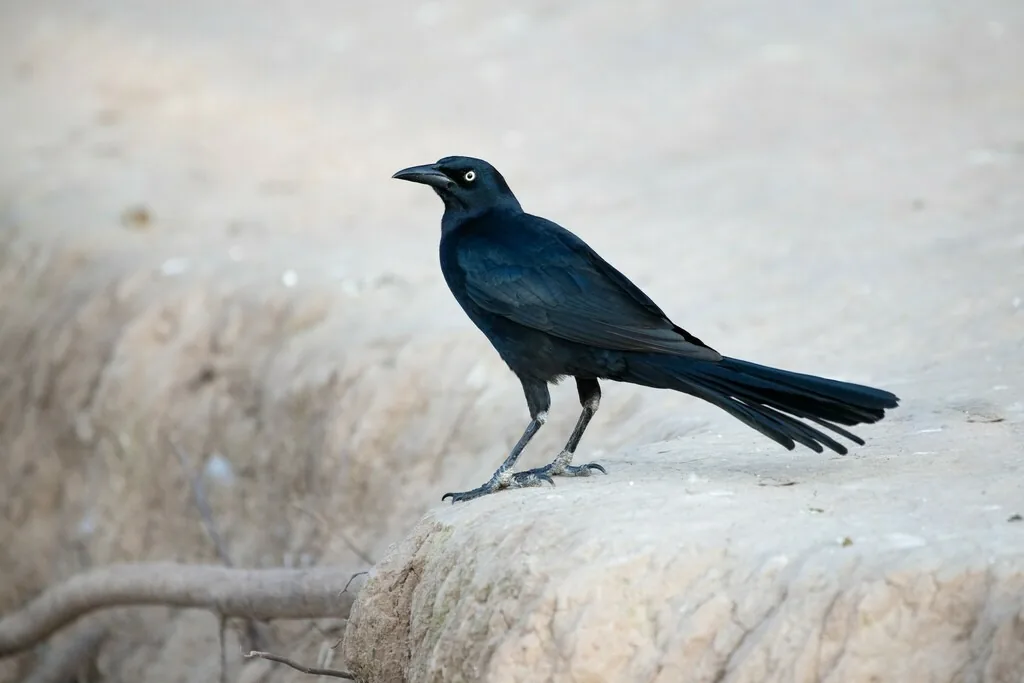
- The largest grackle, with longer wings and an extremely long, keeled tail.[1][2]
- USDA gives males as about 18 inches long with a 23-inch wingspan and females about 15 inches with a 19-inch wingspan; Audubon gives wider ranges, 18 to 23 inches for males and 15 to 18 inches for females.[1][2]
- Males are glossy black with an even purple-blue iridescence. Audubon describes yellow eyes, while USDA notes eye color varies between populations.[1][2]
- Females are smaller and browner: blackish above with a pale to dark grayish-brown breast and throat, and buff below and over the eye.[1][2]
- Loud and social, with a great variety of calls; they feed in flocks, mostly on the ground.[2]
Look-alikes
| Look-alike | How to tell them apart |
|---|---|
| Common grackle | Smaller than the great-tailed grackle, with a shorter tail; its song is a harsh, toneless hiss.[1] |
| European starling | Also gathers in large, messy flocks but is a short-tailed, robin-sized bird about 8 inches long.[3] |
Where it lives
Native to North America, its range stretches from Louisiana and western Arkansas west through Colorado, Utah, southern Nevada and southern California, and south into Mexico. Audubon says it is still expanding its range and increasing in numbers.[1][2]
Biology and life cycle
Grackles nest loosely in colonies, usually raising one clutch a year, sometimes two. USDA gives 3 to 5 eggs; Audubon says 3 to 4, sometimes 5, incubated by the female for about 13 to 14 days.[1][2]
They eat mostly seeds, grain and nuts, but in summer animal foods such as worms, grasshoppers, small fish, mice and other birds' eggs make up a quarter to half of the diet.[1]
Great-tailed and common grackles form large winter roosts, often mixed with other blackbirds; urban roosts can spread over several city blocks.[1]
Great-tailed grackle use of feedlots is low in summer but high from October to April, peaking in October and March when birds are migrating.[1]
In southern climates, they pick roost trees and powerlines for protection from predators rather than for warmth.[1]
Damage and signs
- Large roosts in towns are noisy, and the noise can last all night if the area is well lit.[1]
- Droppings pile up on houses, cars and pavement under roost trees, which drives many complaints.[1]
- In south Texas they damage ripening oranges and grapefruit, and they feed on grain crops and at feedlots.[1]
- Great-tailed grackles are among the birds recorded colliding with aircraft.[1]
Health risk
Droppings beneath long-used winter blackbird roosts, including grackle roosts, can support Histoplasma, the fungus that causes histoplasmosis. CDC says the fungus lives in soil and spreads in bird and bat droppings mixed into soil; breathing in the spores can cause a lung infection, although most people who breathe them in do not get sick.[1][4]
Control
Prevention
Pruning roost trees to open the canopy can push grackles to roost elsewhere, though it works poorly in southern areas where birds pick trees for predator protection.[1][5]
Keep them out
Netting keeps grackles off small trees, gardens or vines with ripening fruit, but it is impractical for large areas.[1]
Traps and physical control
Scare grackles out of a roost with pyrotechnics, distress calls, low-powered lasers or a high-pressure hose, and keep it up for several nights in a row.[1][5]
Combine sight and sound scare devices and move them often so the birds don't get used to them; it often takes five to seven nights or more of steady effort.[5]
Pesticides
Methyl anthranilate repellents (for example EPA Reg. No. 33162-1) are registered for many bird uses, including ripening fruit; they wash off and must be reapplied after rain or irrigation.[1]
When to call a professional
The toxic bait registered for grackles, DRC-1339 (3-chloro-4-methylbenzenamine), may be used only by USDA APHIS-certified applicators trained in bird control or people under their direct supervision, so it isn't a do-it-yourself option.[1]
Legal status: the depredation order
The Migratory Bird Treaty Act prohibits killing, capturing, selling or transporting protected migratory birds without U.S. Fish and Wildlife Service authorization. All grackles are protected, but a standing federal depredation order allows damage control, including lethal take, under set conditions.[6][1]
USDA's 2020 guide quotes the order (then 50 CFR 21.43) as allowing take of grackles found committing or about to commit depredations on trees, crops, livestock or wildlife, or concentrated in numbers that create a health hazard or other nuisance.[1]
That 2020 guide said the federal order overrode state regulations or the need for a state permit; we could not read the current text of the order today, so confirm current federal and state rules before any lethal control.[1]
FWS's annual-report form for the order says anyone who conducted control under it must report take by species and location to their Regional Migratory Bird Permit Office by January 31 of the following year.[7]
Moving a roost
Relocating a roost is an attractive alternative to lethal control, and steady disturbance with lasers or water can move it.[1]
Well-established roosts often need continuous, multiple-night efforts before the birds leave.[1]
Trapping usually fails if plenty of food is available outside the traps.[1]
Common questions
- Why do grackles gather in town every evening?
- Great-tailed grackles form large fall and winter roosts in trees and on powerlines; in the South they choose sites for safety from predators rather than warmth.[1]
- Can I shoot or trap grackles?
- Only under the conditions of the federal depredation order, with take reported to the U.S. Fish and Wildlife Service each year, and in line with state law.[1][7][6]
- Is it safe to clean up grackle droppings?
- Avoid disturbing soil under old roosts: CDC says the histoplasmosis fungus spreads in bird droppings mixed into soil, and USDA notes spores can be released when soil under these roosts is disturbed.[4][1]
Sources
- USDA APHIS Wildlife Services, National Wildlife Research Center, “Grackles, Wildlife Damage Management Technical Series (Bodenchuk and Bergman, April 2020).” www.aphis.usda.gov/wildlife_damage/reports/Wildlife%20Damage%20Management%20Technical%20Series/Grackles_WDM%20Technical%20Series_April%202020.pdf (accessed 2026-11-12)
- National Audubon Society, “Great-tailed Grackle (Guide to North American Birds).” www.audubon.org/field-guide/bird/great-tailed-grackle (accessed 2026-11-12)
- University of Nebraska-Lincoln Extension, “G2024: Urban Pest Birds: Controlling Damage.” extensionpubs.unl.edu/publication/g2024/html/view (accessed 2026-11-12)
- Centers for Disease Control and Prevention, “About Histoplasmosis.” www.cdc.gov/histoplasmosis/about/index.html (accessed 2026-11-12)
- New Mexico State University Cooperative Extension, “Guide L-212: Controlling Nuisance Birds in New Mexico.” pubs.nmsu.edu/_l/L212/index.html (accessed 2026-11-12)
- U.S. Fish and Wildlife Service, “Migratory Bird Treaty Act of 1918.” www.fws.gov/law/migratory-bird-treaty-act-1918 (accessed 2026-11-12)
- U.S. Fish and Wildlife Service, “Annual Report, 50 CFR 21.43: Depredation Order for Blackbirds, Grackles, Cowbirds, Magpies, and Crows (Form 3-200-21-2143, rev. 10/2017).” fws.gov/sites/default/files/documents/3-200-21-2143Rpt_0.pdf (accessed 2026-11-12)
- iNaturalist, “Quiscalus mexicanus taxon page (order and family).” www.inaturalist.org/taxa/9607 (accessed 2026-11-12)