The short answer
- If the nest has eggs or chicks and belongs to a native bird such as a robin, house finch, phoebe, wren, mourning dove or barn swallow, leave it. The federal Migratory Bird Treaty Act protects migratory birds and their nests and eggs, and destroying an in-use nest needs federal authorization.[1][2][5]
- Three common nesters are not protected by the act: the house sparrow, the European starling and the feral rock pigeon. Iowa State Extension and Illinois Extension say their nests can be removed; some states protect other birds, so check your state's rules too.[3][10][9][6]
- The wait is usually short. Wildlife Illinois says it is four to five weeks from the first egg until the young leave the nest, and once they are gone they don't come back to it, so you can take it down then. Swallows are the exception: their young return to the nest for weeks after fledging.[8][7]
- After the nest is empty, bag it with gloves on, clean the spot, and block the site before next spring. Old nests can release bird mites into the house.[11][25][24][9]
Related pest profiles
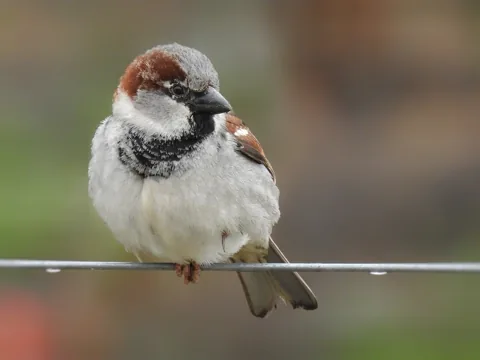 House sparrow (English sparrow)
Passer domesticus
The house sparrow is a small, chunky, non-native bird that thrives wherever people build farms, towns and cities. It packs messy nests into any sheltered gap on buildings, leaves droppings where it roosts, and drives native birds from nest boxes.
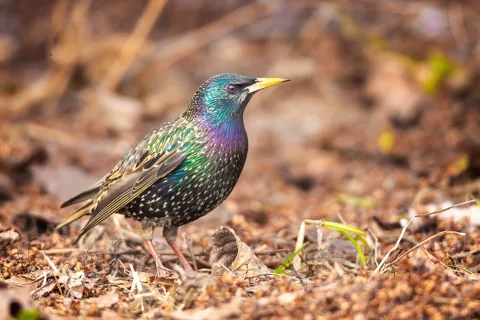 European starling
Sturnus vulgaris
The European starling is a stocky, short-tailed, non-native bird that now lives across most of North America. Pairs nest in building cavities and vents in spring, and fall and winter flocks of thousands foul roost sites with noise and droppings. The Missouri Department of Conservation lists it as invasive.
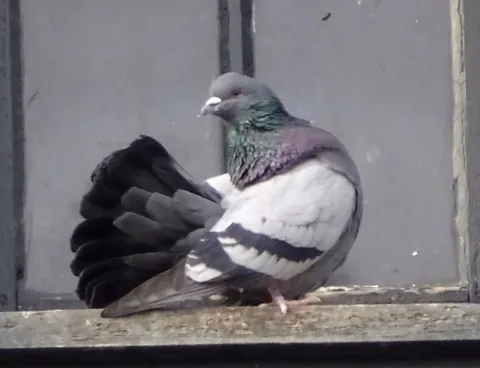 Pigeon (feral rock pigeon)
Columba livia
Feral pigeons are non-native birds that depend on people for food and nesting sites. Flocks on ledges, eaves and rooftops leave heavy, acidic droppings that deface buildings and clog gutters, and dried droppings can carry fungi and bacteria that cause lung infections.
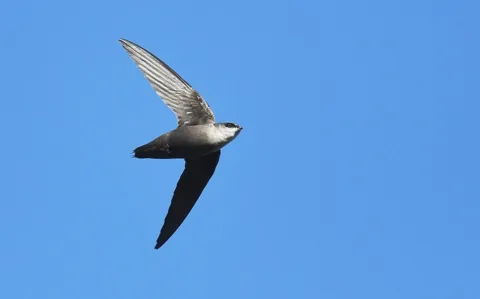 Chimney swift
Chaetura pelagica
Chimney swifts are small, cigar-shaped birds that spend most of their time flying and nest inside open chimneys. They are a federally protected migratory bird, so an active nest has to be left alone; the fix is a chimney cap once the birds have gone.
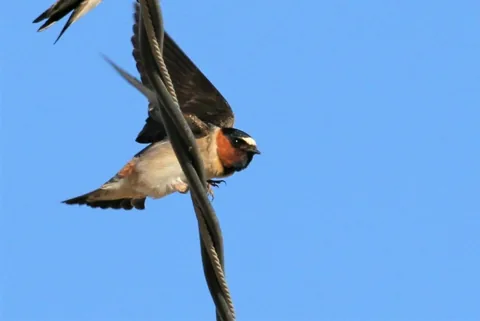 Cliff swallow
Petrochelidon pyrrhonota
Cliff swallows are small migratory birds that plaster colonies of mud nests under the eaves of buildings, bridges and overpasses. They are protected under the Migratory Bird Treaty Act, so timing matters: active nests can't be touched without a permit, and exclusion before nesting is the long-term fix.
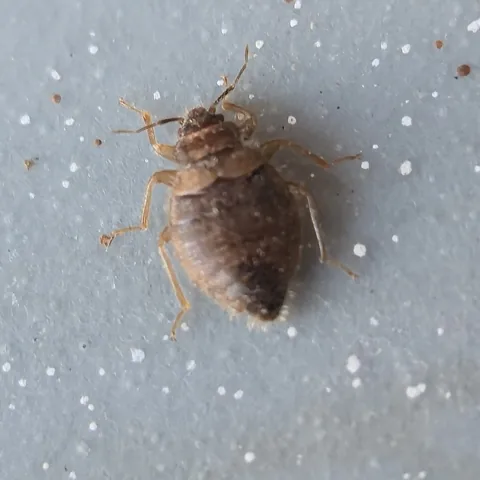 Swallow Bug
Oeciacus vicarius
Swallow bugs are close relatives of bed bugs that feed on the blood of swallows, mainly cliff swallows and sometimes barn swallows. They live in and around mud nests on buildings and bite people mainly when their birds are away.
What it could be: who builds nests on houses
Wildlife Illinois names the eastern phoebe, American robin, northern cardinal, chimney swift, house sparrow, house finch and barn swallow among the most common birds that nest near homes, and says they use spots over doorways, on or in light fixtures, on porch or deck railings, in hanging plants and in wreaths on doors. Illinois Extension adds eaves, gutters, attic vents and chimneys.[8][9]
The nest and its spot often tell you the builder. These field notes come from the Missouri Department of Conservation unless another source is named; for full profiles and a side-by-side of the three unprotected birds, see the links below.[13][14]
- American robin (protected): a cup of mud, grass and twigs, often in plain sight on a ledge or light. Usually 3 to 5 blue eggs.[13][5]
- House finch (protected): a cup-shaped nest in a cavity or nook, including building vents and lights. Usually 2 to 6 eggs.[14][5]
- Eastern phoebe (protected): a cup of mud, moss and plant material stuck to a building just under a roof or other sheltered niche, often over a porch light.[16][8][5]
- Barn swallow (protected): an open, cup-shaped mud nest lined with plant material and feathers, stuck to a rough wall or beam under an overhang. Barn swallows almost always nest on human-built structures.[15][5]
- Carolina wren (protected): a cup of twigs and other material in odd places near houses, such as mailboxes, porch planters, carpet rolls and clothes on a line. A pair often starts several nests before picking one.[17][5]
- Mourning dove (protected): a flimsy nest of sticks holding usually 2 eggs. A pair can make as many as 7 nesting attempts between late March and early September.[18][5]
- Chimney swift (protected): a nest inside the chimney. Most people notice swifts only when the young start calling, at about two weeks old; see the chimney swift profile.[23][22]
- House sparrow (not protected): a bulky, untidy nest of dried plant fibers decorated with feathers, string, paper and plastic (Iowa State), or a messy pile of grasses, string, paper and twigs filling a crevice (Nebraska), in cavities of houses and other structures.[10][11][3]
- European starling (not protected): a nest hidden in a cavity, often a cranny in a building, sometimes marked by a fan-shaped spray of droppings on the wall below.[11][20][3]
- Rock pigeon (not protected): typically just a pile of sticks and hardened droppings on a ledge. The mourning dove, by contrast, is native and protected.[11][21][3][5]
Is it legal to remove it?
Under the Migratory Bird Treaty Act, protected birds include their parts, nests and eggs, and the act prohibits taking them without authorization. Federal rules define take as to pursue, hunt, shoot, wound, kill, trap, capture or collect, or try to. The list of protected species at 50 CFR 10.13 includes over 1,100 species, among them the American robin, house finch, eastern phoebe, barn swallow, Carolina wren and mourning dove.[1][4][5][2]
The Fish and Wildlife Service's 2025 nest memorandum draws the line at use. A nest is in use from the first egg until the young fledge and no longer depend on it; a nest still being built, or one the young have left, is inactive. An inactive nest can be destroyed without a permit as long as nobody keeps it, while destroying an in-use nest needs authorization.[2]
The species not covered: in 2020 the Fish and Wildlife Service published the list of nonnative, human-introduced birds the act doesn't apply to, which includes the rock pigeon, and explained that the house sparrow and European starling are outside the act because their families aren't covered by the treaties.[3][1]
State law can add protection. Iowa State Extension says all birds in Iowa are protected by state law except house sparrows, pigeons and European starlings, and Illinois Extension says the only unprotected species in Illinois are house sparrows, European tree sparrows, European starlings and feral rock pigeons. The federal birds-in-buildings rule also says you must follow any state, tribal or territorial requirements.[10][9][6]
A nest inside the living space is a special case. A federal rule, 50 CFR 21.14, lets anyone without a permit remove migratory birds, and their nests, eggs and nestlings, from the interior of a home or business where people live or work, when the birds prevent normal use of the building. It does not cover nests on the outside of a building, such as siding or eaves. It asks you to wait for nestlings to fledge when possible, bars glue traps, and sends orphaned or injured birds to a federally permitted rehabilitator.[6]
Removing nests is covered in more detail, including swallows and permits, in our guide to keeping birds off buildings.[2][7]
How long until they're gone?
Most nests on a house are active for about a month. Wildlife Illinois gives four to five weeks from the first egg until the young leave, and Illinois Extension says many birds fledge in a matter of a few weeks. Typical timing from the sources below:[8][9]
- American robin: chicks hatch in 14 days and fledge 14 days later, but still need their parents' help after leaving.[13]
- House finch: incubation about 2 weeks; the young fledge about 2 weeks later.[14]
- Eastern phoebe: eggs incubated about 15 days; fledging 16 to 20 days after hatching.[16]
- Mourning dove: eggs incubated 14 days; squabs fully fledged at about 2 weeks.[18]
- House sparrow: eggs incubated 10 to 14 days; young stay in the nest another 10 to 14 days.[19]
- European starling: incubation about 12 days; young fledge in 21 to 23 days.[20]
- Barn and other swallows: the Fish and Wildlife Service says eggs incubate 13 to 17 days and the young fledge after 18 to 24 days, then return to the nest for several weeks.[7]
- Chimney swift: incubation some 15 to 20 days and fledging after 15 to 20 days (Missouri Department of Conservation); North Carolina's wildlife agency says that once you hear the young calling, it takes only a few more weeks for them to fledge and the noise to stop.[22][23]
Is one nest a sign of more?
Often, yes, for the same spot. Wildlife Illinois says birds that raise a brood successfully are likely to return to nest close by the next year. Robins usually have 2 to 3 broods a season, barn swallows usually two, and mourning doves start the next nest as soon as one is finished.[8][13][15][18]
The unprotected birds rebuild fast. ICWDM says pest birds often rebuild in the same spot and suggests removing pigeon nests and eggs at 2-week intervals; Iowa State likewise says to clear nests from building cavities every two weeks through the nesting season.[12][10]
Safety first
Expect a defense. Wildlife Illinois says robins and cardinals can be aggressive near their nests, calling, flying at people and even pecking at heads or arms, and that they stop when you move away. Use another door until the young leave if you can.[8]
Wear gloves. North Carolina's wildlife agency says it's good practice to wear gloves when handling any animal, and Nebraska Extension advises gloves and bagging nest material to avoid nest mites and lice.[23][11]
Droppings under a nest are mostly a cleanup job. CDC says to avoid exposure to bird or bat droppings, that large amounts should be cleaned up by professional companies that specialize in hazardous waste removal, and that workers can wear N95 masks; see our droppings cleanup guide.[26]
Bird mites can bite. University of Minnesota Extension says bird mites can bite people but cannot reproduce on human blood, and that when a nest is abandoned or a chick dies, the mites look for other hosts and may enter homes. Utah State says they feed mostly at night.[24][25]
A nest in a vent, gutter or chimney is a building problem too. Illinois Extension says nests in these spots can cause issues with airflow, water drainage or fire hazards, which is a reason to fix the opening once the nest is empty.[9]
How to tell if the nest is active
Watch from a distance before touching anything. A nest with eggs or nestlings is in use until the young fledge and stop depending on it; one still being built, or one the young have left for good, is inactive. The Fish and Wildlife Service says it's your responsibility to be sure, and that colonial, burrowing and secretive birds make it hard to judge.[2]
Don't be fooled by an empty-looking nest early in the season. Carolina wrens often start several nests before picking one, and swallow chicks keep returning to the nest for several weeks after they fledge.[17][7]
Hearing chirping in a chimney usually means swift chicks about two weeks old. North Carolina's wildlife agency says a chimney cap can't go on while there is an active nest, because shutting out the adults would kill the young.[23]
A chick on the ground isn't always in trouble. If one has fallen or left the nest, see our guide to finding a baby wild animal before picking it up.[2]
What to do next
Here is the order the sources point to.[9][8]
- Active nest of a protected bird: leave it, keep people and pets away, and use another exit if it's over a door. Take it down after the young have left.[8][9][2]
- Nest still being built, with no eggs: discouraging nest building before eggs are laid is typically allowed and more effective, says Illinois Extension. Remove the material and block the spot.[9][2]
- House sparrow, starling or pigeon nest: these can be removed; expect them to rebuild and check every two weeks during the season.[10][12][3]
- Empty nest, after the season: use the inverted-bag technique (Utah State) or gloves and a bag (Nebraska), clean the surface the nest touched, and don't keep the nest.[25][11][2]
- Mites in the house after a nest: Utah State advises removing the nest, cleaning the area, sealing cracks and hot-washing bedding and clothes left on floors. Minnesota says northern fowl mites can live 2 to 3 weeks without a host, while Utah State says bird mites can survive up to a month off a host. See our bird and rodent mites guide.[25][24]
- Prevent next year: Illinois Extension suggests inspecting the home from early October through February and sealing siding gaps, installing gutter, vent and chimney covers, and screening ledges and porch lights. For swallows, the Fish and Wildlife Service says to remove old nests and all traces of mud and put barriers over likely nest sites before the birds return.[9][7]
When to call a pro
Call for help when a protected bird's active nest truly can't wait, such as a health or safety hazard. The Fish and Wildlife Service says it doesn't issue permits for bird nuisance issues and that removal requests need strong reasons like a health or safety hazard or property damage; North Carolina's wildlife agency says USDA Wildlife Services helps homeowners get federal depredation permits.[7][23]
Iowa State Extension says to consult a wildlife conservation officer if protected birds are causing problems around your home, and the federal birds-in-buildings rule says a bird that is exhausted, ill, injured or orphaned should go to a federally permitted migratory bird rehabilitator.[10][6]
Large piles of droppings under a long-used roost or nest site are a job for specialists: CDC says large amounts should be cleaned up by professional companies that specialize in hazardous waste removal.[26]
Common questions
- Can I move a robin's nest off my porch light?
- Not while it has eggs or chicks. Robins are protected by the Migratory Bird Treaty Act, and the Fish and Wildlife Service says moving a nest, active or not, needs federal authorization because it means possessing the nest. Wait about a month; once the young have left you may take it down and throw it away.[5][2][8]
- Which bird nests can I remove any time?
- Nests of house sparrows, European starlings and rock pigeons, which the Migratory Bird Treaty Act does not cover. Iowa State says they are also exempt from Iowa law, but check your own state's rules.[3][10][6]
- Will the birds come back to the same nest?
- Wildlife Illinois says the young don't return to the nest once they leave, but adults that raise a brood are likely to nest close by the next year. Swallows are the exception: their chicks return to the nest for several weeks after fledging.[8][7]
- There are tiny mites coming from a nest. Are they dangerous?
- Bird mites can bite people but can't reproduce on human blood, University of Minnesota Extension says; remove the empty nest and clean the area (Utah State).[24][25]
- Is it legal to remove a bird nest from inside my garage or attic?
- A federal rule, 50 CFR 21.14, lets people remove migratory birds and their nests from the interior of buildings where people live or work when the birds prevent normal use, without a permit; it asks you to wait for nestlings to fledge when possible and doesn't apply to nests on siding or eaves. State rules also apply.[6]
Photo credits
- House sparrow (English sparrow): (c) Esteban Poveda, some rights reserved (CC BY) — via iNaturalist, CC BY 4.0
- European starling: (c) egorbirder, some rights reserved (CC BY) — via iNaturalist, CC BY 4.0
- Pigeon (feral rock pigeon): (c) cornwallcen, some rights reserved (CC BY) — via iNaturalist, CC BY 4.0
- Chimney swift: Chrissy McClarren and Andy Reago, public domain (CC0), via iNaturalist
- Cliff swallow: (c) Xochitl Zambrano, some rights reserved (CC BY) — via iNaturalist, CC BY 4.0
- Swallow Bug: (c) John Clonce, some rights reserved (CC BY) — via iNaturalist, CC BY 4.0
Sources
- U.S. Fish and Wildlife Service, “Migratory Bird Treaty Act of 1918.” www.fws.gov/law/migratory-bird-treaty-act-1918 (accessed 2026-11-14)
- U.S. Fish and Wildlife Service, “Migratory Bird Permit Memorandum MBPM-2-02: application of the MBTA to the take of migratory bird nests (January 15, 2025).” www.fws.gov/sites/default/files/documents/2025-01/mbpm-2-nest-memorandum-2025.pdf (accessed 2026-11-14)
- U.S. Fish and Wildlife Service, “List of Bird Species To Which the Migratory Bird Treaty Act Does Not Apply (85 FR, April 16, 2020; FR Doc. 2020-06782).” www.fws.gov/sites/default/files/federal_register_document/2020-06782.pdf (accessed 2026-11-14)
- Electronic Code of Federal Regulations (eCFR), “50 CFR 10.12 Definitions.” www.ecfr.gov/current/title-50/part-10/section-10.12 (accessed 2026-11-14)
- Electronic Code of Federal Regulations (eCFR), “50 CFR 10.13 List of Birds Protected by the Migratory Bird Treaty Act.” www.ecfr.gov/current/title-50/part-10/section-10.13 (accessed 2026-11-14)
- Electronic Code of Federal Regulations (eCFR), “50 CFR 21.14 Authorization: birds in buildings.” www.ecfr.gov/current/title-50/part-21/section-21.14 (accessed 2026-11-14)
- U.S. Fish and Wildlife Service, “Nuisance swallows.” www.fws.gov/story/nuisance-swallows (accessed 2026-11-14)
- Wildlife Illinois (University of Illinois Extension and Illinois Department of Natural Resources), “Bird Nest Near My Home or Pool.” wildlifeillinois.org/solve-wildlife-problems/bird-nest-near-my-home-or-pool/ (accessed 2026-11-14)
- University of Illinois Extension, “Coexisting with nesting birds: protecting the home and supporting wildlife (Kimberly Rohling, Sept. 17, 2026).” extension.illinois.edu/blogs/everyday-environment/2026-09-17-coexisting-nesting-birds-protecting-home-and-supporting-wildlife (accessed 2026-11-14)
- Iowa State University Extension and Outreach, Natural Resource Stewardship, “Nuisance Birds: Damage Management.” naturalresources.extension.iastate.edu/encyclopedia/nuisance-birds-damage-management (accessed 2026-11-14)
- University of Nebraska-Lincoln Extension, “G2024 Urban Pest Birds: Controlling Damage (issued 2010).” extensionpubs.unl.edu/publication/g2024/html/view (accessed 2026-11-14)
- Internet Center for Wildlife Damage Management, “Pigeon Damage Control and Prevention Methods.” icwdm.org/species/birds/pigeons/pigeon-damage-control-and-prevention-methods/ (accessed 2026-11-14)
- Missouri Department of Conservation, “American Robin (field guide).” mdc.mo.gov/discover-nature/field-guide/american-robin (accessed 2026-11-14)
- Missouri Department of Conservation, “House Finch (field guide).” mdc.mo.gov/discover-nature/field-guide/house-finch (accessed 2026-11-14)
- Missouri Department of Conservation, “Barn Swallow (field guide).” mdc.mo.gov/discover-nature/field-guide/barn-swallow (accessed 2026-11-14)
- Missouri Department of Conservation, “Eastern Phoebe (field guide).” mdc.mo.gov/discover-nature/field-guide/eastern-phoebe (accessed 2026-11-14)
- Missouri Department of Conservation, “Carolina Wren (field guide).” mdc.mo.gov/discover-nature/field-guide/carolina-wren (accessed 2026-11-14)
- Missouri Department of Conservation, “Mourning Dove (field guide).” mdc.mo.gov/discover-nature/field-guide/mourning-dove (accessed 2026-11-14)
- Missouri Department of Conservation, “House Sparrow (field guide).” mdc.mo.gov/discover-nature/field-guide/house-sparrow (accessed 2026-11-14)
- Missouri Department of Conservation, “European Starling (field guide).” mdc.mo.gov/discover-nature/field-guide/european-starling (accessed 2026-11-14)
- Missouri Department of Conservation, “Rock Pigeon (field guide).” mdc.mo.gov/discover-nature/field-guide/rock-pigeon (accessed 2026-11-14)
- Missouri Department of Conservation, “Chimney Swift (field guide).” mdc.mo.gov/discover-nature/field-guide/chimney-swift (accessed 2026-11-14)
- North Carolina Wildlife Resources Commission, “Chimney Swifts (wildlife damage control guidance).” ncwildlife.gov/media/2294/download (accessed 2026-11-14)
- University of Minnesota Extension, “Bird mites.” extension.umn.edu/garden-and-home/home-maintenance/household-insects/bird-mites (accessed 2026-11-14)
- Utah State University Extension, “Bird Mites.” extension.usu.edu/planthealth/ipm/notes_nuisance/bird-mites.php (accessed 2026-11-14)
- Centers for Disease Control and Prevention, “Reducing Risk for Histoplasmosis.” www.cdc.gov/histoplasmosis/prevention/index.html (accessed 2026-11-14)