The short answer
- It's most likely not orphaned. Kentucky Department of Fish and Wildlife says that in almost every case baby wildlife found in the wild are not really abandoned; deer, rabbits and other species leave their young alone for long stretches each day and return to care for them. Virginia's wildlife agency says more than 75 percent of the "orphans" people pick up each spring should have been left alone.[1][11]
- Leave it where it is, keep children and pets away, and watch from a distance. Kentucky and New York's DEC both say to keep children and pets away, and Wisconsin DNR says not to let dogs and cats near the area.[1][2][3]
- Don't touch it with bare hands, and never handle a baby raccoon, skunk or bat. Kentucky says not to approach or handle baby raccoons or skunks because they may have rabies; Wisconsin DNR says never to touch a bat with bare hands; CDC says to keep your distance from wildlife.[1][8][18]
- Call a licensed wildlife rehabilitator, through your state wildlife agency, only if it's injured, was caught by a cat or dog, its parent is dead, or it is still alone after the waiting period for its species (Wisconsin DNR, Kentucky). Raising it yourself is illegal in these states.[3][1][2]
Profiles on this site
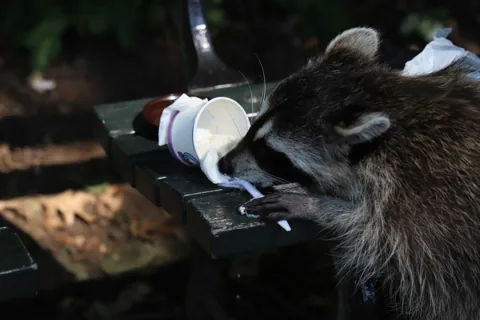 Raccoon
Procyon lotor
Raccoons are masked, ring-tailed mammals that adapt very well to towns and suburbs. They raid garbage and gardens, den in attics, chimneys and under decks, and can carry rabies and raccoon roundworm.
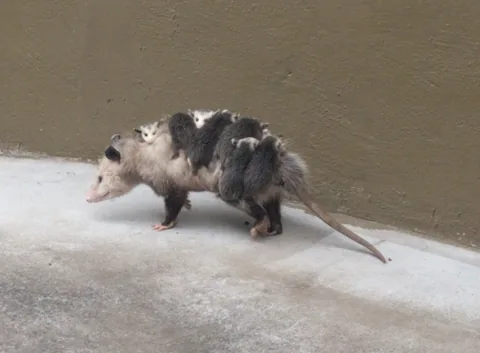 Virginia opossum
Didelphis virginiana
The Virginia opossum is North America's only marsupial, a cat-sized animal with a pointed face and a long, hairless tail. Around homes it raids pet food, garbage and fruit and dens under decks, sheds and houses.
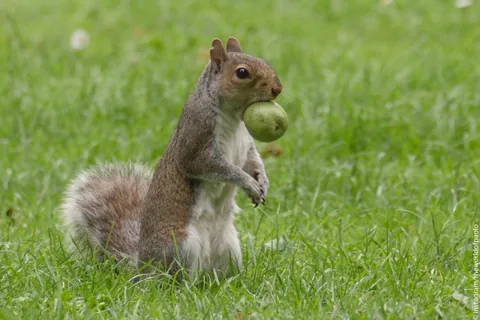 Tree squirrels (eastern gray and fox squirrels)
Sciurus species (shown: eastern gray squirrel, S. carolinensis)
Tree squirrels such as the eastern gray squirrel and fox squirrel are bushy-tailed, daytime rodents. Around homes they raid fruit, nuts and bird feeders, dig up lawns and gardens, and chew their way into attics.
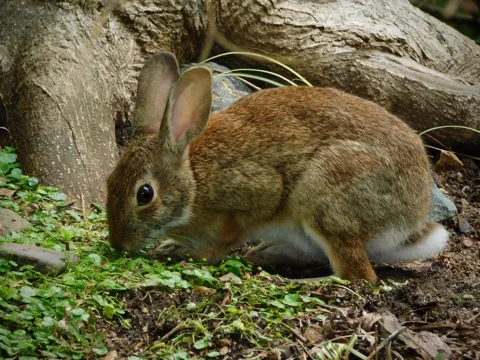 Rabbits (cottontails; eastern cottontail shown)
Sylvilagus species (shown: eastern cottontail, S. floridanus)
Cottontail rabbits are common in yards with brush and dense landscaping. They clip vegetables and flowers in spring and summer and gnaw the bark of young trees and shrubs in fall and winter.
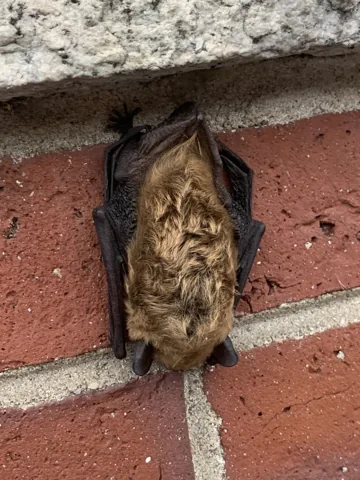 Bats (big brown bat and little brown bat)
Eptesicus fuscus and Myotis lucifugus (shown: big brown bat)
Bats are flying, insect-eating mammals that sometimes roost in attics, walls and other parts of buildings. They are valuable insect eaters, but colonies leave droppings, urine stains and odor.
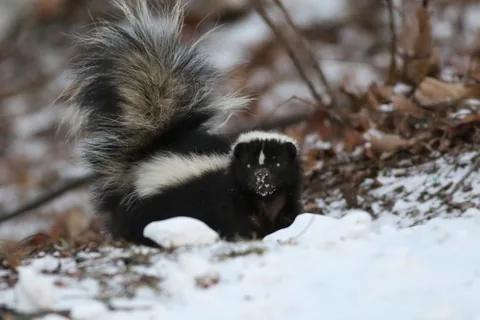 Striped skunk
Mephitis mephitis
The striped skunk is a cat-sized, black and white mammal that often lives under porches, decks and sheds. It digs lawns for grubs, sprays pets that corner it, and is one of the main wildlife carriers of rabies.
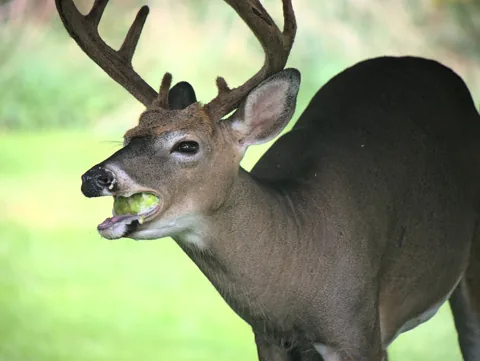 Deer (white-tailed deer shown; mule deer similar)
Odocoileus species (shown: white-tailed deer, O. virginianus; also mule deer, O. hemionus)
White-tailed and mule deer browse gardens, shrubs, young trees and flowers, often at dawn and dusk when no one sees them. Fencing is the most reliable fix, with repellents and plant choice helping in lighter cases.
What you probably found, and what's normal
New York's DEC says the young animals most often "kidnapped" by well-meaning people are fawns, cottontail rabbits and fledgling birds, because their normal behavior looks like abandonment. Here is what is normal for each, according to state wildlife agencies.[2]
- Fawn lying alone in grass: normal. New York's DEC says newborn fawns are hidden in tall grass or under bushes while the doe feeds, lie quietly without moving, and the doe returns to feed the fawn every 4-5 hours. Kentucky says lone fawns are not abandoned; unless the mother is dead nearby or the fawn is visibly injured, leave it alone.[2][1]
- Nest of baby rabbits in the lawn: normal. New York's DEC says the mother may only return at dawn and dusk to the shallow nest, covering the young with grass in between, and that cottontails are independent at only 4 weeks old; a small rabbit with its eyes open hopping outside the nest is likely independent. Kentucky says to leave a lone baby rabbit or a nest alone, as its mother is often nearby. Our rabbits in the garden page covers living with a nest in your yard.[2][1]
- Young bird on the ground with feathers: usually a fledgling, and normal. Kentucky says fledglings have feathers, hop on the ground and make short flights, rarely go back to the nest, and are fed by a parent nearby. Wisconsin DNR says songbirds leave the nest before their flight feathers are fully developed and cannot fly for several days.[1][4]
- Bird with no or few feathers that can't hop: a nestling that fell. Kentucky and Wisconsin DNR say to put it back in the nest. Wisconsin calls it a myth that parent birds won't return if humans have touched the young, and Indiana DNR says it is OK to gently return a fallen bird to its nest.[1][4][9]
- Baby squirrel on the ground: Wisconsin DNR says a very young squirrel with its eyes closed has probably fallen from its nest; put it back if it's safe, or leave it at the base of the nest tree on a soft cloth during daylight so the mother can retrieve it. Kentucky says mother squirrels may return to move their babies to a new nest. A squirrel about half adult size with a bushy tail is old enough to be on its own (Wisconsin DNR).[5][1]
- Raccoon kits: Wisconsin DNR says it is not uncommon for curious young raccoons to explore outside the den; if a kit has its eyes open and isn't in immediate danger, watch from a distance to see if it climbs back or its mother retrieves it. For a kit with eyes still closed, contact the DNR or a licensed rehabilitator before intervening. Kentucky says mother raccoons may leave young behind while they search for food.[6][1]
- Baby opossum alone: young opossums ride on the mother's back and sometimes fall off (Wisconsin DNR). The size cutoffs differ: Wisconsin DNR says one longer than 9 inches snout to rump, not counting the tail, is old enough to be independent and one less than 7 inches may need a licensed rehabilitator; Virginia's DWR says one at least 8 inches from nose to base of tail and over 7.25 ounces can survive on its own.[7][12]
- Bat: Wisconsin DNR says most bat pups are born in late May through June and fly and forage on their own 3 to 4 weeks after birth. UC IPM says a bat that flies into living space is usually a lost, young one trying to escape. See our found a bat in my house page before doing anything, because bats need rabies precautions.[8][15]
Does it really need help?
The test agencies use is simple: is it hurt, or has the parent really gone? Kentucky says that unless the parent was injured or killed, or the baby is injured, it should be left alone. Wisconsin DNR lists when to contact a wildlife rehabilitator.[1][3]
- It was caught or attacked by a cat, dog or another animal (Wisconsin DNR).[3]
- It is bleeding or looks injured: punctures, cuts or broken bones (Wisconsin DNR; Virginia DWR).[3][11]
- The parent is dead nearby, such as hit by a car, or has been trapped and moved away (Kentucky; Wisconsin DNR).[1][3]
- It is very thin, has diarrhea, or has flies, fly eggs or maggots on it (Wisconsin DNR).[3]
- It is still alone after you've waited. Indiana DNR says to lay strings or sticks across a nest and check back; if they are disturbed, the mother came back. New York's DEC gives the same leaves-or-sticks test for rabbit nests. Indiana says to call a rehabilitator if an adult does not return after several hours; Kentucky says to wait most of the day for a fallen nestling and a day for raccoon or skunk babies; Wisconsin DNR says a re-nested bird should be left alone unless the parent does not return within one hour.[9][2][1][4]
Safety first
Young wild animals can carry diseases that spread to people and pets, even when they look healthy (Wisconsin DNR; CDC). CDC says the best way to avoid rabies is to keep your distance from wildlife, and that raccoons, skunks, bats and foxes are common rabid animals in the United States.[3][17][18]
- Never handle a bat, skunk or raccoon barehanded. CDC says to avoid touching bats; Virginia DWR says not to try to rescue skunks or bats because they are high-risk animals, and Kentucky says not to approach or handle baby raccoons or skunks.[19][11][1]
- If you must move a hurt animal, Virginia DWR says to wear heavy gloves, handle it as little as possible and keep your hands away from its mouth, then place it in a ventilated cardboard box in a dark, quiet, warm place and not feed it. Never try to capture a sick or injured adult mammal (Virginia DWR).[11]
- Keep children away. CDC says to teach children never to handle unfamiliar animals and to supervise their handwashing; wash your hands with soap and running water after being outdoors.[17]
- If you are bitten or scratched, CDC says to wash the wound immediately with soap and water for 15 minutes and talk with a healthcare or public health professional about rabies; tell them what kind of animal it was. Contact your health department if you were exposed to an animal that might have rabies.[18][17]
- Raccoon droppings: CDC says raccoon roundworm spreads by swallowing eggs from raccoon feces, that most infections are in children, and that raccoon feces should be removed carefully. If you think you swallowed raccoon feces, seek medical attention right away.[20]
How to check without making things worse
Watch from far enough away that the parent will come back. New York's DEC says adult does may not approach while people are close by and to observe over a period of hours; Virginia DWR says a parent is sometimes close by, waiting for the human to leave.[2][11]
- Use the string or stick test on a rabbit nest or den opening and check back later (Indiana DNR; New York DEC).[9][2]
- Look for feathers and hopping: a feathered young bird that's alert and moving with parents nearby should be watched, not touched (New York DEC; Kentucky).[2][1]
- If you already picked up a fawn or baby rabbit the same day, Virginia DWR says it can often go back where it was found: parents stay in the area for at least a day, so put it back as close as possible to the spot, move at least 50 yards away and watch until dusk.[11]
- Don't feed it or give it water. Wisconsin DNR says young wild animals need a specific diet and human food can do more harm than good; Virginia DWR says not to feed it.[3][11]
What to do next
If it truly needs help, call a licensed or permitted wildlife rehabilitator. Your state wildlife agency keeps the list: New York's DEC says to call its regional wildlife office, Indiana and Kentucky publish permitted rehabilitator lists, and Virginia runs a wildlife conflict helpline. Wisconsin DNR notes its own staff are not licensed to care for wild animals.[2][10][1][11][3]
- Don't keep or raise it. New York's DEC says keeping young wildlife as pets is illegal; Kentucky says it is illegal to remove wildlife from the wild unless you are a permitted rehabilitator; Wisconsin DNR says most wild animals are protected under state and federal laws. CDC also says wildlife should never be kept as pets.[2][1][3][17]
- Move fast if you do pick it up. Wisconsin DNR says its rules let a person possess a wild animal for up to 24 hours to transfer it to a licensed rehabilitator or veterinarian; Indiana DNR says a rescued animal must be given to a permitted rehabilitator within twenty-four (24) hours. Rules vary by state, so ask your own state wildlife agency.[3][10]
- Fawns may have extra rules. Kentucky says rehabilitators cannot take fawns from counties in a chronic wasting disease surveillance zone, and Indiana prohibits moving deer out of its CWD positive area.[1][10]
- Babies in your attic, eaves or chimney: wait for the family to leave before you seal anything. Wisconsin DNR says a mother raccoon will usually move her kits to another den one at a time over several nights if the space is made less appealing, and to close entry points or cap the chimney after the entire family has left. ICWDM says raccoons often raise young in uncapped chimneys and that anyone excluding raccoons in spring and summer should expect young to be present; UC IPM warns against leaving young behind to starve. Our raccoons in the attic and squirrels in the attic pages give the full steps.[6][16][14]
- Bats with pups: the windows differ. New Jersey's wildlife agency says no exclusions from May 1st to July 31st, when young may be present; CDC says to be careful not to trap young bats inside if you are bat-proofing between May and August.[13][19]
When to call a pro
For a baby animal outdoors, the right call is a licensed wildlife rehabilitator, not a pest control company (New York DEC; Wisconsin DNR). New York says rehabilitators are the only people legally allowed to receive and treat distressed wildlife.[2][3]
- Call a wildlife control professional when animals are raising young inside your house and you need them removed. UC IPM says a professional can tell whether a trapped female is nursing young, which matters so young aren't left behind to starve.[14]
- Call your health department or a doctor, not a rehabilitator, if anyone may have been bitten or scratched, or touched a bat (CDC).[18][19]
- Report a raccoon or skunk acting strangely or looking ill to your state wildlife agency; Kentucky asks people to call its information center.[1]
Common questions
- Will the mother reject a baby if I touched it?
- For birds, no. Wisconsin DNR says it is a myth that parent birds won't return to young that humans touched, and Indiana DNR says it is OK to gently return a fallen bird to its nest. For mammals, keep handling to a minimum: Virginia DWR says human contact should always be kept to a minimum, and CDC says getting too close can cause some animals to abandon their young.[4][9][11][17]
- Can I raise a baby squirrel or rabbit myself?
- No. Kentucky says raising baby squirrels, rabbits, raccoons and skunks yourself is illegal and they may not adapt when returned to the wild; New York's DEC says it is illegal to keep young wildlife as pets and many "rescued" animals die despite people's best efforts.[1][2]
- How long should I wait before calling for help?
- It depends on the animal. A doe returns every 4-5 hours (New York DEC) and a mother rabbit may come only at dawn and dusk (New York DEC); Indiana DNR says to call if no adult returns after several hours; Kentucky says to wait a day for baby raccoons or skunks. Call right away if it is injured or was caught by a pet (Wisconsin DNR).[2][9][1][3]
- There are baby animals in my chimney. Can I just seal it?
- No. Wait until the whole family has left, then cap the chimney (Wisconsin DNR). ICWDM says raccoons often raise young on the smoke shelf of uncapped chimneys, and UC IPM warns that young can be left behind to starve.[6][16][14]
Photo credits
- Raccoon: (c) Steven Bodzin, some rights reserved (CC BY) — via iNaturalist, CC BY 4.0
- Virginia opossum: (c) Millie Basden, some rights reserved (CC BY) — via iNaturalist, CC BY 4.0
- Tree squirrels (eastern gray and fox squirrels): (c) Paolo Zucca, some rights reserved (CC BY) — via iNaturalist, CC BY 4.0
- Rabbits (cottontails; eastern cottontail shown): (c) Michael J. Papay, some rights reserved (CC BY) — via iNaturalist, CC BY 4.0
- Bats (big brown bat and little brown bat): (c) Thomas Irvine, some rights reserved (CC BY) — via iNaturalist, CC BY 4.0
- Striped skunk: (c) Richard Poort, some rights reserved (CC BY) — via iNaturalist, CC BY 4.0
- Deer (white-tailed deer shown; mule deer similar): (c) Blake Ross, some rights reserved (CC BY) — via iNaturalist, CC BY 4.0
Sources
- Kentucky Department of Fish and Wildlife Resources, “Injured and Orphaned Wildlife.” fw.ky.gov/Wildlife/Pages/Injured-and-Orphaned-Wildlife.aspx (accessed 2026-11-14)
- New York State Department of Environmental Conservation, “Care of Young Wildlife (If You Care, Leave It There).” www.dec.ny.gov/animals/6956.html (accessed 2026-11-14)
- Wisconsin Department of Natural Resources, “Keep Wildlife Wild.” dnr.wisconsin.gov/topic/WildlifeHabitat/orphan (accessed 2026-11-14)
- Wisconsin Department of Natural Resources, “Songbird (Keep Wildlife Wild).” dnr.wisconsin.gov/topic/WildlifeHabitat/orphan/Songbird (accessed 2026-11-14)
- Wisconsin Department of Natural Resources, “Squirrel (Keep Wildlife Wild).” dnr.wisconsin.gov/topic/WildlifeHabitat/orphan/Squirrel (accessed 2026-11-14)
- Wisconsin Department of Natural Resources, “Raccoon (Keep Wildlife Wild).” dnr.wisconsin.gov/topic/WildlifeHabitat/orphan/Raccoon (accessed 2026-11-14)
- Wisconsin Department of Natural Resources, “Opossum (Keep Wildlife Wild).” dnr.wisconsin.gov/topic/WildlifeHabitat/orphan/Opossum (accessed 2026-11-14)
- Wisconsin Department of Natural Resources, “Bat (Keep Wildlife Wild).” dnr.wisconsin.gov/topic/WildlifeHabitat/orphan/Bat (accessed 2026-11-14)
- Indiana Department of Natural Resources (IN.gov FAQ), “What should I do if I find an injured or baby animal?.” faqs.in.gov/hc/en-us/articles/115005069947-What-should-I-do-if-I-find-an-injured-or-baby-animal (accessed 2026-11-14)
- Indiana Department of Natural Resources, Division of Fish and Wildlife, “Indiana DNR Permitted Wildlife Rehabilitators.” www.in.gov/dnr/fish-and-wildlife/wildlife-resources/orphaned-and-injured-animals/wildlife-rehabilitators/ (accessed 2026-11-14)
- Virginia Department of Wildlife Resources, “Injured & Orphaned Wildlife.” dwr.virginia.gov/wildlife/injured/ (accessed 2026-11-14)
- Virginia Department of Wildlife Resources, “Opossums (Injured & Orphaned Wildlife).” dwr.virginia.gov/wildlife/injured/opossums/ (accessed 2026-11-14)
- New Jersey Division of Fish and Wildlife, Endangered and Nongame Species Program, “Nuisance Wildlife Control Guidelines for Bats.” nj.gov/dep/fgw/ensp/pdf/bat_control.pdf (accessed 2026-11-14)
- University of California Statewide IPM Program, “Raccoons (Pest Notes).” ipm.ucanr.edu/home-and-landscape/raccoons/ (accessed 2026-11-14)
- University of California Statewide IPM Program, “Bats (Pest Notes).” ipm.ucanr.edu/home-and-landscape/bats/ (accessed 2026-11-14)
- Internet Center for Wildlife Damage Management, “Raccoon Damage Prevention and Control Methods.” icwdm.org/species/carnivores/raccoons/raccoon-damage-prevention-and-control-methods/ (accessed 2026-11-14)
- Centers for Disease Control and Prevention, “Wildlife (Healthy Pets, Healthy People).” www.cdc.gov/healthy-pets/about/wildlife.html (accessed 2026-11-14)
- Centers for Disease Control and Prevention, “Rabies Prevention and Control.” www.cdc.gov/rabies/prevention/index.html (accessed 2026-11-14)
- Centers for Disease Control and Prevention, “Preventing Rabies from Bats.” www.cdc.gov/rabies/exposure/animals/bats.html (accessed 2026-11-14)
- Centers for Disease Control and Prevention, “About Raccoon Roundworm.” www.cdc.gov/baylisascaris/about/index.html (accessed 2026-11-14)