The short answer
- It's most likely a skunk, opossum, raccoon, groundhog, fox or rat. Tracks, the size of the hole and the time of day it's active usually tell you which. Don't reach in or try to handle it: Texas health officials say not to handle any wildlife, whether it looks healthy or sick.[6][4][9][10][12][18]
- Next, find out if it's still living there. Sprinkle a thin layer of flour in front of the hole or stuff the hole loosely with newspaper. Wildlife Illinois says that if there are no tracks and the paper hasn't moved after two or three days, it's safe to close the opening.[21][1]
- Never seal the hole while an animal or its young may be inside. Wildlife Illinois puts the breeding season at March through late July, and Penn State says skunk dens sealed from early May to mid-August can trap the young inside. Once everything is out, screen the space with hardware cloth buried and bent outward at the bottom.[21][2][6]
Related profiles on this site
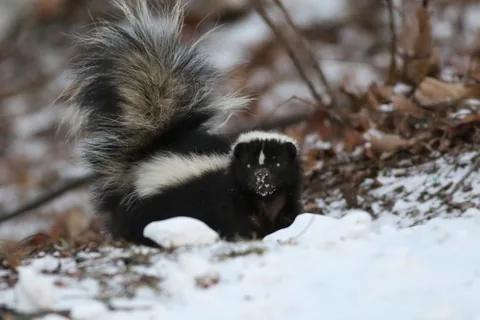 Striped skunk
Mephitis mephitis
The striped skunk is a cat-sized, black and white mammal that often lives under porches, decks and sheds. It digs lawns for grubs, sprays pets that corner it, and is one of the main wildlife carriers of rabies.
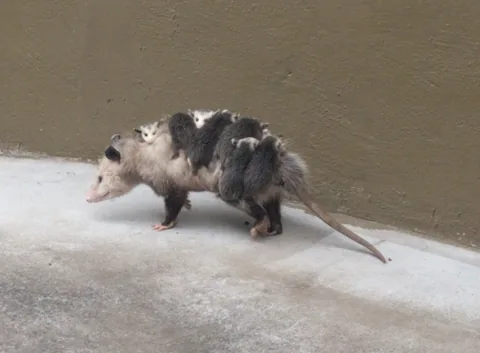 Virginia opossum
Didelphis virginiana
The Virginia opossum is North America's only marsupial, a cat-sized animal with a pointed face and a long, hairless tail. Around homes it raids pet food, garbage and fruit and dens under decks, sheds and houses.
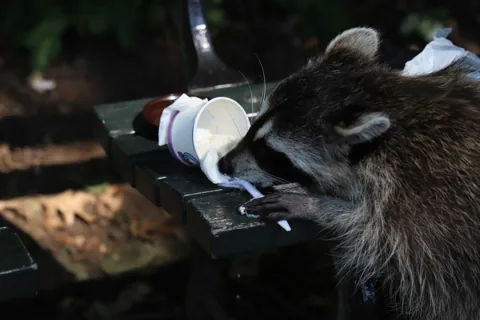 Raccoon
Procyon lotor
Raccoons are masked, ring-tailed mammals that adapt very well to towns and suburbs. They raid garbage and gardens, den in attics, chimneys and under decks, and can carry rabies and raccoon roundworm.
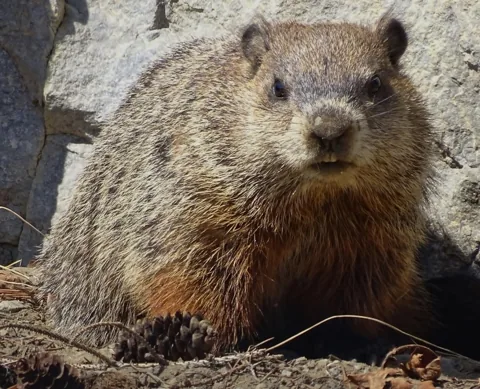 Groundhog (woodchuck)
Marmota monax
The groundhog, or woodchuck, is a burrowing member of the squirrel family found across eastern and central North America. It feeds on garden vegetables and clover by day and digs extensive burrows that can undermine foundations, sidewalks and pools.
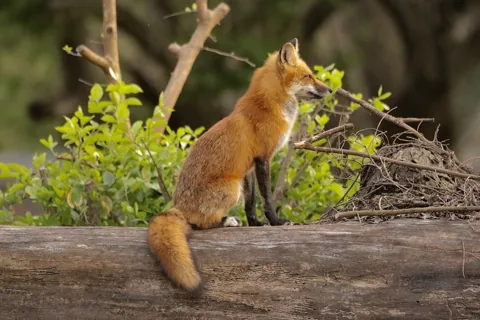 Red Fox
Vulpes vulpes
The red fox is the most common native fox in North America and has established breeding populations in many towns and cities, where most problems involve dens under decks and sheds and raids on poultry or small livestock.
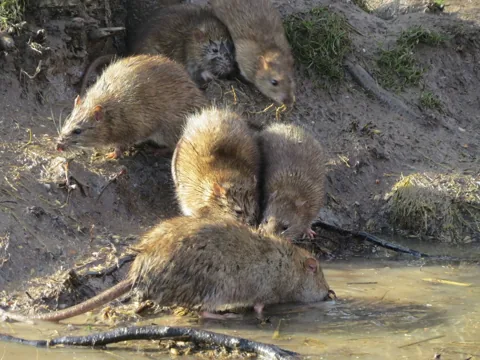 Norway Rat
Rattus norvegicus
The Norway rat, also called the brown or sewer rat, is a large, burrowing rat found throughout the contiguous United States wherever people live.
Who's under there? Clues for each animal
Most of these animals are out at night, so you'll usually go by sign. The vs pages linked below cover the raccoon, opossum and skunk split in much more detail.[6][1][4]
- Skunk: active at dawn, dusk and night. Musky odor is the usual clue, along with small cone-shaped holes in the lawn where it dug for grubs. UC IPM says skunks den under buildings and that you may smell them in late winter, when males spray while fighting over females.[1][2]
- Opossum: nocturnal, about the size of a house cat, with a pointed face and a long, nearly hairless tail. UC IPM says it lives under decks and in garden sheds in towns and cities, and that a cornered opossum may hiss, growl and show its teeth.[4]
- Raccoon: nocturnal, with handlike front paws and long, flexible toes, and it often dens beneath decks in backyards. UC IPM says tracks and droppings can give away its visits.[6]
- Groundhog (woodchuck): the one that digs a real burrow. Penn State gives the entrance as 10 to 12 inches across and says burrows are often near building foundations. Connecticut's wildlife agency says woodchucks are commonly seen in early morning or late afternoon in warm months and hibernate in winter.[7][9]
- Red fox: Connecticut's wildlife agency says foxes commonly den in the crawl space under decks and sheds and are best told by a reddish coat, black legs and ears, and a long white-tipped tail. ICWDM notes foxes are often drawn to rodents living in crawl spaces and sheds.[10][11]
- Norway rat: UC IPM says this burrowing rat digs along building foundations and beneath trash piles and woodpiles. UC IPM also lists gnawed fruit or nuts in the yard as a sign of rats.[12]
Is it still under there?
Wildlife Illinois says many den animals are active from dusk through dawn, so you probably won't see them come and go. Two simple tests show whether a site is still in use.[21]
- Flour tracking patch: UC IPM says to sprinkle a smooth layer of flour about 1/8 inch thick in front of the entrance and check it soon after dark; footprints mean the animal has gone out for the night. Penn State suggests a patch about 2 feet around. The prints also help you tell which animal it is.[1][4][2]
- Loose newspaper: Wildlife Illinois says to stuff the hole loosely with several sheets of newspaper. If tracks show up or the paper is pushed out, an animal is likely still using the site; if nothing changes after two or three days, it's safe to make repairs.[21]
- Groundhog burrows: Penn State and ICWDM both plug burrow openings with crumpled newspaper packed with loose soil. ICWDM notes that a closed burrow is sometimes reopened by another animal moving in.[7][8]
Spring and summer: there may be babies
Wildlife Illinois warns that sealing an animal in makes it do more damage trying to get out or reach its young, and an animal that dies inside will smell. It suggests doing repairs before the breeding season, March through late July.[21]
- Skunks: Penn State says older females have young in early May and yearlings in early June, and that burrows sealed from early May to mid-August may trap young skunks. UC IPM says a one-way door won't help if the kits can't walk yet.[2][1]
- Raccoons: UC IPM says young are generally born in April or May.[6]
- Groundhogs: Connecticut's wildlife agency says young are born in April or May and start foraging outside the den at 5 to 6 weeks old. ICWDM says complaints rise in July as the young spread out to find their own territories.[9][8]
- Foxes: Connecticut's wildlife agency says pups stay in the den until about 4 to 5 weeks old, then come out and play near the entrance, and that most foxes have more than one den and will move their young if disturbed.[10]
- What to do: for maternity dens of skunks, raccoons, squirrels and groundhogs, the Pennsylvania Game Commission says to let the young leave, noting that waiting until fall is a good bet, then block access to the den.[13]
One-way door, then close it for good
Once you know the young are out and moving, use a one-way door so the last animal can leave but can't get back in. Then screen the whole space so nothing else moves in.[1][21]
- One-way door: UC IPM describes a gate of 1/2-inch hardware cloth hinged at the top and loose on the other three sides, made larger than the opening so it can only swing outward. The animal pushes it open to leave but can't push it inward to get back in.[1]
- Screen and bury: UC IPM's raccoon guide says to screen the space under porches, decks and sheds with 10-gauge 1/4- or 1/3-inch galvanized hardware mesh, with the bottom edge buried at least 6 inches deep, run 12 inches outward and covered with soil. It says this also keeps out skunks, opossums, squirrels and rats.[6]
- How deep: sources differ. Penn State says to bury the lowest foot of fencing with the bottom 6 inches bent 90 degrees outward. ICWDM says 2 inches deep with mesh extending at least 12 inches outward for skunks, and a 12- to 18-inch skirt for opossums, adding that deeper burial isn't needed to keep opossums out.[2][3][5]
- Smaller mesh: UC IPM says 1/4-inch hardware cloth has the advantage of also keeping out rats and house mice.[4]
- Take away the draw: ICWDM says decks and outbuildings with crawl spaces should be secured to keep foxes from denning, and that controlling rodents may be needed because rodents attract foxes.[11]
Safety for you and your pets
- Don't handle it. Texas health officials say not to handle any wildlife, whether it seems healthy or sick, and list coyotes, foxes, bats, skunks and raccoons seen in the daytime when you don't usually see them as a warning sign.[18]
- CDC names bats, skunks, raccoons and foxes among the main wild animals that carry rabies in the US, and says it spreads mainly through bites or scratches.[16]
- If you're bitten or scratched, CDC says to wash the wound right away with soap and water for 15 minutes and contact your health department immediately.[17]
- Raccoon droppings can carry raccoon roundworm. CDC says to avoid contact with raccoons and their feces and to keep sandboxes covered, since raccoons may use them as latrines.[19]
- Pets: the Merck Veterinary Manual says a currently vaccinated pet exposed to a possibly rabid animal should get wound care, be revaccinated immediately and be watched closely for 45 days. Call your veterinarian if your dog or cat tangles with one.[20]
Trapping and relocating: check your state
Moving a trapped animal somewhere else is often illegal. A few state rules from the agencies themselves:[13][14]
- Pennsylvania: the Game Commission says skunks, raccoons, groundhogs, foxes, bats and coyotes are rabies vector species and should not be relocated, and landowners should contact their region office before trapping nuisance wildlife.[13]
- New York: DEC says it is illegal to move an animal off your property, and a live-trapped animal can't be released in a park, on State land or anywhere other than where it was caught.[14]
- California: UC IPM says state regulations prohibit relocating skunks and other wildlife without written permission from the Department of Fish and Wildlife.[1]
- Missouri: the Department of Conservation says you or someone acting for you may trap most wildlife damaging your property without a permit, and to contact a county conservation agent for some species or if a foothold or body-gripping trap is needed.[15]
When to call a wildlife professional
- If you have no experience trapping skunks, UC IPM says to hire a professional wildlife control operator, who has the equipment and is much less likely to get sprayed.[1]
- New York DEC says to contact a Nuisance Wildlife Control Operator if you need a wild animal removed from your property.[14]
- UC IPM notes that kits too young to walk out through a one-way door may have to be removed by other means.[1]
- If the animal acts sick or bites someone or a pet, call your health department. CDC says to contact it right away after a possible rabies exposure.[17]
Common questions
- Can I just block the hole tonight?
- Only if you're sure nothing is inside. Wildlife Illinois says to check with flour or loose newspaper for two or three days first, and to avoid repairs during the March to late July breeding season that could trap young.[21]
- Can I trap it and let it go in the woods?
- Usually not. New York DEC says it's illegal to move an animal off your property, Pennsylvania's Game Commission says rabies vector species shouldn't be relocated, and California requires written permission from the Department of Fish and Wildlife.[14][13][1]
- What mesh should I use around the deck?
- UC IPM recommends galvanized hardware mesh of 1/4 or 1/3 inch, buried and bent outward at the bottom; 1/4-inch also keeps out rats and mice.[6][4]
Photo credits
- Striped skunk: (c) Richard Poort, some rights reserved (CC BY) — via iNaturalist, CC BY 4.0
- Virginia opossum: (c) Millie Basden, some rights reserved (CC BY) — via iNaturalist, CC BY 4.0
- Raccoon: (c) Steven Bodzin, some rights reserved (CC BY) — via iNaturalist, CC BY 4.0
- Groundhog (woodchuck): (c) cornwallcen, some rights reserved (CC BY) — via iNaturalist, CC BY 4.0
- Red Fox: (c) Rev. Lee A. Payne, Jr., some rights reserved (CC BY) — via iNaturalist, CC BY 4.0
- Norway Rat: petehawkins, public domain (CC0), via iNaturalist
Sources
- University of California Statewide IPM Program, “Skunks (Pest Notes).” ipm.ucanr.edu/home-and-landscape/skunks/ (accessed 2026-11-14)
- Penn State Extension, “Skunks - Solutions to Common Problems.” extension.psu.edu/skunks (accessed 2026-11-14)
- Internet Center for Wildlife Damage Management, “Skunk Damage Prevention and Control Methods.” icwdm.org/species/carnivores/skunks/skunk-damage-prevention-and-control-methods/ (accessed 2026-11-14)
- University of California Statewide IPM Program, “Pest Notes: Opossum (Publication 74123).” ipm.ucanr.edu/home-and-landscape/opossum/ (accessed 2026-11-14)
- Internet Center for Wildlife Damage Management, “Opossum Damage Prevention and Control Methods.” icwdm.org/species/other-mammals/opossums/opossum-damage-prevention-and-control-methods/ (accessed 2026-11-14)
- University of California Statewide IPM Program, “Pest Notes: Raccoons.” ipm.ucanr.edu/home-and-landscape/raccoons/ (accessed 2026-11-14)
- Penn State Extension, “Woodchucks (wildlife damage control fact sheet).” extension.psu.edu/woodchucks (accessed 2026-11-14)
- Internet Center for Wildlife Damage Management, “Woodchuck Damage Prevention and Control Methods.” icwdm.org/species/rodents/woodchucks/woodchuck-damage-prevention-and-control-methods/ (accessed 2026-11-14)
- Connecticut Department of Energy and Environmental Protection, “Woodchuck (fact sheet, rev. 6/22).” portal.ct.gov/deep/wildlife/fact-sheets/woodchuck (accessed 2026-11-14)
- Connecticut Department of Energy and Environmental Protection, “Red Fox (Wildlife Fact Sheet).” portal.ct.gov/deep/wildlife/fact-sheets/red-fox (accessed 2026-11-14)
- Internet Center for Wildlife Damage Management, “Fox Damage Prevention and Control Methods.” icwdm.org/species/carnivores/foxes/fox-damage-prevention-and-control-methods/ (accessed 2026-11-14)
- University of California Statewide IPM Program, “Rats (Pest Notes, Home and Landscape).” ipm.ucanr.edu/home-and-landscape/rats/ (accessed 2026-11-14)
- Pennsylvania Game Commission, “Nuisance Wildlife.” www.pa.gov/agencies/pgc/wildlife/nuisance-wildlife.html (accessed 2026-11-14)
- New York State Department of Environmental Conservation, “Remove or "Take" Nuisance Animals Legally.” dec.ny.gov/nature/animals-fish-plants/nuisance-wildlife-species/remove-take-legally (accessed 2026-11-14)
- Missouri Department of Conservation, “Wildlife Control Guidelines.” mdc.mo.gov/wildlife/nuisance-problem-species/wildlife-control-guidelines (accessed 2026-11-14)
- U.S. Centers for Disease Control and Prevention, “About Rabies.” www.cdc.gov/rabies/about/index.html (accessed 2026-11-14)
- U.S. Centers for Disease Control and Prevention, “Rabies Prevention and Control.” www.cdc.gov/rabies/prevention/index.html (accessed 2026-11-14)
- Texas Department of State Health Services, “Rabies.” www.dshs.texas.gov/rabies (accessed 2026-11-14)
- Centers for Disease Control and Prevention, “Preventing Raccoon Roundworm.” www.cdc.gov/baylisascaris/prevention/index.html (accessed 2026-11-14)
- Merck Veterinary Manual, “Rabies in Animals.” www.merckvetmanual.com/nervous-system/rabies/rabies-in-animals (accessed 2026-11-14)
- Wildlife Illinois (Illinois Department of Natural Resources and University of Illinois Extension), “Repairing Damage: What to Know.” wildlifeillinois.org/repairing-damage-what-to-know/ (accessed 2026-11-14)