The short answer
- Size: a coyote looks like a small German shepherd dog and weighs roughly 20 to 45 pounds. A red fox weighs 8 to 15 pounds, about the size of a small dog, and a gray fox 7 to 13 pounds.[1][4][9][5][11][16][19]
- Tail tip and legs: a red fox has black legs and a white-tipped tail. A coyote's bushy tail has a black tip, and the gray fox's tail also ends in black, so a black tip alone does not rule out a fox.[11][15][17][1][4][18]
- Color and build: a gray fox is salt-and-pepper gray with rusty sides of the neck and legs, short legs and a short muzzle, and it can climb trees. A coyote is usually a brown-gray blend, larger and longer-legged than either fox.[11][20][15][18][1][4]
Animals on this page
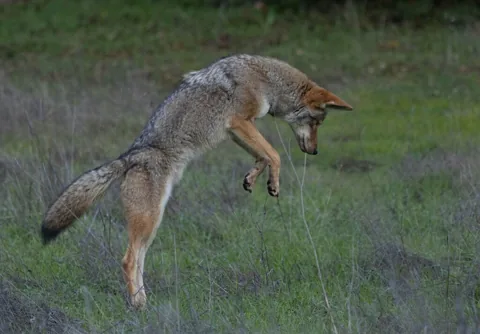 Coyote
Canis latrans
Coyotes are wild members of the dog family that now live in towns and suburbs as well as open country. Most avoid people, but coyotes that find easy food around homes can lose their wariness and start taking pets. What you can legally do about a problem coyote depends on your state.
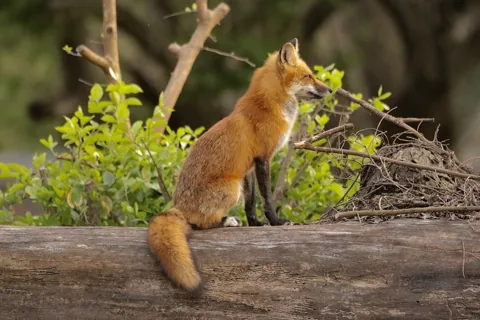 Red Fox
Vulpes vulpes
The red fox is the most common native fox in North America and has established breeding populations in many towns and cities, where most problems involve dens under decks and sheds and raids on poultry or small livestock.
Side by side
There are two common foxes in most of the US. The red fox is the most common fox native to North America and is behind most fox losses of poultry and livestock; the gray fox lives in the eastern, north-central and southwestern US and spends more time in wooded areas. UC IPM says coyotes can live in almost any habitat in California, including residential neighborhoods and parks, and Wildlife Illinois finds them in rural, suburban and highly urban areas.[11][20][4][8]
- Weight: ICWDM gives western male coyotes 25 to 45 pounds and females 22 to 35, with eastern coyotes larger (males averaging 45 pounds, females 30). UC IPM gives California males 20 to 35 lbs and females 18 to 25 lbs, Missouri Department of Conservation 18 to 30 pounds, and New York DEC 35 to 45 pounds for eastern coyotes.[1][4][10][5]
- Weight of foxes: red foxes weigh 8 to 15 pounds (ICWDM, New York DEC); Connecticut DEEP gives 7 to 15 pounds and NC Wildlife 7.7 to 15.4 pounds. Gray foxes weigh 7 to 13 pounds per ICWDM; NC Wildlife says adults may weigh as much as a red fox but look smaller because of shorter legs and fur.[11][16][15][19][20]
- Length and height: a coyote is 4 to 5 feet from nose to tail per New York DEC (Missouri gives 39 to 54 inches) and stands about 18 inches at the shoulder. A red fox is 36 to 43 inches long per New York DEC and 39 to 43 inches per Connecticut DEEP; ICWDM gives a wider 34 to 62 inches.[5][10][4][16][15][11]
- Coat: coyotes are usually rust-colored to brown to gray, often brown-gray with a light gray or cream belly, but color varies from nearly black to red to nearly white. Red foxes are light orange-red with black legs and lighter under-fur; silver, black and cross foxes are color phases of the red fox and keep the white tail tip and dark feet. Gray foxes are salt-and-pepper gray with rusty yellow on the sides of the neck, backs of the ears, legs and feet.[4][1][11][15][19]
- Tail: the coyote's tail is bushy and black-tipped and is usually carried pointing down. The red fox's tail is white-tipped and proportionally longer than a coyote's; New York DEC says it makes up nearly half the fox's length, and Connecticut DEEP says a running red fox holds it out horizontally. The gray fox's tail has a dark streak along the top and a black tip, and Missouri notes it is triangular in cross section rather than round.[1][5][11][15][16][20][18][17]
- Head: both have pointed, upright ears. The coyote has a long, narrow snout; the red fox an elongated, pointed muzzle with blackish backs of the ears; the gray fox a shorter muzzle and shorter ears than the red fox.[4][1][17][15]
- Tracks: a coyote's front track is 2½ to 3 inches long per ICWDM (Missouri gives 2½ inches), oval, with the two middle claw marks close together. A red fox's front track is 2 to 2¼ inches, and foot hair can blur the pad marks; a gray fox's front track is about 2 inches and looks dainty.[1][10][17][18]
- Stride: ICWDM gives a trotting coyote's stride as 16 to 18 inches, and Missouri gives 18 to 22 inches when walking. Missouri gives 8 to 15 inches for a trotting red fox and 9 to 16 inches for a gray fox.[2][10][17][18]
- Sounds: coyotes bark and give a flat howl, plus yips, warbles and a laugh-like call, and two coyotes howling together can sound like many more. Foxes bark, scream, howl, yap and make hiccup-like sounds, and in winter male red foxes give a yelling bark; Connecticut DEEP describes short, sharp yaps and barks as well as screeches, yells and long howls.[1][10][5][11][15]
- Dens and young: coyote pups are born in March and April in California and April to mid-May in Colorado, in litters of 4 to 7 per UC IPM. Red fox litters average 4 or 5 pups, and Connecticut DEEP says it is common for foxes to den in the crawl space under decks and sheds. Missouri says coyotes often remodel the dens of foxes, skunks, woodchucks or badgers.[4][7][15][10]
- Activity: both can be out by day. Coyotes are most active at dawn and dusk and after dark but are often seen in daylight; red foxes hunt mostly at dawn and dusk, and it is not unusual to see them during the day.[7][5][8][15][12]
- Climbing: the gray fox readily climbs trees, grasping the trunk with its front feet, and suns, feeds and takes refuge in trees.[18]
How to confirm which one it is
Use a trail camera. ICWDM says foxes are easy to detect with commercially available trail cameras even when they leave no physical sign. A clear frame of the tail tip and legs answers the question fastest.[13]
- Look at tracks in mud or snow. Coyote tracks are oval and about the size and shape of an egg, and coyotes often step in their own prints in a fairly straight line. Domestic dog trails tend to meander and zigzag, while wild canid trails tend to run straight.[10][11][1]
- Watch where it goes. A fox-sized animal that runs up a tree is almost certainly a gray fox, which Missouri says readily climbs trees.[18]
- Check scat on trails. Coyote scat is tubular, segmented and tapered at one end, and it often holds fur, bone, feathers or fruit; coyotes leave it along trails and at intersections to mark territory.[1][5]
- If you find a dead chicken or lamb, look quickly. ICWDM says foxes often carry prey to a den and bury uneaten parts, and they also scavenge, so the cause of death gets hard to read if the carcass is not found soon. Coyotes, foxes and other predators usually feed at the flanks or behind the ribs and eat the organs first.[13][2]
- Ask your state wildlife agency. Colorado Parks and Wildlife's district wildlife managers meet with homeowner associations, and Wildlife Illinois advises alerting neighbors and the local municipality as soon as a coyote problem develops.[7][8]
Why it matters
Pets: coyotes prey on cats and small dogs in urban and suburban areas, and New York DEC says incidents involving pets were the most common coyote issue reported in the state. ICWDM says fox attacks on small dogs, under 10 pounds, are infrequent in urban and suburban areas.[4][5][13]
- Poultry and livestock: foxes take ducks, chickens, rabbits and young lambs but generally leave larger livestock alone. Coyotes take poultry, sheep and goats, and some learn to kill livestock and pets and keep doing it until something changes.[15][4]
- People: Connecticut DEEP says healthy foxes pose virtually no danger to humans, and ICWDM says healthy foxes generally are not dangerous. Coyotes normally avoid people, but some in neighborhoods lose their fear; New York DEC says they seldom approach or act aggressively toward people directly.[15][13][4][5]
- Fences: a 5-foot wire-mesh fence with openings of 3 inches or less, buried with an apron, is ICWDM's design for keeping out red foxes. ICWDM says most coyotes readily cross over, under or through ordinary livestock and residential fences, so a fence that stops a fox may not stop a coyote.[14][3]
- Legal status: ICWDM says foxes are protected fur-bearers or game animals in most states, and coyote status varies from year-round predator in most western states to game, fur-bearer or protected in some eastern states. Check your state's rules before trapping or removing either one.[11][1]
If it's a coyote
Remove food. Secure garbage in containers with tight lids and put it out the morning of pickup, and remove pet food, food scraps and unsecured compost.[9]
- Keep cats indoors and supervise pets outside, especially at dawn and dusk; keep dogs on a short leash, and if a dog must stay outside, use a fully enclosed kennel.[7][8][9]
- Haze it if it comes close: do not run or turn your back, stand tall, yell, wave your arms and throw objects toward it. If it does not leave, face it and back away slowly.[7][8]
- Expect more defensive behavior around dens. NC Wildlife says coyotes mate around February to March and give birth April to May, and that hazing is not always productive when a coyote is defending a den; avoid that area until pup season is over.[9]
- For more on hazing, pets, children and reporting, see our coyotes in neighborhoods guide.[7][6]
If it's a fox
Often you can leave it alone. Connecticut DEEP says the mere presence of a fox should not be seen as a problem and that foxes need not be feared.[15]
- Never feed foxes, feed pets indoors, pick up fallen fruit and bird seed, and store garbage in animal-proof containers in a garage or shed.[15]
- Protect poultry at night, when most predation happens, with pens or coops closed from above and below; foxes dig or squeeze under poorly kept fences and may climb small ones.[15][14]
- Use frightening techniques: loud noises, bright lights or water from a hose. Disturbing a den in spring, physically or with odors, may make the foxes move.[15]
- Most foxes keep more than one den and will move their young if disturbed, and pups leave the den with the adults at about 12 weeks.[15]
Rabies and sick-looking animals
CDC says the animals most often found with rabies in the US are bats, skunks, raccoons and foxes.[21]
- Texas DSHS lists a change in behavior, wild animals that seem friendly or tame, and night animals such as foxes seen in the daytime as possible signs of rabies, and says a biting fox or coyote must be tested for rabies. Daytime activity alone is not proof: New York DEC and Connecticut DEEP say healthy coyotes and red foxes are often seen by day.[23][5][15]
- If a coyote or fox bites or scratches you, CDC says to wash the wound with soap and water for 15 minutes and contact your health department or a healthcare provider right away; rabies is preventable with prompt post-exposure care.[22]
Pets and rabies
The Merck Veterinary Manual says rabid foxes and coyotes often invade yards or even enter houses and attack dogs, and that rabid foxes in suburban areas may attack pets.[24]
- Merck lists rabies vaccination of cats and dogs as a core part of preventing rabies in animals; ask your veterinarian whether your pets are current.[24]
Common questions
- Is it a coyote or a fox if the tail has a black tip?
- It could be either a coyote or a gray fox; both have black-tipped tails. A red fox's tail tip is white. Size settles it: a gray fox weighs about 7 to 13 pounds, a coyote roughly 18 to 45 pounds depending on region.[1][11][4][18]
- Can a red fox be black or silver?
- Yes. Silver, black and cross foxes are color phases of the red fox. Connecticut DEEP says they always keep the white-tipped tail and dark feet, which also separates them from a dark coyote.[11][15]
- What is the small gray fox-like animal in a tree?
- Almost certainly a gray fox. Missouri Department of Conservation says it readily climbs trees, gripping the trunk with its front feet and pushing with its hind feet.[18]
- Do coyotes kill foxes?
- Yes. ICWDM says coyotes compete with and kill foxes, and New York DEC says red foxes tend to avoid coyote territories or live at their edges. NC Wildlife says the gray fox appears to be faring better than the red fox where coyotes have spread.[11][16][20]
- Is a fox or coyote out in the daytime rabid?
- Not necessarily. New York DEC says seeing a coyote by day does not by itself mean it is sick, and Connecticut DEEP says it is not unusual to see red foxes in the daytime. Watch for odd behavior such as unprovoked aggression, stumbling or unusual boldness, and keep away.[5][15][23]
Photo credits
- Coyote: (c) Annette Herz, some rights reserved (CC BY) — via iNaturalist, CC BY 4.0
- Red Fox: (c) Rev. Lee A. Payne, Jr., some rights reserved (CC BY) — via iNaturalist, CC BY 4.0
Sources
- Internet Center for Wildlife Damage Management, “Coyotes: Identification.” icwdm.org/species/carnivores/coyotes/ (accessed 2026-11-14)
- Internet Center for Wildlife Damage Management, “Coyote Damage Identification.” icwdm.org/species/carnivores/coyotes/coyote-damage-identification/ (accessed 2026-11-14)
- Internet Center for Wildlife Damage Management, “Coyote Damage Prevention and Control Methods.” icwdm.org/species/carnivores/coyotes/coyote-damage-prevention-and-control-methods/ (accessed 2026-11-14)
- University of California Statewide IPM Program, “Pest Notes: Coyote.” ipm.ucanr.edu/home-and-landscape/coyote/ (accessed 2026-11-14)
- New York State Department of Environmental Conservation, “Eastern Coyote.” dec.ny.gov/nature/animals-fish-plants/eastern-coyote (accessed 2026-11-14)
- New York State Department of Environmental Conservation, “Coyote Conflicts.” dec.ny.gov/nature/animals-fish-plants/nuisance-wildlife-species/coyote-conflicts (accessed 2026-11-14)
- Colorado Parks and Wildlife, “Living with Coyotes.” cpw.state.co.us/living-coyotes (accessed 2026-11-14)
- Wildlife Illinois (Illinois Department of Natural Resources and University of Illinois Extension), “A Coyote in My Neighborhood or Yard.” wildlifeillinois.org/?p=2227 (accessed 2026-11-14)
- North Carolina Wildlife Resources Commission, “Coyote (species profile and coexisting with coyotes).” www.ncwildlife.gov/species/coyote (accessed 2026-11-14)
- Missouri Department of Conservation, “Coyote (Field Guide).” mdc.mo.gov/discover-nature/field-guide/coyote (accessed 2026-11-14)
- Internet Center for Wildlife Damage Management, “Foxes: Identification.” icwdm.org/species/carnivores/foxes/ (accessed 2026-11-14)
- Internet Center for Wildlife Damage Management, “Fox Biology.” icwdm.org/species/carnivores/foxes/fox-biology/ (accessed 2026-11-14)
- Internet Center for Wildlife Damage Management, “Fox Damage Identification.” icwdm.org/species/carnivores/foxes/fox-damage-identification/ (accessed 2026-11-14)
- Internet Center for Wildlife Damage Management, “Fox Damage Prevention and Control Methods.” icwdm.org/species/carnivores/foxes/fox-damage-prevention-and-control-methods/ (accessed 2026-11-14)
- Connecticut Department of Energy and Environmental Protection, “Red Fox (Wildlife Fact Sheet).” portal.ct.gov/deep/wildlife/fact-sheets/red-fox (accessed 2026-11-14)
- New York State Department of Environmental Conservation, “Red Fox.” dec.ny.gov/nature/animals-fish-plants/red-fox (accessed 2026-11-14)
- Missouri Department of Conservation, “Red Fox (Field Guide).” mdc.mo.gov/discover-nature/field-guide/red-fox (accessed 2026-11-14)
- Missouri Department of Conservation, “Gray Fox (Field Guide).” mdc.mo.gov/discover-nature/field-guide/gray-fox (accessed 2026-11-14)
- North Carolina Wildlife Resources Commission, “Red Fox.” www.ncwildlife.gov/species/red-fox (accessed 2026-11-14)
- North Carolina Wildlife Resources Commission, “Gray Fox.” www.ncwildlife.gov/species/gray-fox (accessed 2026-11-14)
- Centers for Disease Control and Prevention, “About Rabies.” www.cdc.gov/rabies/about/index.html (accessed 2026-11-14)
- Centers for Disease Control and Prevention, “Preventing Rabies.” www.cdc.gov/rabies/prevention/index.html (accessed 2026-11-14)
- Texas Department of State Health Services, “Rabies.” www.dshs.texas.gov/rabies (accessed 2026-11-14)
- Merck Veterinary Manual, “Rabies in Animals.” www.merckvetmanual.com/nervous-system/rabies/rabies-in-animals (accessed 2026-11-14)