On this page
How to identify it
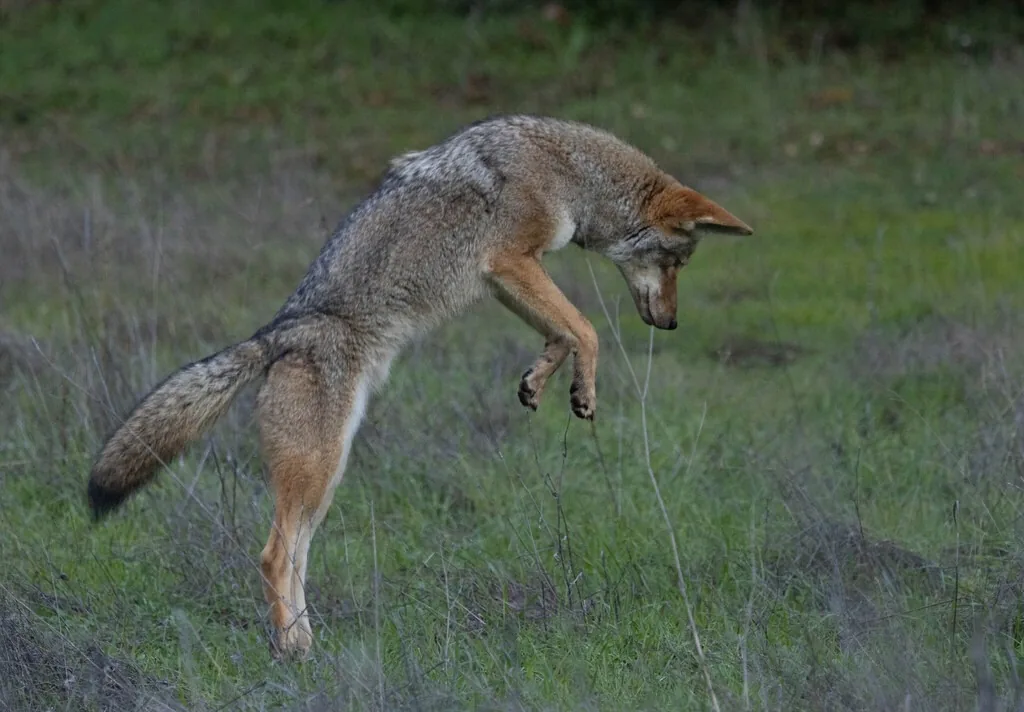
- A coyote looks like a small German shepherd with erect, pointed ears, a long narrow snout and a bushy tail with a black tip.[1][2]
- Fur is usually a mix of rust, brown and gray with a paler belly, though some coyotes are nearly black, reddish or almost white.[1][2]
- Weights vary by source and region. UC IPM gives about 20 to 35 pounds for full-grown males and 18 to 25 for females in California. The Internet Center for Wildlife Damage Management gives 25 to 45 pounds for western males and 22 to 35 for females, with eastern coyotes larger (males average about 45 pounds). North Carolina's wildlife agency says 20 to 45 pounds. They stand about 18 inches at the shoulder.[1][2][4]
- Tracks are oval and compact, with front tracks about 2 1/2 to 3 inches long. Nail marks are less obvious than a dog's, and the prints tend to follow a straighter line.[1][2]
- Scats are about as thick as a cigar, often tapered at one end, and full of hair, bone, feathers or seeds. Look for them along trails and roadsides.[1]
Look-alikes
Where it lives
Coyotes were once most common on the Great Plains and western grasslands. Their range has since grown to take in much of North and Central America, including all of the U.S. North Carolina, for example, first saw them in the 1980s.[2][4]
Biology and life cycle
Coyotes breed once a year. UC IPM puts breeding in late January and February with pups born in March and April; North Carolina's agency says mating runs February to March with births in April and May. Litters are usually 4 to 7 pups.[1][4]
Dens are dug in soil or set in enlarged burrows, hollow logs, rock piles or culverts, usually where people rarely go.[1]
They eat rodents and rabbits when they can, plus insects, fruit, berries, birds and carrion. Suburban coyotes also eat garbage, pet food and garden fruit, and they take cats and small dogs.[1][7]
Coyotes are most active after dusk and before daylight, and they bark and howl in the evening and at night for most of the year.[1]
Two coyotes howling together can sound like many more, which leads people to overestimate how many are around.[2]
Territory size follows food. UC IPM reports territories of more than 15 square miles in dry country, down to a fraction of a square mile in the Los Angeles suburbs.[1]
A 2019 study found urban coyotes bolder and more willing to explore new things than rural ones. The authors suspect how people treat them matters: rural coyotes were often persecuted, while urban ones rarely were and were sometimes rewarded for staying close to people.[12]
Damage and signs
- In suburbs, coyotes kill house cats and small dogs, and groups have attacked even large dogs such as Labrador retrievers with their owners nearby.[1]
- They prey on poultry, sheep, goats and calves, raid gardens and fruit trees, and chew drip irrigation lines.[1]
- Coyotes that are fed or find easy food can grow bold. UC IPM describes a typical progression: more coyotes in yards at night, then in the early morning and late afternoon, then taking pets by day, and finally acting aggressively toward people. California has had more than 160 coyote attacks on people since the 1970s, one of them fatal.[1]
- A study of carnivore attacks on people in U.S. and Canadian urban areas from 1980 to 2016 found coyotes attacked in a wider range of settings than black bears did.[14]
Health risk
Coyotes can get rabies, as any mammal can, but CDC says the animals most often found rabid in the U.S. are bats, skunks, raccoons and foxes. Oral rabies vaccination eliminated rabies in coyotes, which helped the U.S. be declared free of canine rabies in 2007. If a coyote bites or scratches you, wash the wound right away with soap and water for 15 minutes and get medical care urgently.[9][10][13]
Control
Prevention
Never feed coyotes. Feed pets indoors or pick up dishes right after they eat, store pet food in sealed containers, and keep trash, recycling and pet food in secure bins.[1][7]
Keep cats and small dogs inside or in an enclosed kennel, bring pets in at night, and keep their rabies vaccines up to date. UC IPM also advises distemper and parvovirus shots as your vet recommends.[1][7][9]
Walk dogs on a leash; North Carolina suggests a 6-foot one. Avoid dawn, dusk and dense brush, and don't fall into a regular routine.[1][4][7]
Keep them out
Close off crawl spaces under porches, decks and sheds. For fencing, UC IPM and the Internet Center say at least 5 1/2 feet tall; North Carolina says at least 6 feet. All three call for a barrier at ground level, such as a buried wire apron, to stop digging.[1][3][4]
Sanitation
Pick up fallen fruit, clean up spilled birdseed, manage compost so it doesn't draw rodents, and prune shrubs up to about 2 feet so coyotes have nowhere to hide.[1][7]
Traps and physical control
Haze coyotes that come near homes: shout, throw things, spray them with a hose, blow an air horn or whistle, and keep it up until the coyote leaves.[1][3][7]
When to call a professional
A coyote that has lost its fear of people usually has to be removed, and how that can be done depends on state law. See the legal status section below before you act.[1][8]
If a coyote approaches you or your pet
Stand up tall, shout in a deep voice, wave your arms, throw things at it and look it in the eye. If you're wearing a coat, spread it open to look bigger.[1]
Back away slowly so you don't turn your back on the coyote. If a coyote makes contact, California's wildlife agency says to fight back, then call animal control or 911.[1][7]
Sources differ on how much hazing achieves. The Internet Center says it frightens coyotes only temporarily and works only when it is widespread, consistent and paired with removing food. In a 2025 Edmonton study, coyotes retreated before volunteers came within 40 meters in 71 percent of sightings and fled at once in 22 of 23 hazing events, though the researchers found no sign it changed later behavior.[3][11]
Report coyote aggression or attacks to local animal control and your state wildlife agency. North Carolina also asks people to report coyotes they suspect have rabies.[1][4]
Between February and June, a coyote that holds its ground may be guarding a den or pups. North Carolina's agency says hazing doesn't always work then and you should leave the area calmly.[4]
What doesn't work well
Lights, sirens and other scare devices work only for a while. Without any real threat, coyotes quickly get used to them.[1][3]
UC IPM says no chemical repellents are registered for keeping coyotes away, and Missouri doesn't recommend fumigants or repellents because none are known to work. Missouri also calls large cage traps impractical for coyotes.[1][5]
Sources weigh removal differently. North Carolina says wiping out coyotes in an area isn't a practical long-term solution, and UC IPM notes other coyotes quickly move into vacant territories. But UC IPM also says removing just a few problem coyotes can make the rest wary of people again, often for months or years.[4][1]
Legal status: check your state
Rules vary widely. USDA's Wildlife Services says some states protect coyotes outside regulated hunting and trapping seasons, often with provisions for landowners to remove problem animals, while others list them as predators or unprotected and allow taking them year-round.[8][2]
Missouri classes the coyote as a furbearer and game mammal taken in set seasons, but lets owners shoot or trap coyotes that are causing damage out of season without a permit. Its rules list restrictions, and you should check local firearm laws.[5]
North Carolina classes it as nongame. It can be hunted year-round with firearms and archery gear where local rules allow shooting, and landowners can call a licensed Wildlife Control Agent or bring in a licensed trapper during trapping season. Local animal control won't remove a coyote just for being in the area.[4]
Mississippi lists the coyote as a nuisance animal. Anyone 16 or older trapping on land other than their own needs a trapping license, and hunting nuisance animals requires a hunting license unless you are exempt.[6]
In California coyotes have no special protection, but since a 1998 ballot measure, leghold traps can't be used on them except in declared health and safety emergencies or to protect endangered species.[1]
Moving a coyote somewhere else is rarely legal. USDA says relocation is rarely legal and not a viable fix, it is illegal in North Carolina, and California requires prior approval from the state wildlife department.[8][4][1]
Common questions
- Is it normal to see a coyote in my neighborhood?
- Yes. Coyotes live in many suburbs and cities. In UC IPM's list of warning signs, more coyotes in yards at night comes first; coyotes in yards by day or going after pets and people mean they are getting bolder.[1]
- Will a coyote attack my dog?
- Coyotes do take small dogs and cats. Their food needs peak in the pup-rearing season, which UC IPM puts at March through August. Keep small pets inside or supervised and walk dogs on a leash.[1][4]
- Can I trap and move a coyote?
- Usually not. USDA says relocation is rarely legal, North Carolina bans it outright, and California requires state approval. Coyotes moved elsewhere are also quickly replaced by others.[8][4][1]
- Can I shoot or trap a coyote on my property?
- It depends on your state and town. Missouri lets owners shoot or trap coyotes causing damage, North Carolina allows year-round hunting, and California bans leghold traps in most cases. Check local firearm rules and your state wildlife agency first.[5][4][1]
- I found a coyote pup alone. Should I help it?
- Leave it alone. North Carolina's wildlife agency says coyotes can't be rehabilitated and that pups that look orphaned or injured should be left where they are.[4]
Sources
- University of California Statewide IPM Program, “Pest Notes: Coyote (UC ANR Publication 74135).” ipm.ucanr.edu/home-and-landscape/coyote/ (accessed 2026-11-13)
- Internet Center for Wildlife Damage Management, “Coyotes: Identification.” icwdm.org/species/carnivores/coyotes/ (accessed 2026-11-13)
- Internet Center for Wildlife Damage Management, “Coyote Damage Prevention and Control Methods.” icwdm.org/species/carnivores/coyotes/coyote-damage-prevention-and-control-methods/ (accessed 2026-11-13)
- North Carolina Wildlife Resources Commission, “Coyote (species profile and coexisting with coyotes).” www.ncwildlife.gov/species/coyote (accessed 2026-11-13)
- Missouri Department of Conservation, “Coyote Control.” huntfish.mdc.mo.gov/wildlife/nuisance-problem-species/coyote-control (accessed 2026-11-13)
- Mississippi Department of Wildlife, Fisheries, and Parks, “Nuisance Wildlife.” mdwfp.com/wildlife-hunting/nuisance-wildlife (accessed 2026-11-13)
- California Department of Fish and Wildlife, “Human-Wildlife Conflicts: Coyotes.” wildlife.ca.gov/HWC/Coyotes (accessed 2026-11-13)
- USDA APHIS Wildlife Services, “Coyotes (Wildlife Damage Management Technical Series, 2020).” www.aphis.usda.gov/wildlife_damage/reports/Wildlife%20Damage%20Management%20Technical%20Series/coyotes-wdm-technical-series.pdf (accessed 2026-11-13)
- Centers for Disease Control and Prevention, “About Rabies.” www.cdc.gov/rabies/about/index.html (accessed 2026-11-13)
- Centers for Disease Control and Prevention, “Preventing Rabies.” www.cdc.gov/rabies/prevention/index.html (accessed 2026-11-13)
- PLoS One (via PubMed), “Urban coyotes were observed rarely and retreated consistently from assertive approaches by volunteers in neighborhoods (Lajeunesse G et al., PLoS One, 2025) (abstract).” pubmed.ncbi.nlm.nih.gov/40238769/ (accessed 2026-11-13)
- Scientific Reports (via PubMed), “The intrepid urban coyote: a comparison of bold and exploratory behavior in coyotes from urban and rural environments (Breck SW et al., Scientific Reports, 2019) (abstract).” pubmed.ncbi.nlm.nih.gov/30765777/ (accessed 2026-11-13)
- PLoS Neglected Tropical Diseases (via PubMed), “Oral rabies vaccination in North America: opportunities, complexities, and challenges (Slate D et al., PLoS Neglected Tropical Diseases, 2009) (abstract).” pubmed.ncbi.nlm.nih.gov/20027214/ (accessed 2026-11-13)
- Scientific Reports (via PubMed), “Patterns of wild carnivore attacks on humans in urban areas (Bombieri G et al., Scientific Reports, 2018) (abstract).” pubmed.ncbi.nlm.nih.gov/30531972/ (accessed 2026-11-13)
- Global Biodiversity Information Facility (GBIF), “Canis latrans Say, 1823 (GBIF Backbone Taxonomy).” api.gbif.org/v1/species/5219153 (accessed 2026-11-13)