The short answer
- Check the footprints. Raccoon prints look like small bare hands with long toes, the hind print like a small human footprint, and claw marks often show. An opossum's hind print has a thumb sticking out at a right angle with no claw mark, and the front print looks star-shaped. Skunk prints are smaller, with five toes and claw marks on the front feet.[4][1][9][6][14][11]
- Look at the lawn. Skunks dig small cone-shaped holes, about 3 to 5 inches across, while hunting grubs. Raccoons usually roll back pieces of sod, especially newly laid sod, instead of digging holes.[10][12][1][2]
- Find the droppings. Raccoons use the same spots again and again as latrines, on decks, woodpiles, rooftops, in attics and even sandboxes. Opossums leave droppings on garden paths and patios.[18][17][1][5]
- Use your nose. Skunk musk is unmistakable and lingers for days. A raccoon latrine smells strongly too, but the smell stays at the pile of droppings.[11][12][1][18]
Animals on this page
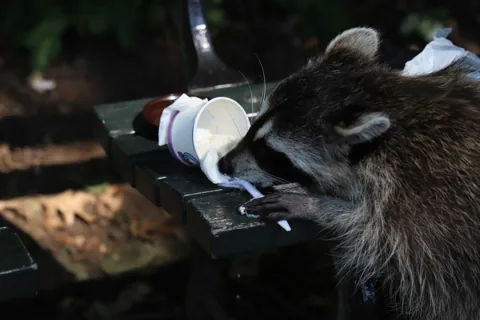 Raccoon
Procyon lotor
Raccoons are masked, ring-tailed mammals that adapt very well to towns and suburbs. They raid garbage and gardens, den in attics, chimneys and under decks, and can carry rabies and raccoon roundworm.
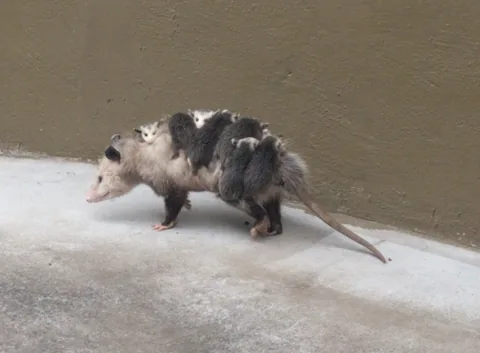 Virginia opossum
Didelphis virginiana
The Virginia opossum is North America's only marsupial, a cat-sized animal with a pointed face and a long, hairless tail. Around homes it raids pet food, garbage and fruit and dens under decks, sheds and houses.
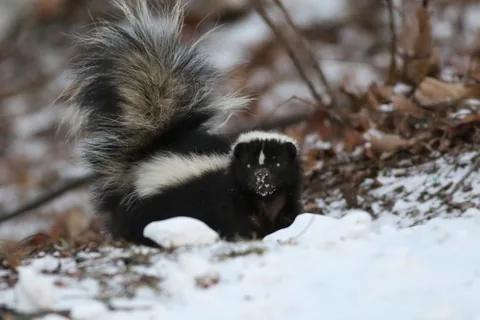 Striped skunk
Mephitis mephitis
The striped skunk is a cat-sized, black and white mammal that often lives under porches, decks and sheds. It digs lawns for grubs, sprays pets that corner it, and is one of the main wildlife carriers of rabies.
Side by side
What they look like: raccoons are stocky, with a black mask over the eyes and a furry tail with light and dark rings. Opossums are about the size of a house cat, with coarse grayish fur, a pointed face, hairless rounded ears and a long hairless tail they can grip with. Striped skunks are black with white stripes running down the back.[1][4][5][6][10][14]
- Raccoon tracks: five toes on the front and hind feet. Missouri's Department of Conservation gives the front track as 2 1/2 to 3 inches long and the hind track as 3 3/4 to 4 inches, like a small human footprint except for the long toes, with claw marks that often show. UC IPM describes the front paws as handlike, with long, flexible toes.[4][1]
- Opossum tracks: both feet look like little hands with widely spread fingers, about 2 inches long. The hind foot has a thumb that sticks out at a right angle and leaves no claw print, while the other toes carry claws; ICWDM says that hind thumb is what separates opossum tracks from raccoon tracks, and a correctly identified hind track is definitive.[6][9][5][7]
- Skunk tracks: five toes on both feet. Missouri gives the front track as 1 3/4 inches long with claw marks that often show, and the hind track as 2 3/4 inches with the heel seldom showing and claw marks rarely showing. Penn State Extension says the claws are usually visible but the heels of the front feet normally are not. Skunks shuffle and waddle with a 5 to 6 inch stride.[14][11]
- Lawn damage: skunks dig small cone-shaped holes or patches of upturned earth while hunting grubs. UC IPM puts the pits at 3 to 5 inches across; ICWDM and Penn State say 3 to 4 inches. Raccoons roll up freshly laid sod looking for earthworms and grubs and may come back on following nights to roll up more; UC IPM says they don't typically dig holes, and cone-shaped holes are likely skunks. Skunks can roll back sod too.[10][12][11][1][2]
- Droppings: CDC describes raccoon feces as dark and tubular, with a strong odor (usually worse than dog or cat feces), often holding undigested seeds or other food, piled in latrines on woodpiles, decks, rooftops, attics, garages and haylofts. UC IPM says opossums defecate on garden paths and patios.[18][17][5]
- Dens: raccoons den in attics, uncapped chimneys and the spaces under houses, porches and decks. Opossums live under decks, steps, porches and garden sheds and, if they can get in, in attics and garages, where ICWDM says they may make a messy nest. Skunks den under decks, porches, sheds and loose foundations and in old woodchuck burrows.[1][3][5][8][10][11][13]
- Garbage and pet food: all three eat it. ICWDM says garbage cans and dumps can be a major raccoon food source in cities; opossums scavenge from unsecured garbage cans and outdoor pet bowls; UC IPM's advice for skunks includes putting pet food away at night and keeping tight lids on garbage.[2][1][9][7][10]
- Odor: skunks spray musk as far as 6 to 10 feet in self-defense, and Penn State says the smell lingers for days. Before spraying they usually stamp their front feet and arch the tail over the back. A frightened opossum may play dead and give off a greenish musky fluid. Raccoons using an attic latrine stain the ceiling below with urine and leave an objectionable odor.[10][11][12][5][1]
- Activity times: all three are mostly out at night. Skunks are active at dawn, dusk and night. Opossums may forage by day, especially in cold weather. Raccoons don't truly hibernate but hole up during severe winter weather, and skunks go dormant for about a month (up to two in the north) in the coldest part of winter; Missouri notes opossums stay active in winter while raccoons are dormant or inactive.[1][4][10][11][8][3][13][9]
- Young: most raccoon litters are born in April or May, and skunks give birth in May or early June. Opossums start earlier: in Missouri most litters are born by the end of February, and females raise 2, rarely 3, litters a year.[3][1][13][11][9][8]
How to confirm which one you have
Make a tracking patch. Smooth a thin layer of flour on the ground in front of the hole (UC IPM says about 1/8 inch thick) and check it after dark. The prints tell you which animal it is, and prints heading out tell you it has left to feed.[10][11]
- Look closely at the hind print. A thumb set off at a right angle with no claw mark means opossum; long, slender toes with claw marks and a heel like a small human foot means raccoon.[9][6][4]
- Match the lawn damage. Neat cone-shaped pits a few inches wide point to skunks; sheets of sod peeled back and flipped over point to raccoons. Either way, check for grubs under the turf, since both are digging for them.[1][10][12][2]
- Find the latrine. A pile of droppings in one spot on a deck, roof, woodpile or attic floor means raccoons. Don't handle it: CDC says raccoon roundworm eggs can't be seen with the naked eye.[18][17]
- Watch at dusk from a distance, and read the smell. A strong skunk odor near a deck or foundation, especially in late winter when males spray while fighting over females, is a sign a skunk may be moving in.[10]
Why the difference matters
Rabies risk differs. CDC lists bats, skunks, raccoons and foxes as the wildlife most often found with rabies in the US, and says more than 90% of reported animal rabies cases occur in wildlife. Opossums are not on that list, but CDC says any mammal can get rabies.[15][16]
- Raccoon latrines carry raccoon roundworm. CDC says the eggs pass in raccoon feces, are not infectious right away, and that prompt removal and destruction of the feces before the eggs become infectious lowers the risk.[17][18]
- Leptospirosis spreads through the urine of infected animals, according to CDC. The Virginia Department of Health names raccoons and opossums among the wild and domestic animals that can carry the bacterium.[19][20]
- Moving them is restricted. Pennsylvania's Game Commission says skunks and raccoons are rabies vector species and should not be relocated like other wildlife. New York says it is illegal for you to move an animal off the property where it was caught, and Missouri does not recommend relocation. Check your state wildlife agency before trapping any of the three.[22][21][23]
- Timing changes with the animal. Raccoon and skunk young arrive in spring, but opossum litters can come from late winter through summer, so a den that's empty of adults in one season may hold young in another.[3][13][9][8]
What to do for each
All three: take away the food. Put lids that close tightly on garbage cans, bring pet food in at night and pick up fallen fruit.[10][1][5]
- Raccoons: close off attic and basement access, cap the chimney (UC IPM says uncapped chimneys are common den sites), cover sandboxes when not in use, and clean up latrines carefully. CDC says to burn, bury or bag raccoon feces for the landfill and treat deck and patio surfaces with boiling water or a propane flame gun. See our raccoon guides for the yard and for attics.[18][17][1]
- Opossums: ICWDM says they are usually solitary and nomadic, so removing the food and shelter that hold one in place comes first. Seal openings under decks and sheds only after you've confirmed the animal is out; our opossum guide covers one-way doors and the pouch-young timing.[8][5][7][9]
- Skunks: confirm the skunk has left with a tracking patch, then close the opening. Avoid sealing in spring when young may be in the den, and if a skunk is close, move away slowly; it usually warns by stamping its front feet first.[10][11][12][13]
- Lawn digging by skunks or raccoons stops once the grubs are gone. Confirm grubs before treating; the grub guide covers counts, timing and products.[1][10]
Health: what CDC and state health departments say
If any of these animals bites or scratches you, wash the wound right away with soap and water for 15 minutes and contact your health department immediately. CDC says rabies post-exposure care includes wound washing, rabies immune globulin and rabies vaccine.[16]
- If you think you may have swallowed raccoon feces or material contaminated with it, CDC says to seek medical attention immediately.[17]
- To avoid leptospirosis, keep away from water or soil that may be contaminated with animal urine, and wear waterproof clothing and boots near it.[19]
- Keep pets' rabies vaccinations up to date; CDC says this lowers your household's risk.[16]
Common questions
- What animal digs small round holes in my lawn at night?
- Most often a skunk hunting grubs: the holes are cone-shaped and about 3 to 5 inches across. Raccoons tend to roll back the sod instead of digging holes.[10][1][12]
- How can I tell opossum tracks from raccoon tracks?
- Look at the hind foot. An opossum's has a thumb sticking out at a right angle with no claw mark; a raccoon's looks like a small human footprint with long toes and claw marks.[9][6][4]
- Do opossums carry rabies?
- CDC's list of the wildlife most often found with rabies in the US names bats, skunks, raccoons and foxes, not opossums, but CDC also says any mammal can get rabies. Treat any wildlife bite as a possible exposure.[15][16]
- Which one is living under my deck?
- Any of the three can. A flour tracking patch at the hole, checked after dark, shows the prints; a skunk smell or a raccoon latrine nearby narrows it down.[10][11][5][1][18]
- Can I trap it and let it go somewhere else?
- Often not. New York makes moving an animal off your property illegal, Pennsylvania says raccoons and skunks should not be relocated, and Missouri doesn't recommend it. Check your state's rules first.[21][22][23]
Photo credits
- Raccoon: (c) Steven Bodzin, some rights reserved (CC BY) — via iNaturalist, CC BY 4.0
- Virginia opossum: (c) Millie Basden, some rights reserved (CC BY) — via iNaturalist, CC BY 4.0
- Striped skunk: (c) Richard Poort, some rights reserved (CC BY) — via iNaturalist, CC BY 4.0
Sources
- University of California Statewide IPM Program, “Pest Notes: Raccoons.” ipm.ucanr.edu/home-and-landscape/raccoons/ (accessed 2026-11-14)
- Internet Center for Wildlife Damage Management, “Raccoon Damage Identification.” icwdm.org/species/other-mammals/raccoons/raccoon-damage-identification/ (accessed 2026-11-14)
- Internet Center for Wildlife Damage Management, “Raccoon Biology.” icwdm.org/species/other-mammals/raccoons/raccoon-biology/ (accessed 2026-11-14)
- Missouri Department of Conservation, “Raccoon (Field Guide).” mdc.mo.gov/discover-nature/field-guide/raccoon (accessed 2026-11-14)
- University of California Statewide IPM Program, “Pest Notes: Opossum.” ipm.ucanr.edu/home-and-landscape/opossum/ (accessed 2026-11-14)
- Internet Center for Wildlife Damage Management, “Opossums: Identification.” icwdm.org/species/other-mammals/opossums/ (accessed 2026-11-14)
- Internet Center for Wildlife Damage Management, “Opossum Damage Identification.” icwdm.org/species/other-mammals/opossums/opossum-damage-identification/ (accessed 2026-11-14)
- Internet Center for Wildlife Damage Management, “Opossum Biology.” icwdm.org/species/other-mammals/opossums/opossum-biology/ (accessed 2026-11-14)
- Missouri Department of Conservation, “Virginia Opossum (Field Guide).” mdc.mo.gov/discover-nature/field-guide/virginia-opossum (accessed 2026-11-14)
- University of California Statewide IPM Program, “Pest Notes: Skunks.” ipm.ucanr.edu/home-and-landscape/skunks/ (accessed 2026-11-14)
- Penn State Extension, “Skunks.” extension.psu.edu/skunks (accessed 2026-11-14)
- Internet Center for Wildlife Damage Management, “Skunk Damage Identification.” icwdm.org/species/carnivores/skunks/skunk-damage-identification/ (accessed 2026-11-14)
- Internet Center for Wildlife Damage Management, “Skunk Biology.” icwdm.org/species/carnivores/skunks/skunk-biology/ (accessed 2026-11-14)
- Missouri Department of Conservation, “Striped Skunk (Field Guide).” mdc.mo.gov/discover-nature/field-guide/striped-skunk (accessed 2026-11-14)
- Centers for Disease Control and Prevention, “About Rabies.” www.cdc.gov/rabies/about/index.html (accessed 2026-11-14)
- Centers for Disease Control and Prevention, “Preventing Rabies.” www.cdc.gov/rabies/prevention/index.html (accessed 2026-11-14)
- Centers for Disease Control and Prevention, “About Raccoon Roundworm.” www.cdc.gov/baylisascaris/about/index.html (accessed 2026-11-14)
- Centers for Disease Control and Prevention, “Preventing Raccoon Roundworm.” www.cdc.gov/baylisascaris/prevention/index.html (accessed 2026-11-14)
- Centers for Disease Control and Prevention, “About Leptospirosis.” www.cdc.gov/leptospirosis/about/index.html (accessed 2026-11-14)
- Virginia Department of Health, “Leptospirosis (Epidemiology Fact Sheet).” www.vdh.virginia.gov/epidemiology/epidemiology-fact-sheets/leptospirosis/ (accessed 2026-11-14)
- New York State Department of Environmental Conservation, “Remove or Take Nuisance Wildlife Legally.” dec.ny.gov/nature/animals-fish-plants/nuisance-wildlife-species/remove-take-legally (accessed 2026-11-14)
- Pennsylvania Game Commission, “Nuisance Wildlife.” www.pgc.pa.gov/Wildlife/Pages/NuisanceWildlife.aspx (accessed 2026-11-14)
- Missouri Department of Conservation, “Wildlife Control Guidelines.” mdc.mo.gov/wildlife/nuisance-problem-species/wildlife-control-guidelines (accessed 2026-11-14)