The short answer
- Don't touch it with bare hands, and don't swat it out of the air. CDC says bat bites can be tiny and you may not know you were bitten.[1][5][9]
- Keep it, don't release it, if there may have been contact: someone woke up with the bat in the room, or it was near a baby, young child, or a person with dementia or another condition that keeps them from saying whether they were touched. Illinois' wildlife agency says these bats should be tested, and CDC says not to release a bat found in your home until you've talked with a public health expert.[5][1][4]
- Call your local health department or animal control. They decide whether the bat needs a rabies test and whether anyone needs medical care.[1][6][3]
- If they agree no one could have been touched, shut the bat in one room with a window or outside door open, keep people and pets out, and let it leave on its own.[5][6][8]
Related pest profiles
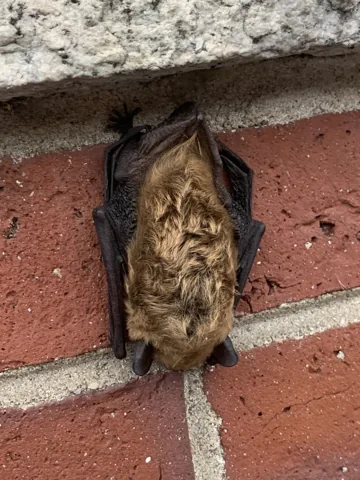 Bats (big brown bat and little brown bat)
Eptesicus fuscus and Myotis lucifugus (shown: big brown bat)
Bats are flying, insect-eating mammals that sometimes roost in attics, walls and other parts of buildings. They are valuable insect eaters, but colonies leave droppings, urine stains and odor.
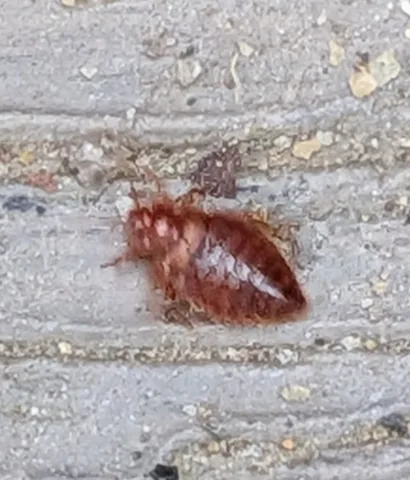 Bat Bugs
Cimex adjunctus (eastern bat bug) and Cimex pilosellus (western bat bug)
Bat bugs are close relatives of bed bugs that feed on the blood of roosting bats. They turn up in homes that have bats in the attic or walls, and they may bite people when the bats leave or are shut out.
First question: could anyone have been touched?
New Jersey's health department defines a bat exposure as a bite, or saliva or brain tissue getting into a fresh scratch or wound or into the eyes, nose or mouth. It adds that bat bites may be less severe and harder to recognize than bites from larger animals.[4][1]
That's why the rules are cautious. In New Jersey's review, 17 of the 24 human rabies cases acquired in the United States or Puerto Rico from 2003 through 2013 were associated with bats, and in most of them no bite was reported or the kind of exposure was unknown.[4]
New Jersey says treatment may be considered for people who were in the same room as a bat and might not know they were bitten: a sleeping person who wakes to find a bat in the room, or an adult who finds a bat in a room with a child, a mentally disabled person or an intoxicated person who was left alone. It says treatment is not recommended for the other people in the household during the incident.[4]
Illinois' wildlife agency gives the same examples for when a bat should be tested: someone sleeping who wakes up to find a bat in the room, and possible contact with infants, young children or people with dementia or other health issues. Its advice when in doubt is to err on the side of caution and have the bat tested.[5]
Pets count too. Illinois says a bat that has bitten a person or a pet needs to be tested for rabies.[5]
If there may have been contact: keep the bat for testing
Close the bat into the room it's in, then call. Illinois says to keep a bat that has bitten, or may have bitten, a person or pet enclosed in the room and have animal control capture it. CDC says to contact animal control or your health department to capture it safely, and not to let it go until you've talked with a public health expert.[5][1]
If you have to catch it yourself, CDC's method needs a box or jar big enough for the bat, a piece of cardboard with small air holes punched in it, tape and leather work gloves. Wait for the bat to land, approach slowly, set the container over it, slide the cardboard underneath to trap it, and tape the cardboard on. Then contact your health department.[1][4]
Don't crush or hit the bat. Testing is done on the brain, and New Jersey and Illinois both warn that damaging the head can make the bat useless for testing.[4][5]
If the bat is already dead, New Jersey's health department says to keep it cool so it doesn't decompose, which would also ruin the test.[4]
If you can't safely catch it, CDC says to speak with your public health department for advice.[1]
If someone was bitten or scratched
Wash the wound with soap and water and get medical help right away. CDC also says to see a healthcare provider urgently if bat saliva or brain material got into the eyes, nose, mouth or an open wound.[1][3]
Don't wait for symptoms. CDC says rabies is nearly always fatal once symptoms appear, while care given after an exposure, called post-exposure prophylaxis or PEP, is nearly 100% effective. PEP includes wound care, human rabies immune globulin and a series of four or five vaccine doses given as soon as possible.[2][3]
MedlinePlus says to contact your provider or health department if you find a bat in your home even if you don't feel or see a bite, because they can tell you whether you need treatment. It puts the usual time from infection to illness at 3 to 12 weeks, with a range of 10 days to 7 years.[3]
If no one was touched: let it out
Maryland's natural resources agency urges you to call your county health agency any time you find a single bat in the house, so it can help rule out contact with people or pets. If you're certain there was no contact, Maryland, Illinois, UC IPM and Missouri all describe letting the bat go.[6][5][8][7]
Stay calm and keep the bat in sight. UC IPM says a panicked exit is about the worst thing you can do, because the bat may hide and you won't know whether it got out.[8][5]
Shut it in one room. Close interior doors so the bat is in a single room with no people or pets, then open a window or outside door. Illinois says to take the screen off the window, leave the room, and give the bat time, which can take a few hours if it's disoriented. Keep people and pets out until you're sure it's gone.[5][8][6]
Or cover it and carry it out. Once the bat lands, put on thick or leather gloves, set a bowl, can or box over it, slide cardboard or a magazine underneath, and release it outdoors.[6][8][7]
A bat that won't fly may be torpid. UC IPM says bats can go torpid in cool weather and look sick or dead, or bare their teeth and hiss to defend themselves; it can take an hour or more for one to warm up enough to fly. Its advice is to gently scrape the bat into a can or box with gloves on, cover it, let it warm up, then release it outside.[8]
Maryland says no permit from its wildlife agency is needed to remove a single bat from a house. Check your own state's rules: Missouri, for example, says all bats are protected under its Wildlife Code, and CDC notes some bats are endangered.[6][7][1]
Where the advice differs
Not every agency is comfortable with the open-the-window approach. New Jersey's health department guidance for officials says residents who report a bat in the home should be told to leave it alone until animal control arrives, and should not be told to open a window or release it.[4]
The wildlife agencies in Maryland and Illinois and UC IPM describe releasing a bat when there was certainly no contact. The common ground is CDC's advice: talk to your health department before you let a bat found in your home go.[6][5][8][1]
If your dog or cat may have had the bat
Merck Veterinary Manual says that where bat rabies occurs, any animal bitten or otherwise exposed by a bat that isn't available for testing should be treated as exposed to rabies. That's one more reason to keep the bat if your pet caught or played with it.[10][5]
Merck cites national veterinary public health guidance that a currently vaccinated dog, cat or ferret that is exposed should have its wounds cared for, be revaccinated right away and be closely watched for 45 days. For an unvaccinated pet the guidance is much harder: euthanasia, or strict isolation for 4 to 6 months with vaccination at the start.[10]
Is one bat a sign of more?
Often it isn't. UC IPM says a bat that flies into living space is usually a lost, young one trying to get out, and Maryland calls the lone summer bat usually a young bat that made a mistake. ICWDM treats a lone bat in the living space as a separate problem from bats living in the building.[8][6][9]
Season gives a clue. Maryland says a lone bat inside in winter is likely a big brown bat, the only species that can spend the winter in homes, roused from hibernation by warmth and out looking for water and food.[6]
Look outside to be sure. Maryland recommends checking the outside of the house for signs bats are roosting elsewhere in it, and Illinois says bats coming and going from the building may mean a colony inside. Watching at dusk can show where they leave, UC IPM and Missouri say. For telling droppings, stains, odor and sounds apart from birds, see our bats vs birds in the attic guide.[6][5][8][7]
Keeping the next one out
CDC says bats can fit through openings as small as 1/4 inch. It suggests caulking any opening larger than a dime, using screens, chimney caps and draft guards on attic doors, filling electrical and plumbing holes with steel wool or caulk, and making sure outside doors close tightly. Missouri notes a lone bat may come in through an open door or window or drop down a chimney.[1][7][8]
If there is a colony, don't seal it in during pup season. CDC warns against trapping young bats inside when bat-proofing between May and August, and Maryland marks May and June as the months when exclusion is not recommended because flightless young are likely present, with September and October the best time to begin. Maryland also requires paperwork for some exclusions from March 1 to August 31. The full method and other states' rules are in our bat exclusion guide.[1][6]
Who to call
Possible contact or a bite: your local health department or animal control, who can arrange rabies testing and tell you whether anyone needs care. A bite or scratch also means a call to a doctor right away.[1][5][3]
A bat you can't catch safely: your public health department, per CDC.[1]
A colony in the walls or attic: Maryland points homeowners to permitted wildlife control operators, and only those with a state permit that mentions bats may do exclusions there. Illinois says to contact a state wildlife biologist if a colony can't be left for the season.[6][5]
Common questions
- I woke up and there was a bat in my bedroom. Do I need rabies shots?
- Maybe. Don't let the bat go. Call your health department; New Jersey's guidance says treatment may be considered for a sleeping person who wakes to find a bat in the room when rabies can't be ruled out by testing the bat. A negative test on the captured bat can spare you the shots.[4][1][5]
- Can I just open a window and let it fly out?
- Only if you're certain no one, including a pet, could have been touched, and ideally after you've talked with your health department. CDC says not to release a bat found in your home until you've spoken with a public health expert.[1][6][5]
- Can a bat bite me without me knowing?
- Yes. CDC says bat bites can be tiny and you may not even know you were bitten, and MedlinePlus says the same.[1][3]
- What do I do with a bat my cat caught?
- Don't throw it away. Put on gloves, contain it without crushing the head, keep it cool if it's dead, and call your health department and your vet. Merck Veterinary Manual says a pet exposed to a bat that can't be tested should be regarded as exposed to rabies.[4][10][5]
- Does one bat mean I have bats in the attic?
- Not necessarily. A lone summer bat is usually a lost young one, according to UC IPM and Maryland. Check the outside of the house at dusk for bats leaving, and see bats vs birds in the attic for other signs.[8][6][5]
Photo credits
- Bats (big brown bat and little brown bat): (c) Thomas Irvine, some rights reserved (CC BY) — via iNaturalist, CC BY 4.0
- Bat Bugs: (c) Jason Hill, some rights reserved (CC BY) — via iNaturalist, CC BY 4.0
Sources
- U.S. Centers for Disease Control and Prevention, “Preventing Rabies from Bats.” www.cdc.gov/rabies/exposure/animals/bats.html (accessed 2026-11-14)
- U.S. Centers for Disease Control and Prevention, “About Rabies.” www.cdc.gov/rabies/about/index.html (accessed 2026-11-14)
- MedlinePlus, U.S. National Library of Medicine, “Rabies (Medical Encyclopedia).” medlineplus.gov/ency/article/001334.htm (accessed 2026-11-14)
- New Jersey Department of Health, “Guide to Proper Handling of Bat Exposures (May 2017).” nj.gov/health/cd/documents/rabies/batexposure.pdf (accessed 2026-11-14)
- Wildlife Illinois (Illinois Department of Natural Resources with University of Illinois Extension), “Bats in my Home.” wildlifeillinois.org/solve-wildlife-problems/bats-in-my-home/ (accessed 2026-11-14)
- Maryland Department of Natural Resources, “Bats in Houses.” dnr.maryland.gov/wildlife/pages/plants_wildlife/bats/batsinhome.aspx (accessed 2026-11-14)
- Missouri Department of Conservation, “Bat Control.” mdc.mo.gov/wildlife/nuisance-problem-species/bat-control (accessed 2026-11-14)
- University of California Statewide IPM Program, “Pest Notes: Bats (Publication 74150).” ipm.ucanr.edu/home-and-landscape/bats/ (accessed 2026-11-14)
- Internet Center for Wildlife Damage Management, “Bat Damage Identification.” icwdm.org/species/other-mammals/bats/bat-damage-identification/ (accessed 2026-11-14)
- Merck & Co., “Rabies in Animals (Merck Veterinary Manual).” www.merckvetmanual.com/nervous-system/rabies/rabies-in-animals (accessed 2026-11-14)