The short answer
- A series of small holes in a row in wood siding, eaves or trim, often with a loud pounding noise, is woodpecker damage.[1][2]
- A nearly perfectly round hole about 1/2 inch across in unpainted wood under the eaves, with large bees hovering nearby, is a carpenter bee nest.[5][4]
- A ragged, chewed opening in siding or under the eaves, golf-ball to baseball size, is likely tree squirrels.[6][7]
- Small gnawed holes low on walls, doors or baseboards, with droppings nearby, point to mice or rats.[9][10]
Profiles of animals that make holes in houses
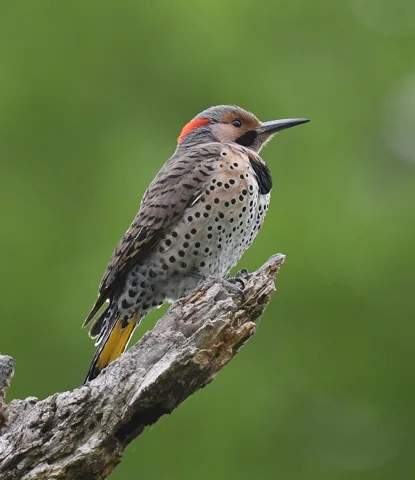 Woodpeckers
Family Picidae (shown: northern flicker, Colaptes auratus)
Woodpeckers come into conflict with people when they peck buildings looking for insects, drum on loud surfaces to claim territory, or carve out nest holes. All are protected under the federal Migratory Bird Treaty Act, but they can legally be kept off a house.
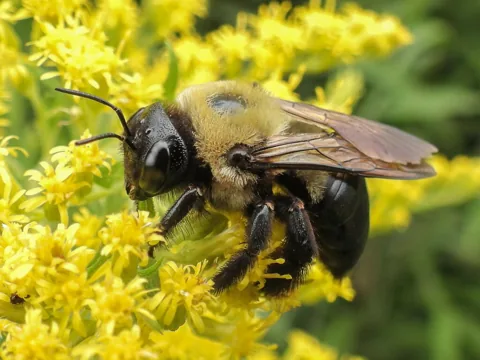 Eastern Carpenter Bee
Xylocopa virginica
Carpenter bees are large, solitary bees that bore round tunnels into bare, weathered wood to rear their young; they rarely cause severe damage but can weaken wood that is reused year after year.
 Tree squirrels (eastern gray and fox squirrels)
Sciurus species (shown: eastern gray squirrel, S. carolinensis)
Tree squirrels such as the eastern gray squirrel and fox squirrel are bushy-tailed, daytime rodents. Around homes they raid fruit, nuts and bird feeders, dig up lawns and gardens, and chew their way into attics.
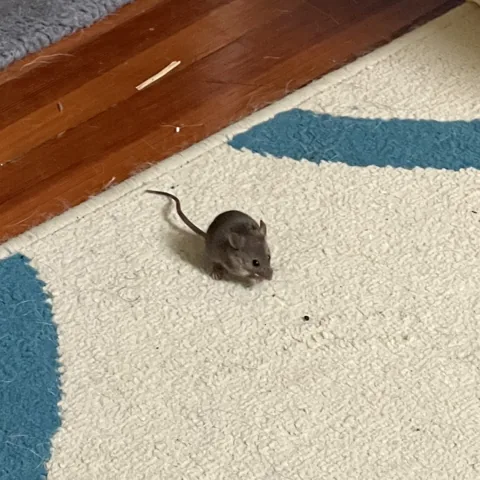 House Mouse
Mus musculus
The house mouse is a small, adaptable rodent that lives close to people in homes, schools and food businesses, eating and contaminating food, gnawing wiring and carrying disease.
Hole clues and the likely culprit
Note the hole's size and shape, what material it's in and how high up it is. Then look for the animal or its signs.[2][5][7]
- Holes drilled into wood siding, eaves, window frames or trim boards, small holes in a row or narrow horizontal damage along plywood grooves, and a pounding noise: woodpeckers. Cedar and redwood siding are favorites, but synthetic siding gets hit too.[1][2]
- A round entrance hole about 1/2 inch in diameter in unpainted wood such as eaves, railings, doors or windowsills, with stains on the wall below the opening: carpenter bees.[5][4]
- Chewed openings in siding or under the eaves leading to a nest in the attic, or entry through loose siding or vent screens: tree squirrels.[6][7]
- Small gnawed holes in walls, doors and ledges, fresh gnawed wood shavings or insulation, and droppings: mice or rats. ICWDM notes rodent entry holes are often 1½ inches in diameter or less.[9][10]
How to confirm what's making the holes
- Woodpeckers: listen for a pounding noise; woodpeckers drum on resonant surfaces to proclaim territory, and they also peck while searching for insects.[1][2]
- Carpenter bees: watch the hole for large, shiny black bees flying in and out or hovering near the eaves. Penn State notes the top of a carpenter bee's abdomen is mostly bare and shiny, unlike a bumble bee's hairy one.[5][4]
- Squirrels: look for activity in the daytime and nesting material in the attic.[6][7]
- Mice and rats: check for droppings and compare gnaw-mark size; ICWDM gives rat tooth marks as about twice as wide as mouse marks.[9][8]
What to do next
- Woodpeckers are protected under the federal Migratory Bird Treaty Act, so don't harm them. UC IPM says the most effective way to stop damage to a building is bird netting, and they can be legally excluded.[1][3]
- Woodpeckers often hunt insects hidden in siding gaps, so if they're probing for food, UC IPM says caulking holes and cracks and applying a wood preservative may also help.[1][2]
- Carpenter bees prefer bare wood, so paint or varnish exposed surfaces regularly. See the carpenter bee guide for treating and sealing existing holes.[4][5]
- Squirrels, mice and rats: seal openings with heavy materials such as sheet metal and hardware cloth after the animals are out, using the guides below.[10][11][6]
Common questions
- What makes perfectly round holes under my eaves?
- Carpenter bees. The female drills a nearly perfect round hole about 1/2 inch across into bare wood.[5][4]
- Why is a woodpecker pecking my house?
- Woodpeckers peck houses to look for insects, to drum for territory, or to dig nest holes. Drumming surfaces that resonate loudly are favorites.[1][2]
- Can I kill a woodpecker damaging my house?
- No, not without a federal permit. Woodpeckers are protected under the Migratory Bird Treaty Act; you can exclude them legally, for example with netting.[3][1]
Photo credits
- Woodpeckers: Chrissy McClarren and Andy Reago, public domain (CC0), via iNaturalist
- Eastern Carpenter Bee: Erik Schiff, public domain (CC0), via iNaturalist
- Tree squirrels (eastern gray and fox squirrels): (c) Paolo Zucca, some rights reserved (CC BY) — via iNaturalist, CC BY 4.0
- House Mouse: (c) Carrie Seltzer, some rights reserved (CC BY) — via iNaturalist, CC BY 4.0
Sources
- University of California Statewide IPM Program, “Pest Notes: Woodpeckers.” ipm.ucanr.edu/home-and-landscape/woodpeckers/ (accessed 2026-11-12)
- Internet Center for Wildlife Damage Management, “Woodpecker Damage Identification.” icwdm.org/species/birds/woodpeckers/woodpecker-damage-identification/ (accessed 2026-11-12)
- Internet Center for Wildlife Damage Management, “Woodpeckers: Identification and Legal Status.” icwdm.org/species/birds/woodpeckers/ (accessed 2026-11-12)
- University of California Statewide IPM Program, “Pest Notes: Carpenter Bees.” ipm.ucanr.edu/home-and-landscape/carpenter-bees/ (accessed 2026-11-12)
- Penn State Extension, “Carpenter Bees.” extension.psu.edu/carpenter-bees (accessed 2026-11-12)
- Penn State Extension, “Tree Squirrels.” extension.psu.edu/tree-squirrels (accessed 2026-11-12)
- Internet Center for Wildlife Damage Management, “Tree Squirrel Damage Identification.” icwdm.org/species/rodents/tree-squirrels/tree-squirrel-damage-identification/ (accessed 2026-11-12)
- University of California Statewide IPM Program, “Pest Notes: House Mouse, Publication 7483 (revised July 2025).” ipm.ucanr.edu/legacy_assets/PDF/PESTNOTES/pnhousemouse.pdf (accessed 2026-11-12)
- Internet Center for Wildlife Damage Management, “House Mice: Identification and Damage Signs.” icwdm.org/species/rodents/house-mice/ (accessed 2026-11-12)
- University of California Statewide IPM Program, “Rats (Pest Notes, Home and Landscape).” ipm.ucanr.edu/home-and-landscape/rats/ (accessed 2026-11-12)
- Internet Center for Wildlife Damage Management, “House Mouse Damage Prevention and Control Methods.” icwdm.org/species/rodents/house-mice/house-mouse-damage-prevention-and-control-methods/ (accessed 2026-11-12)