The short answer
- Coarse, stringy shavings mixed with dead insect parts, sifting out of cracks or from behind moldings, point to carpenter ants. The ants don't eat the wood; they dig it out to nest, usually in wood that is damp or decaying.[2][3][1]
- Coarse sawdust below a perfectly round hole about 1/2 inch across in eaves, fascia, decks or other bare wood is a carpenter bee nest.[4][5]
- Fine powder like flour or talcum powder below tiny round holes in hardwood floors, trim or furniture is powderpost beetle frass.[7][8][9]
- Hard, six-sided pellets the color of the wood, piling up below tiny holes, aren't sawdust at all; they are drywood termite droppings, and drywood termites are a job for a professional.[13][14]
Profiles of wood-boring pests
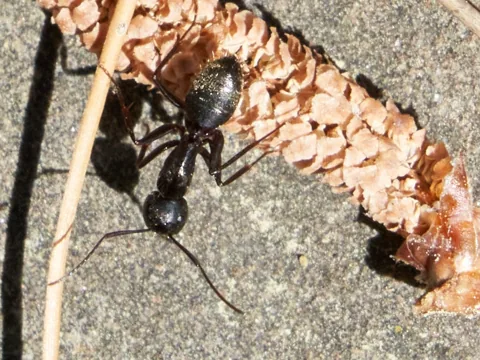 Carpenter Ants
Camponotus species
Carpenter ants don't eat wood the way termites do; they excavate it to nest, usually starting where wood is damp or decayed, and indoor nests are often satellites of a parent colony outdoors. Minnesota and Clemson extension both stress that they don't eat wood; they tunnel into it to make a nest.
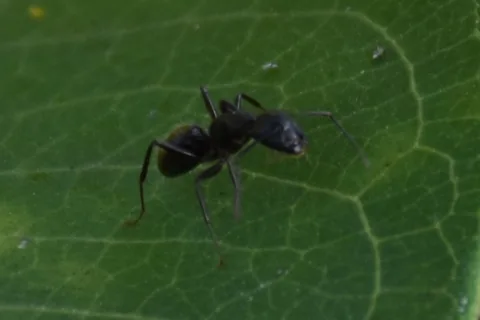 Black carpenter ant
Camponotus pennsylvanicus
The black carpenter ant is a common home invader in the northeastern United States and the most common carpenter ant in Ohio and Nebraska. Its large black workers come indoors looking for food, and colonies can set up satellite nests in moist or rotting wood and foam insulation inside the house.
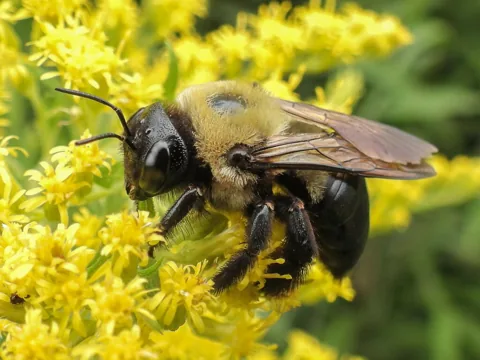 Eastern Carpenter Bee
Xylocopa virginica
Carpenter bees are large, solitary bees that bore round tunnels into bare, weathered wood to rear their young; they rarely cause severe damage but can weaken wood that is reused year after year.
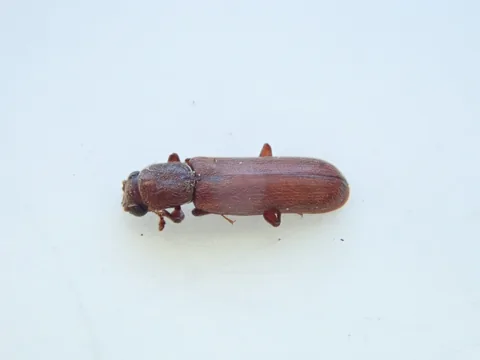 Powderpost Beetles
Lyctinae (e.g., Lyctus brunneus, Lyctus planicollis)
Powderpost beetles are small brown beetles whose larvae tunnel through dry, seasoned hardwood. Often the first clues are tiny round exit holes and little piles of flour-fine dust on floors, furniture or paneling.
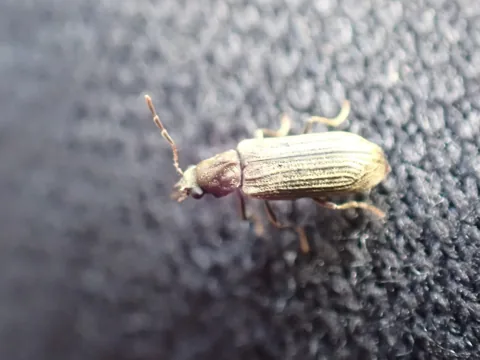 Deathwatch beetles
Anobiinae
Of the three groups of beetles that bore wood inside buildings, the deathwatch beetles are the ones a crawl space should worry about. True powderpost beetles stick to hardwood trim and furniture, but anobiids attack the spruce, pine, fir and Douglas-fir used for floor joists, studs, sills and beams, and because they digest cellulose rather than depending on the starch that fades from aging wood, they can keep reinfesting a house year after year. They need damp wood to do it, which is why Kentucky and NC State treat them as a moisture problem first and an insecticide problem second.
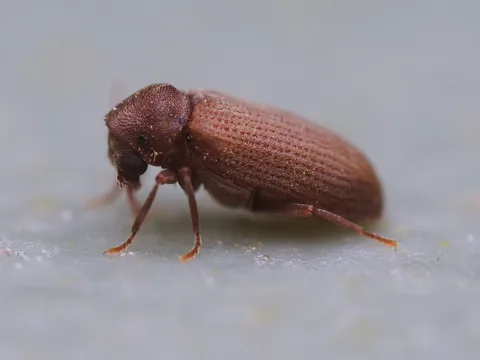 Common Furniture Beetle
Anobium punctatum
The common furniture beetle, Anobium punctatum, is a small anobiid powderpost beetle, often called woodworm. Its larvae tunnel through seasoned wood for a year or more, and despite the name it also attacks floors, framing and structural timbers.
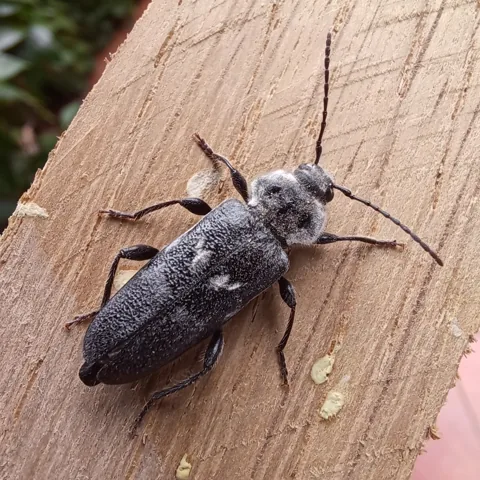 Old House Borer
Hylotrupes bajulus
Despite its name, the old house borer most often turns up in fairly new buildings. Its larvae tunnel inside pine, spruce, fir and other softwood framing for years, and damp, poorly ventilated spaces let infestations spread.
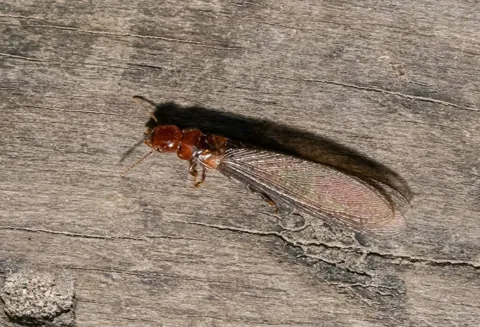 Western Drywood Termite
Incisitermes minor
Drywood termites live entirely inside wood without needing soil contact; the western drywood termite is California's second most important termite pest after subterranean termites. Clemson Extension says drywood termites get the moisture they need from humid air and are most common along humid coastal areas of South Carolina.
What's in the pile, and what it points to
- Coarse, stringy or fibrous wood particles with ant body parts and other debris, near window and door frames, sills, porch timbers, or in the basement or attic: carpenter ants.[2][1][3]
- Coarse sawdust on the ground or a ledge right under a round hole about the width of your little finger, often with large black bees hovering nearby in spring: carpenter bees. The tunnels run 6 to 10 inches into the wood, according to UC IPM.[4][5][6]
- Fine, dust-like powder with the feel of flour or talcum powder, in small piles under small round holes in hardwoods such as oak, ash or hickory: powderpost (lyctid) beetles. Most of the powder stays packed in the tunnels and only some falls out.[7][8][9]
- Grittier powder from softwood beams and joists, especially in a damp crawl space, basement or garage: deathwatch (anobiid) beetles. Coarse powder that stays packed tightly in the tunnels and feels like powdered borax soap points to false powderpost (bostrichid) beetles.[7][10]
- Powder the color of fresh-cut wood collecting below oval holes 1/4 to 3/8 inch across in pine or other softwood framing, sometimes with a rasping or clicking sound from inside the wood: old house borer.[11][12]
- Small piles of hard pellets, each about 1/32 inch long with six flat sides, beneath kick-out holes smaller than 2 mm: drywood termites. UC IPM notes ant sawdust is fibrous, unlike these pellets.[13][14][1]
How to confirm
- Look closely at the pile. Ant debris is fibrous and often holds bits of dead ants; drywood termite pellets have six sides and are diagnostic for drywood termites.[1][2][13]
- If you can see into the damaged wood, carpenter ant galleries are clean and smooth, as if sanded, with no soil or droppings in them, unlike termite galleries.[3][2]
- Carpenter ants forage mostly at night in spring and summer, so a flashlight check after dark can turn up workers. Winged ants at indoor windows suggest a nest inside, and you can sometimes hear a nest rustling inside a wall.[2][3][1]
- For powderpost beetles, fresh activity shows as powder the color of freshly sawn wood sifting from the holes. Yellowed, caked powder is usually old and likely from an infestation that has ended.[10][8]
- Drywood termite pellets don't show whether the infestation is still active or how far it reaches; UC IPM says sizing up an infestation takes experience and is best done by a professional.[13]
What to do next
- Carpenter ants: fix leaks and other moisture problems and replace water-damaged wood. If you use bait, pick a slow-acting product labeled for ants so workers carry it back to the colony.[3][1][2]
- Carpenter bees: they prefer bare, weathered softwoods such as redwood, cedar, cypress and pine, and painted or pressure-treated wood is much less likely to be attacked.[4][5]
- Powderpost beetles: borate products such as Tim-Bor and Bora-Care can penetrate unfinished wood and kill beetles inside it; UC IPM says a licensed pest control operator must apply them. Paint or varnish seals the pores where the beetles lay eggs.[7][10]
- Widespread beetle damage inside walls and floors may call for structural fumigation, which kills the beetles in the wood but doesn't keep new ones from moving in later.[10][7][9]
- Drywood termites: UC IPM advises calling a pest control professional, since the products for controlling them aren't sold to the public and do-it-yourself treatment isn't recommended.[13]
Common questions
- Is sawdust a sign of termites?
- Sometimes it's termite droppings mistaken for sawdust. Drywood termites push hard, six-sided pellets out of small holes; carpenter ant debris is stringy and fibrous by comparison, and powderpost beetle frass is flour-fine.[13][1][14][7]
- Do carpenter ants eat wood?
- No. They excavate galleries for their nests and push the wood out, which is why you find shavings rather than chewed-up wood inside the galleries.[3][2]
- Can powderpost beetles move from furniture into the house?
- They can. UC IPM says infestations often start with beetles or larvae brought in with furniture, firewood or wooden decor, and emerging adults lay eggs on other unfinished wood. Painted, varnished, waxed or stained surfaces are not attacked.[7][10]
Photo credits
- Carpenter Ants: (c) Linda Watson, some rights reserved (CC BY) — via iNaturalist, CC BY 4.0
- Black carpenter ant: (c) Zac Peterson, some rights reserved (CC BY) — via iNaturalist, CC BY 4.0
- Eastern Carpenter Bee: Erik Schiff, public domain (CC0), via iNaturalist
- Powderpost Beetles: Karel Schoonvaere, public domain (CC0), via iNaturalist
- Deathwatch beetles: (c) Lee Cain, some rights reserved (CC BY) — via iNaturalist, CC BY 4.0
- Common Furniture Beetle: (c) Tom, some rights reserved (CC BY) — via iNaturalist, CC BY 4.0
- Old House Borer: (c) Johannes Schlagbauer, some rights reserved (CC BY) — via iNaturalist, CC BY 4.0
- Western Drywood Termite: (c) Jeremiah Degenhardt, some rights reserved (CC BY) — via iNaturalist, CC BY 4.0
Sources
- University of California Statewide IPM Program, “Pest Notes: Carpenter Ants (UC ANR Publication 7416).” ipm.ucanr.edu/home-and-landscape/carpenter-ants/ (accessed 2026-11-12)
- Penn State Extension, “Carpenter Ants (Jacobs).” extension.psu.edu/carpenter-ants (accessed 2026-11-12)
- University of Minnesota Extension, “Carpenter ants (Hahn and Kells; reviewed 2024).” extension.umn.edu/insects-infest-homes/carpenter-ants (accessed 2026-11-12)
- University of Kentucky Entomology, “ENTFACT-611: Carpenter Bees.” entomology.mgcafe.uky.edu/ef611 (accessed 2026-11-12)
- University of California Statewide IPM Program, “Pest Notes: Carpenter Bees.” ipm.ucanr.edu/home-and-landscape/carpenter-bees/ (accessed 2026-11-12)
- Penn State Extension, “Carpenter Bees.” extension.psu.edu/carpenter-bees (accessed 2026-11-12)
- University of California Statewide IPM Program, “Pest Notes: Wood-Boring Beetles in Homes, Publication 7418 (V. R. Lewis, S. J. Seybold).” ipm.ucanr.edu/home-and-landscape/wood-boring-beetles-in-homes/ (accessed 2026-11-12)
- NC State Extension, “Powderpost Beetles and Wood-Inhabiting Fungi (reviewed 2023).” content.ces.ncsu.edu/powderpost-beetles-and-wood-inhabiting-fungi (accessed 2026-11-12)
- Penn State Extension, “Powderpost Beetles.” extension.psu.edu/powderpost-beetles (accessed 2026-11-12)
- University of Kentucky Entomology, “ENTFACT-616: Powderpost Beetles.” entomology.mgcafe.uky.edu/ef616 (accessed 2026-11-12)
- University of Kentucky Entomology, “ENTFACT-653: Old House Borer (revised March 2026).” entomology.mgcafe.uky.edu/ef653 (accessed 2026-11-12)
- Penn State Extension, “Old House Borer.” extension.psu.edu/old-house-borer (accessed 2026-11-12)
- University of California Statewide IPM Program, “Pest Notes: Drywood Termites (web edition).” ipm.ucanr.edu/home-and-landscape/drywood-termites/ (accessed 2026-11-12)
- Texas A&M University, Urban and Structural Entomology Program, “Drywood Termites.” urbanentomology.tamu.edu/urban-pests/termites/drywood/ (accessed 2026-11-12)
Updated 2026-11-12. Built from sourced records. Spot an error? Tell us.