The short answer
- Tiny round holes with fine, flour-like powder below them, in hardwood furniture, floors or trim, are usually powderpost beetle exit holes. The larvae can feed inside for one to five years before the adults emerge.[1][2][3]
- Oval holes 1/4 to 3/8 inch across in pine or other softwood framing point to the old house borer; a perfectly round hole about 1/2 inch wide in outdoor wood is a carpenter bee nest.[5][6][7][8]
- Fresh powder the color of new-cut wood means the insects are still active. Yellowed, caked powder is usually old.[1][3]
Profiles of wood-boring insects
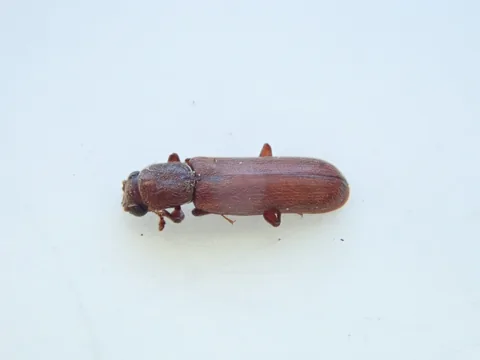 Powderpost Beetles
Lyctinae (e.g., Lyctus brunneus, Lyctus planicollis)
Powderpost beetles are small brown beetles whose larvae tunnel through dry, seasoned hardwood. Often the first clues are tiny round exit holes and little piles of flour-fine dust on floors, furniture or paneling.
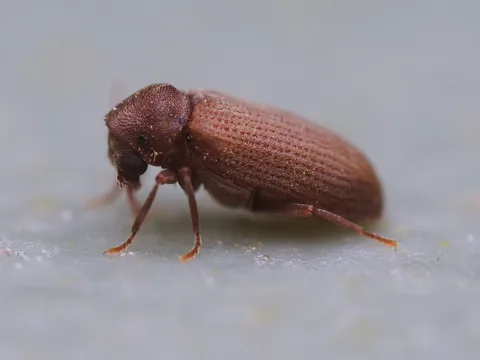 Common Furniture Beetle
Anobium punctatum
The common furniture beetle, Anobium punctatum, is a small anobiid powderpost beetle, often called woodworm. Its larvae tunnel through seasoned wood for a year or more, and despite the name it also attacks floors, framing and structural timbers.
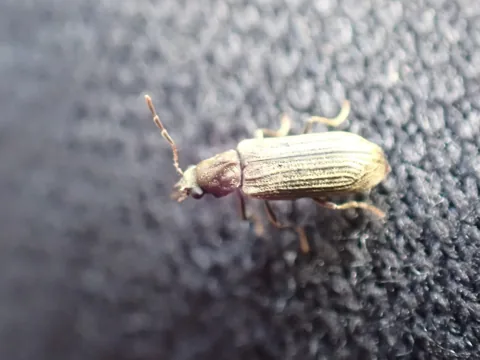 Deathwatch beetles
Anobiinae
Of the three groups of beetles that bore wood inside buildings, the deathwatch beetles are the ones a crawl space should worry about. True powderpost beetles stick to hardwood trim and furniture, but anobiids attack the spruce, pine, fir and Douglas-fir used for floor joists, studs, sills and beams, and because they digest cellulose rather than depending on the starch that fades from aging wood, they can keep reinfesting a house year after year. They need damp wood to do it, which is why Kentucky and NC State treat them as a moisture problem first and an insecticide problem second.
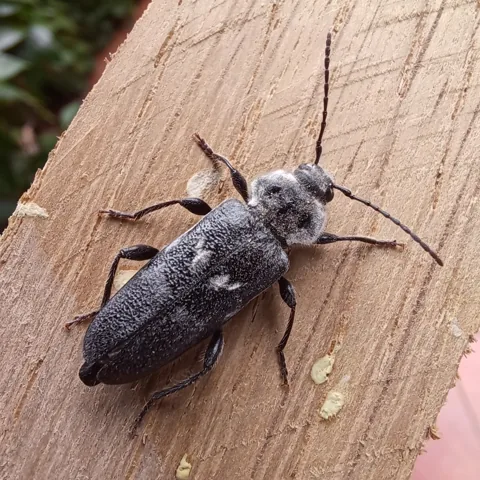 Old House Borer
Hylotrupes bajulus
Despite its name, the old house borer most often turns up in fairly new buildings. Its larvae tunnel inside pine, spruce, fir and other softwood framing for years, and damp, poorly ventilated spaces let infestations spread.
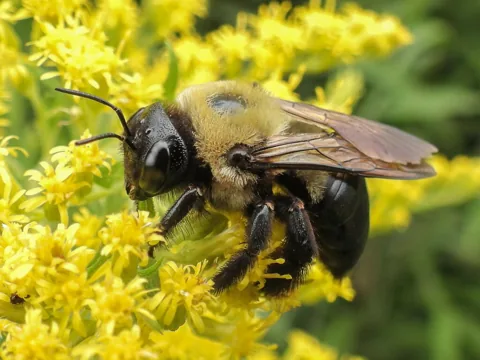 Eastern Carpenter Bee
Xylocopa virginica
Carpenter bees are large, solitary bees that bore round tunnels into bare, weathered wood to rear their young; they rarely cause severe damage but can weaken wood that is reused year after year.
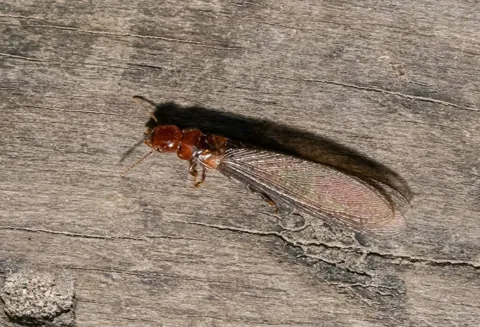 Western Drywood Termite
Incisitermes minor
Drywood termites live entirely inside wood without needing soil contact; the western drywood termite is California's second most important termite pest after subterranean termites. Clemson Extension says drywood termites get the moisture they need from humid air and are most common along humid coastal areas of South Carolina.
Hole size and shape, and what made them
Sources give slightly different hole sizes for the same beetles, so treat the numbers below as rough guides and look at the powder and the type of wood too.[3][4][1]
- Round holes about 1/32 to 1/16 inch across (NC State) and frass that looks and feels like talcum powder, in hardwoods such as oak, ash, hickory, maple, walnut or mahogany: lyctid powderpost beetles. Penn State gives 1/16 to 1/8 inch for powderpost beetle holes in general.[3][2][4]
- Round holes 1/16 to 1/8 inch, often of mixed sizes, in softwood or hardwood beams, floors and furniture in damp crawl spaces, basements and garages, with grittier powder: anobiid (deathwatch) beetles. They need wood moisture of 13 to 30 percent to develop.[1][2]
- Round holes 1/8 to 1/4 inch with coarse, meal-like powder packed tightly in the tunnels, often in new hardwood, bamboo articles or imported woods: bostrichid (false powderpost) beetles. They seldom re-infest wood after the first generation emerges.[1][2]
- Oval holes 1/4 to 3/8 inch in pine, spruce or other softwoods, with powder sifting out: old house borer.[5][6]
- One perfectly round hole about 1/2 inch across in eaves, fascia, decks or outdoor furniture, with coarse sawdust below: carpenter bee.[7][8]
- Very small kick-out holes, under 2 mm, with hard six-sided pellets piled below: drywood termites.[9][10]
Old damage or an active infestation?
- Check the powder. Active powderpost infestations usually have powder the color of freshly sawn wood sifting from the holes, while yellow, caked frass is usually old.[1][3]
- Expect to see damage rather than beetles. The adults hide and are active mainly at night, and small numbers may keep emerging for up to about five years.[1]
- New holes in a varnished or painted piece mean larvae were already in the wood. Beetles don't lay eggs on finished surfaces, but larvae inside can chew out through a finish, and some species even exit through plaster, plastic or soft metal.[1][2]
- Lyctids avoid softwoods such as pine, and UC IPM says powderpost beetles favor hardwoods because softwoods lack the pores they lay eggs in. Holes in pine framing therefore point to anobiids or the old house borer instead.[1][2][5]
What to do next
- Move infested pieces away from other wood and have them fumigated or otherwise treated; UC IPM advises removing and fumigating objects that show signs of beetle infestation.[2]
- Seal bare wood. Painting or varnishing closes the pores, cracks and holes where these beetles lay eggs.[2][1]
- Borate products such as Tim-Bor and Bora-Care penetrate unfinished wood, deeper when the wood is damper, and kill beetles inside it and those coming or going through the surface. UC IPM says a licensed pest control operator must apply them.[1][2]
- For anobiids, drying out the crawl space or basement matters most, since they need damp wood to survive.[1]
- Structural fumigation is the last resort for infestations, usually anobiid, that have spread into walls and between floors where surface treatment or removing wood isn't practical.[1][4]
- Drywood termites: call a professional; UC IPM says do-it-yourself treatment isn't recommended.[9]
Common questions
- Will powderpost beetles in a table spread to my floors and framing?
- Lyctids attack only hardwoods and avoid softwoods like pine, so softwood framing is at little risk from them. Anobiids are the group that can damage softwood beams, mainly where the wood is damp.[3][1][2]
- Are the holes in my antique furniture still active?
- Look for fresh powder the color of new-cut wood below the holes; yellowed, caked powder points to an old infestation. Brush the old powder away and check again for new piles.[1][3]
- Is fumigation always needed?
- No. Fumigation kills all stages of the beetles but leaves no protection against a new attack, and the University of Kentucky reserves it for infestations that can't be reached with surface treatment or wood removal.[4][1][2]
Photo credits
- Powderpost Beetles: Karel Schoonvaere, public domain (CC0), via iNaturalist
- Common Furniture Beetle: (c) Tom, some rights reserved (CC BY) — via iNaturalist, CC BY 4.0
- Deathwatch beetles: (c) Lee Cain, some rights reserved (CC BY) — via iNaturalist, CC BY 4.0
- Old House Borer: (c) Johannes Schlagbauer, some rights reserved (CC BY) — via iNaturalist, CC BY 4.0
- Eastern Carpenter Bee: Erik Schiff, public domain (CC0), via iNaturalist
- Western Drywood Termite: (c) Jeremiah Degenhardt, some rights reserved (CC BY) — via iNaturalist, CC BY 4.0
Sources
- University of Kentucky Entomology, “ENTFACT-616: Powderpost Beetles.” entomology.mgcafe.uky.edu/ef616 (accessed 2026-11-12)
- University of California Statewide IPM Program, “Pest Notes: Wood-Boring Beetles in Homes, Publication 7418 (V. R. Lewis, S. J. Seybold).” ipm.ucanr.edu/home-and-landscape/wood-boring-beetles-in-homes/ (accessed 2026-11-12)
- NC State Extension, “Powderpost Beetles and Wood-Inhabiting Fungi (reviewed 2023).” content.ces.ncsu.edu/powderpost-beetles-and-wood-inhabiting-fungi (accessed 2026-11-12)
- Penn State Extension, “Powderpost Beetles.” extension.psu.edu/powderpost-beetles (accessed 2026-11-12)
- University of Kentucky Entomology, “ENTFACT-653: Old House Borer (revised March 2026).” entomology.mgcafe.uky.edu/ef653 (accessed 2026-11-12)
- Penn State Extension, “Old House Borer.” extension.psu.edu/old-house-borer (accessed 2026-11-12)
- University of California Statewide IPM Program, “Pest Notes: Carpenter Bees.” ipm.ucanr.edu/home-and-landscape/carpenter-bees/ (accessed 2026-11-12)
- University of Kentucky Entomology, “ENTFACT-611: Carpenter Bees.” entomology.mgcafe.uky.edu/ef611 (accessed 2026-11-12)
- University of California Statewide IPM Program, “Pest Notes: Drywood Termites (web edition).” ipm.ucanr.edu/home-and-landscape/drywood-termites/ (accessed 2026-11-12)
- Texas A&M University, Urban and Structural Entomology Program, “Drywood Termites.” urbanentomology.tamu.edu/urban-pests/termites/drywood/ (accessed 2026-11-12)