The short answer
- Pattern of holes: a sapsucker drills small holes in tidy horizontal rows, often stacked down the trunk, and keeps coming back to them for sap. Other woodpeckers leave scattered or irregular holes, strip patches of bark while hunting insects, or chop larger nest holes.[1][11][13][10][2]
- Where: sapsucker wells are on live trees, usually healthy ones. Penn State says healthy trees are rarely damaged by woodpeckers, and when they are, the yellow-bellied sapsucker is usually the culprit. Pecking on siding, eaves, trim and gutters is the work of other woodpeckers.[6][1][10][2]
- The bird: a yellow-bellied sapsucker has a long white patch on the wing, a red forehead and, in males, a red throat. Downy and hairy woodpeckers, the usual mix-ups, have black crowns, plain white undersides and small white spots on the wings instead of a white band.[3][1]
- Sound: sapsucker drumming is irregular, like Morse code. Missouri Department of Conservation describes it as tap-tap, tap-tap-tap, tap; Penn State as rapid thumps followed by slow rhythmic ones.[3][1]
Birds on this page
Side by side
North America has four sapsuckers. The yellow-bellied sapsucker is the eastern one; Missouri Department of Conservation places the red-naped sapsucker in the Rocky Mountains and Great Basin, the red-breasted sapsucker along the Pacific Coast ranges from Alaska to northern California, and Williamson's sapsucker from southwestern Canada into central Mexico. WSU says the red-breasted sapsucker is common throughout western Washington.[3][10][12]
The "other woodpeckers" column below covers the species ICWDM lists as most often damaging homes and wooden structures: red-headed, acorn, golden-fronted, red-bellied, ladder-backed, downy, hairy and pileated woodpeckers and the northern flicker.[9]
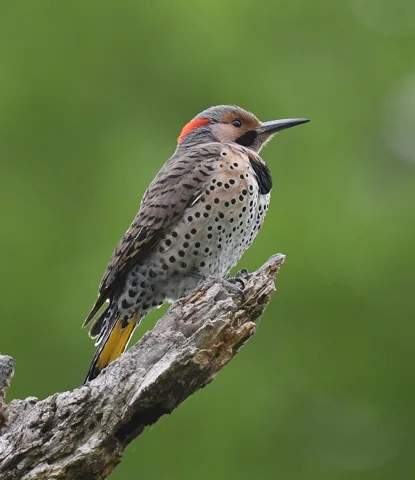
- Size: yellow-bellied sapsucker, 8 1/2 inches (Missouri) or 8 to 9 inches (Penn State). Downy woodpecker 6 3/4 inches (Missouri) or 6 to 7 inches (Penn State); hairy woodpecker 9 1/4 inches (Missouri) or 8.5 inches (Penn State); northern flicker 12 to 14 inches; pileated woodpecker 16 1/2 inches, crow-sized.[3][1][4][5]
- Markings: sapsucker, black and white head with a red crown, a white wing band, white rump and a finely mottled back that blends into bark; males have a red throat, females a white one, and the belly has a yellow wash. Downy and hairy, black crown, solid white underside, checkered black-and-white back and small white wing spots; the male has a red patch at the nape.[3][1][4]
- Young birds: juvenile sapsuckers have a brownish head, neck and throat, and Penn State says immature sapsuckers are brown, so a brown woodpecker on a sap-wet trunk in fall is worth a second look.[3][1]
- Food: sapsuckers rely more on sap than on insects. They drink the sap, eat the inner bark and catch insects, especially ants, drawn to the sap. Other woodpeckers mostly dig for wood-boring larvae and other insects; red-bellied woodpeckers prefer nuts and berries, and flickers often feed on the ground.[13][3][1][2]
- Marks on trees: sapsucker, parallel rows of closely spaced holes 1/4 to 3/8 inch across (ICWDM), or about a quarter inch (Mississippi State), on live trees. Other woodpeckers, bark flaked off in patches while hunting insects; pileated woodpeckers cut large oval to rectangular holes in dead trees, live conifers and utility poles.[6][10][2][1][5]
- Marks on houses: sapsuckers mostly damage trees. Other woodpeckers peck rows of small holes in siding when hunting insects, cut larger holes to nest in wall cavities, drum on downspouts, chimney caps and antennas, and in the West acorn woodpeckers stuff acorns into drilled holes and under shakes.[2][1][6]
- Nests: all are cavity nesters. ICWDM says yellow-bellied sapsuckers prefer to dig cavities in live trees, while red-headed and pileated woodpeckers favor dead trees; downy and hairy woodpeckers dig a new cavity each year and flickers return to the same one.[7][3]
- Season: in Missouri, yellow-bellied sapsuckers are present only from mid-September through April, peaking in March and October; they breed in Canada, the Great Lakes and New England. ICWDM says most woodpecker damage to buildings happens from February through June and again in fall.[3][13][6]
Reading the holes on a tree
Sapsucker wells come in two kinds. Mississippi State, Clemson and Arkansas Extension all describe small, deep, round holes where the bird probes for sap, and shallow rectangular holes it keeps open so sap continues to flow.[10][11][13]
The rows are the giveaway. Penn State says the bird typically drills five to seven holes arranged horizontally, adding rows down the trunk; Mississippi State says new holes usually line up with old ones. Arkansas Extension notes rows can run horizontally or vertically and may circle the whole stem.[1][10][13]
Look for wet, dark bark below fresh wells. Missouri Department of Conservation shows a black walnut trunk wet with sap from about 20 small sapsucker holes, and says squirrels, other birds and insects come to lick the sap. Hummingbirds may find their first meals of the season at sap wells, before flowers open.[3][11]
Same tree, year after year. ICWDM says sapsuckers usually feed on just a few ornamental or fruit trees while nearby trees of the same species go untouched, and Arkansas Extension says they are drawn to old wounds and may return to the same trees each season.[6][13]
Insect holes look different. Mississippi State says holes from bark beetles and other insects are typically fewer, smaller and not lined up, and often come with frass, the sawdust-like boring dust. Arkansas Extension adds that borer holes appear randomly rather than in neat rows, so homeowners sometimes blame borers for sapsucker work.[10][13]
Holes from other woodpeckers hunting insects are not lined up the way sap wells are, and UC IPM says woodpeckers searching for insects may also strip bark, leaving a patchy look on the trunk.[10][2]
Which trees sapsuckers pick
Clemson's Home and Garden Information Center says yellow-bellied sapsuckers drill wells in more than 1,000 species of trees and large woody plants, with pecan, maple, birch, elm and some oaks among the favorites. Arkansas Extension gives a similar southern list, adding pine, and notes that feeding is more likely on red maple than on southern red oak.[11][13]
Thin, smooth bark is easier. Mississippi State says sapsuckers prefer thin-barked trees such as maple and birch, that Bradford pears are common hosts because of their soft bark, and that trees with thick, furrowed bark are better defended. They also favor young, vigorous trees.[10]
Choices shift with the season. Penn State says the yellow-bellied sapsucker drills hemlocks, pines and other conifers in spring and also taps mature elm, maple and hickory; during fall migration it may drill apple, hackberry, maple and hemlock.[1]
Will the tree be okay?
Usually, yes. Clemson says the holes typically don't affect the overall health of the tree, WSU says mild to moderate damage usually has little long-term impact, and Missouri says sapsuckers in most cases don't seriously damage mature trees. Penn State notes that sapsucker holes in apple trees are shallow and soon heal over.[11][12][3][1]
Heavy feeding is the exception. Enough holes around a trunk or limb can girdle it and kill the part above. Missouri says this is mainly a problem in small trees and in birches in northern states, and Penn State says extensive summer drilling in high-sugar birches may kill branches or whole trees.[6][3][10][1]
Wounds open the door to other problems. Mississippi State and Arkansas Extension say many holes can let in insects and wood-decay fungi, and WSU says severe damage can weaken a tree enough to make it more prone to wind damage. UC IPM adds that the loss of sap may weaken the tree.[10][13][12][2]
Penn State says that in the forest, trees pecked by sapsuckers are most often ones that should be culled anyway. Woodpeckers that forage for bark insects are a help: Missouri says downy woodpeckers do trees a great service.[1][4]
The legal side
The U.S. Fish and Wildlife Service says the Migratory Bird Treaty Act prohibits the take of protected migratory birds, including killing, capturing, selling, trading and transport, without prior authorization from the Service.[14]
The federal list of protected birds in 50 CFR 10.13 includes all four sapsuckers (yellow-bellied, red-naped, red-breasted and Williamson's) along with downy, hairy, red-bellied and pileated woodpeckers and the northern flicker. Clemson notes the Act and federal regulations prohibit shooting sapsuckers, and Arkansas Extension says lethal control, including toxicants, is not an option.[15][11][13]
States add their own rules. UC IPM notes that the Gila woodpecker and gilded flicker are California-listed endangered species with greater protection. Before doing anything beyond scaring or excluding a bird, or touching a nest, check with USFWS or your state wildlife agency.[2][14]
What to do for each
Sapsucker on a valued tree: wrap the area being worked with 1/4-inch hardware cloth, plastic mesh or burlap. ICWDM says such barriers can be practical on high-value ornamental or shade trees; UC IPM says chicken wire around the trunk or limbs often persuades the bird to move on.[8][1][2][10]
Take the wrap off later. Arkansas Extension says to remove burlap once the feeding period has passed, and Mississippi State warns that leaving it on indefinitely can cause other damage.[13][10]
Expect the bird to try a neighbor. Mississippi State says wrapping can shift the bird to nearby trees, and in orchards and woodlots ICWDM suggests it may be better to let a sapsucker keep one or more favorite trees so it doesn't spread damage to others.[10][8]
Other deterrents for trees: Penn State and Arkansas Extension mention sticky repellents smeared on the limbs or trunk being worked; Arkansas and Mississippi State mention reflective tape, pie pans and owl decoys that move, which Arkansas says have had some success.[1][13][10]
Woodpecker on the house: the fixes are about the building, not the tree: netting, covering the spot, filling holes, and checking for insects in the siding. Our woodpecker-on-house guide walks through those steps, and the holes-in-siding page helps rule out bees and other causes.[2][8]
Woodpecker foraging on a tree: usually leave it be, since it is eating bark insects. If you also find scattered small holes with frass, the sawdust-like boring dust, the tree may have bark beetles or borers; our tree and shrub pest pages help identify them.[4][10]
Common questions
- Is a sapsucker a woodpecker?
- Yes. Sapsuckers are in the woodpecker family, Picidae, along with flickers. They differ in feeding mostly on sap from wells they drill rather than digging for insects.[1][2][13]
- What makes neat rows of holes around a tree trunk?
- Almost always a sapsucker. Rows of small, evenly spaced holes, often wet with sap, are sap wells. Insect exit holes are fewer, smaller and scattered, often with sawdust-like frass.[11][10][13][6]
- Will sapsucker holes kill my tree?
- Usually not. Most trees recover, but heavy drilling that circles a trunk or limb can girdle it, especially on small trees and birches, and the wounds can let in insects and decay.[11][3][10][1]
- Is the bird pecking my siding a sapsucker?
- Probably not. Sapsuckers mainly feed on trees. Damage to siding, eaves and trim, and drumming on gutters or chimney caps, is from other woodpeckers such as downy, hairy, red-bellied, flickers and pileated.[1][9][2]
- Can I kill or trap a sapsucker?
- No, not without authorization. Sapsuckers and the common woodpeckers are on the federal list of birds protected by the Migratory Bird Treaty Act. Use wraps or deterrents, and check with USFWS or your state wildlife agency before doing anything more.[14][15][13]
Photo credits
- Woodpeckers: Chrissy McClarren and Andy Reago, public domain (CC0), via iNaturalist
Sources
- Penn State Extension, “Woodpeckers.” extension.psu.edu/woodpeckers (accessed 2026-11-14)
- University of California Statewide IPM Program, “Pest Notes: Woodpeckers.” ipm.ucanr.edu/home-and-landscape/woodpeckers/ (accessed 2026-11-14)
- Missouri Department of Conservation, “Yellow-Bellied Sapsucker (field guide).” mdc.mo.gov/discover-nature/field-guide/yellow-bellied-sapsucker (accessed 2026-11-14)
- Missouri Department of Conservation, “Downy Woodpecker (field guide).” mdc.mo.gov/discover-nature/field-guide/downy-woodpecker (accessed 2026-11-14)
- Missouri Department of Conservation, “Pileated Woodpecker (field guide).” mdc.mo.gov/discover-nature/field-guide/pileated-woodpecker (accessed 2026-11-14)
- Internet Center for Wildlife Damage Management, “Woodpecker Damage Identification.” icwdm.org/species/birds/woodpeckers/woodpecker-damage-identification/ (accessed 2026-11-14)
- Internet Center for Wildlife Damage Management, “Woodpecker Biology.” icwdm.org/species/birds/woodpeckers/woodpecker-biology/ (accessed 2026-11-14)
- Internet Center for Wildlife Damage Management, “Woodpecker Damage Prevention and Control Methods.” icwdm.org/species/birds/woodpeckers/woodpecker-damage-prevention-and-control-methods/ (accessed 2026-11-14)
- Internet Center for Wildlife Damage Management, “Woodpeckers: Identification and Legal Status.” icwdm.org/species/birds/woodpeckers/ (accessed 2026-11-14)
- Mississippi State University Extension, “Recognizing Sapsucker Damage in Yard Trees.” extension.msstate.edu/publications/recognizing-sapsucker-damage-yard-trees (accessed 2026-11-14)
- Clemson University Home and Garden Information Center, “Yellow-bellied Sapsucker, Sphyrapicus varius, Sapwells.” hgic.clemson.edu/?p=17285 (accessed 2026-11-14)
- Washington State University Extension, “Vertebrate: Sapsucker damage (Hortsense).” hortsense.cahnrs.wsu.edu/fact-sheet/sapsucker-damage/ (accessed 2026-11-14)
- University of Arkansas System Division of Agriculture, “Sapsucker Damage on Woody Plants (FSA7561).” www.uaex.uada.edu/publications/PDF/FSA-7561.pdf (accessed 2026-11-14)
- U.S. Fish and Wildlife Service, “Migratory Bird Treaty Act of 1918.” www.fws.gov/law/migratory-bird-treaty-act-1918 (accessed 2026-11-14)
- Electronic Code of Federal Regulations, “50 CFR 10.13: List of Birds Protected by the Migratory Bird Treaty Act.” www.ecfr.gov/current/title-50/chapter-I/subchapter-B/part-10/subpart-B/section-10.13 (accessed 2026-11-14)