The short answer
- Look at the shape and size. Emerald ash borer is a narrow, bullet-shaped beetle about 1/2 inch long and 1/8 inch wide, small enough to fit on a penny, with uniformly bright metallic green wing covers and a purple or coppery-red abdomen under the wings.[1][2][3][11][16]
- Look at the hole. Adults chew out D-shaped exit holes about 1/8 inch across. The other borers that attack ash leave round or oval holes.[5][14][2][15][16]
- Look at the tree. Emerald ash borer develops only in ash (Fraxinus) and has also been found in white fringetree. A similar D-shaped hole in birch points to bronze birch borer, and mountain ash is not a true ash.[11][2][6][9]
- Look under loose bark. Emerald ash borer larvae leave winding S-shaped galleries packed with fine, sawdust-like frass, and they don't push sawdust out of the tree. Lilac/ash borer often expels coarse sawdust and leaves its old pupal skin sticking out of the hole.[1][6][11]
Profiles on this site
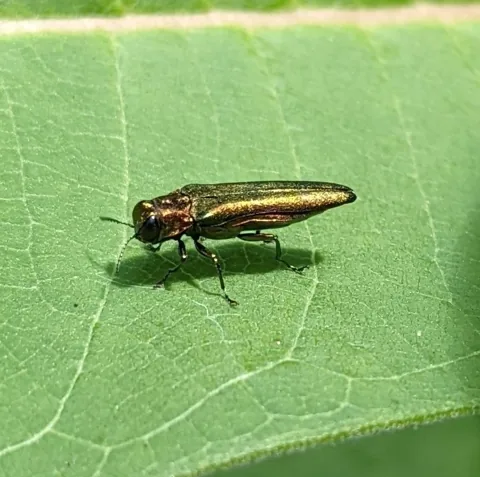 Emerald Ash Borer
Agrilus planipennis
The emerald ash borer is an invasive wood-boring beetle from Asia that has killed tens of millions of North American ash trees. Its larvae feed just under the bark, cutting off the flow of water and nutrients until the tree dies.
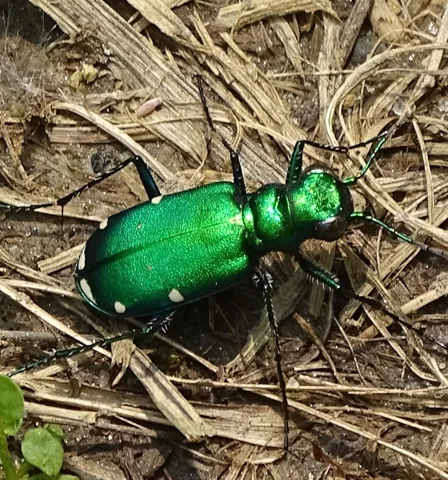 Six-spotted tiger beetle
Cicindela sexguttata
The six-spotted tiger beetle is a shiny, metallic green beetle that runs and flies in quick bursts along sunny trails in spring. Adults and larvae both hunt other insects, and the University of Minnesota counts it among the predators that help keep insects in check.
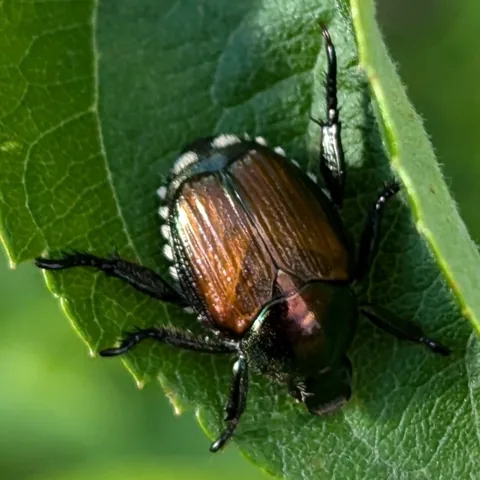 Japanese Beetle
Popillia japonica
The Japanese beetle damages landscapes twice: metallic green adults chew the leaves, flowers and fruit of hundreds of plants in early summer, and their white grubs feed on grass roots underground. A review of its biology calls it the most widespread and destructive insect pest of turf, landscapes and nursery crops in the eastern United States.
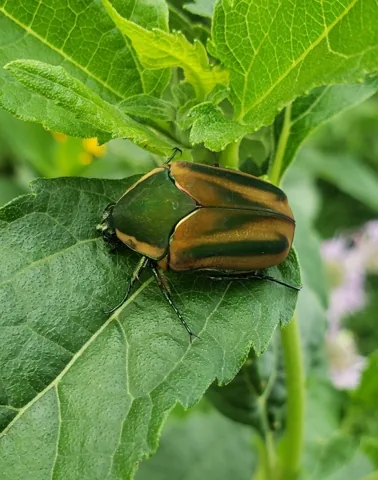 Green June Beetle
Cotinis nitida
Green June beetles are large, metallic green scarabs that cruise a few feet above lawns on summer days with a loud buzz. The adults damage ripe fruit, and their oversized grubs burrow in lawns rich in organic matter.
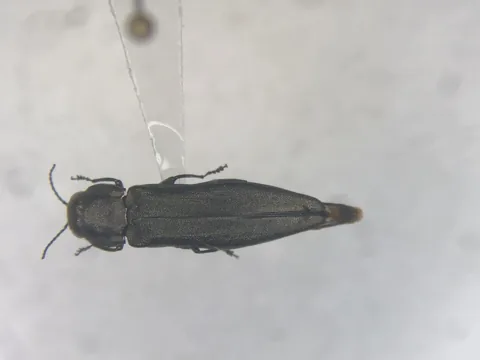 Bronze Birch Borer
Agrilus anxius
The bronze birch borer is a native wood-boring beetle whose larvae tunnel just under birch bark, girdling branches and trunks. It mostly kills stressed trees, and white-barked European and Asian birches are especially vulnerable.
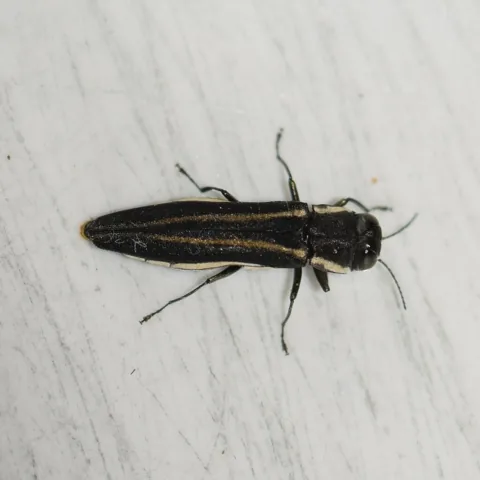 Twolined Chestnut Borer
Agrilus bilineatus
The twolined chestnut borer attacks stressed oaks; dieback starting at the top of the canopy is the classic sign.
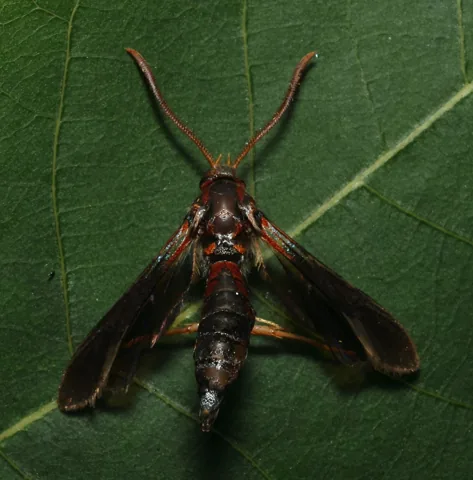 Ash/Lilac Borer
Podosesia syringae
The ash borer, also called the lilac or lilac/ash borer, is a native wasp-like clearwing moth whose caterpillars tunnel in ash, lilac, privet and related plants, mostly in stressed trees. It is not the emerald ash borer.
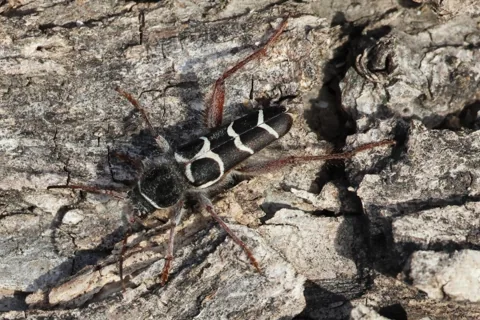 Banded ash borer
Neoclytus caprea
The banded ash borer is a black-and-yellow longhorned beetle whose larvae feed under the bark of dead, dying or stressed ash, elm and hickory and in freshly cut logs. If one shows up in your house in winter, it almost certainly came out of firewood. It can't harm people, pets or the house; sweep it up, and store firewood outdoors until you burn it.
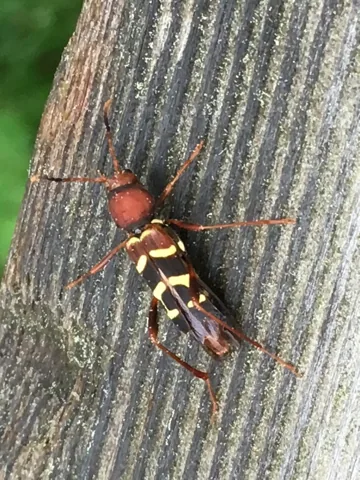 Redheaded Ash Borer
Neoclytus acuminatus
The redheaded ash borer, Neoclytus acuminatus, is a slender longhorned beetle about 1/2 to 5/8 inch long with a reddish head and thorax and yellow bands across dark wing covers; MDC says adults resemble wasps. Its grubs bore in newly planted, stressed, dying or dead hardwoods and bark-covered logs. NC State says beetles that emerge from firewood indoors can be a nuisance, and Kentucky entomologists say firewood borers have a very low potential to infest structural wood in a home. NC State's prevention advice is to keep trees healthy, and NPIC and Kentucky say to inspect firewood before moving it or bringing it in.
No photo yet
Western ash bark beetle
Hylesinus californicus
The western ash bark beetle is a tiny bark beetle that breeds in the inner bark of ash. It usually stays in injured or weakened branches, but after storms or drought leave a lot of weakened wood, numbers can build until many branches die, and an attack on the main stem can kill the tree.
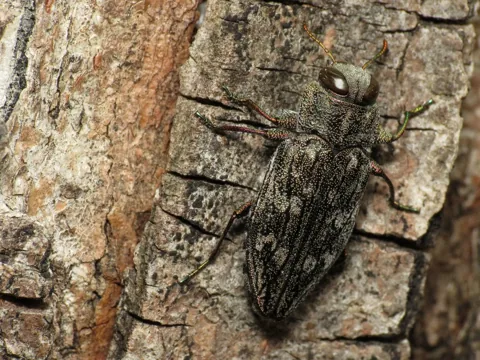 Flatheaded Appletree Borer
Chrysobothris femorata
The flatheaded appletree borer is a native metallic wood-boring beetle. Its larvae tunnel under the bark of the trunk and main branches of young, newly planted or stressed trees, apples and many shade trees alike, and can girdle and kill them.
Side by side
Each line compares emerald ash borer (Agrilus planipennis) with the beetles most often mistaken for it in the Midwest and East: the six-spotted tiger beetle, the Japanese beetle, the green June beetle and its own native relatives in the genus Agrilus, such as bronze birch borer and twolined chestnut borer.[4][13][6][5]
- Size: emerald ash borer is about 1/2 inch long (APHIS, Kentucky); Minnesota gives 3/8 to 1/2 inch and Colorado State 9-13 mm. Six-spotted tiger beetle is about the same, around half an inch (12-14mm). Japanese beetle is 7/16 inch in Kentucky's fact sheet, 1/3 to 1/2 inch in Minnesota's and about 10 mm (3/8 inch) in Penn State's. Green June beetle is much bigger, 3/4 inch to 1 inch long and 1/2 inch wide. Bronze birch borer and twolined chestnut borer are 1/4 to 1/2 inch long.[1][2][3][11][20][23][24][6][22][9]
- Color: emerald ash borer has uniformly bright metallic green wing covers and a purple or coppery-red abdomen under them. Six-spotted tiger beetles are metallic green, sometimes blue, usually with small white spots on the edges of the wing covers. Japanese beetles have a metallic green head and thorax with copper-brown wing covers. Green June beetles are dull or velvety green and tan on top and shiny metallic green or gold underneath. Bronze birch borer is iridescent bronze; twolined chestnut borer is bluish-black with two yellow stripes.[11][1][5][20][23][24][21][22][9]
- Shape: emerald ash borer has the bullet-shaped body typical of the metallic wood-boring beetle family (Buprestidae). Japanese and green June beetles are stout, rounded scarabs; the green June beetle is half as wide as it is long. Tiger beetles have long legs, big bulging eyes and large sickle-shaped jaws.[11][2][22][23][20]
- White hair tufts: Japanese beetles have a row of white tufts of hair along each side under the wing covers, five patches per side plus two at the tip of the abdomen. Emerald ash borer has no white tufts.[23][24][11]
- Antennae and jaws: emerald ash borer has very short antennae. Tiger beetle mandibles are large pincers, with the antennae starting just above their base.[7][19][20]
- Behavior: six-spotted tiger beetles run and fly fast and dart along trails just ahead of hikers. Green June beetles are big, noisy fliers whose buzzing sounds like a bumble bee. Japanese beetles feed on leaves and leave them skeletonized.[18][21][23]
- Where you see it: emerald ash borer is tied to ash trees. Tiger beetles are seen on sunny trails, dirt roads and sandbars, and sometimes rest on tree trunks. Japanese beetles are on the plants they feed on. Green June beetles come to ripe, thin-skinned fruit such as figs and grapes, and their grubs live in lawns.[11][20][19][23][21][22]
- Season: emerald ash borer adults emerge from late May to August in Minnesota, and in June and July according to the University of Wisconsin. Six-spotted tiger beetles are active from spring into early summer. Japanese beetles start feeding in June, with the heaviest activity over 4 to 6 weeks from late June. Green June beetle adults emerge in July and August.[5][15][20][18][23][22]
- Damage: emerald ash borer larvae kill ash by feeding under the bark. Tiger beetles are predators and cause no damage. Japanese beetles skeletonize leaves and their grubs damage turf. Green June beetles damage ripe fruit and their grubs injure lawns.[5][20][23][24][22][21]
The green beetles people mistake for emerald ash borer
Minnesota says many insects can be mistaken for emerald ash borer because of their size, shape or metallic green color. These are the ones that turn up most on the state and university look-alike lists.[3][4][6]
- Six-spotted tiger beetle (Cicindela sexguttata): probably the most familiar tiger beetle in Missouri and common along forest paths in Pennsylvania. It is about the same length as emerald ash borer and just as shiny, but it has long legs, large jaws and, in most individuals, white spots on the wing covers. The spot count varies from none to eight. It is a predator of other insects, so leave it alone.[18][6][20]
- Japanese beetle (Popillia japonica): two-toned rather than all green. The copper-brown wing covers and the white hair tufts along the sides separate it at a glance. It is a leaf feeder with hundreds of host plants, not a borer, and it starts feeding in June.[23][24][6]
- Green June beetle (Cotinis nitida): about twice the length of an emerald ash borer, broad, and dull green and tan on its back. Only the underside is bright metallic green or gold. Penn State notes it is native to the eastern half of the United States.[6][22][21]
- Bronze birch borer (Agrilus anxius): a close relative with the same slim shape, but bronze rather than green, and it feeds on birch. Its larvae also make S-shaped galleries and 1/8-inch D-shaped exit holes, so the host tree is what separates them.[9][6]
- Twolined chestnut borer (Agrilus bilineatus): another native relative in the same family, slender and 5 mm to 13 mm long, bluish-black with two light stripes on the wing covers. It feeds on white and red oaks.[6][9][25]
- Other native Agrilus: Colorado State says the native Agrilus species with green hues are smaller and less intensely colored than emerald ash borer; the most common one there, Agrilus cyanescens, is a blue-green beetle about 6-mm long that develops in honeysuckle.[11]
- Other metallic beetles: Minnesota's list also includes a Buprestis wood borer, a dogbane beetle, a green stink bug and ground beetles, and Penn State's list adds a dog-day cicada and a wasp in the family Chrysididae. Colorado State notes that some metallic green leaf beetles, usually found on leaves, can also be mistaken for it.[4][6][11]
Signs on an ash tree: holes, galleries and woodpeckers
Iowa State lists the signs together: canopy dieback, sprouts on the trunk, S-shaped feeding galleries under the bark, D-shaped exit holes, and more woodpecker activity and damage. No single one is proof, so look for several.[7][15]
- Exit holes: emerald ash borer leaves small, 1/8-inch D-shaped holes on the trunk and branches. The University of Wisconsin calls the D-shaped hole a strong indicator. Colorado State says the D shape is unique to metallic wood borers and may be the best indication of possible infestation. Oregon State warns that some emerald ash borer holes look more oval than D-shaped, but they have smooth edges.[5][15][11][14]
- Round or oval holes: exit holes of native borers are round or oval and vary in size, usually smaller or larger than an emerald ash borer hole.[15][16][2]
- Galleries under the bark: emerald ash borer larvae carve winding, S-shaped (serpentine) galleries in the inner bark that widen as the larva grows and are packed with frass. Colorado State says the tunnels stay confined to the cambium, with no sawdust pushed out of the tree.[1][2][6][11]
- Woodpecker flecking: woodpeckers peel off the outer bark and punch through to the larvae. Maryland DNR says the stripped bark leaves lighter patches; heavy damage is sometimes called flecking or bronzing. Penn State says these jagged woodpecker holes may be one of the first signs.[1][13][15][6][7]
- Woodpeckers alone don't prove it: they attack nearly any tree full of insect larvae, so the University of Wisconsin treats woodpecker activity as an indicator, not confirmation.[15][8]
- Crown and trunk: early symptoms include branch dieback in the upper part of the tree and sprouts on the lower trunk. As the tree declines, the bark may split vertically over the galleries.[2][7][6][5]
- Decline from other causes: drought, compacted soil and girdling roots also stress ash. Black ash in natural stands is prone to dieback without emerald ash borer, urban green ash may shed branches in a way that looks like dieback, and sprouts at the base can come from other stress.[5][15]
Ash damage that isn't emerald ash borer
Several native insects bore into ash. Colorado State and Maryland DNR both single out lilac/ash borer and the Neoclytus borers, whose holes are rounder than an emerald ash borer hole.[11][13]
- Lilac/ash borer (Podosesia syringae): the most common wood borer in ash in Colorado, and a native clearwing moth that resembles a paper wasp. Its caterpillars make gouging wounds, often push coarse sawdust out of the tree, and feed mostly on the lower trunk near the soil line. Exit holes are irregularly round, about 1/4-inch across, often with the old pupal skin sticking out. Moths emerge in early May through mid-June.[11][10]
- Banded ash borer and redheaded ash borer (Neoclytus): roundheaded longhorned beetle larvae that tunnel deep into the wood without mining the cambium the way emerald ash borer larvae do. Exit holes are round or oval, and Maryland DNR says banded ash borer and lilac/ash borer holes are larger and rounder than emerald ash borer holes.[11][13]
- Ash bark beetles: tiny (about 3-mm) beetles whose larvae make a central egg gallery with side galleries running off at right angles, not a single winding S. Exit holes are round, a bit thicker than a pencil lead, and usually many together on infested branches.[11][12]
- Flatheaded appletree borer (Chrysobothris femorata): in the Midwest it rarely attacks highly stressed ash and also makes a D-shaped hole, but its wounds are larger and gouge deeper, and the bark often weeps sap. Emerald ash borer injury doesn't do that.[11]
Why the difference matters
Lilac/ash borer should not be mistaken for emerald ash borer, Colorado State says, because the introduced beetle is far more damaging to ash. The response to each insect is different.[10]
- Emerald ash borer kills ash of all sizes, from trees as small as one inch in diameter to mature trees, and usually in about four years, sometimes as little as two. Ash trees are killed if they are not protected with insecticides, so finding it early leaves time to treat a tree that is worth saving.[5]
- Lilac/ash borer is most common in ash stressed by drought, injury or recent transplanting, and Colorado State says it can be controlled with a spring trunk spray timed to when females lay eggs.[10]
- Ash bark beetles are managed with insecticides applied to the bark and branches where they are active.[12]
- Japanese beetles and green June beetles are leaf, fruit and lawn pests, handled with the methods in the guides linked below. Tiger beetles help with natural insect control and need no treatment.[23][21][20]
How to confirm what you have
Minnesota notes that eggs and pupae are rarely seen and hard to identify, so confirmation rests on the adult beetle, the larvae and their galleries, and the exit holes.[3][5]
- Check the host first. Emerald ash borer develops only in ash, and identification is hard if a beetle isn't found on ash. Mountain ash is related to roses and is not attacked.[11][3][2]
- Measure the hole and look for the flat side of the D. Emerald ash borer holes are about 1/8 inch with smooth edges; lilac/ash borer holes are irregularly round, about 1/4-inch, often with sawdust pushed out or a pupal skin sticking out.[14][11][10]
- Peel back a little loose bark around a hole to see whether the galleries wind back and forth in an S or run off a straight central gallery.[6][11][1]
- Use a diagnostic checklist. University of Minnesota Extension offers a diagnostic tool for ruling out emerald ash borer, and Colorado State asks residents to bring suspect insects or infestations to a county extension office.[5][11]
- Report suspected finds. APHIS has an online form for reporting signs of emerald ash borer, and Minnesota takes reports through its Report a Pest line.[1][5][4]
What to do for each
With early detection and reporting there may be time to protect lightly infested trees nearby or slow the spread, according to University of Minnesota Extension.[5]
- Emerald ash borer confirmed or nearby: decide whether to treat or remove the tree. Arborists can inject emamectin benzoate or azadirachtin into the trunk; see the decision guide linked below for the full set of options.[5]
- Firewood: buy local or certified heat-treated firewood. APHIS removed its domestic emerald ash borer quarantine regulations, with the final rule effective January 14, 2021, but states may still regulate ash: Minnesota keeps quarantines on ash wood and materials, and Wisconsin still recommends buying firewood locally.[1][17][3][5]
- Lilac/ash borer: keep ash healthy and well watered, since stressed trees are the targets; spray the trunk and lower branches in spring when needed.[10]
- Bronze birch borer or twolined chestnut borer: these are birch and oak problems. University of Minnesota Extension says these borers prefer stressed, declining trees, and for birch lists sustained drought, prolonged defoliation, poor planting sites and root or trunk injury as stresses to avoid.[9]
- Japanese or green June beetles: follow the Japanese beetle, June bug and white grub guides linked below.[23][21]
- Six-spotted tiger beetle: no action needed; it is a predator.[20]
Common questions
- I found a shiny green beetle on my porch. Is it an emerald ash borer?
- Probably not, unless it is a slim, bullet-shaped beetle about 1/2 inch long with uniformly green wing covers. A long-legged beetle with big jaws and white spots is a six-spotted tiger beetle, one with copper wing covers and white tufts is a Japanese beetle, and a big, broad, buzzing beetle is a green June beetle.[11][1][2][20][23][21]
- Does a D-shaped hole always mean emerald ash borer?
- Not always. Bronze birch borer makes D-shaped holes in birch, and in the Midwest the flatheaded appletree borer rarely attacks highly stressed ash and also leaves a D-shaped hole. In an ash tree with S-shaped galleries under the bark, though, a 1/8-inch D-shaped hole is a strong sign.[6][9][11][15]
- Is emerald ash borer still under federal quarantine?
- No. APHIS removed its domestic quarantine regulations; the final rule took effect January 14, 2021. Some states still regulate ash wood, such as Minnesota, so check your state's rules before moving ash or firewood.[1][17][3]
- Can emerald ash borer kill my mountain ash?
- No. Mountain ash (Sorbus) is not a true ash; it is more closely related to roses and is not infested.[2]
- Are tiger beetles harmful?
- No. Six-spotted tiger beetles are predators that help with natural control of insects and other arthropods, and their larvae ambush prey from burrows in the soil.[20][19]
Photo credits
- Emerald Ash Borer: Christine Stone, public domain (CC0), via iNaturalist
- Six-spotted tiger beetle: (c) Shirley Zundell, some rights reserved (CC BY) — via iNaturalist, CC BY 4.0
- Japanese Beetle: (c) Emmett Collins-Sussman, some rights reserved (CC BY) — via iNaturalist, CC BY 4.0
- Green June Beetle: Jack, public domain (CC0), via iNaturalist
- Bronze Birch Borer: Nick Bédard, public domain (CC0), via iNaturalist
- Twolined Chestnut Borer: (c) Douglas Hooper, some rights reserved (CC BY) — via iNaturalist, CC BY 4.0
- Ash/Lilac Borer: (c) David George, some rights reserved (CC BY) — via iNaturalist, CC BY 4.0
- Banded ash borer: (c) Isaac Ethington, some rights reserved (CC BY) — via iNaturalist, CC BY 4.0
- Redheaded Ash Borer: wcmorton, public domain (CC0), via iNaturalist
- Flatheaded Appletree Borer: (c) Katja Schulz, some rights reserved (CC BY) — via iNaturalist, CC BY 4.0
Sources
- USDA Animal and Plant Health Inspection Service, “Emerald Ash Borer.” www.aphis.usda.gov/plant-pests-diseases/eab (accessed 2026-11-14)
- University of Kentucky Entomology, “Emerald Ash Borer (ENTFACT-453).” entomology.mgcafe.uky.edu/ef453 (accessed 2026-11-14)
- Minnesota Department of Agriculture, “Emerald Ash Borer.” www.mda.state.mn.us/plants-insects/emerald-ash-borer (accessed 2026-11-14)
- Minnesota Department of Agriculture, “Insects in Minnesota Confused with Emerald Ash Borer.” www.mda.state.mn.us/sites/default/files/docs/2025-07/Insect_Minnesota_Confused_with_Emerald_AshBorer_WEB.pdf (accessed 2026-11-14)
- University of Minnesota Extension, “Emerald ash borer.” extension.umn.edu/garden-and-home/yard-and-garden/yard-and-garden-insects/emerald-ash-borer (accessed 2026-11-14)
- Penn State Extension, “Emerald Ash Borer.” extension.psu.edu/emerald-ash-borer (accessed 2026-11-14)
- Iowa State University Extension and Outreach, “Emerald Ash Borer.” yardandgarden.extension.iastate.edu/encyclopedia/emerald-ash-borer (accessed 2026-11-14)
- USDA Forest Service, “Fighting invasive emerald ash borers with woodpeckers and citizen scientists.” www.fs.usda.gov/about-agency/features/fighting-invasive-emerald-ash-borers-woodpeckers-and-citizen-scientists (accessed 2026-11-14)
- University of Minnesota Extension, “Bronze birch borer and twolined chestnut borer.” extension.umn.edu/garden-and-home/yard-and-garden/yard-and-garden-insects/metallic-wood-boring-beetles (accessed 2026-11-14)
- Colorado State University Extension, “Lilac/Ash Borer: A Common Wood Borer of Colorado's Street Trees.” extension.colostate.edu/resource/lilac-ash-borer-a-common-wood-borer-of-colorados-street-trees/ (accessed 2026-11-14)
- Colorado State University, “Emerald Ash Borer in Colorado: Identification of Insects and Damage of Similar Appearance.” webdoc.agsci.colostate.edu/bspm/Hexapoda%20(Insects)/Emerald%20Ash%20Borer.pdf (accessed 2026-11-14)
- Utah State University Extension, “Ash Bark Beetle.” extension.usu.edu/planthealth/ipm/ornamental-pest-guide/arthopods/bark-beetles/ash-bark-beetle.php (accessed 2026-11-14)
- Maryland Department of Natural Resources, “Signs of Emerald Ash Borer.” dnr.maryland.gov/forests/pages/foresthealth/signs-of-emerald-ash-borer.aspx (accessed 2026-11-14)
- Oregon State University Extension (Solve Pest Problems), “Emerald Ash Borer (EAB).” solvepestproblems.oregonstate.edu/invasive/emerald-ash-borer (accessed 2026-11-14)
- University of Wisconsin-Madison, “Symptoms and Signs of EAB.” eab.russell.wisc.edu/signs-and-symptoms/ (accessed 2026-11-14)
- Illinois Department of Agriculture, “Emerald Ash Borer Life Cycle / Effects.” agr.illinois.gov/insects/pests/emeraldashborer/eab-life-cycle.html (accessed 2026-11-14)
- Wisconsin Department of Natural Resources, “Emerald Ash Borer.” dnr.wisconsin.gov/topic/foresthealth/emeraldashborer (accessed 2026-11-14)
- Missouri Department of Conservation, “Six-Spotted Tiger Beetle (field guide).” mdc.mo.gov/discover-nature/field-guide/six-spotted-tiger-beetle (accessed 2026-11-14)
- Missouri Department of Conservation, “Tiger Beetles (field guide).” mdc.mo.gov/discover-nature/field-guide/tiger-beetles (accessed 2026-11-14)
- University of Minnesota Department of Entomology, “Six-Spotted Tiger Beetle.” entomology.umn.edu/node/1241 (accessed 2026-11-14)
- Penn State Extension, “Green June Beetle.” extension.psu.edu/green-june-beetle (accessed 2026-11-14)
- University of Kentucky Entomology, “Green June Beetle on Grapes (ENTFACT-227).” entomology.mgcafe.uky.edu/ef227 (accessed 2026-11-14)
- University of Kentucky Entomology, “Japanese Beetles in the Urban Landscape (ENTFACT-451).” entomology.mgcafe.uky.edu/ef451 (accessed 2026-11-14)
- University of Minnesota Extension, “Japanese beetles.” extension.umn.edu/yard-and-garden-insects/japanese-beetles (accessed 2026-11-14)
- NC State Extension, “Twolined Chestnut Borer.” content.ces.ncsu.edu/twolined-chestnut-borer (accessed 2026-11-14)