The short answer
- Color: a Japanese beetle has a metallic green head and thorax with copper-brown wing covers. May and June beetles are reddish brown to nearly black, with no spots or stripes.[2][1][5][6]
- White tufts: the Japanese beetle has five patches of white hair along each side of the abdomen and two at the tip. June beetles have none.[2][9][8]
- Day or night: Japanese beetles feed and fly on warm, sunny days. May and June beetles are active after dusk and come to lights at night.[1][3][5][9][6]
- Size: Japanese beetles are about 1/3 to 1/2 inch long (Minnesota). May and June beetles are typically 1/2 to 1 inch.[2][5][6]
Profiles on this site
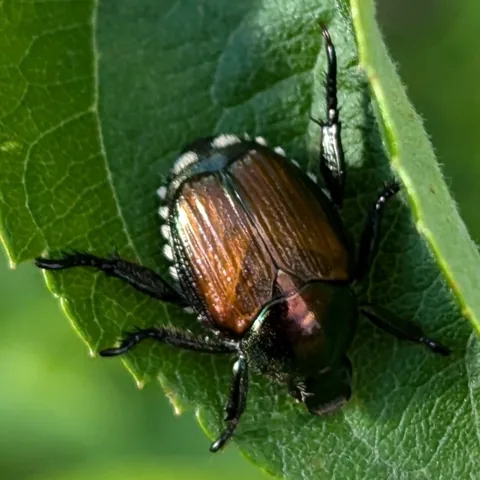 Japanese Beetle
Popillia japonica
The Japanese beetle damages landscapes twice: metallic green adults chew the leaves, flowers and fruit of hundreds of plants in early summer, and their white grubs feed on grass roots underground. A review of its biology calls it the most widespread and destructive insect pest of turf, landscapes and nursery crops in the eastern United States.
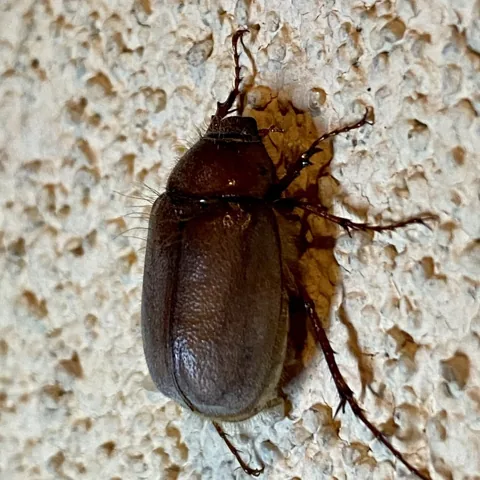 May and June Beetles
Phyllophaga species
May and June beetles, or June bugs, are native scarab beetles in the genus Phyllophaga. The adults buzz around porch lights on early summer nights, while their C-shaped grubs feed on roots, mostly in turf.
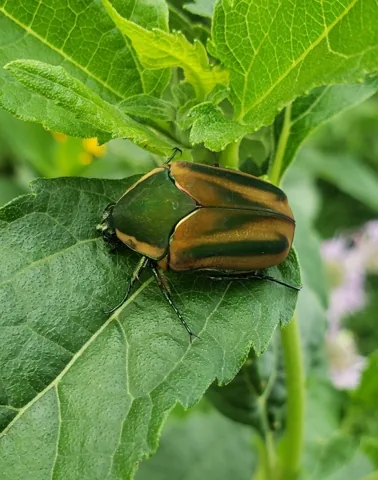 Green June Beetle
Cotinis nitida
Green June beetles are large, metallic green scarabs that cruise a few feet above lawns on summer days with a loud buzz. The adults damage ripe fruit, and their oversized grubs burrow in lawns rich in organic matter.
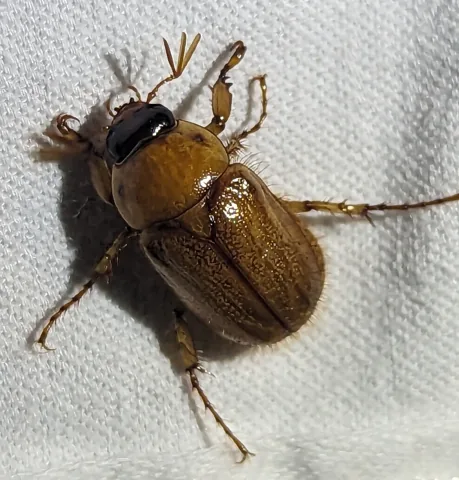 Masked Chafers
Cyclocephala species (northern masked chafer, C. borealis; southern masked chafer, C. lurida)
Masked chafers are native North American beetles whose larvae, called white grubs, feed on turfgrass roots. The adults don't feed at all; the grubs do the damage, mostly in late summer and fall.
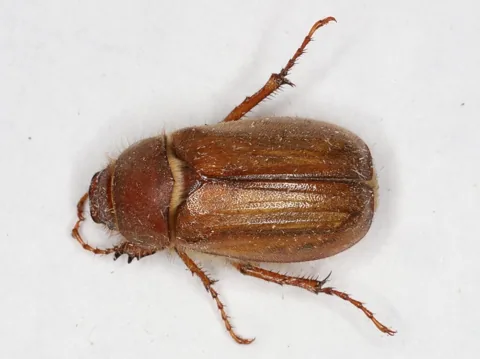 European Chafer
Amphimallon majale
The European chafer is an invasive beetle whose C-shaped white grubs are a severe pest of lawns. The grubs feed longer during the year than Japanese beetle grubs, so they are considered more destructive to turf.
Side by side
Each line below sets the Japanese beetle (Popillia japonica) against the May and June beetles (Phyllophaga species). Wisconsin counts over 200 Phyllophaga species in North America, and Missouri says the many species are hard to tell apart, so the June beetle column describes the group.[5][6]
- Size: Kentucky gives 7/16 inch for the adult Japanese beetle, Penn State ⅜ to ½ inch and NC State about 16 mm. May and June beetles are ½ to 1 inch, depending on species.[1][8][3][5][6]
- Color: Japanese beetle metallic green on the head and thorax with copper-brown wing covers. June beetles brown, rusty or black, sometimes with shiny wing covers, and hairy underneath.[2][1][6][7]
- Field mark: the Japanese beetle's row of white hair tufts shows under the edge of the wing covers on each side, with two more at the tail. A June beetle's sides are plain.[1][2][9]
- Activity: Japanese beetles are most active on warm, sunny days and favor plants in direct sun. May and June beetles fly in the evening, are attracted to lights, and grip window screens and door frames.[1][3][5][7]
- Adult food: Japanese beetles eat the leaves, flowers or fruit of more than 300 plant species, with roses, grapes, linden, apples, cherries, birch and raspberries among the favorites. May and June beetle adults eat leaves and flowers, and Wisconsin notes foliage damage on oaks and other trees.[2][6][5]
- Leaf damage: Japanese beetles eat the tissue between the veins, leaving lace-like, skeletonized leaves, and they feed in groups from the top of the plant down. May and June beetles feed after dark.[1][2][5][9]
- Season: Japanese beetle adults come out in late June or early July and feed mainly in July and August; Kentucky describes a 4 to 6 week peak from late June. May and June beetles are out in late May and early June.[2][1][5][10]
- Life cycle: Japanese beetles complete one generation a year. May and June beetles take longer: Wisconsin says three years for most species (two for Phyllophaga tristis), while Clemson and Purdue give two to three years.[3][9][5][10]
- Origin: the Japanese beetle came from Japan and was first found in New Jersey in 1916. May and June beetles are native.[4][5]
The grubs: all C-shaped and white
You can't tell these grubs apart at a glance. Both are cream-colored, C-shaped larvae with a brownish head and three pairs of legs, and both live in the soil and feed on grass roots.[2][5][12][10]
Size helps a little. Japanese beetle grubs reach about 1 inch by late summer. May and June beetle grubs can be up to 1¼ inches long and get bigger and more destructive through their three larval stages.[1][2][5]
The reliable check is the raster, the pattern of hairs, spines and bare spots on the underside of the last body segment in front of the anus. Lay the grub on its back, rinse that spot with water, and look with a hand lens or magnifying glass.[8][9][10]
Japanese beetle: a distinct V-shaped set of small spines just in front of a crosswise anal slit. Massachusetts and Clemson both call it distinctive.[11][9][8]
May and June beetle: two lengthwise rows of spines with stouter, scattered spines around them. Two nearly parallel rows also show on European chafer and oriental beetle grubs; Massachusetts tells those apart by the anal slit (Y-shaped on the European chafer, crosswise on the oriental beetle).[9][11]
Two more scarabs people call June bugs
If the beetle doesn't match either description, check these before choosing a fix.[8][13]
- Green June beetle (Cotinis nitida): green like a Japanese beetle but much bigger, 3/4 inch to 1 inch long, dull green and tan on top and shiny green-gold underneath, with no white tufts. It buzzes loudly in flight and flies low over turf in the morning. Its grubs reach 2 inches, keep their legs short and crawl on their backs. Adults emerge in July and August and go after ripening fruit such as grapes.[13][14][15][9]
- Masked chafers (Cyclocephala): chestnut brown, about 1/2 inch, with a darker head that gives a masked look. Penn State says they resemble small June beetles and are active at night. Ohio State says the adults do not feed on ornamental plants or turf; the damage comes from the grubs, which have a random raster.[8][16][9]
What each one damages
The Japanese beetle hurts plants twice: adults strip foliage, flowers and fruit in midsummer, and the grubs chew grass roots, so the turf browns, dies and pulls up like a loose carpet. Minnesota says healthy roses can survive the leaf feeding.[2][1]
With May and June beetles the grubs are the main problem. Purdue says the grubs cause their worst turf injury in the second season of the life cycle, when they are larger. Adults feed on leaves after dark, and Wisconsin notes damage to oaks and other trees.[10][5][7]
For both, digging by skunks, raccoons, crows and moles hunting the grubs can tear up more lawn than the grubs do, and Purdue says it can be the first obvious sign. Penn State lists dead patches in spring (April and May) and late summer and fall (September and October).[8][10][2][12]
How to confirm which one you have
Adults: catch one and look at the sides of the abdomen. White tufts plus metallic green and copper means Japanese beetle. A plain brown beetle at the porch light after dark is a May or June beetle, and a large green one buzzing over the lawn in daylight is likely a green June beetle.[2][5][13][14]
Grubs: Clemson suggests cutting three sides of a 12-inch square in the turf, folding the flap back and checking the root zone and top 1 to 3 inches of soil in several spots. Read the raster on a few grubs. If you send grubs in for identification, Clemson says to kill them first in water that has just come off the boil, or they turn black and are much harder to identify.[9][8]
Purdue warns that seeing adults at lights or in traps does not predict next year's grub damage, so check the soil before treating a lawn.[10]
Why the ID changes the plan
Timing differs. Japanese beetle grubs are on a one-year cycle, while June beetle grubs may stay in the same lawn two or three years, and Purdue notes the worst injury comes in their second season.[9][10][5]
Milky spore (Paenibacillus popilliae) products work only on Japanese beetle grubs, according to Purdue, Penn State, Minnesota and NC State's Lee County office. Penn State says it suppresses Japanese beetle grubs; Minnesota says commercial milky spore has not shown a benefit in modern university trials.[10][8][2][7]
Spraying adults is a Japanese beetle question, because they feed on garden plants in daylight. NC State's Lee County office says May-June beetles are not dangerous to people; with them, the grubs are what count.[2][1][7]
What to do for each
Japanese beetle adults: skip the traps. Kentucky research found the traps attract many more beetles than they catch, Minnesota says a trap is not an effective way to protect a home garden, and NC State advises homeowners with fruit trees not to put them up. If you try one anyway, Kentucky says to place it well away from gardens and landscape plants. Handpicking, netting and sprays are covered in the Japanese beetle guide linked below.[1][2][3]
June beetles at lights: the Lee County office says they are not dangerous to people. The June bug guide covers lights, screens and the fruit-feeding green June beetle.[7][6]
Grubs of either kind: treat only when a soil check finds enough grubs to matter. Minnesota and Clemson say healthy turf can typically tolerate up to 10 grubs per square foot, and Purdue says most turf tolerates up to 5 per square foot without visible damage. Preventive and curative timing, product choices and nematodes are covered in the lawn grub guide.[2][9][10]
In the West, the Japanese beetle is a regulated pest. APHIS maintains a quarantine to keep it from hitchhiking to Western states and asks people to report possible finds.[4]
Common questions
- Is a Japanese beetle a June bug?
- No. Both are scarab beetles, but May and June beetles are native Phyllophaga species that are brown and fly at night, while the Japanese beetle is a green and copper import that feeds by day.[5][6][4]
- Do Japanese beetles come to porch lights?
- Not as a rule. They are active on warm, sunny days. Beetles at lights after dark are more likely May or June beetles, which are attracted to lights, or masked chafers, which are active at night.[1][5][8]
- Does milky spore work on June beetle grubs?
- No. Commercial milky spore is active only against Japanese beetle grubs, and Minnesota says it has not shown a benefit in modern university trials.[10][2][8]
- Which grub is worse for my lawn?
- Either can kill turf. Japanese beetle grubs turn over every year, while a May or June beetle brood can feed for two or three years, doing the most harm in its second season.[2][10][9]
Photo credits
- Japanese Beetle: (c) Emmett Collins-Sussman, some rights reserved (CC BY) — via iNaturalist, CC BY 4.0
- May and June Beetles: (c) Elliott Gordon, some rights reserved (CC BY) — via iNaturalist, CC BY 4.0
- Green June Beetle: Jack, public domain (CC0), via iNaturalist
- Masked Chafers: (c) Michael, Antoni and Nihat Hinczewski, some rights reserved (CC BY) — via iNaturalist, CC BY 4.0
- European Chafer: Allan Harris, public domain (CC0), via iNaturalist
Sources
- University of Kentucky Entomology, “ENTFACT-451: Japanese Beetles in the Urban Landscape.” entomology.ca.uky.edu/ef451 (accessed 2026-11-14)
- University of Minnesota Extension, “Japanese beetles in yards and gardens.” extension.umn.edu/yard-and-garden-insects/japanese-beetles (accessed 2026-11-14)
- NC State Extension, “Japanese Beetle.” content.ces.ncsu.edu/japanese-beetle (accessed 2026-11-14)
- USDA Animal and Plant Health Inspection Service, “Japanese Beetle.” www.aphis.usda.gov/plant-pests-diseases/japanese-beetle (accessed 2026-11-14)
- University of Wisconsin-Madison Extension, Wisconsin Horticulture, “May/June Beetles.” hort.extension.wisc.edu/articles/mayjune-beetles/ (accessed 2026-11-14)
- Missouri Department of Conservation, “May Beetles (June Bugs).” mdc.mo.gov/discover-nature/field-guide/may-beetles-june-bugs (accessed 2026-11-14)
- N.C. Cooperative Extension, Lee County Center, “May-June Beetles.” lee.ces.ncsu.edu/2021/05/may-june-beetles (accessed 2026-11-14)
- Penn State Extension, “White Grubs in Home Lawns.” extension.psu.edu/white-grubs-in-home-lawns (accessed 2026-11-14)
- Clemson Cooperative Extension, Home & Garden Information Center, “White Grub Management in Turfgrass.” hgic.clemson.edu/factsheet/white-grub-management-in-turfgrass/ (accessed 2026-11-14)
- Purdue University Extension Entomology, “Managing White Grubs in Turfgrass (E-271-W).” extension.entm.purdue.edu/publications/E-271.pdf (accessed 2026-11-14)
- UMass Amherst Center for Agriculture, Food, and the Environment, “White Grub Identification.” www.umass.edu/agriculture-food-environment/home-lawn-garden/fact-sheets/white-grub-identification (accessed 2026-11-14)
- University of Wisconsin-Madison Extension, Wisconsin Horticulture, “Grub Control in the Home Lawn.” hort.extension.wisc.edu/articles/grub-control-home-lawn/ (accessed 2026-11-14)
- University of Kentucky Entomology, “ENTFACT-227: Green June Beetle.” entomology.mgcafe.uky.edu/ef227 (accessed 2026-11-14)
- Missouri Department of Conservation, “Green June Beetle.” mdc.mo.gov/discover-nature/field-guide/green-june-beetle (accessed 2026-11-14)
- Penn State Extension, “Green June Beetle.” extension.psu.edu/green-june-beetle (accessed 2026-11-14)
- Ohio State University Extension, Ohioline, “Masked Chafers (ENT-51).” ohioline.osu.edu/factsheet/ENT-51 (accessed 2026-11-14)