The short answer
- Lacy leaves eaten from the top, with metallic green and copper beetles on them in summer: Japanese beetles.[2][1]
- Rose leaves with see-through windowpane patches and small green, slug-like larvae: roseslugs (sawfly larvae).[4][5][3]
- Bean leaves turned lacy from underneath, with yellow, spiny larvae on the undersides: Mexican bean beetle.[6][7]
Profiles of pests that skeletonize leaves
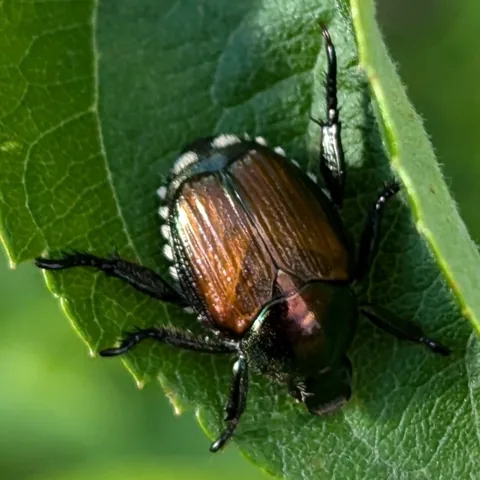 Japanese Beetle
Popillia japonica
The Japanese beetle damages landscapes twice: metallic green adults chew the leaves, flowers and fruit of hundreds of plants in early summer, and their white grubs feed on grass roots underground. A review of its biology calls it the most widespread and destructive insect pest of turf, landscapes and nursery crops in the eastern United States.
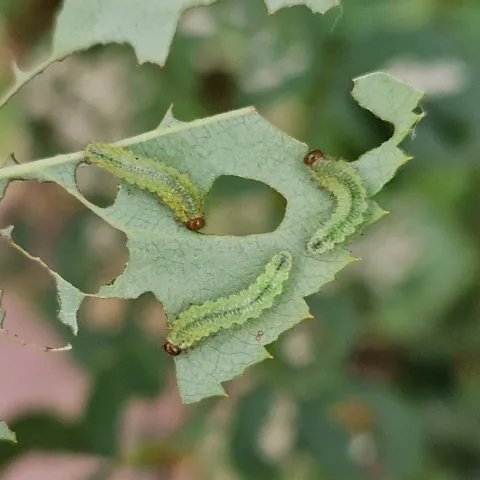 Rose Slugs (Rose Sawflies)
Cladius difformis (bristly roseslug; GBIF treats it as a synonym of Cladius pectinicornis), Endelomyia aethiops and Allantus cinctus
Rose slugs, or roseslugs, are the larvae of sawflies, wasp relatives that feed on rose leaves. The bristly roseslug causes the most trouble because it has several generations a year and keeps feeding until frost, while the roseslug and curled rose sawfly feed mainly early in the season. Ohio State says the bristly roseslug has largely replaced the other two in Ohio.
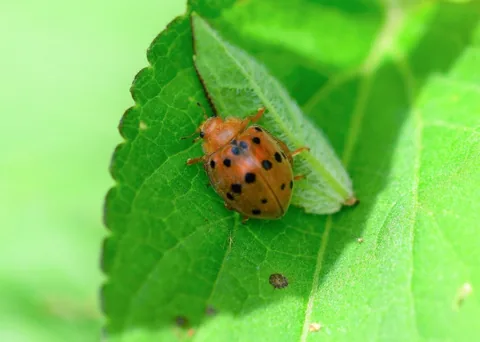 Mexican Bean Beetle
Epilachna varivestis
The Mexican bean beetle is a plant-eating member of the lady beetle family. Adults and spiny yellow larvae feed almost entirely on the undersides of bean leaves, leaving them lacy, and heavy infestations can defoliate plants and cut yields.
Skeletonized leaf clues and the likely culprit
Check which side of the leaf was eaten and what the plant is, then look for the insect on that side.[2][6]
- Tissue chewed out between the veins from the upper surface, giving a lace-like look; damaged leaves turn brown and may drop. Badly hit trees can look scorched: Japanese beetles, which feed on more than 300 plant species.[2][1]
- Windowpane damage, where one leaf surface is scraped away between the veins and the other is left: slug sawfly larvae such as roseslugs. Some species' larvae later chew holes or eat all but the main veins.[3][4][5]
- Lace-like damage on beans, eaten from the underside of leaves, with yellow-orange egg clusters underneath: Mexican bean beetle. Both adults and larvae feed.[6][7]
How to confirm the cause
- Turn leaves over. Roseslug larvae and Mexican bean beetle eggs, larvae and pupae are on the undersides; Japanese beetles feed on the upper surface.[5][6][7][2]
- Roseslugs are green; bristly roseslugs have fine hairlike spines and grow to about ½ inch. They look like slugs but are sawfly larvae.[4][5]
- Mexican bean beetle eggs are yellow and laid in groups of 40 to 50 on leaf undersides; larvae are bright yellow and spiny.[7][6]
What to do next
- Japanese beetles: on small plants, handpick or knock them into a bucket of soapy water. Kentucky warns traps probably do more harm than good in most landscapes.[1][2]
- Healthy, mature trees and shrubs can tolerate a lot of Japanese beetle feeding without lasting harm.[1]
- Mexican bean beetle: search leaf undersides for all stages, and use row covers to keep beetles off until harvest where practical.[6]
- Sawflies and roseslugs: see the sawfly guide below.[3]
Common questions
- What is the difference between skeletonizing and windowpane damage?
- Skeletonized leaves have the tissue between veins eaten through, leaving a lacy network. Windowpane feeding removes only one surface between veins, leaving a thin see-through layer.[2][3]
- Are roseslugs really slugs?
- No. They are the larvae of sawflies, which are related to bees and wasps.[3][5]
- Should I put up Japanese beetle traps?
- University of Kentucky entomologists say traps in most landscapes probably do more harm than good; if you try them, place them well away from gardens and landscape plants.[2]
Photo credits
- Japanese Beetle: (c) Emmett Collins-Sussman, some rights reserved (CC BY) — via iNaturalist, CC BY 4.0
- Rose Slugs (Rose Sawflies): (c) Gabriele Pradelli, some rights reserved (CC BY) — via iNaturalist, CC BY 4.0
- Mexican Bean Beetle: (c) Neptalí Ramírez Marcial, some rights reserved (CC BY) — via iNaturalist, CC BY 4.0
Sources
- University of Minnesota Extension, “Japanese beetles in yards and gardens.” extension.umn.edu/yard-and-garden-insects/japanese-beetles (accessed 2026-11-12)
- University of Kentucky Entomology, “ENTFACT-451: Japanese Beetles in the Urban Landscape (revised March 2026).” entomology.mgcafe.uky.edu/ef451 (accessed 2026-11-12)
- University of Minnesota Extension, “Sawflies (Yard and Garden Insects).” extension.umn.edu/yard-and-garden-insects/sawflies (accessed 2026-11-12)
- University of Illinois Extension, “Why are there holes in my roses? Roseslugs (K. Johnson, Good Growing, June 2024).” extension.illinois.edu/blogs/good-growing/2024-06-07-why-are-there-holes-my-roses-roseslugs (accessed 2026-11-12)
- University of California Statewide IPM Program, “Rose Sawflies (Roseslugs).” ipm.ucanr.edu/home-and-landscape/rose-sawflies-roseslugs/ (accessed 2026-11-12)
- UMass Amherst Center for Agriculture, Food, and the Environment, “Mexican Bean Beetle (vegetable fact sheet).” www.umass.edu/agriculture-food-environment/vegetable/fact-sheets/mexican-bean-beetle (accessed 2026-11-12)
- Cornell University, New York State Integrated Pest Management, “Mexican Bean Beetle, Epilachna varivestis (Vegetable IPM Fact Sheet, December 2025).” cals.cornell.edu/integrated-pest-management/outreach-education/fact-sheets/mexican-bean-beetle-epilachna-varivestis-vegetable-ipm-fact-sheet (accessed 2026-11-12)