The short answer
- Ragged holes in leaves, flowers and fruit, with shiny or dried silvery slime trails nearby, point to slugs or snails. They feed at night and hide by day, so check plants after dark or early in the morning.[1][2]
- Lots of small holes peppering young leaves (shot-hole damage), with tiny beetles that jump when you touch the plant, are flea beetles.[3][4]
- Leaves eaten between the veins until only a lace of veins is left, with beetles feeding in groups on the upper leaf surface, is Japanese beetle damage.[5][6]
- Smooth circles or half-circles cut from the edges of leaves or petals are the work of leafcutting bees. They're pollinators, and UC IPM says the damage is harmless to otherwise healthy plants.[15][16]
Profiles of common leaf chewers
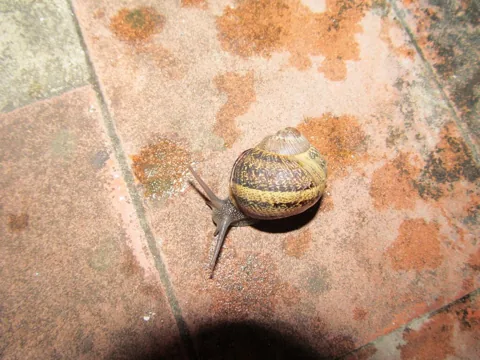 Snails and Slugs
Cornu aspersum (brown garden snail), Deroceras reticulatum (gray garden slug) and related species
Snails and slugs are garden mollusks that hide by day and feed at night, chewing holes in leaves, flowers and low fruit. Slugs are built and behave like snails, just without the external spiral shell, so this page covers both.
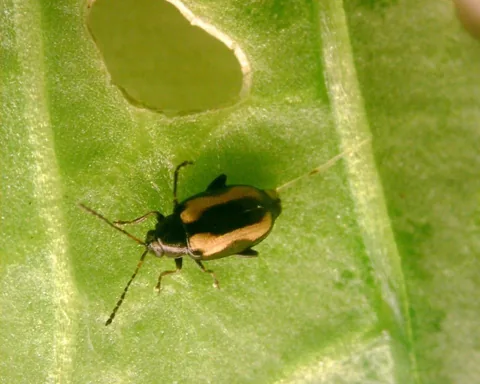 Flea Beetles
Phyllotreta striolata
Flea beetles are tiny, shiny beetles with enlarged hind legs that jump like fleas when disturbed. Adults chew small holes and pits in the leaves of radishes, cabbage and other crucifers, eggplant, potatoes, tomatoes and many other vegetables, and they do the most harm to seedlings in spring.
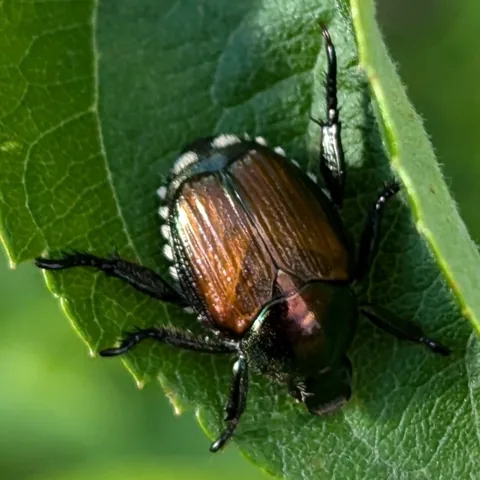 Japanese Beetle
Popillia japonica
The Japanese beetle damages landscapes twice: metallic green adults chew the leaves, flowers and fruit of hundreds of plants in early summer, and their white grubs feed on grass roots underground. A review of its biology calls it the most widespread and destructive insect pest of turf, landscapes and nursery crops in the eastern United States.
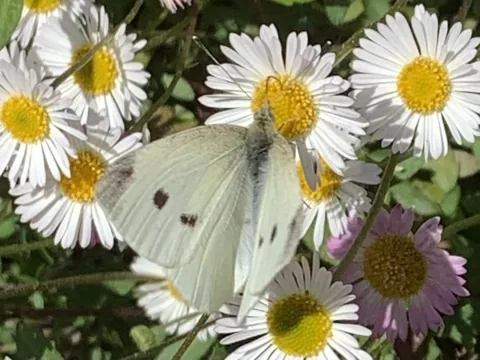 Imported Cabbageworm
Pieris rapae
The imported cabbageworm is the caterpillar of the familiar small white butterfly, the cabbage white. It chews ragged holes in cabbage, broccoli, cauliflower, kale and other cole crops, and it bores into heads as it grows.
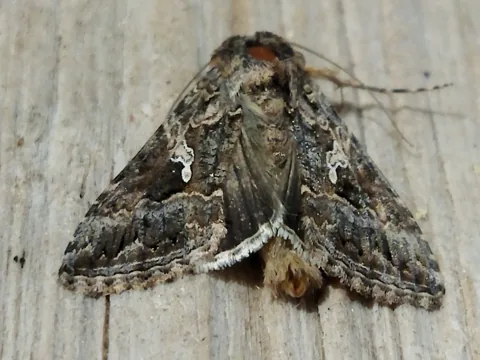 Cabbage Looper
Trichoplusia ni
The cabbage looper is the caterpillar of a gray-brown moth that flies mainly at night. It chews ragged holes in cabbage-family crops and many other vegetables and flowers, and it crawls by looping its body like an inchworm.
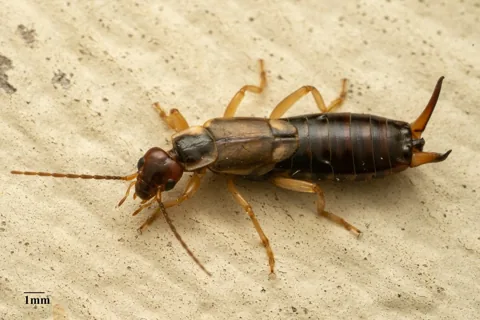 European Earwig
Forficula auricularia
The European earwig, introduced from Europe in the early 1900s, is a familiar garden insect that feeds at night and hides in dark, moist places by day; it damages seedlings and soft fruit but also eats aphids. Clemson says it is the most common earwig pest around homes, and Minnesota says it was first noticed there in the early 1990s.
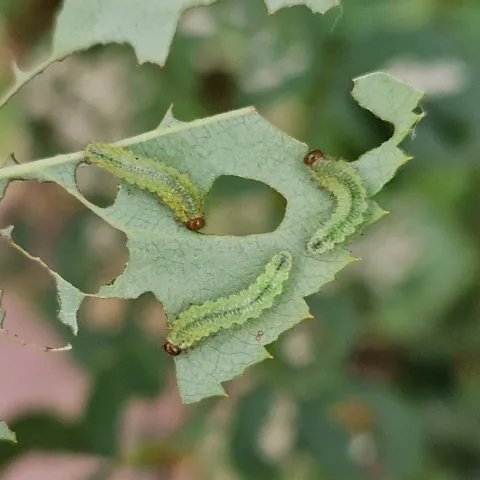 Rose Slugs (Rose Sawflies)
Cladius difformis (bristly roseslug; GBIF treats it as a synonym of Cladius pectinicornis), Endelomyia aethiops and Allantus cinctus
Rose slugs, or roseslugs, are the larvae of sawflies, wasp relatives that feed on rose leaves. The bristly roseslug causes the most trouble because it has several generations a year and keeps feeding until frost, while the roseslug and curled rose sawfly feed mainly early in the season. Ohio State says the bristly roseslug has largely replaced the other two in Ohio.
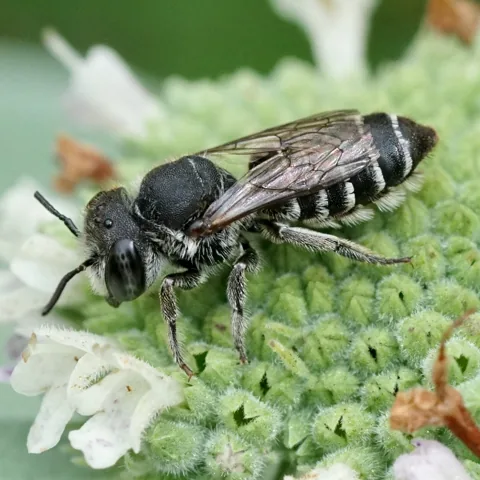 Leafcutter Bees
Megachile species
Neat semicircles cut from the edges of rose leaves are the work of leafcutter bees. These solitary pollinators carry the pieces off to line their nest cells and don't eat the leaves.
Leaf damage clues and the likely culprit
Start with the shape of the hole, then look for what the feeder left behind. Each line below names a damage pattern and the pest it most often points to; the pest profiles are linked in the cards further down.[7][1]
- Irregular holes in leaves, flowers and ripening fruit, plus slime trails that dry to a silvery sheen: slugs or snails. Seedlings are favorite targets, and heavy feeding can leave a plant weak or dying.[1][2]
- Many small holes scattered across the leaf, mostly on seedlings, and shiny beetles under 1/10 inch long that hop away like fleas: flea beetles. Minnesota Extension puts most adults at 1/16 to 1/8 inch.[3][4]
- Leaf tissue chewed out between the veins so the leaf looks like lace (skeletonized), with the beetles feeding in clusters that start at the top of the plant and work down: Japanese beetles. They can eat rose petals and thin-veined leaves completely.[5][6]
- Large, irregular holes, sometimes with webbed or rolled leaves and droppings on the leaves below: caterpillars. On cabbage, broccoli and their relatives, the usual suspects are the velvety green imported cabbageworm, which drops greenish-brown pellets, and green loopers that arch their backs and rest on leaf undersides.[7][8][9][10]
- Irregular holes in leaves and petals of plants such as marigolds, dahlias, butterfly bush and hostas, chewed seedlings, and damage that appears overnight: earwigs.[11][12]
- Rose leaves with see-through "windowpane" patches where only one surface of the leaf is left, later turning into holes or leaves eaten down to the main vein: roseslugs. Despite the name they aren't slugs or caterpillars but sawfly larvae.[13][14]
- Clean-edged circles or half-circles missing from leaf or petal margins, often on roses: leafcutting bees. Females carry the cut pieces away to build cells for their young.[15][16]
How to catch the culprit
- Go out after dark or early in the morning. Slugs, snails and earwigs feed at night and spend the day in cool, damp hiding places, which is why holes often appear with no pest in sight.[1][11][12]
- For slugs and snails, lay a board on the ground raised on 1-inch runners; they collect under it and can be scraped off and destroyed each day. A dried slime trail also confirms they have been active.[1][2]
- For earwigs, leave rolled newspaper, bamboo tubes or short pieces of hose in the garden overnight and check them in the morning.[11]
- Turn leaves over. Loopers and imported cabbageworms feed and rest on the undersides, and UC IPM suggests looking for feeding holes, droppings, webbed or rolled leaves, eggs and the caterpillars themselves.[9][10][7]
- Brush or tap the plant. Flea beetles jump when disturbed, which, with their size and shot-hole damage, makes them easy to identify.[3][4]
What to do next
- Slugs and snails: remove daytime hiding spots such as boards, stones, weeds and flowerpots, and handpick at night. UC IPM says iron phosphate baits are safer around dogs, children and wildlife, ferric sodium EDTA works in a similar way and can kill faster, and metaldehyde baits can poison dogs and birds.[1][2]
- Flea beetles: cover seedlings with row covers or other screening while they grow, and take the covers off before the crop flowers so pollinators can reach it. Covers work as long as crops are rotated.[4][3]
- Japanese beetles: handpick them or knock them into a bucket of soapy water. Skip the traps; University of Kentucky research found they attract many more beetles than they catch, and Minnesota Extension advises against them.[6][5]
- Cabbageworms and loopers: Bacillus thuringiensis (Bt) or spinosad work well, especially while the caterpillars are small.[8][9]
- Earwigs: cut down on hiding places and moisture and trap them daily until they're gone. Earwigs also eat aphids and other insects, so a few are not all bad.[11]
- Leafcutting bees: don't kill them. If they favor a few small plants, cover those with cheesecloth or other screening.[15]
- Healthy plants often outgrow the damage. Minnesota Extension notes that healthy flowering plants such as roses can survive Japanese beetle feeding.[6]
Common questions
- Why can't I find anything on my plants even though the holes keep getting bigger?
- Many leaf chewers work at night. Slugs, snails and earwigs hide during the day in damp, sheltered spots, so look with a light after dark or check traps in the morning.[1][11][12]
- Are leafcutter bees harmful?
- Not really. They're native pollinators with a mild sting used only when handled, and the circles they cut mar the look of a plant without harming a healthy one.[16][15]
- Do Japanese beetle traps help?
- Usually not in a home garden. Kentucky research showed the traps pull in many more beetles than they catch; if you try them, put them well away from the plants you want to protect.[5][6]
Photo credits
- Snails and Slugs: (c) zebedeugalinha, some rights reserved (CC BY) — via iNaturalist, CC BY 4.0
- Flea Beetles: 螯蝦, public domain (CC0), via iNaturalist
- Japanese Beetle: (c) Emmett Collins-Sussman, some rights reserved (CC BY) — via iNaturalist, CC BY 4.0
- Imported Cabbageworm: (c) eebee, some rights reserved (CC BY) — via iNaturalist, CC BY 4.0
- Cabbage Looper: (c) SteveM4560, some rights reserved (CC BY) — via iNaturalist, CC BY 4.0
- European Earwig: Jesse Rorabaugh, public domain (CC0), via iNaturalist
- Rose Slugs (Rose Sawflies): (c) Gabriele Pradelli, some rights reserved (CC BY) — via iNaturalist, CC BY 4.0
- Leafcutter Bees: (c) Amy Schnebelin, some rights reserved (CC BY) — via iNaturalist, CC BY 4.0
Sources
- UC Statewide IPM Program, “Pest Notes: Snails and Slugs (UC ANR Publication 7427; C.A. Wilen, M.L. Flint).” ipm.ucanr.edu/home-and-landscape/snails-and-slugs/ (accessed 2026-11-12)
- University of Minnesota Extension, “Slugs in home gardens.” extension.umn.edu/yard-and-garden-insects/slugs (accessed 2026-11-12)
- University of California Statewide IPM Program, “Pest Notes: Flea Beetles (Home and Landscape).” ipm.ucanr.edu/home-and-landscape/flea-beetles/ (accessed 2026-11-12)
- University of Minnesota Extension, “Flea beetles (reviewed 2022).” extension.umn.edu/yard-and-garden-insects/flea-beetles (accessed 2026-11-12)
- University of Kentucky Entomology, “ENTFACT-451: Japanese Beetles in the Urban Landscape (revised March 2026).” entomology.mgcafe.uky.edu/ef451 (accessed 2026-11-12)
- University of Minnesota Extension, “Japanese beetles in yards and gardens.” extension.umn.edu/yard-and-garden-insects/japanese-beetles (accessed 2026-11-12)
- University of California Statewide IPM Program, “Leaf-Feeding Caterpillars (Home and Landscape).” ipm.ucanr.edu/home-and-landscape/leaf-feeding-caterpillars/ (accessed 2026-11-12)
- University of California Statewide IPM Program, “Imported Cabbageworm (Home and Landscape).” ipm.ucanr.edu/PMG/GARDEN/VEGES/PESTS/importcabwrm.html (accessed 2026-11-12)
- University of California Statewide IPM Program, “Loopers (Pest Notes, Home and Landscape).” ipm.ucanr.edu/home-and-landscape/loopers/ (accessed 2026-11-12)
- UMass Amherst Center for Agriculture, Food, and the Environment, “Imported Cabbageworm.” www.umass.edu/agriculture-food-environment/vegetable/fact-sheets/imported-cabbageworm (accessed 2026-11-12)
- UC Statewide Integrated Pest Management Program, “Earwigs (Pest Notes 74102).” ipm.ucanr.edu/home-and-landscape/earwigs/ (accessed 2026-11-12)
- University of Minnesota Extension, “Earwigs.” extension.umn.edu/garden-and-home/yard-and-garden/yard-and-garden-insects/earwigs (accessed 2026-11-12)
- University of California Statewide IPM Program, “Rose Sawflies (Roseslugs).” ipm.ucanr.edu/home-and-landscape/rose-sawflies-roseslugs/ (accessed 2026-11-12)
- University of Illinois Extension, “Why are there holes in my roses? Roseslugs (K. Johnson, Good Growing, June 2024).” extension.illinois.edu/blogs/good-growing/2024-06-07-why-are-there-holes-my-roses-roseslugs (accessed 2026-11-12)
- University of California Statewide IPM Program, “Leafcutting bees (Pest Notes for home and landscape).” ipm.ucanr.edu/PMG/GARDEN/PLANTS/INVERT/leafcutbes.html (accessed 2026-11-12)
- Colorado State University Extension, “Leafcutter Bees.” extension.colostate.edu/resource/leafcutter-bees/ (accessed 2026-11-12)