The short answer
- If the dead turf lifts up like a loose carpet because the roots are gone, look for white grubs in the soil under it. Skunks, crows or moles digging in the lawn are another good sign of grubs.[1][2]
- If grass breaks off at the crown when you tug it and you see fine, sawdust-like material, it's billbugs.[6][7]
- If yellowing patches in hot, sunny spots don't green up after watering, check the edges for chinch bugs.[4][3]
- If there's a dead spot ringed by dark green grass, suspect dog urine rather than insects.[10][11]
Profiles of lawn insects that cause brown patches
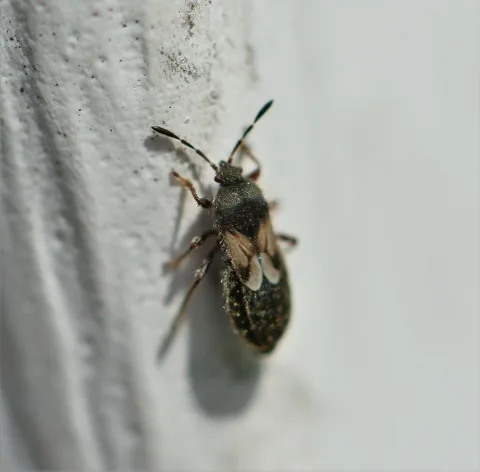 Southern Chinch Bug
Blissus insularis
The southern chinch bug is a tiny sap-sucking bug and the most important insect pest of St. Augustinegrass lawns in the southern United States. Feeding groups kill grass in spreading, irregular patches, often first in hot, dry, sunny spots. The University of Florida calls it the second most expensive plant-feeding arthropod in Florida.
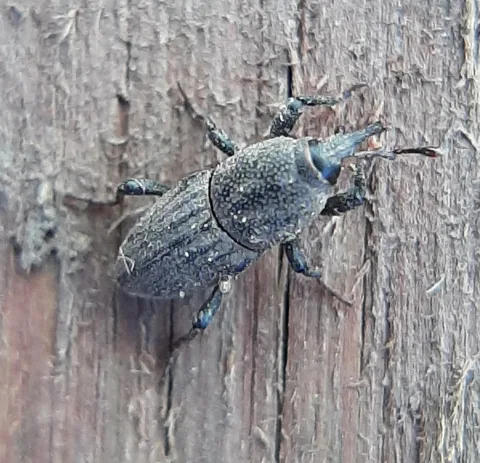 Billbugs
Sphenophorus species, e.g., S. parvulus (bluegrass billbug) and S. venatus vestitus (hunting billbug)
Billbugs are small weevils with a long snout. Their legless grubs bore inside grass stems and later feed on crowns and roots, killing scattered patches that are one of the most commonly misdiagnosed lawn problems.
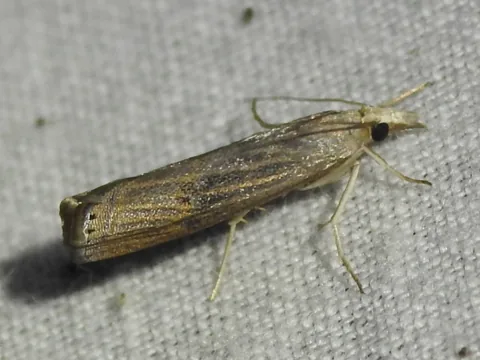 Sod Webworms
Crambinae lawn moths, e.g., Parapediasia teterrella (bluegrass sod webworm), Pediasia trisecta and Crambus species
Sod webworms are caterpillars of small, pale lawn moths with snout-like mouthparts. The larvae hide in silk-lined tunnels in the thatch by day and chew grass blades at night, leaving small brown patches that can merge during dry summers.
Lawn damage clues and the likely culprit
Insect damage and drought stress often look alike, and both can happen together. Use these clues to narrow it down, then confirm with the checks in the next section.[5][6]
- Spongy turf that rolls back like a piece of carpet, with C-shaped, dirty white grubs with brown heads and six legs in the soil: white grubs. Infested turf often wilts fast and turns yellow because the roots have been eaten.[1][2]
- Grass torn up by skunks, armadillos, raccoons, crows or moles: often a sign that animals are digging for grubs.[1][2]
- Yellow patches that die and don't recover with watering, worst in sunny, drought-stressed areas and less common in shade: chinch bugs. Their feeding can look like drought, other insect damage or turf disease.[4][3][5]
- Stems that break at the crown when tugged, hollowed stems and fine, white, sawdust-like frass: billbugs. Utah State notes billbug damage is often mistaken for drought, and billbugs are more abundant where soil is dry.[6][7]
- Small, ragged brown spots about the size of a quarter, grass blades clipped off, green droppings in the thatch and pencil-sized holes where birds have probed: sod webworms.[9][8]
- Round dead spots surrounded by a ring of darker green grass: dog or other animal urine. The damage is worse on dry soil, and fertilizer or salt spills cause similar spots without the ammonia odor.[10][11][12]
- Patches that follow mower tracks, dormant grass, drought or freeze drying, and turf diseases also cause dead patches. Colorado State's diagnosis guide lists these alongside urine spots, grubs and sod webworms.[13][5]
How to confirm the cause
- Grubs: with a spade or knife, cut a square of sod about a foot across on three sides, fold it back and look through the roots and the top few inches of soil. Check several spots, including the edge of the damage.[2][1]
- Billbugs: use the tug test. Pull up on the damaged grass; if it breaks at the crown and you see sawdust-like frass, billbug larvae have been feeding.[6][7]
- Chinch bugs: Clemson describes a flotation check. Cut both ends out of a large can, push it into the turf at the edge of the yellow area, fill it with water and remove floating debris; adults and nymphs float up within five minutes.[3]
- Sod webworms: Minnesota Extension's soap flush works by pouring dish-soap water over a small area; the soapy water irritates the larvae and brings them to the surface. Fresh green droppings in the thatch also point to active feeding.[9][8]
- Dog urine: water the spot heavily. Washington State notes urine damage often shows a dark green ring and that it can be mistaken for patch diseases.[10][11]
What to do next
- Find the insect before treating. Chinch bug and billbug damage are both easily confused with drought stress.[5][6][4]
- Grubs: see the grub control guide for timing and options, including beneficial nematodes and why milky disease only helps against Japanese beetle grubs.[1]
- Chinch bugs and billbugs both do more damage in dry turf: chinch bug damage is worse on drought-stressed lawns, and billbugs are more abundant where soil moisture is low.[4][6]
- Urine spots: water the spot soon after the dog urinates to dilute and flush the salts.[10][11]
Common questions
- Why doesn't my lawn green up after watering?
- Grass killed by chinch bugs doesn't recover with watering, unlike grass that is only drought-stressed. Check the edges of the patch for the bugs.[4][3]
- Animals are tearing up my lawn. Does that mean grubs?
- Often. Skunks, crows, moles, armadillos and raccoons dig for grubs, so lift a few squares of sod to check.[1][2]
- Can dog urine look like insect damage?
- Yes. Urine spots are round and often ringed with dark green grass. They're worse on dry soil and can be mistaken for patch diseases.[10][11][12]
Photo credits
- Southern Chinch Bug: (c) Barry Cottam, some rights reserved (CC BY) — via iNaturalist, CC BY 4.0
- Billbugs: (c) Will Linnard, some rights reserved (CC BY) — via iNaturalist, CC BY 4.0
- Sod Webworms: (c) Sam Kieschnick, some rights reserved (CC BY) — via iNaturalist, CC BY 4.0
Sources
- Penn State Extension, “White Grubs in Home Lawns.” extension.psu.edu/white-grubs-in-home-lawns (accessed 2026-11-12)
- Clemson Cooperative Extension Home & Garden Information Center, “White Grub Management in Turfgrass (HGIC).” hgic.clemson.edu/factsheet/white-grub-management-in-turfgrass/ (accessed 2026-11-12)
- Clemson Cooperative Extension Home & Garden Information Center, “Chinch Bugs (HGIC 2487).” hgic.clemson.edu/factsheet/chinch-bugs/ (accessed 2026-11-12)
- Washington State University Extension, “Lawn and Turf: Chinch bugs (Hortsense).” hortsense.cahnrs.wsu.edu/fact-sheet/chinch-bugs/ (accessed 2026-11-12)
- Ohio State University Extension, “Chinch Bugs in Turfgrass, HYG-2503 (D. J. Shetlar, J. Andon, 2012).” ohioline.osu.edu/factsheet/HYG-2503-11 (accessed 2026-11-12)
- Utah State University Extension, “Billbugs in Turfgrass.” extension.usu.edu/planthealth/research/billbugs (accessed 2026-11-12)
- UMass Amherst Center for Agriculture, Food, and the Environment, “Billbugs in Lawns.” www.umass.edu/agriculture-food-environment/home-lawn-garden/fact-sheets/billbugs-in-lawns (accessed 2026-11-12)
- Penn State Extension, “Sod Webworms in Home Lawns.” extension.psu.edu/sod-webworms-in-home-lawns (accessed 2026-11-12)
- University of Minnesota Extension, “Sod webworms (reviewed 2018).” extension.umn.edu/yard-and-garden-insects/sod-webworms (accessed 2026-11-12)
- Washington State University Extension, “Lawn and Turf: Dog injury (Hortsense).” hortsense.cahnrs.wsu.edu/fact-sheet/dog-injury/ (accessed 2026-11-12)
- University of California Statewide IPM Program, “Healthy Lawns: Abiotic Disorders, Dog Injury.” ipm.ucanr.edu/TOOLS/TURF/PESTS/abiodog.html (accessed 2026-11-12)
- Kansas State University Turfgrass, “Animal Urine Damage (Lawn Problem Solver).” www.k-state.edu/turf/resources/lawn-problem-solver/problem-solver/dead-patches/urine/index.html (accessed 2026-11-12)
- Colorado State University Extension, “Diagnosing Lawn Problems (Colorado Master Gardener training, June 2021).” cmg.extension.colostate.edu/wp-content/uploads/sites/59/2021/06/Diagnosing-Lawn-Problems-CMG-June-2021.pdf (accessed 2026-11-12)