The short answer
- Pull on the dead grass. If a section lifts or rolls back like loose carpet with few roots holding it, dig for C-shaped white grubs in the top couple of inches of soil.[1][4][5][2]
- Look at where and when. Chinch bug patches show up in hot, dry weather in the sunniest parts of the lawn, often along driveways, sidewalks and roads. Grub damage tends to show in late summer and fall, and again in spring.[11][10][8][9][1]
- Water it and wait. Grass hurt by chinch bugs keeps dying even when it's watered. With grubs, Clemson notes that rain and irrigation can hide the root damage for a while.[12][9][2]
- Find the insect. Grubs are fat, whitish, C-shaped larvae with six legs and brown heads, in the soil. Chinch bugs are tiny black bugs, about 1/6 to 1/5 inch, with white wings, plus orange to red nymphs, in the thatch at the edge of the yellowing patch.[4][3][10][5][8]
Profiles on this site
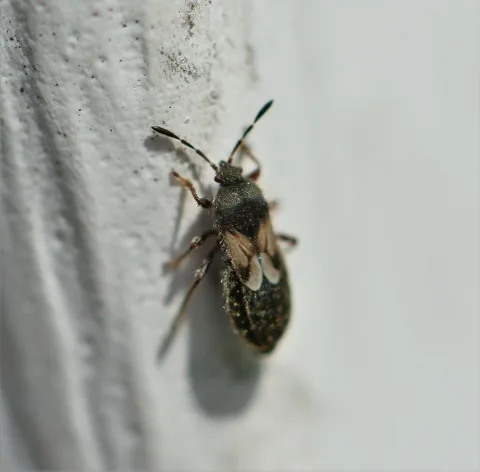 Southern Chinch Bug
Blissus insularis
The southern chinch bug is a tiny sap-sucking bug and the most important insect pest of St. Augustinegrass lawns in the southern United States. Feeding groups kill grass in spreading, irregular patches, often first in hot, dry, sunny spots. The University of Florida calls it the second most expensive plant-feeding arthropod in Florida.
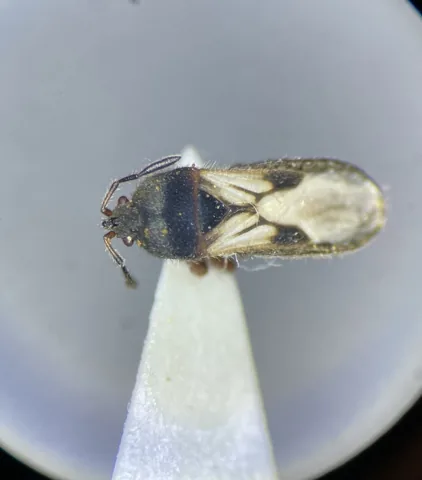 Hairy chinch bug
Blissus leucopterus hirtus
The hairy chinch bug is a tiny black-and-white bug, about 1/6 inch long, that lives in the thatch of northern lawns. It sucks sap from grass stems, and its saliva clogs the grass, so sunny patches turn yellow, then brown, and can die in hot, dry weather even when watered. The fact sheets advise a coffee-can float test at the edge of a dead patch, proper mowing height, no overfertilizing, and resistant endophyte-enhanced grasses, and save insecticides for lawns where sampling finds damaging numbers.
No photo yet
Western chinch bug
Blissus occiduus
The western chinch bug is a small black true bug that has become a serious pest of buffalograss lawns in Nebraska and, more recently, of zoysiagrass. It feeds on sap in the grass crowns, and damage shows up as patches that yellow and then dry to straw brown.
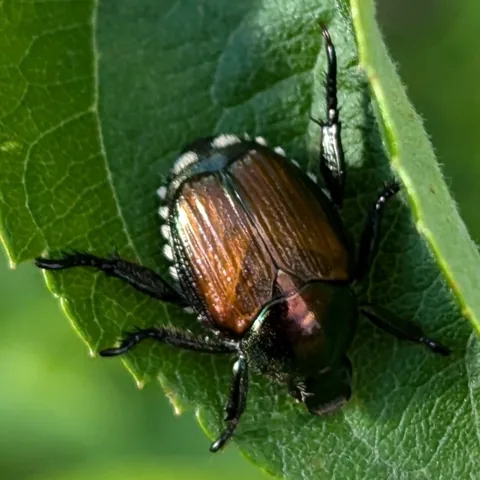 Japanese Beetle
Popillia japonica
The Japanese beetle damages landscapes twice: metallic green adults chew the leaves, flowers and fruit of hundreds of plants in early summer, and their white grubs feed on grass roots underground. A review of its biology calls it the most widespread and destructive insect pest of turf, landscapes and nursery crops in the eastern United States.
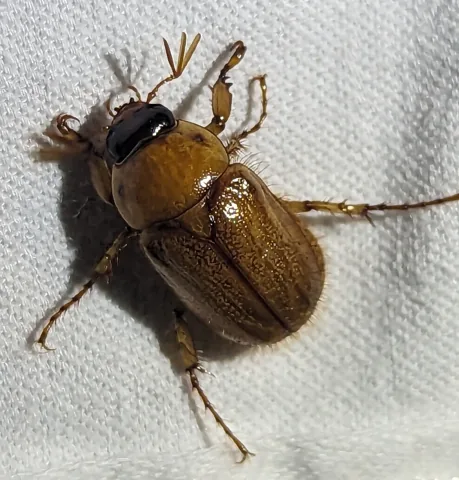 Masked Chafers
Cyclocephala species (northern masked chafer, C. borealis; southern masked chafer, C. lurida)
Masked chafers are native North American beetles whose larvae, called white grubs, feed on turfgrass roots. The adults don't feed at all; the grubs do the damage, mostly in late summer and fall.
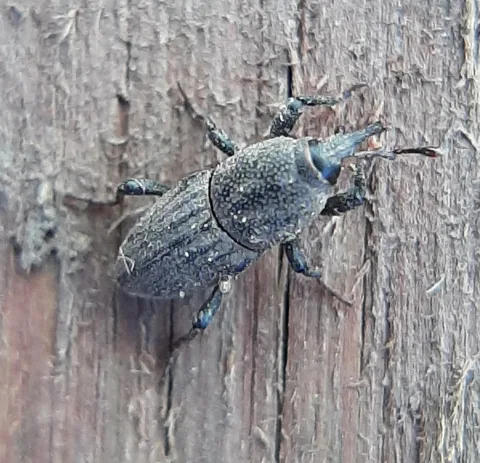 Billbugs
Sphenophorus species, e.g., S. parvulus (bluegrass billbug) and S. venatus vestitus (hunting billbug)
Billbugs are small weevils with a long snout. Their legless grubs bore inside grass stems and later feed on crowns and roots, killing scattered patches that are one of the most commonly misdiagnosed lawn problems.
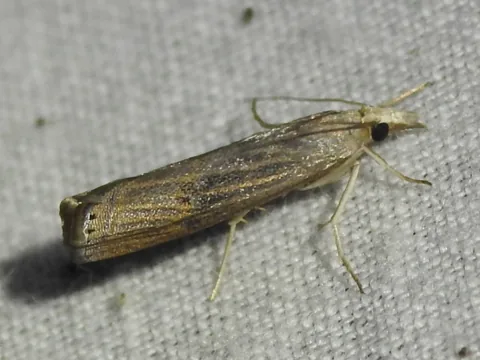 Sod Webworms
Crambinae lawn moths, e.g., Parapediasia teterrella (bluegrass sod webworm), Pediasia trisecta and Crambus species
Sod webworms are caterpillars of small, pale lawn moths with snout-like mouthparts. The larvae hide in silk-lined tunnels in the thatch by day and chew grass blades at night, leaving small brown patches that can merge during dry summers.
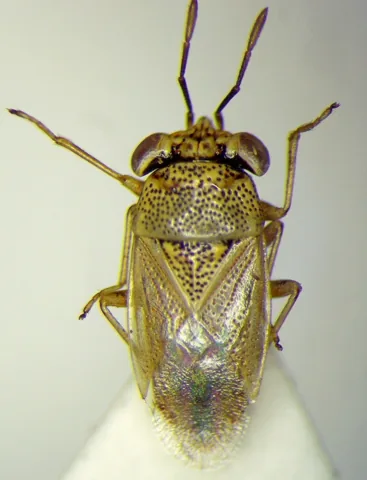 Bigeyed Bugs
Geocoris species (e.g., G. punctipes)
Bigeyed bugs are small true bugs that hunt mites, aphids, whiteflies and insect eggs on low-growing plants and in lawns. They resemble chinch bugs and other plant-feeding bugs, so check before you spray.
Side by side
"White grub" covers the larvae of several scarab beetles, including Japanese beetles and masked chafers. "Chinch bug" usually means the southern chinch bug in St. Augustinegrass lawns of the South, or the hairy chinch bug in cool-season lawns farther north.[1][9][8][10]
- What it eats: grubs feed on grass roots below the soil surface. Chinch bug adults and nymphs suck sap from the grass and inject saliva that interferes with water and nutrient movement.[1][3][5][8]
- Insect size and look: mature grubs run from 1/4 to 1 1/2 inches by NC State's measure, depending on species, and Japanese beetle and northern masked chafer grubs reach slightly over an inch at full size, according to Penn State. Adult chinch bugs are 1/6 to 1/5 inch by Texas A&M's measure and 1/10 to 1/5 inch by NC State's.[3][1][10][5]
- Color: grubs are whitish with yellow to brown heads and a darker rear end. Adult chinch bugs are black with white wings that each carry a black triangular mark. Young nymphs are bright orange or red with a white band across the abdomen and darken to black as they grow.[3][4][10][8][5][11]
- Legs and posture: grubs have six legs and lie curled in a C. Chinch bugs are plant-feeding true bugs that hide in the thatch; some adults have full wings and some have short ones that can't fly.[1][3][10][9][16]
- Where the damage starts: chinch bugs are worst in sunny, hot spots. Clemson says damage is often more severe near roadways, driveways and sidewalks, and UMass lists sunny, drought-stressed areas, thick thatch and sandy root zones. UC IPM says white grubs often come back year after year in the same limited areas where the adult beetles like to lay eggs.[8][15][11][10][14]
- What the patch looks like: grub-damaged turf wilts fast, yellows and goes spongy underfoot. Chinch bug damage starts as irregular yellow patches, sometimes with a pinkish or purplish cast, that turn brown and keep expanding outward, often with a halo of yellowing grass around the dead center.[2][1][9][10][11]
- Tug test: in heavy grub infestations, the sod can be pulled up or rolled back like a loose carpet because the roots are gone. Chinch bugs don't eat roots, so look for them in the thatch and at the base of the stems instead of in the soil.[4][1][5][9]
- Watering: Washington State says chinch bug-damaged grass does not recover with watering, and Ohio State says the turf eventually dies regardless of irrigation. Clemson notes that rainfall and irrigation can mask grub damage to the root system.[12][9][2]
- Season: Penn State lists grub damage in spring (April and May) and late summer and fall (September and October); NC State puts active grub feeding near the surface from August through October and again in April to early May. Ohio State says chinch bug damage generally occurs in hot, dry weather from June into September, and Washington State says mid- to late summer.[1][3][9][12]
- Animals digging: skunks, raccoons, armadillos, crows and moles feeding in the lawn are a classic grub sign.[1][2][4]
- Grass type: hairy chinch bugs prefer Kentucky bluegrass, fescues, perennial ryegrass, bentgrass and zoysiagrass. The southern chinch bug is a major pest of St. Augustinegrass; UC IPM says only St. Augustinegrass is seriously damaged in California.[9][8][13][10]
Skunk and raccoon digging points to grubs
If something is tearing up the lawn at night, grubs are the likely draw. The Internet Center for Wildlife Damage Management says skunks dig small, 3- to 4-inch cone-shaped holes or patches of upturned earth while hunting grubs. Raccoons roll back sections of sod looking for earthworms and grubs and may come back night after night, especially in mid- to late summer.[6][7]
Clemson notes that animals can do real damage even when grub numbers are below what the turf itself would tolerate, which is why its threshold for healthy turf drops when diggers are around. Penn State adds a caution: moles also eat earthworms and other insects, so mole activity alone doesn't prove grubs.[2][1]
The ICWDM says skunk digging in an area generally stops after about 3 weeks, once the food runs out. For the animals themselves, see our skunk and raccoon guides.[6]
How to check for each one
Look for the insect before you treat. Texas A&M calls finding the insects themselves the best proof of chinch bug damage, and Penn State says to survey and map the area to be sure a grub infestation is present.[10][1]
- Grubs, dig a sample: NC State says to cut three sides of a 1-foot square of sod about 2 inches deep, peel it back to see whether the roots have been chewed off and sift the soil for larvae. Penn State suggests removing a square foot of turf and soil two to four inches deep at several spots. Count the grubs in each square.[5][1]
- Where to dig: sample at the edge of the dead area where the grass is still alive, and in several spots across the lawn. NC State says grubs may be concentrated in localized areas, and UC IPM says they often reinfest the same limited areas year after year.[2][5][14]
- Chinch bugs, the can test: cut both ends out of a large can, twist it into the turf at the edge of the yellowing area, fill it with water and remove debris that floats up. Clemson says adults and nymphs should float up within five minutes; Ohio State counts over 10 minutes; UC IPM says 5 to 10 minutes. Add water if it soaks in.[8][9][13][11]
- Chinch bugs, the hands-and-knees check: Ohio State says to spread the grass and look in the thatch, but warns that nymphs hide deep and eggs and small nymphs are easily missed. NC State also lists sticky cards, pitfall traps and vacuum sampling.[9][5]
- Don't count the wrong bug: bigeyed bugs are beneficial predators that eat chinch bugs and are often mistaken for them. Texas A&M says bigeyed bugs have large, bulging eyes, a head at least as wide as the thorax and lack the chinch bug's white wings with black triangles. Leave them alone.[10][16]
- Photos and a lab: a hand lens or phone camera helps with something as small as a chinch bug, and Colorado State's lawn-diagnosis guide lists magnification, digital pictures, a spade and a sharp knife as basic tools. NC State notes some turf samples may need to go to its Plant Disease and Insect Clinic; your county extension office can tell you where to send yours.[19][5]
How many is too many
Extension thresholds differ by region, grass and lawn health, so treat these as rough lines rather than exact cutoffs. A lawn that is watered and fed well tolerates more insects than a stressed one.[2][1][14]
- White grubs: Penn State says five to ten per square foot is often used as the threshold for curative treatment. Clemson says healthy, unstressed turf can tolerate 5 to 7 per square foot, and for Japanese beetle grubs gives about 10, with 6 to 8 as a safer line when skunks or raccoons dig. UC IPM's California figure is 6 per square foot.[1][2][14]
- Chinch bugs: Clemson gives 20 to 25 per square foot as a general treatment threshold for southern chinch bugs, and Texas A&M says damage normally appears at about that level. UC IPM uses an average of 3 per can sample, or 15 nymphs and adults per square foot. Ohio State says 25 to 30 per square foot warrant control, especially in June and July, and Wisconsin says treatment may be needed at an average of two to three per flotation test.[8][10][13][14][9][11]
- Nothing found: Texas A&M says dead spots without high chinch bug numbers are probably caused by something else, and suggests checking for lack of irrigation, white grub feeding or turf disease.[10]
Two more suspects: sod webworms and billbugs
If the soil has no grubs and the can test turns up no chinch bugs, two other lawn insects are worth a look. Utah State says billbug damage is often mistaken for drought stress, and Penn State says sod webworm feeding frequently goes unnoticed during dry spells.[18][17]
- Sod webworms: the caterpillars chew off leaves and stems just above the crown. Penn State describes brown patches up to baseball size that grow and merge, sometimes punctured with pencil-sized holes where birds probed, and fresh green droppings in the thatch. Sunny areas, steep slopes and dry banks get hit hardest, according to UMass and Penn State. A soapy-water flush brings the larvae up.[18][15]
- Billbugs: grass breaks off at the crown when tugged, and the stems are hollow and packed with sawdust-like frass. Utah State says the larvae are legless and cream colored with a red-brown head, up to about 1/3 inch, which separates them from six-legged white grubs.[17]
- Our lawn insect identification guide walks through the tug test, can test and soap flush for all of these in one place.[17][18][8]
When it's drought or disease instead
Plenty of brown lawns have no insect problem at all. Colorado State's lawn-diagnosis training starts with patterns and timing, and Texas A&M says to rule out lack of irrigation and turf disease when chinch bug counts are low.[19][10]
- Drought: Ohio State says chinch bug feeding may look like drought stress, other insect damage or turf disease, and Colorado State's training guide says watering problems are the most common cause of lawn trouble it sees. Check sprinkler coverage before blaming insects.[9][19]
- Drought and chinch bugs together: Colorado State lists chinch bugs among insects whose damage is worse in dry turf, and Clemson says damage shows up faster on grass stressed by drought or heat. Both problems can happen at once.[19][8]
- Brown patch disease in St. Augustinegrass: Texas A&M says it usually shows up in a circular or semicircular pattern, while chinch bug damage leaves irregular dead areas. Finding the insects is the best proof.[10]
- Other diseases: Colorado State names Ascochyta leaf blight and dollar spot as diseases more common in drought-stressed lawns and necrotic ring spot as a late-summer and fall problem on Kentucky bluegrass, the same seasons and conditions when grubs and chinch bugs show up.[19]
- Straight lines and repeating shapes: Colorado State says neither disease nor insects make neat patterns, such as the same brown corner on every piece of new sod. Its example is new sod that overheated in transit, leaving the same spot brown on every piece.[19]
What to do for each
The two pests are handled differently, so the count from your dig or can test decides the next step. UC IPM says not to treat lawn insects unless treatment thresholds are exceeded.[14]
- Grubs: confirm with a dig, then time any treatment to the young grubs near the surface. NC State says feeding near the surface runs from August through October and again in April to early May, and that late summer or fall curative treatments usually work better than spring ones. Our grub control guide covers preventive and curative products, nematodes and milky spore.[3][1][2]
- Chinch bugs: start with the lawn. Clemson says they are most common on lush, heavily fertilized grass with heavy thatch, and UC IPM recommends lowering fertilizer and keeping moisture adequate. Washington State says perennial ryegrasses and fine and tall fescues high in endophytes resist chinch bugs, and UC IPM lists resistant St. Augustinegrass varieties. Our chinch bug guide covers insecticide timing and resistance.[8][13][12]
- Either one: Wisconsin says a healthy lawn better tolerates a small chinch bug infestation, and Penn State says grub damage depends on many variables. Treat only after a count says you need to.[11][1]
Common questions
- Can I have grubs and chinch bugs at the same time?
- Yes. Their seasons overlap in late summer, and Texas A&M's chinch bug fact sheet tells you to check for white grub feeding when chinch bug numbers don't explain the damage. Run both checks: a square-foot dig for grubs and a can test at the edge of the patch for chinch bugs.[10][1][9]
- Why is the lawn dying next to the driveway first?
- That's a classic chinch bug pattern. Clemson says damage is often worst near roadways, driveways and sidewalks, where heat stress is highest, and Texas A&M and Wisconsin both point to hot, sunny parts of the lawn.[8][10][11]
- Skunks are digging but the grass looks fine. Do I have grubs?
- Probably. Skunks dig cone-shaped holes hunting grubs, and Clemson notes that digging animals can cause serious damage even when there are fewer grubs than the turf could tolerate. Dig a few square-foot samples to see how many there are.[6][2]
- Will watering more fix chinch bug damage?
- Watering won't bring back grass chinch bugs have killed, according to Washington State. Wisconsin says wet weather slows chinch bug buildup and favors a fungus disease that attacks them, and UC IPM recommends adequate moisture, so steady watering helps the lawn hold up while you confirm the problem.[12][11][13]
- Are grubs the same as the beetles I see in summer?
- They're the same insects at different stages. White grubs are the larvae of scarab beetles such as Japanese beetles and masked chafers. Penn State says Japanese beetle adults are active late June through August and lay eggs in July and August; those eggs hatch into the grubs that feed on roots into fall.[1]
Photo credits
- Southern Chinch Bug: (c) Barry Cottam, some rights reserved (CC BY) — via iNaturalist, CC BY 4.0
- Hairy chinch bug: (c) Jacob Weston, some rights reserved (CC BY) — via iNaturalist, CC BY 4.0
- Japanese Beetle: (c) Emmett Collins-Sussman, some rights reserved (CC BY) — via iNaturalist, CC BY 4.0
- Masked Chafers: (c) Michael, Antoni and Nihat Hinczewski, some rights reserved (CC BY) — via iNaturalist, CC BY 4.0
- Billbugs: (c) Will Linnard, some rights reserved (CC BY) — via iNaturalist, CC BY 4.0
- Sod Webworms: (c) Sam Kieschnick, some rights reserved (CC BY) — via iNaturalist, CC BY 4.0
- Bigeyed Bugs: (c) Konstantin Grebennikov, some rights reserved (CC BY) — via iNaturalist, CC BY 4.0
Sources
- Penn State Extension, “White Grubs in Home Lawns.” extension.psu.edu/white-grubs-in-home-lawns (accessed 2026-11-14)
- Clemson Cooperative Extension Home & Garden Information Center, “White Grub Management in Turfgrass (HGIC).” hgic.clemson.edu/factsheet/white-grub-management-in-turfgrass/ (accessed 2026-11-14)
- NC State Extension, “White Grubs in Turf.” content.ces.ncsu.edu/white-grubs-in-turf (accessed 2026-11-14)
- University of Missouri Extension, “Turfgrass Insects, IPM1020, page 2: annual white grub species.” extension.missouri.edu/publications/ipm1020/2 (accessed 2026-11-14)
- NC State Extension, “Arthropod Pests of North Carolina Turf: A Guide.” content.ces.ncsu.edu/arthropod-pests-of-north-carolina-turf-a-guide (accessed 2026-11-14)
- Internet Center for Wildlife Damage Management, “Skunk Damage Identification.” icwdm.org/species/carnivores/skunks/skunk-damage-identification/ (accessed 2026-11-14)
- Internet Center for Wildlife Damage Management, “Raccoon Damage Identification.” icwdm.org/species/carnivores/raccoons/raccoon-damage-identification/ (accessed 2026-11-14)
- Clemson Cooperative Extension Home & Garden Information Center, “Chinch Bugs (HGIC 2487).” hgic.clemson.edu/factsheet/chinch-bugs/ (accessed 2026-11-14)
- Ohio State University Extension, “Chinch Bugs in Turfgrass, HYG-2503 (D. J. Shetlar, J. Andon, 2012).” ohioline.osu.edu/factsheet/HYG-2503-11 (accessed 2026-11-14)
- Texas A&M AgriLife Extension, “Chinch Bugs in St. Augustine Lawns, E-420 (M. E. Merchant, D. A. Mott).” agrilifeextension.tamu.edu/wp-content/uploads/2025/05/Chinch-Bugs-in-San-Augustine-Lawns.pdf (accessed 2026-11-14)
- University of Wisconsin-Extension, “Turfgrass Disorder: Chinch Bug, A3237 (R. C. Williamson, D. L. Mahr, R. Kachadoorian, 2005).” hort.extension.wisc.edu/files/2023/12/A3237-1.pdf (accessed 2026-11-14)
- Washington State University Extension, “Lawn and Turf: Chinch bugs (Hortsense).” hortsense.cahnrs.wsu.edu/fact-sheet/chinch-bugs/ (accessed 2026-11-14)
- UC Statewide IPM Program, “Southern Chinch Bug, Turfgrass Pest Management Guidelines.” ipm.ucanr.edu/agriculture/turfgrass/southern-chinch-bug/ (accessed 2026-11-14)
- UC Statewide IPM Program, “Monitoring and Treating Insects and Mites (Turfgrass Pest Management Guidelines).” ipm.ucanr.edu/agriculture/turfgrass/monitoring-and-treating-insects-and-mites/ (accessed 2026-11-14)
- UMass Amherst Center for Agriculture, Food, and the Environment, “Best Management Practices for Lawn and Landscape Turf: 11. Insect Management.” www.umass.edu/agriculture-food-environment/turf/best-management-practices-bmps-for-lawn-landscape-turf/11-insect-management (accessed 2026-11-14)
- UC Statewide IPM Program, “Bigeyed Bugs (Natural Enemies Gallery).” ipm.ucanr.edu/natural-enemies/bigeyed-bugs/ (accessed 2026-11-14)
- Utah State University Extension, “Billbugs in Turfgrass.” extension.usu.edu/planthealth/research/billbugs (accessed 2026-11-14)
- Penn State Extension, “Sod Webworms in Home Lawns.” extension.psu.edu/sod-webworms-in-home-lawns (accessed 2026-11-14)
- Colorado State University Extension, “Diagnosing Lawn Problems (Colorado Master Gardener training, June 2021).” cmg.extension.colostate.edu/wp-content/uploads/sites/59/2021/06/Diagnosing-Lawn-Problems-CMG-June-2021.pdf (accessed 2026-11-14)