On this page
How to identify it
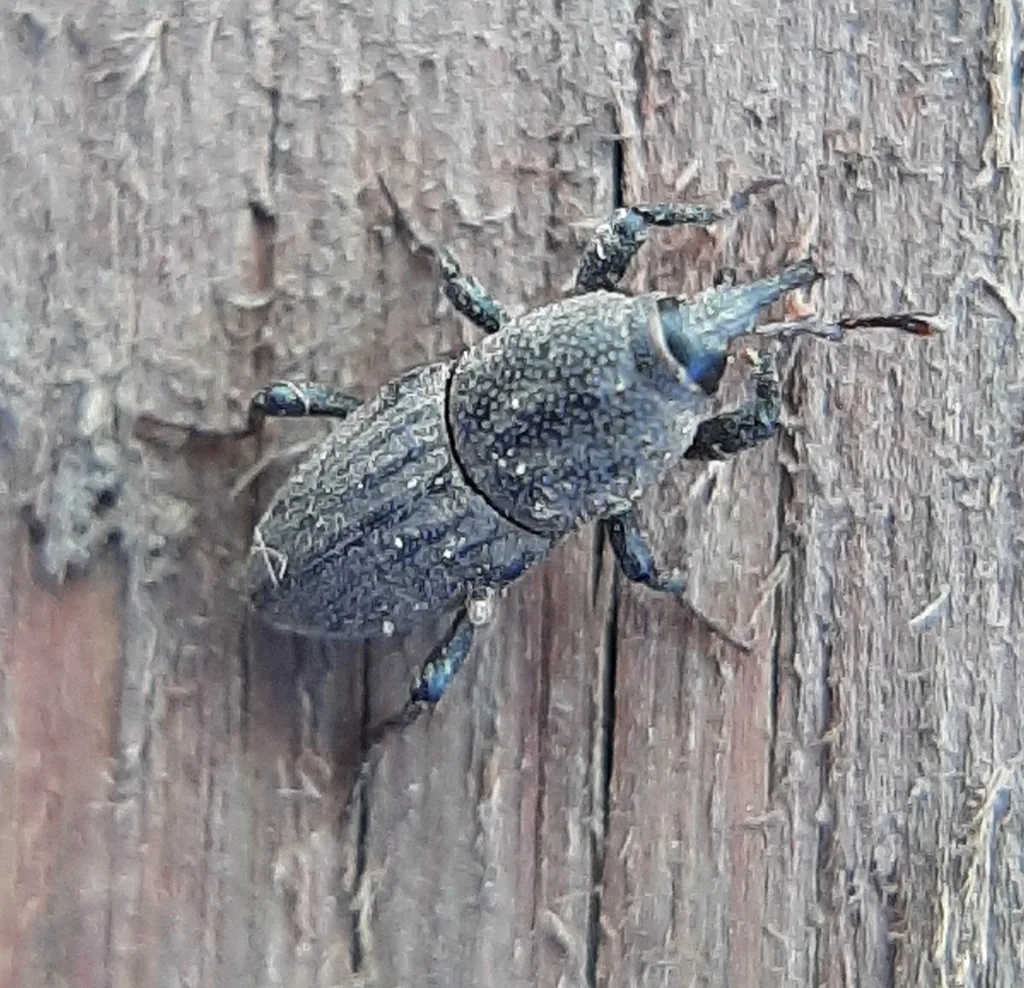
- Adults are hard-bodied weevils about 1/4 to 1/2 inch long, gray, brown or nearly black, with a long curved snout, elbowed antennae with small clubs and a pitted thorax. For the bluegrass billbug, UF/IFAS gives 5 to 8 mm, averaging 7.6 mm in females and 6.9 mm in males, with small, even pits on the thorax and wing covers lined with rows of pits like parallel chains; newly emerged adults are rusty brown and darken as they harden.[7][3][8][12]
- The name comes from the long snout, or bill, which has small chewing jaws at the tip.[1][6]
- Larvae are legless, white or cream-colored grubs with a hard brown head, only about 1/4 to 3/8 inch long when grown. Larvae of the different species can't be told apart by eye. UF/IFAS says bluegrass billbug larvae grow from 1.2 mm at hatching to 8 mm in the last stage, the head turning from yellowish to dark red or brown, and that the eggs are bean-shaped, off-white and 1.4 to 1.6 mm long.[3][4][7][2][12]
- Hunting billbug adults carry a raised Y-shaped mark on the thorax with parenthesis-shaped marks on either side; in the Phoenix billbug those marks join into an M.[8][7]
- Damaged stems are hollow and packed with sawdust-like frass, and they break off easily at the crown when tugged.[2][1][7][4]
Look-alikes
| Look-alike | How to tell them apart |
|---|---|
| White grubs | Billbug larvae are tiny and legless, unlike white grubs, which have three pairs of legs. Billbug-damaged turf snaps at the crown but can't be rolled back like a carpet the way grub-damaged turf can.[2][7][8] |
| Chinch bugs | Billbug damage is easy to confirm with the tug test: affected stems pull out and are hollowed and filled with frass.[2][7] |
Where it lives
At least 10 billbug species are turf pests across the United States, in both cool- and warm-season grass. The bluegrass billbug was first reported nearly a century ago in Nebraska and is now a turf pest through much of the country; the Denver billbug is limited to the Rocky Mountains and northern Great Plains, the Phoenician (Phoenix) billbug to southern California and Arizona, and the hunting billbug is an important pest of warm-season turf in Georgia and also occurs in California. UF/IFAS says more than 64 billbug species occur in the United States, about 25 of them in Florida, and that the bluegrass billbug is widely distributed in the United States and Canada.[7][6][3][1][8][12]
Biology and life cycle
Adults overwinter in leaf litter, thatch, hedgerows and debris around building foundations, and become active from late April through mid-May in Pennsylvania once temperatures pass 65 degrees F, often walking across driveways and sidewalks. UF/IFAS, citing Nebraska studies, says bluegrass billbugs come out when soil 1 inch (2.5 cm) deep reaches 64.4°F to 68°F. Only adults overwinter in this species, while the hunting billbug can overwinter in several stages or keep feeding.[3][4][7][12]
Females chew holes in grass stems near the crown and tuck eggs inside; bluegrass billbug eggs hatch in about 7 to 14 days, hunting billbug eggs in 3 to 10. UF/IFAS says each hole gets one to three eggs and a female lays about 255 eggs over three months, most of them in the first month; at 69.8°F eggs hatch in six to 11 days.[3][1][2][5][12]
Young larvae feed inside the stem, then drop into the thatch and soil as they grow and feed on roots, rhizomes and crowns; Penn State says the larval stage takes 5 to 8 weeks. UF/IFAS gives 23 to 60 days for larval development, depending on temperature, and says pupae lie 2 to 5 cm (3/4 to 2 in) deep in the soil near the host for eight to ten days. Cutting an infested stem shows powdery frass.[3][4][1][12]
The bluegrass billbug has one generation a year in the North, with new adults emerging in late summer and fall; Utah research suggests a partial second generation there. The hunting billbug has two overlapping generations in North Carolina and six reported in Florida, with all stages present year-round in south Georgia. UF/IFAS says the bluegrass billbug has one to two generations a year in Kentucky, Ohio, West Virginia and Pennsylvania and two or more in warmer regions; in Nebraska, eggs turn up from May to September, with egg laying peaking in May and June.[3][4][6][7][1][12]
Hunting billbug adults are active mostly at night, but are often seen on sidewalks and driveways early in the morning.[1]
Billbug species timing differs enough that DNA barcoding of larvae is being used to work out which species is active when.[10][4]
Damage and signs
- Damage starts as small, scattered patches of wilting, straw-colored or yellowish-brown grass that don't green up with watering; in the North it usually shows from late June through August.[3][1][4]
- Bluegrass billbugs favor Kentucky bluegrass but also attack perennial ryegrass and fescues; hunting billbugs attack zoysiagrass, bermudagrass and other warm-season turf, and zoysia damage can be especially serious. UF/IFAS adds corn, barley, wheat, rye, orchardgrass and bentgrass to the bluegrass billbug's hosts.[3][4][1][8][12]
- Damage often starts along the edges of driveways and walks and can look like salt damage, except that it appears in July.[4]
- Utah State says billbugs are more abundant where soil moisture is low, so drought-stressed lawns are more likely to suffer serious damage; Iowa State says damage rarely occurs in turf less than 3 years old.[7][5]
- Billbugs move to new places in infested bermudagrass and zoysia sod, and a Georgia study found adults active in freshly harvested sod fields.[1][9]
- High populations can kill large areas of grass. UF/IFAS says feeding shows more when soil moisture and fertility are low, that bacteria and fungi can invade damaged plants, and that the damage is often confused with white grub or chinch bug damage or with grass diseases.[12]
Health risk
Billbugs are plant pests that specialize on grasses, including crops such as corn, barley and rye; adults chew grass blades and larvae feed inside stems and on roots.[7]
Control
Prevention
Endophyte-enhanced perennial ryegrass and fescues resist billbugs, and some Kentucky bluegrass and zoysia cultivars show less damage. Keep endophyte seed away from livestock. UF/IFAS adds Reveille, a Texas bluegrass and Kentucky bluegrass hybrid, as less preferred and more tolerant.[3][4][1][7][12]
Keep turf adequately watered and fertilized so it tolerates and masks light feeding; Utah State says drought-tolerant bluegrass cultivars suffer less billbug damage. UF/IFAS adds that irrigation can drown larvae as they leave the stems to feed on crowns and roots.[3][7][1][12]
Traps and physical control
Monitor with buried cup pitfall traps, a flashlight search of the lawn at night, or the tug test for loose, hollow stems. In New England, seeing two or more adults a minute crossing pavement in late May or early June predicts damage nearby about six weeks later. UF/IFAS describes pitfall traps as plastic cups of 200 ml or larger sunk in the ground with soapy water, checked twice a week, and stresses finding overwintered adults early in spring.[1][7][4][6][12]
Biological control
Insect-parasitic nematodes such as Steinernema carpocapsae and Heterorhabditis bacteriophora can control billbug larvae, though results vary with soil moisture and temperature. UF/IFAS adds that ground beetles prey on billbugs and that the fungus Beauveria bassiana infects adults naturally, with partial control reported in the field.[1][8][3][12]
Pesticides
Insecticides remain the most effective billbug control, but timing is critical: preventive systemic products must be in place before eggs are laid to catch young larvae, and contact sprays such as pyrethroids target adults before they lay eggs. UF/IFAS says to use insecticides after other tools once populations have grown, notes contact products cut adult numbers while systemic products work better on larvae inside stems, and says every application must follow the label.[1][7][8][12]
Timing treatments
Missouri, Penn State and Iowa State aim at overwintered adults in late April or early May, before egg laying.[2][3][5]
UGA lists imidacloprid, clothianidin, chlorantraniliprole and cyantraniliprole as effective on larvae, and bifenthrin on adults.[1]
UC IPM says preventive grub products must go down before eggs are laid, and curative treatment of billbug grubs is difficult. Follow the product label for every insecticide application.[8][3]
Where sources disagree
Best timing: Missouri, Penn State and Iowa State favor spring sprays against adults; UMass and UNH say June, aimed at small larvae, is the most reliable timing in New England because the adult window is only 7 to 10 days and several species with different timing may be present.[2][3][5][4][6]
Adult size: UMass says the bluegrass billbug is not quite 1/4 inch, Penn State and UNH say 3/8 inch, and Iowa State says about 1/2 inch. UF/IFAS gives 5 to 8 mm.[4][3][6][5][12]
Flight: Utah State calls adults flightless; UGA says hunting billbugs mostly crawl rather than fly.[7][1]
Thresholds: Penn State cites 6 to 8 per square foot, UMass suggests 8 to 12 larvae per square foot for New England lawns, and Utah State uses one or more larvae per cup-cutter sample. UF/IFAS cites an aesthetic threshold of about six billbugs per square foot for Florida lawns.[3][4][7][12]
Lawn age: UF/IFAS says damage is more common in newly established lawns, while Iowa State says damage rarely occurs in turf less than 3 years old.[12][5]
Common questions
- Why is billbug damage so often misdiagnosed?
- Its spotty dead patches look like drought, disease, chinch bug or white grub damage. Tug on the dead grass: billbug-damaged stems snap off at the crown and are full of frass.[2][1][5]
- What's the little snouted beetle on my driveway in the morning?
- Possibly a billbug. Hunting billbugs in the Southeast turn up on sidewalks and driveways early in the morning, and bluegrass billbugs walk across paved areas in spring.[1][3][4]
Sources
- University of Georgia Cooperative Extension, “Hunting Billbug: Biology and Management in Turfgrass (Circular 1173, reviewed July 2025).” fieldreport.caes.uga.edu/wp-content/uploads/2025/08/C-1173_2.pdf (accessed 2026-11-11)
- University of Missouri Extension, “Integrated Pest Management for Turfgrass Insects (IPM1020): Other subsurface-feeding insects.” extension.missouri.edu/publications/ipm1020/3 (accessed 2026-11-11)
- Penn State Extension, “Billbugs in Home Lawns.” extension.psu.edu/billbugs-in-home-lawns (accessed 2026-11-11)
- UMass Amherst Center for Agriculture, Food, and the Environment, “Billbugs in Lawns.” www.umass.edu/agriculture-food-environment/home-lawn-garden/fact-sheets/billbugs-in-lawns (accessed 2026-11-11)
- Iowa State University Extension and Outreach, “Bluegrass Billbug (Yard and Garden).” yardandgarden.extension.iastate.edu/encyclopedia/bluegrass-billbug (accessed 2026-11-11)
- University of New Hampshire Cooperative Extension, “Bluegrass Billbug [fact sheet].” extension.unh.edu/resource/bluegrass-billbug-fact-sheet (accessed 2026-11-11)
- Utah State University Extension, “Billbugs in Turfgrass.” extension.usu.edu/planthealth/research/billbugs (accessed 2026-11-11)
- University of California Statewide IPM Program, “Billbugs (UC IPM Pest Management Guidelines: Turfgrass).” ipm.ucanr.edu/agriculture/turfgrass/billbugs/ (accessed 2026-11-11)
- Journal of Economic Entomology, via PubMed, “Surface movement of billbugs in harvested and nonharvested sod (Gireesh and Joseph 2021).” pubmed.ncbi.nlm.nih.gov/33295986/ (accessed 2026-11-11)
- Insects, via PubMed, “Characterizing billbug (Sphenophorus spp.) seasonal biology using DNA barcodes and a simple morphometric analysis (Rodriguez-Soto et al. 2021).” pubmed.ncbi.nlm.nih.gov/34680699/ (accessed 2026-11-11)
- iNaturalist, “Sphenophorus parvulus taxon page (order and family).” www.inaturalist.org/taxa/231367 (accessed 2026-11-11)
- University of Florida IFAS Extension, EDIS, “Bluegrass Billbug, Sphenophorus parvulus Gyllenhal, EENY-653/IN1133 (Featured Creatures).” ask.ifas.ufl.edu/publication/IN1133 (accessed 2026-11-14)