The short answer
- Body: a carpenter bee is a robust bee with a shiny black, mostly hairless abdomen and yellow, orange or white hairs on the thorax. A carpenter ant has a narrow waist with a single node and elbowed (bent) antennae.[1][3][2][10][9]
- The hole: carpenter bees bore perfectly round holes about 1/2 inch wide on the outside of bare wood. Carpenter ants leave no neat entry hole; look for piles of coarse, stringy shavings mixed with dead insect parts.[1][4][7][6]
- Where and when: carpenter bees hover around eaves, decks and fascia boards in spring and summer daylight. Carpenter ant workers mostly forage at night and nest in moist or decaying wood, often near leaks.[1][3][6][7][10]
- Winged ants indoors: many winged ants inside in spring point to a carpenter ant nest in the house, not bees.[10][7][9]
Profiles on this site
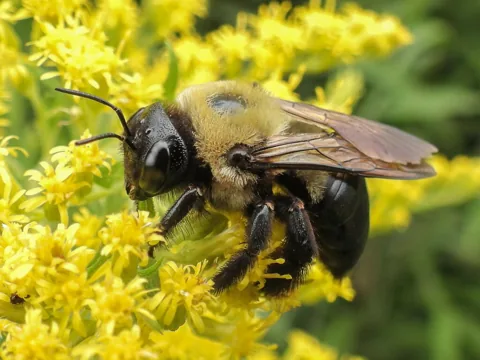 Eastern Carpenter Bee
Xylocopa virginica
Carpenter bees are large, solitary bees that bore round tunnels into bare, weathered wood to rear their young; they rarely cause severe damage but can weaken wood that is reused year after year.
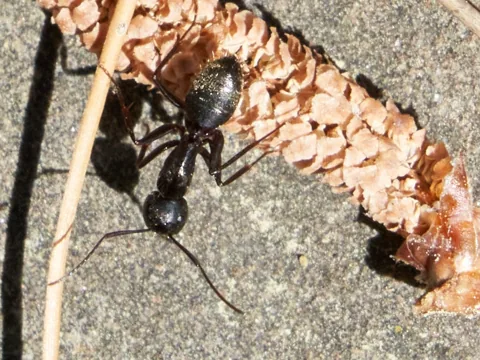 Carpenter Ants
Camponotus species
Carpenter ants don't eat wood the way termites do; they excavate it to nest, usually starting where wood is damp or decayed, and indoor nests are often satellites of a parent colony outdoors. Minnesota and Clemson extension both stress that they don't eat wood; they tunnel into it to make a nest.
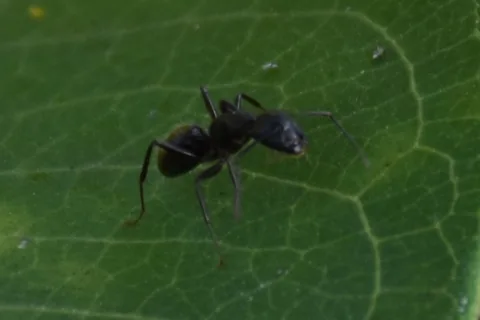 Black carpenter ant
Camponotus pennsylvanicus
The black carpenter ant is a common home invader in the northeastern United States and the most common carpenter ant in Ohio and Nebraska. Its large black workers come indoors looking for food, and colonies can set up satellite nests in moist or rotting wood and foam insulation inside the house.
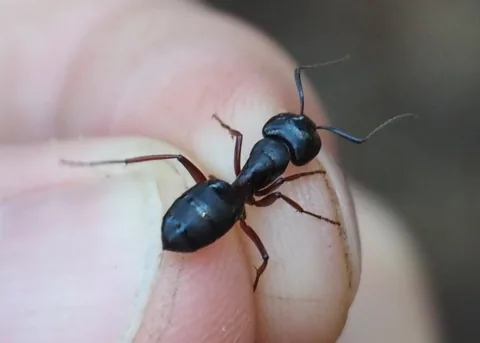 Western black carpenter ant
Camponotus modoc
The western black carpenter ant is a large black ant with dark red legs and one of the two most destructive carpenter ants in the western United States. It doesn't eat wood, but it hollows out galleries for its nest, often starting in wood that is already wet or decaying.
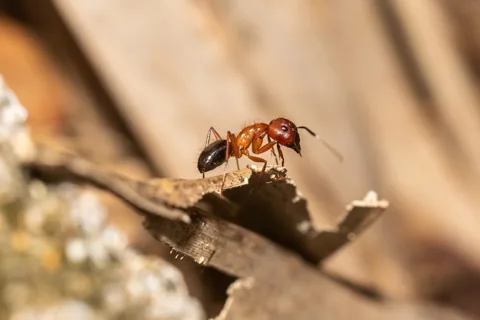 Florida Carpenter Ant
Camponotus floridanus
The Florida carpenter ant, called the bull ant in Florida for its strong bite, is a large two-toned carpenter ant of the Southeast and one of the more common ants found foraging and nesting in and around homes. UF/IFAS Featured Creatures calls carpenter ants one of the most common indoor insect pests in Florida and cites a survey of four Florida metropolitan areas in which Florida carpenter ants accounted for about 20% of all ant complaints by homeowners.
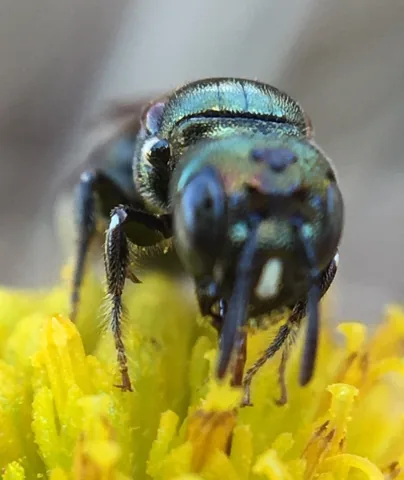 Small Carpenter Bees
Ceratina species
Small carpenter bees are tiny, shiny black bees with blue or green highlights that hollow out nests in the pith of broken weed stems, dead canes and freshly cut rose stems. They are gentle pollinators, though nesting in a fresh rose cut can make the cane die back.
Side by side
Size, carpenter bee: large and heavy-bodied. Clemson gives three-quarters inch to one inch; UC IPM says females are about 5/8 to 1 inch long.[1][4]
Size, carpenter ant workers: 1/4 to 5/8 inch per Clemson and Nebraska, in varied sizes within one colony. Winged reproductives are about 3/8 to 1/2 inch per Penn State, and queens up to 3/4 inch per Clemson.[6][11][7][9]
Color, carpenter bee: shiny black abdomen, sometimes with metallic blue reflections per UC IPM; the thorax carries yellow, orange or white hairs. Bumble bees, the usual mix-up, have a hairy abdomen with yellow markings.[1][2][4][3]
Color, carpenter ant: Nebraska says the foraging workers are black and quite large; UC IPM notes some species are red and black, and Nebraska describes a smaller ant with a reddish-orange head and thorax and a black abdomen.[11][8]
Body, carpenter bee: Kentucky's side-by-side photo with a bumble bee shows the shiny abdomen as the quick tell. Males have yellow or white face markings, females an all-black head.[5][2][1]
Body shape, carpenter ant: narrow waist with a single node and an evenly rounded thorax when seen from the side; elbowed antennae. If wings are present, the hind wings are shorter than the front ones.[10][9][8][7]
Social life, carpenter bee: solitary. Each female has her own gallery; there are no colonies or worker castes.[2][5]
Social life, carpenter ant: a colony of workers of various sizes plus a queen. Penn State says a colony usually makes winged males and queens only when it is several years old and has about 2,000 to 3,000 workers.[9][7]
What they eat: carpenter bees feed on pollen and nectar and are pollinators. Carpenter ants eat dead insects and other small invertebrates plus honeydew from aphids and scale insects. Neither eats wood.[2][3][7][6][9]
Wood they pick, carpenter bee: sound, unpainted, weathered wood, especially softer kinds such as redwood, cedar, cypress and pine; Penn State says they prefer wood more than two inches thick.[4][5][3]
Wood they pick, carpenter ant: moist or decayed wood from leaks, condensation or poor air flow. Penn State says they usually won't infest sound wood with a moisture content of less than 15 percent.[10][7][6]
Season, carpenter bee: very active from early spring through summer; they mate in spring, new adults emerge in August or late summer, and both sexes overwinter in old tunnels.[1][3][4]
Reading the damage
Carpenter bee entry hole: clean-cut and round, slightly less than a half-inch wide, about the diameter of the bee. The female bores in, turns about 90 degrees and tunnels along the grain for 4 to 6 inches.[2][1]
Carpenter bee galleries can grow: UC IPM says nests are usually 6 to 10 inches deep and that, over time, tunnels may extend as far as 10 feet into timbers as new generations reuse them.[4][1]
Other carpenter bee signs: coarse sawdust below the hole, yellowish to brownish fecal staining under the entrance, and buzzing or tunneling sounds in the wood. Woodpeckers digging for the larvae can add more holes.[5][2][3][1]
Carpenter ant signs: piles of coarse, stringy wood particles with dead insect parts sifting out of cracks in siding, behind moldings, in basements, attics and under porches. Nebraska says the shavings look all the same size, as if cut with tiny chisels.[7][6][11]
How to confirm which one you have
Check the insect, not just the sawdust. A sharp photo or a dead specimen settles it: shiny bare abdomen and thick hairy thorax for the bee; narrow waist with a node and bent antennae for the ant.[3][1][10][9]
Look at the outside of the house on a sunny spring day. Bees hovering at eaves and round holes in bare trim mean carpenter bees; Penn State says the males hover a short distance from people and approach anyone who moves quickly or waves a hand.[3][1][2]
Look at night for ants. Minnesota suggests watching workers between sunset and midnight in spring and summer; Penn State suggests a flashlight to follow foraging workers back to the nest.[10][7][6]
Count the winged ones. Minnesota says large numbers of winged ants indoors are a sure sign of an indoor nest, but one or a few winged queens are likely newly mated queens that wandered in.[10][9][7]
Why the difference matters
Carpenter bees are a wood and nuisance problem outdoors: Ohio State says many generations enlarging galleries can do extensive damage over time, and painting or varnishing bare wood is the main prevention.[2][4][5]
Carpenter ants are often a moisture problem: Clemson says the most important thing to remember is that they are attracted to moist wood, and any excess moisture found in the structure needs fixing.[6][11][9]
Do they sting?
Male carpenter bees dive-bomb and hover but have no stinger. Females can sting, and Kentucky, Penn State and UC IPM say they seldom do unless handled.[2][1][5][3][4]
If someone is stung, MedlinePlus says to scrape a stinger out with the edge of a credit card and put wrapped ice on the sting for 10 minutes on, 10 minutes off. For a severe reaction, use the person's EpiPen if they have one and call 911.[12]
- NIOSH says workers with a history of severe allergic reactions to stings should carry an EpiPen and wear a medical ID bracelet or necklace.[13]
What to do for each
Carpenter bees: paint or varnish bare wood; Kentucky says they usually won't tunnel into painted wood and that painted or pressure-treated wood is much less susceptible. Stains and preservatives are less reliable.[5][4][2]
Carpenter bees, if you treat: UC IPM says to treat tunnels in early spring before nesting or in fall when adults settle in, and to treat at night when the bees are inside; Clemson also advises late evening or night.[4][1][3]
Carpenter ants: find and fix the moisture (leaky pipes, damaged roofing, clogged gutters, poor attic ventilation) and replace moist or damaged wood.[9][6][11][10]
Carpenter ants, finding the nest: follow night foragers and look for shavings. If you can't find it, Minnesota says slow-acting baits can work because ants share food with the nest, but placement and monitoring are key.[10][7][11]
- Hidden nests inside walls are hard to locate, and Kentucky recommends professional help for those.[9]
Common questions
- Are carpenter ants just small carpenter bees?
- No. One is a solitary bee that eats pollen and nectar; the other is an ant that lives in colonies. The ant has a narrow waist and elbowed antennae; the bee has a shiny black abdomen and a hairy thorax.[2][10][9][3]
- What made the perfectly round holes in my deck or fascia board?
- Round holes about 1/2 inch wide in bare wood, often with coarse sawdust or yellowish stains below, are the work of carpenter bees. Carpenter ants don't drill neat entry holes.[1][4][2][5]
- I found sawdust indoors. Which is it?
- Indoors, coarse shavings mixed with dead insect parts sifting from cracks or moldings point to carpenter ants. Carpenter bees attack outdoor wood such as eaves, siding, decks and outdoor furniture.[7][6][1]
- Do either of them eat wood like termites?
- No. Both dig tunnels for nesting. Ohio State and Penn State say carpenter bees don't eat wood, and Clemson and Kentucky say the same of carpenter ants.[2][3][6][9]
Photo credits
- Eastern Carpenter Bee: Erik Schiff, public domain (CC0), via iNaturalist
- Carpenter Ants: (c) Linda Watson, some rights reserved (CC BY) — via iNaturalist, CC BY 4.0
- Black carpenter ant: (c) Zac Peterson, some rights reserved (CC BY) — via iNaturalist, CC BY 4.0
- Western black carpenter ant: (c) John G. Phillips, some rights reserved (CC BY) — via iNaturalist, CC BY 4.0
- Florida Carpenter Ant: (c) Richard Stovall, some rights reserved (CC BY) — via iNaturalist, CC BY 4.0
- Small Carpenter Bees: (c) James Kindt, some rights reserved (CC BY) — via iNaturalist, CC BY 4.0
Sources
- Clemson Cooperative Extension Home & Garden Information Center, “Carpenter Bees (HGIC).” hgic.clemson.edu/factsheet/carpenter-bees/ (accessed 2026-11-14)
- Ohio State University Extension, “HYG-2074: Carpenter Bees.” ohioline.osu.edu/factsheet/hyg-2074 (accessed 2026-11-14)
- Penn State Extension, “Carpenter Bees.” extension.psu.edu/carpenter-bees (accessed 2026-11-14)
- University of California Statewide IPM Program, “Pest Notes: Carpenter Bees.” ipm.ucanr.edu/home-and-landscape/carpenter-bees/ (accessed 2026-11-14)
- University of Kentucky Entomology, “ENTFACT-611: Carpenter Bees.” entomology.mgcafe.uky.edu/ef611 (accessed 2026-11-14)
- Clemson Cooperative Extension Home & Garden Information Center, “Carpenter Ants (HGIC).” hgic.clemson.edu/factsheet/carpenter-ants/ (accessed 2026-11-14)
- Penn State Extension, “Carpenter Ants.” extension.psu.edu/carpenter-ants (accessed 2026-11-14)
- University of California Statewide IPM Program, “Pest Notes: Carpenter Ants.” ipm.ucanr.edu/home-and-landscape/carpenter-ants/ (accessed 2026-11-14)
- University of Kentucky Entomology, “ENTFACT-603: Carpenter Ants.” entomology.mgcafe.uky.edu/ef603 (accessed 2026-11-14)
- University of Minnesota Extension, “Carpenter ants.” extension.umn.edu/insects-infest-homes/carpenter-ants (accessed 2026-11-14)
- University of Nebraska-Lincoln Extension, “G1738: Carpenter Ant Management.” extensionpubs.unl.edu/publication/g1738/na/html/view (accessed 2026-11-14)
- MedlinePlus (U.S. National Library of Medicine), “Insect bites and stings.” medlineplus.gov/ency/article/000033.htm (accessed 2026-11-14)
- CDC National Institute for Occupational Safety and Health, “Insects and Scorpions (Outdoor Workers).” www.cdc.gov/niosh/outdoor-workers/about/insects-and-scorpions.html (accessed 2026-11-14)