The short answer
- Look inside the damaged wood. Carpenter ant galleries are clean and smooth, with a sanded look and no debris. Subterranean termite galleries run along the grain and are lined with bits of dried mud or soil.[7][8][2][6]
- Look at what is outside the wood. Carpenter ants push out coarse, fibrous sawdust with dead insect parts mixed in, often in a pile below a hole. Subterranean termites leave earthen mud tubes, usually about the width of a pencil, on foundations, piers and joists.[8][9][5][3][2][6]
- Look at the insects. Carpenter ant workers are large, dark, wingless ants that walk in the open, often at night. Termite workers are small, soft and creamy-white to light caramel, avoid light and are rarely seen unless their wood or tubes are broken open.[5][7][4][6]
- Seeing winged insects? Antennae, waist and wing shape settle that; see the swarmer comparison linked below. Winged termites indoors almost always mean an infestation.[2]
Profiles on this site
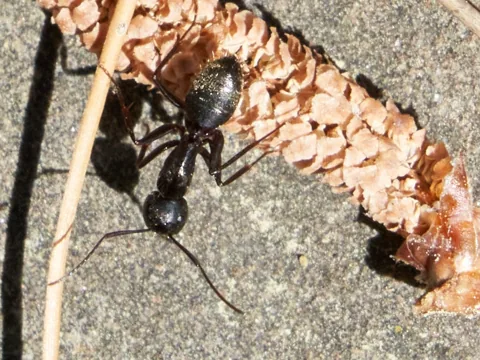 Carpenter Ants
Camponotus species
Carpenter ants don't eat wood the way termites do; they excavate it to nest, usually starting where wood is damp or decayed, and indoor nests are often satellites of a parent colony outdoors. Minnesota and Clemson extension both stress that they don't eat wood; they tunnel into it to make a nest.
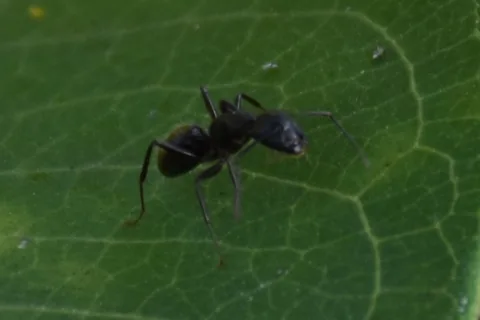 Black carpenter ant
Camponotus pennsylvanicus
The black carpenter ant is a common home invader in the northeastern United States and the most common carpenter ant in Ohio and Nebraska. Its large black workers come indoors looking for food, and colonies can set up satellite nests in moist or rotting wood and foam insulation inside the house.
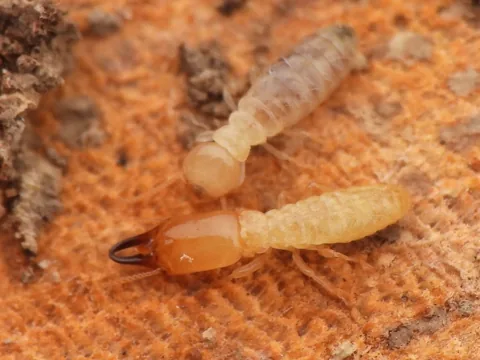 Eastern Subterranean Termite
Reticulitermes spp. (shown: R. flavipes)
Subterranean termites live in the soil and travel into buildings through earthen shelter tubes; they are the most destructive termites in most of the United States and usually warrant a professional.
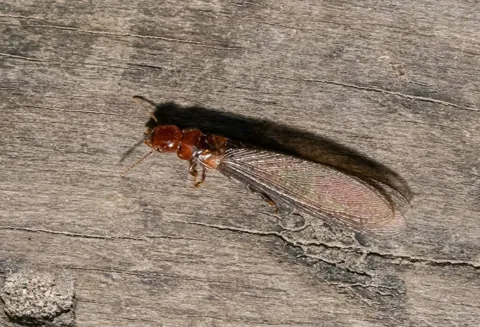 Western Drywood Termite
Incisitermes minor
Drywood termites live entirely inside wood without needing soil contact; the western drywood termite is California's second most important termite pest after subterranean termites. Clemson Extension says drywood termites get the moisture they need from humid air and are most common along humid coastal areas of South Carolina.
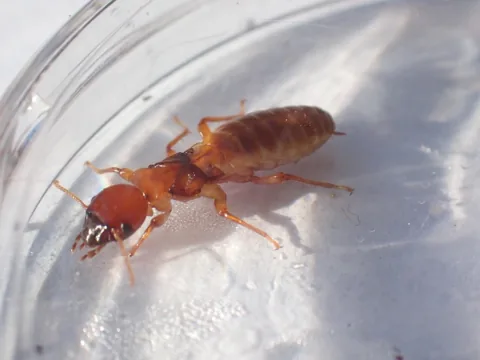 Dampwood Termites
Zootermopsis angusticollis
Dampwood termites live and feed in wet or rotting wood and don't nest in dry, sound lumber. Finding them in a building points to a leak, wood touching soil, or another moisture problem that needs fixing.
Side by side
These are the marks extension entomologists use for the workers and the damage. Sizes vary a little by source, so each range is given with its source.[5][7][8][4]
- Worker size: carpenter ant workers 1/4 to 1/2 inch per Penn State and UC IPM, 3/8 to 1/2 inch per Minnesota, and 1/4 to 5/8 inch per Nebraska, which notes the workers come in many sizes. Termite workers 1/8 to 1/4 inch per Penn State.[5][3][7][8]
- Worker look: carpenter ant workers are black or red and black, shiny, with a narrow waist. Termite workers are wingless, soft-bodied and creamy-white to light caramel, with broad waists and straight antennae.[7][5][3][4]
- Where you see them: carpenter ant workers crawl around inside homes, especially around sinks, dishwashers, tubs and toilets at night. Termite workers live hidden from view unless their tunnels are exposed.[5][7][6]
- What they do with wood: termite workers consume wood. Carpenter ants do not eat wood; they remove it to make galleries for their nest and feed on insects, honeydew, sweets, meat and fats.[2][6][8][7][9]
- Galleries: carpenter ant galleries are clean and smooth with a well-sanded appearance. Subterranean termite galleries are hollowed out along the grain and coated with an earth-like material.[7][8][2][6]
- Debris: carpenter ants leave coarse, stringy sawdust with insect parts. Subterranean termites leave mud: soil in the galleries and earthen tubes. Drywood termites leave six-sided pellets, not fibrous sawdust.[5][9][8][3][2]
- Moisture: carpenter ants usually start in moist or decayed wood but can spread into sound, dry wood. Subterranean termites nest in soil and reach wood through soil contact or shelter tubes; dampwood termites need very moist, decayed wood; drywood termites live in dry wood.[1][7][4][2]
- Activity time: carpenter ant workers forage from late afternoon or sunset through the night. Termites forage out of sight inside wood, soil and tubes.[8][7][4][2]
- Swarmers: both make winged reproductives, and Kentucky says ants tend to swarm at the same time of year as termites. The swarmer comparison page linked below covers the antennae, waist and wing differences.[2][4]
Reading the damage: galleries, sawdust and mud
Carpenter ants keep occupied galleries clean and push the wood out, so a cone-shaped pile often builds up just below the nest opening. Under a magnifying glass, Nebraska says, the shavings are all about the same size, as if cut by tiny chisels, and usually contain insect parts.[8]
Penn State says to look for piles of coarse, stringy wood particles, dead insect parts and other debris sifting from cracks in siding, behind moldings, in the basement and attic, and under porches. UC IPM adds that carpenter ant sawdust is fibrous, unlike the six-sided pellets of drywood termites.[5][3]
Termite damage looks different. Kentucky says termite-damaged wood is hollowed out along the grain with dried mud or soil lining the galleries, and that wood damaged by moisture or by carpenter ants will not look like this. Penn State says long-infested wood may be largely hollowed out and look rotten.[2][6]
Moisture: what each one needs
Minnesota says carpenter ant parent nests in homes are in moist or decayed wood from leaks, condensation or poor air circulation, while satellite nests can be in drier spots such as insulation, hollow doors, sound wood and wall voids. Kentucky says carpenter ants typically inhabit moist wood but can spread into rotting and undamaged wood.[7][1]
UC IPM says subterranean termites nest in soil and infest wood that touches soil or reach it through shelter tubes. Dampwood termites infest decayed wood kept moist by soil contact or a leak. Drywood termites can survive in very dry wood and do not need contact with soil.[4]
- Penn State says termites favor areas near furnaces, chimneys, water heaters and hot water pipes that stay warm in cold months.[6]
Workers seen foraging vs workers kept hidden
Carpenter ant workers leave the nest in late afternoon or early evening, forage through the night and return by early morning, Nebraska says. Minnesota says they search for food between sunset and midnight in spring and summer and can travel up to 100 yards from the nest.[8][7]
Penn State says large, wingless, dark ants inside are usually the first sign of carpenter ants, but the nest may be outside near the building. Minnesota says carpenter ants seen indoors in winter mean there is a nest inside, though a few workers carried in with firewood cannot start a nest.[5][7]
Termites behave the opposite way. Penn State says the workers and soldiers do not willingly expose themselves to light, so the black winged swarmers are the stage people most often see. Kentucky calls termites cryptic and says infestations can go undetected for years behind walls, floor coverings and insulation.[6][2]
- When infested wood is opened, UC IPM says the workers are the termites most often seen; soldiers have larger amber or brownish heads and bigger jaws.[4]
How to confirm which one you have
- Probe suspect wood with an awl, ice pick or screwdriver and look for mud-lined passages and mud tunnels, as Penn State advises for termites.[6]
- Check any sawdust pile with a magnifying glass for uniform shavings and insect parts, which point to carpenter ants.[8][9]
- Follow carpenter ants at night with a flashlight covered with red film, which the ants cannot see, or partly covered so it is dim; trails lead back to the nest.[7][3]
- Save a few insects and ask your county extension office; Kentucky suggests checking with local extension because termites and treatments vary by area, and Clemson says correct ant ID is needed for control to work.[2][9]
Why the difference matters
Treatment is different. Kentucky says termite control is a job for professionals, using liquid soil termiticides or cellulose baits in stations. Carpenter ant control depends on finding the parent nest and every satellite nest and treating them directly.[2][1][8]
Nebraska says injecting insecticide into the soil around the house the way termites are treated is unnecessary for carpenter ants. UC IPM says carpenter ant baits should be slow-acting so workers share them with the colony.[8][3]
What to do for each
- Carpenter ants: fix leaks and other moisture problems, replace moisture-damaged wood, and keep stored lumber and firewood off the ground and away from the house.[7][8][5]
- Carpenter ants: locate the nest by following foraging workers and sawdust piles, then treat the nest itself; the carpenter ant guide below covers dusts and baits.[1][8]
- Termites: break any shelter tubes between soil and wood, direct runoff away from the foundation, and keep a 12-inch strip of concrete, coarse sand or other inorganic material between soil and structural wood.[4][6]
- Termites: have a professional inspect and treat; Kentucky says do-it-yourself treatment is best avoided for a home infestation.[2]
Common questions
- Do carpenter ants eat wood like termites?
- No. Carpenter ants hollow out wood to nest and push it out as sawdust. Termites eat the wood.[8][7][9][2]
- I found sawdust under a hole. Is it termites?
- Coarse, fibrous sawdust with insect parts points to carpenter ants. Subterranean termites leave mud, not sawdust, and drywood termites leave hard six-sided pellets.[8][9][3][2]
- Big black ants walk around my kitchen at night. Could they be termites?
- Large dark ants in the open at night fit carpenter ant workers, which hunt for moisture around sinks, dishwashers and tubs. Termite workers are small and pale and stay hidden from light.[7][5][6]
- Can carpenter ants nest in dry wood?
- Yes. They usually start in moist or decayed wood, but satellite nests can be in dry spots such as insulation, hollow doors and sound wood.[1][7]
Photo credits
- Carpenter Ants: (c) Linda Watson, some rights reserved (CC BY) — via iNaturalist, CC BY 4.0
- Black carpenter ant: (c) Zac Peterson, some rights reserved (CC BY) — via iNaturalist, CC BY 4.0
- Eastern Subterranean Termite: (c) Sam Kieschnick, some rights reserved (CC BY) — via iNaturalist, CC BY 4.0
- Western Drywood Termite: (c) Jeremiah Degenhardt, some rights reserved (CC BY) — via iNaturalist, CC BY 4.0
- Dampwood Termites: Ellyne Geurts, public domain (CC0), via iNaturalist
Sources
- University of Kentucky Entomology, “ENTFACT-603: Carpenter Ants.” entomology.mgcafe.uky.edu/ef603 (accessed 2026-11-14)
- University of Kentucky Entomology, “ENTFACT-604: Termite Control: Answers for Homeowners.” entomology.mgcafe.uky.edu/ef604 (accessed 2026-11-14)
- University of California Statewide IPM Program, “Pest Notes: Carpenter Ants.” ipm.ucanr.edu/home-and-landscape/carpenter-ants/ (accessed 2026-11-14)
- University of California Statewide IPM Program, “Pest Notes: Subterranean and Other Termites.” ipm.ucanr.edu/home-and-landscape/subterranean-and-other-termites/ (accessed 2026-11-14)
- Penn State Extension, “Carpenter Ants.” extension.psu.edu/carpenter-ants (accessed 2026-11-14)
- Penn State Extension, “Eastern Subterranean Termites.” extension.psu.edu/eastern-subterranean-termites (accessed 2026-11-14)
- University of Minnesota Extension, “Carpenter ants.” extension.umn.edu/insects-infest-homes/carpenter-ants (accessed 2026-11-14)
- University of Nebraska-Lincoln Extension, “G1738: Carpenter Ant Management.” extensionpubs.unl.edu/publication/g1738/na/html/view (accessed 2026-11-14)
- Clemson Cooperative Extension Home & Garden Information Center, “Carpenter Ants (HGIC).” hgic.clemson.edu/factsheet/carpenter-ants/ (accessed 2026-11-14)