On this page
How to identify it
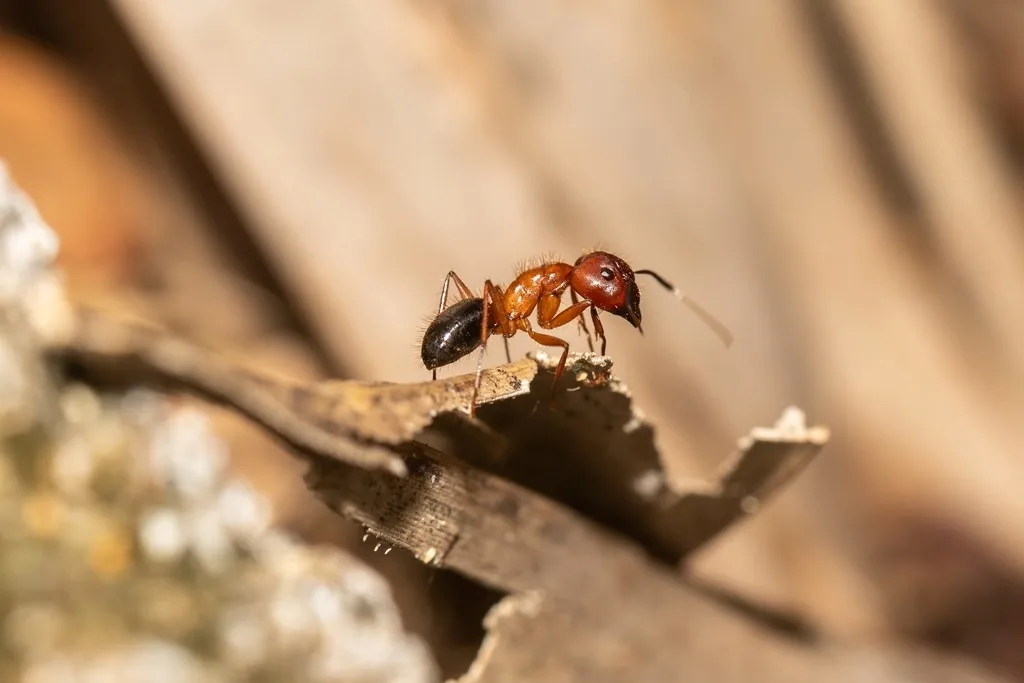
- The head and thorax are reddish and the abdomen shiny black. Legs and antennae carry many long, coarse, golden to brown hairs, and the whole body has a dense covering of golden hairs. UF/IFAS describes the head and thorax as ash brown to rusty orange and the body hairs as abundant, long and golden.[2][1][4][3]
- Workers vary a lot in size within one colony, so size alone is not a good way to identify it. UGA gives about 3/8 to 5/8 inch; museum specimens measured about 6 mm for small workers, about 9 to 10.4 mm for large workers and 12 to 14 mm for queens. UF/IFAS gives workers 5.5 to 11 mm (0.2 to 0.4 in), with smaller minors and larger majors, and winged queens up to 20 mm (3/4 in); males are much smaller than queens.[2][4][3]
- Like other carpenter ants, it has a single node on the waist and an evenly rounded back seen from the side.[5]
- Carpenter ants can't sting, but they bite with strong jaws and can spray formic acid into the bite. UF/IFAS also says workers bite and spray formic acid for defense.[5][1][3]
- The antennae have 12 segments and no club, ending in a slightly elongated, bullet-shaped segment, and there is a circular ring of hair at the tip of the abdomen.[3]
Look-alikes
| Look-alike | How to tell them apart |
|---|---|
| Black carpenter ant | The black carpenter ant is dull black with yellowish hairs on the abdomen and in Georgia is more common inland in central and northern parts of the state; the Florida carpenter ant has a reddish head and thorax and is most common in southern and southeastern Georgia. UF/IFAS notes that the black carpenter ant is found in Florida's panhandle.[2][3] |
| Termite swarmers | Ants have a pinched waist, elbowed antennae and hind wings smaller than the front wings; termites have a broad waist, straight antennae and front and hind wings about the same size. UF/IFAS adds that termite swarmers have beaded antennae and that winged carpenter ants are often mistaken for them during the spring swarm season.[6][3] |
| Compact carpenter ant | A small, exotic carpenter ant that forages in the daytime; UF/IFAS says it has become common in many parts of central and southern Florida.[3] |
| Tortugas carpenter ant | A close relative, also common around buildings, that UF/IFAS says lives only in central and southern Florida. Major workers have a head longer than broad, the leg tibiae and antennal bases lack erect hairs, and it is thinner and paler with less color contrast. In south Florida, Florida carpenter ants outnumber it about 2:1.[3] |
Where it lives
A southeastern US species, most common on the Coastal Plain. In Georgia it is most common in the southern and southeastern part of the state; source lists of states differ (see below). UF/IFAS says it is widely distributed throughout Florida and some neighboring states.[7][2][1][3]
Biology and life cycle
Mating flights happen in spring, usually April to June, triggered by day length and temperature, and winged ants can appear in alarming numbers then. A mated queen starts a nest under loose bark or wood debris and raises small first workers called minims. UF/IFAS says winged reproductives fly in the evening or at night during the rainy season, May through November, and that a colony usually sends out its first winged reproductives when it is two to five years old.[1][3]
Egg to adult takes 50 to 70 days. Typical nests hold several thousand ants, up to about 8,000, and can last several years; queenless satellite nests can be 20 to 100 feet from the main nest. UF/IFAS adds that larvae are maggot-like and pupae sit in silk cocoons that are often mistaken for eggs, and that nests close together can lead to fighting between neighboring colonies.[1][3]
It forages mainly at night. UGA notes carpenter ants come out about 15 minutes after sundown and travel up to hundreds of feet along paths they reuse from year to year. UF/IFAS puts peak foraging from just before sunset until two hours after, then again around dawn, along loose trails or by single ants that seem to wander aimlessly.[1][2][3]
It feeds on honeydew from aphids, scales and mealybugs, on flower nectar and other sweets, and carpenter ants also prey on other insects. UF/IFAS says they also take living and dead insects and turn up in campgrounds near soda machines.[1][3]
In the wild it lives in sandy coastal and inland habitats such as dunes, pine-oak woodlands, longleaf pine savannas and hardwood hammocks, nesting in sandy soil, rotting wood and decaying pine stumps.[4]
Damage and signs
- It nests in existing hollows in wood or burrows into soft materials such as pithy wood and foam, and it seeks moisture around plumbing leaks, doors and windows. UF/IFAS says they hollow out wood softened by moisture or fungi and other soft materials such as Styrofoam but will not excavate nesting galleries in sound wood, and they push out debris called frass: bits of excavated material and dead insects.[1][3]
- Indoor nests turn up in wall voids, attic insulation and eaves, under bathtubs, in window and door frames, around skylights, in boxes and closets, and under appliances. UF/IFAS adds spots under dishwashers, in flat roofs, behind wood panels, in wood furniture, between floor cracks, and in electrical boxes such as fuse, meter and timer boxes.[1][2][3]
- Outdoors it nests in trees and is more opportunistic than the black carpenter ant, also nesting under loose debris on the ground (old doors, shingles, cardboard, plywood) and in stumps, logs and railroad ties. UF/IFAS adds old drywood termite galleries, old leaf bases of palms (especially around coconut palm flowers), tree roots (especially citrus), bamboo poles, mulch, coconuts left on the ground, and voids in concrete decorations, walls and expansion joints.[2][3]
Health risk
It does not sting, but workers bite hard and can spray formic acid when disturbed.[1][5]
Control
Keep them out
Trim tree limbs and shrubs away from the house, and seal cracks and openings, including where utility lines enter. UF/IFAS adds that ants trail along wires and cables into attics, that sticky barrier products on tree trunks can stop them, and that caulking and weather stripping help.[2][8][3]
Sanitation
Fix leaks around vents, pipes, sinks, chimneys and skylights and replace water-damaged wood, since moisture draws carpenter ants. UF/IFAS also suggests controlling aphids and other honeydew producers on nearby plants to cut the ants' food.[2][8][3]
Traps and physical control
Find the nest: inspect at night starting about 30 minutes after sunset and follow foragers back. Honey or another sweet food helps, since workers that feed on it lead you back to the nest. UF/IFAS says watching foragers enter voids at their peak night hours is the best way to find a nest; a few drops of sugar water, honey or dead insects along a trail draws more nestmates to follow.[2][8][3]
Pesticides
UGA prefers baits in most cases: bait stations indoors where ants travel, and small piles of gel bait outdoors on their paths or on trees with nests, placed in the evening. Clemson notes baits work well in some cases and not in others. UF/IFAS recommends treating the nest directly where it can be reached, since it holds the queen, brood and most workers: a small amount of insecticidal dust or spray applied right on the nest is usually successful, while heavy treatment near but not on it can make the colony move. Where the nest can't be found, it suggests a bait made for carpenter ants along the trail, noting these finicky eaters don't recruit in large numbers to baits.[2][8][3]
Where ants are nesting in wood or walls, Clemson describes drilling small holes into the galleries and injecting an insecticide dust or aerosol. Follow the label.[8]
Not established in California
California's agriculture department gives it an A rating. It has never been found living in California's natural environment, but border stations, dog teams and the fire ant program intercepted it 20 times from January 2000 to November 2016.[1]
Where sources disagree
How much damage it does: CDFA calls it a serious house-infesting ant that can expand nests into sound wood and compromise structural integrity; the Mississippi Entomological Museum's species page says it is not a major structural pest and infestations are generally localized and non-destructive, while the museum's list of common southeastern pest ants rates it a structural pest and nuisance. UF/IFAS says Florida carpenter ants will not excavate nesting galleries in sound wood and that homeowners sometimes incorrectly learn they damage a home's structure.[1][4][7][3]
Range: CDFA gives North Carolina to Florida and west to Mississippi; the museum's species page lists Florida, South Carolina, Georgia, Alabama, Mississippi and Texas; its pest-ant list gives Alabama, Florida, Georgia, Louisiana, Mississippi, North Carolina and South Carolina, mostly in coastal sandy areas. UF/IFAS says throughout Florida and some neighboring states.[1][4][7][3]
Flight season: CDFA puts mating flights in spring, usually April to June; UF/IFAS says complaints peak in the spring swarm season, usually April to June, but that winged reproductives fly during the rainy season, May through November, and are seen from spring to fall.[3][1]
Size: UGA gives about 3/8 to 5/8 inch and the Mississippi Entomological Museum measured queens at 12 to 14 mm; UF/IFAS gives workers 5.5 to 11 mm (0.2 to 0.4 in) and winged queens up to 20 mm (3/4 in).[2][4][3]
Common questions
- Do Florida carpenter ants damage houses?
- Sources differ. CDFA says it can expand nests into sound wood, while the Mississippi Entomological Museum says damage is usually localized and minor. Either way, nests often follow moisture, so finding them may point to a leak that needs fixing. UF/IFAS says they do not excavate sound wood.[1][4][2][3]
- Do bull ants sting?
- No. Carpenter ants have no sting, but Florida carpenter ants bite hard and can spray formic acid.[5][1]
- Why do I see them at night?
- They forage mainly at night; carpenter ants leave the nest in numbers shortly after sundown. UF/IFAS puts the peak from just before sunset to two hours after, and again around dawn.[1][2][3]
- Why are winged ants at my windows in spring?
- UF/IFAS says complaints peak in the spring swarm season, usually April to June, when winged Florida carpenter ants turn up along window ledges and near sliding glass doors. They are often mistaken for termite swarmers, but ants have elbowed antennae, front wings larger than the hind wings and a pinched waist.[3]
Sources
- California Department of Food and Agriculture (Pest Ratings), “California Pest Rating: Camponotus floridanus (Buckley) – Florida Carpenter Ant.” blogs.cdfa.ca.gov/Section3162/?p=3203 (accessed 2026-11-14)
- University of Georgia Cooperative Extension, “Carpenter Ants (Circular 929, Suiter and Forschler; published with full review July 2022).” fieldreport.caes.uga.edu/?p=61081 (accessed 2026-11-14)
- University of Florida/IFAS Extension (Featured Creatures), “Florida Carpenter Ant, Bull Ant, Tortugas Carpenter Ant, Camponotus floridanus (Buckley) and Camponotus tortuganus (Emery), EENY-272/IN455.” ask.ifas.ufl.edu/publication/IN455 (accessed 2026-11-14)
- Mississippi Entomological Museum, Mississippi State University, “Camponotus (Myrmothrix) floridanus (Buckley) species page.” mississippientomologicalmuseum.org.msstate.edu/Researchtaxapages/Formicidaepages/genericpages/Camponotus_floridanus.htm (accessed 2026-11-14)
- University of California Statewide IPM Program, “Pest Notes: Carpenter Ants, Publication 7416 (August 2009).” ipm.ucanr.edu/legacy_assets/PDF/PESTNOTES/pncarpenterants.pdf (accessed 2026-11-14)
- University of California Statewide IPM Program, “Pest Notes: Ants, Publication 7411 (October 2012).” ipm.ucanr.edu/legacy_assets/PDF/PESTNOTES/pnants.pdf (accessed 2026-11-14)
- Mississippi Entomological Museum, Mississippi State University, “Common Pest Ants of the Southeastern United States.” mem.org.msstate.edu/Researchtaxapages/Formicidaepages/faunal.lists/Common_Pest_Ants.html (accessed 2026-11-14)
- Clemson Cooperative Extension Home & Garden Information Center, “Carpenter Ants (HGIC 2406).” hgic.clemson.edu/factsheet/carpenter-ants/ (accessed 2026-11-14)
- iNaturalist, “Camponotus floridanus taxon page (order and family).” www.inaturalist.org/taxa/81709 (accessed 2026-11-14)