On this page
How to identify it
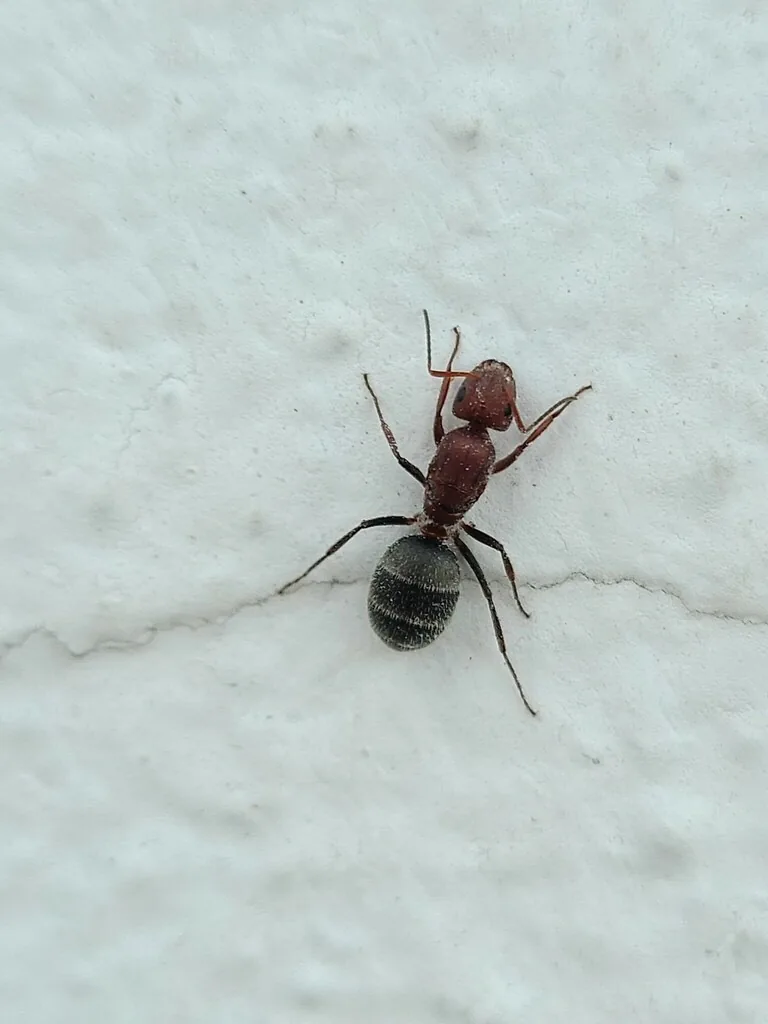
- It is easy to separate from other Southeastern carpenter ants by its small size, about 3.5 to 6.0 mm, and its two-tone color: reddish brown with a dark blackish-brown abdomen. UF/IFAS gives a worker range of 3 to 6 mm (~1/8 to 1/4 in) and describes the head and thorax as ash brown with a blackish gaster, like the Florida carpenter ant but smaller.[1][5][3]
- Workers come in more than one size. The Mississippi Entomological Museum (MEM) measures minor workers at about 3.5 to 4.0 mm and major workers at 5.0 to 6.0 mm, with queens about the size of majors.[1][2]
- Under a lens, long white hairs cover most of the body except the antenna bases, the thorax is strongly and evenly arched with no spines, and the waist has a single node.[1]
- It forages by day, mostly on the outside of buildings.[2]
- UF/IFAS adds 12-segmented antennae with a slightly elongated, bullet-shaped tip, abundant long hairs on the head, thorax and abdomen but few on the legs, and no stinger.[3]
Look-alikes
| Look-alike | How to tell them apart |
|---|---|
| Florida carpenter ant | Larger, with black antenna bases that carry erect hairs; the compact carpenter ant has no erect hairs on its antenna bases. UF/IFAS calls it a smaller, more compact close relative of the Florida carpenter ant complex (Camponotus floridanus and C. tortuganus) and says it is often found living near them.[1][3] |
Where it lives
Thought to be native to Central America and northern South America, it occurs in Cuba and from Mexico to Colombia. In the United States the Mississippi Entomological Museum lists it from southern Florida, southern Texas and coastal Hancock County, Mississippi, where it was probably brought in on palms from Florida. In Florida it is most common in the Keys but also occurs on the mainland; California's agriculture department names Sarasota, Tampa and east Miami among established sites, also lists Texas and Hawaii, and says it has never been found in California's natural environment, though it is often intercepted at the state's border stations. UF/IFAS describes it as well established in Sarasota, Tampa, east Miami and the Florida Keys, with further reports from Lee, Manatee, Monroe, Sarasota, Broward and Indian River Counties, and well established in Palm Beach County.[1][2][3]
Biology and life cycle
A single queen starts each colony and raises the first larvae until they become workers. Colonies keep growing for 2 to 5 years before producing winged males and queens, which fly from spring to fall. UF/IFAS adds that it develops by complete metamorphosis, with pupae in silk cocoons.[2][3]
Sources differ on colony size: MEM describes colonies as small, while the California Department of Food and Agriculture (CDFA) says one can reach 10,000 workers.[1][2]
Nests are mostly up in trees, in hollow twigs, old termite galleries in dead wood, grass clumps, hollows in tree trunks and the leaf bases of palms. UF/IFAS says nests are usually difficult to find.[1][5][2][3]
Workers collect honeydew, including drops that land on exterior walls, trees, shrubs, sidewalks and lawns, and the ant has been reported to protect the honeydew-producing insects.[2][1]
In Florida it is most common in the Keys, where it is a dominant ant in tropical hammocks, with scattered populations on the mainland.[1]
Whether it is native is debated. MEM says populations in the Southwest are almost certainly a natural extension of its range from Mexico, that a Florida ant specialist has questioned whether it is native to Florida, and that the Hancock County, Mississippi, population most likely arrived on palms imported from south Florida.[1]
Mississippi State's 2021 exotic ant bulletin lists US records from Florida, Mississippi, New Mexico and Texas, and CDFA also mentions Hawaii.[5][2]
Workers forage singly or in very dispersed trails and stay active all day, even in direct sunlight. UF/IFAS reports them feeding on drops of honey on walls with surface temperatures as high as 37°C (98.6°F).[3]
Damage and signs
- It can get into buildings through cracks and crevices in the structure. UF/IFAS says it is rarely seen inside but has been seen entering under doors and through cracks around windows, and that, unlike Florida carpenter ants, its winged swarmers do not fly in buildings.[2][3]
- Its pest status is rated differently even by one research group. MEM's species page says it is not considered a serious economic threat in Mississippi, though it sometimes nests in wood, while the 2021 bulletin says it has proven difficult to control at isolated Hancock County sites and is considered a significant pest there.[1][5]
- MEM's list of common Southeastern pest ants rates it a structural and nuisance pest in Florida and Mississippi, and both MEM and CDFA say it may compete with native ants and prey on other arthropods.[4][5][2]
Health risk
These sources treat it as a nuisance and structural pest, not a health pest. UF/IFAS notes that it has no stinger.[4][5][3]
Control
Prevention
Moving firewood can carry it long distances, according to CDFA.[2]
Keep them out
CDFA names the practices this ant would call for: trimming branches close to buildings, sealing entry points, improving ventilation in damp areas, and storing firewood off the ground and away from the house.[2]
Caulking exterior openings and adding weather stripping may also help, according to UF/IFAS.[3]
Pesticides
UF/IFAS says residual surface sprays will control the usual complaints about these ants on building exteriors, direct sprays to nest sites are recommended if nests can be found, and baits placed along trails help reduce colony populations. Read and follow the label.[3]
When to call a professional
Where it is established, it can be hard to get rid of: in Mississippi it has proven difficult to control at the sites where it lives.[5]
More from the California Department of Food and Agriculture
The California Department of Food and Agriculture gives it an A rating (a pest of known economic importance subject to state action): it has never been found living in California, but border stations intercepted it 28 times between 2014 and late 2017 and 34 more times in early 2018, mostly on vehicles entering the state; CDFA also notes that colonies have a single queen and keep growing for 2 to 5 years.[2]
Where the sources disagree
Native or introduced in Florida: UF/IFAS describes it as now regarded as exotic to Florida; the Mississippi Entomological Museum says a Florida ant specialist has questioned whether it is native there and considers Southwestern populations a natural range extension from Mexico.[3][1]
Body hairs: UF/IFAS describes the long body hairs as golden; the Mississippi Entomological Museum describes them as white.[3][1]
Common questions
- What are the small ants marching on my house walls in daylight?
- In south Florida, possibly compact carpenter ants, which forage by day on exterior walls, trees and sidewalks. Look for a small two-toned ant, reddish brown with a dark abdomen and covered in long white hairs.[2][1]
- Do they come inside?
- They can, through cracks and crevices in the structure, but they are mostly a pest of building exteriors. UF/IFAS says they are rarely seen inside, though they may slip under doors and around windows.[2][3]
- Why do I see these ants in the daytime when carpenter ants are usually out at night?
- UF/IFAS says the compact carpenter ant is day-active, so homeowners see it more often than other carpenter ants, which tend to be nocturnal.[3]
Sources
- Mississippi Entomological Museum, Mississippi State University, “Camponotus (Myrmothrix) planatus Roger, 1863 (species page, J. A. MacGown and R. J. Whitehouse).” mississippientomologicalmuseum.org.msstate.edu/Researchtaxapages/Formicidaepages/genericpages/Camponotus_planatus.htm (accessed 2026-11-14)
- California Department of Food and Agriculture (Pest Ratings), “California Pest Rating: Compact Carpenter Ant | Camponotus planatus.” blogs.cdfa.ca.gov/Section3162/?p=5145 (accessed 2026-11-14)
- University of Florida/IFAS Extension (Featured Creatures), “Compact Carpenter Ant (proposed common name), Camponotus planatus (Roger), EENY189/IN346 (Featured Creatures).” ask.ifas.ufl.edu/publication/IN346 (accessed 2026-11-14)
- Mississippi Entomological Museum, Mississippi State University, “Common Pest Ants of the Southeastern United States.” mem.org.msstate.edu/Researchtaxapages/Formicidaepages/faunal.lists/Common_Pest_Ants.html (accessed 2026-11-14)
- Mississippi Agricultural and Forestry Experiment Station, Mississippi State University, “Exotic Ants (Hymenoptera: Formicidae) of Mississippi, Bulletin 1229 (May 2021), by J. A. MacGown.” www.mafes.msstate.edu/publications/bulletins/b1229.pdf (accessed 2026-11-14)
- iNaturalist, “Camponotus planatus taxon page (order and family).” www.inaturalist.org/taxa/300418 (accessed 2026-11-14)