The short answer
- Look at the top of the abdomen (the rear section). A carpenter bee's is mostly bare and shiny black. A bumble bee's is covered in hair, usually banded black and yellow.[1][3][9][5][7]
- Watch where it goes. Carpenter bees bore perfectly round holes, about 1/2 inch across, into wood such as eaves, fascia, decks and railings. Bumble bees nest in existing cavities, often underground in old rodent burrows.[3][4][1][9][6]
- A large bee hovering in front of you near a deck or eave is most likely a male carpenter bee guarding its territory. Males have no stinger; females can sting but seldom do unless handled.[3][1][4][2]
- Bumble bee queens and workers can sting and will defend their nest, though they are less likely to attack than yellowjackets.[6][7][9]
Profiles on this site
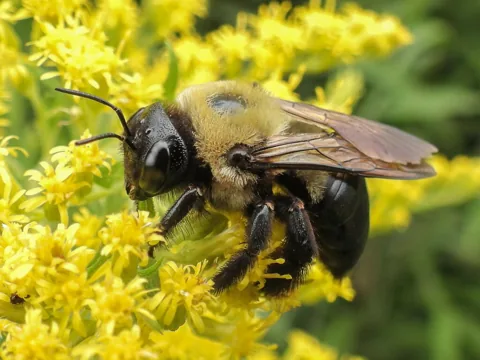 Eastern Carpenter Bee
Xylocopa virginica
Carpenter bees are large, solitary bees that bore round tunnels into bare, weathered wood to rear their young; they rarely cause severe damage but can weaken wood that is reused year after year.
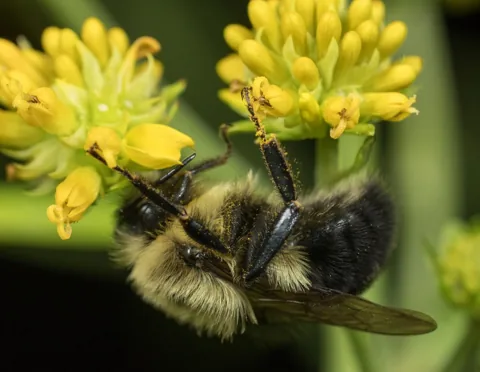 Common Eastern Bumble Bee
Bombus impatiens
Bumble bees are social bees that form annual colonies in soil cavities, old rodent burrows and similar voids; they are valuable pollinators and defend their nests only when disturbed.
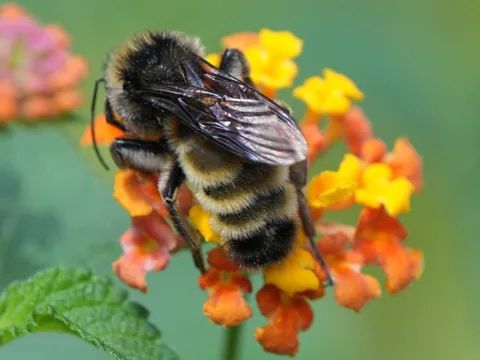 American bumble bee
Bombus pensylvanicus
The American bumble bee was once one of the most common and widespread bumble bees in the eastern and southeastern United States. MDC puts its North American decline at nearly 90 percent between 2000 and 2020, and the U.S. Fish and Wildlife Service cites a 2014 assessment that found an 89 percent drop in abundance relative to other bees sharing its habitat. Losses are worst in the northern part of its range.
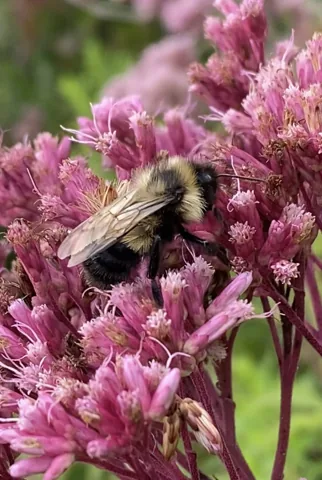 Rusty-patched bumble bee
Bombus affinis
The rusty patched bumble bee was once common across the northern part of eastern North America. The U.S. Fish and Wildlife Service listed it as endangered in 2017, making it the first federally protected bumble bee and the first bee on the endangered species list, and it now survives in low numbers in a small part of its former range.
Side by side
Extension fact sheets agree on the main marks. Where they give different numbers, both are listed with their source.[1][3][5]
- Size: carpenter bees about three-quarters of an inch to 1 inch long per Clemson and Ohio State, with UC IPM giving 5/8 to 1 inch for females. Bumble bees 1/2 to 1 inch per Penn State and Missouri Department of Conservation, 15-25mm per Texas A&M, and ⅓ to 1⅜ inches across queens, males and workers per Ohio State.[4][5][2][3][9][7][6]
- Abdomen: carpenter bees have a largely bare, shiny black upper abdomen; UC IPM notes fringes of hair on some segments. Bumble bees have an abdomen fully clothed in hair, many of the hairs yellow.[3][5][2][9][1]
- Thorax and face: carpenter bees have yellow, orange or white hair on the thorax. The female's head is all black; the male has yellow or white markings on the face.[5][4]
- Head width: Ohio State says a carpenter bee's head is as broad as its thorax, while a bumble bee's head is much narrower than its thorax.[5][6]
- Hind legs: bumble bees carry large pollen baskets on the hind legs; carpenter bees have a dense brush of hairs there instead.[5]
- Nest: carpenter bee females tunnel into wood to lay eggs. Bumble bees nest in an existing cavity, often underground in an abandoned rodent burrow, and also use brush piles, trash heaps, bird houses and similar spaces.[1][9][7]
- Social life: each carpenter bee female has her own gallery, and there are no queen or worker castes. Bumble bees live in annual colonies with a queen, males and smaller workers, usually fewer than 50 individuals per Ohio State.[5][8][6]
- Stinging: male carpenter bees cannot sting, and females seldom do unless handled. Bumble bee queens and workers have stingers, can sting more than once, and defend their nests.[1][3][4][6][7]
- Season: carpenter bees emerge in spring (April and early May in Ohio), and new adults appear in late summer, then overwinter in the tunnels. Bumble bee queens start colonies in spring, the colony grows through summer, and workers and males die with the first hard freeze.[5][3][1][6][7]
Holes, sawdust and stains: what carpenter bees leave behind
The entrance hole is perfectly round and about the diameter of your little finger, Kentucky says; Penn State and Clemson put it at about 1/2 inch, and Ohio State at slightly less than 1/2 inch, roughly the width of the bee's body.[1][3][4][5]
The female bores in against the grain, then turns at about a right angle and tunnels along the grain. Ohio State says the gallery runs 4 to 6 inches; UC IPM describes tunnels 6 to 10 inches deep divided into cells, each with an egg and a pollen supply.[1][3][5][2]
Kentucky describes coarse sawdust below the opening and says tunneling sounds are sometimes heard inside the wood; Clemson calls it fine sawdust, found on the ground beneath the holes in spring. Penn State says the bees often defecate on the surface below the hole, leaving stains.[1][4][3]
One bee's tunnel does little harm. Penn State and Kentucky say the trouble comes when later broods reuse and extend the same galleries year after year, and Kentucky adds that the holes let in moisture that leads to rot.[3][1][5]
The bee that hovers at your face
The carpenter bee people notice most is the male. Penn State says males hover near the nest, dart after other flying insects and approach people who move quickly or wave a hand. Clemson calls them territorial and says that although they act aggressive, they have no stinger.[3][4][1]
You can tell a male by the yellow or white marks on the face. The female, with an all-black head, is the one able to sting, and Penn State, Kentucky and UC IPM all say she rarely does unless handled or roughly disturbed. Texas A&M says carpenter bees do not sting to defend their nests.[5][4][3][1][2][7]
Both are pollinators, and some bumble bees are in trouble
Carpenter bees feed on pollen and nectar, not wood, and UC IPM and Ohio State both call them beneficial pollinators. The USDA Forest Service says they buzz-pollinate and are excellent pollinators of eggplant, tomato and other vegetables, though they also cut slits at the base of some flowers to take nectar without pollinating.[5][2][8]
Texas A&M says most of the roughly 50 North American bumble bee species are important pollinators. Missouri Department of Conservation says many bumble bee species are declining, and Ohio State advises against eliminating ground-nesting bees in most situations because of their value as pollinators.[7][9][6]
The rusty patched bumble bee was listed as federally endangered in 2017, the U.S. Fish and Wildlife Service says. Its historical range covered the eastern United States and upper Midwest.[11]
- The Fish and Wildlife Service says the exact cause of its decline is unknown, but evidence points to an introduced pathogen interacting with exposure to pesticides, including insecticides and fungicides. The University of Minnesota Bee Lab says workers and males carry the rusty patch on the second segment of the abdomen.[11][10]
How to confirm which one you have
- Watch where the bee lands. Penn State says several large bees hovering near the eaves or drilling into wood means carpenter bees. A bee going in and out of a hole in the ground, a brush pile or a bird house fits a bumble bee.[3][9][1]
- Get a photo of the top of the abdomen from above: bare and shiny for a carpenter bee, hairy and banded for a bumble bee.[1][3][9]
- Check the wood for round holes and look for sawdust and stains on the surface below; Clemson and Kentucky say you may hear buzzing or tunneling inside.[1][4][3]
- If you think you have seen a rusty patched bumble bee, the Fish and Wildlife Service asks for photos from the top, side and head, uploaded to Bumble Bee Watch, where identifications can often be verified from the photos.[11][10]
Why the difference matters
Carpenter bees are a wood problem: UC IPM says their nests weaken structural wood and leave holes and stains, and control is aimed at the tunnels. Bumble bees are a sting-risk question only when the nest is where people walk, and Ohio State says the best option is usually to avoid that area while the bees are active.[2][3][6]
- Spraying flowers is the wrong move for either one. Texas A&M says insecticide sprays should never be applied to flowers for bumble bee control.[7]
What to do for each
- Carpenter bees: paint or varnish exposed wood regularly; Kentucky says painted or pressure-treated wood is much less likely to be attacked, and the bees prefer bare, weathered softwoods such as cedar, redwood, cypress and pine.[2][1][5]
- Carpenter bees: if you treat, UC IPM says to treat tunnels in early spring before nesting starts or in fall after adults settle in to overwinter, then fill empty holes with steel wool and caulk and paint over them. The carpenter bee guide linked below covers dusts and timing.[2][3]
- Bumble bees: Ohio State says the workers and males die with the first hard freeze, and the best option for a nest in a busy spot is often to stay away from it during the season it is active.[6]
- Bumble bees: if a nest must go, Texas A&M says people allergic to bee stings should not treat it themselves, and a pest management professional is an option.[7]
- If someone is stung: MedlinePlus says to scrape out any stinger left in the skin with a straight edge such as a credit card and apply wrapped ice for 10 minutes on, 10 minutes off. NIOSH says never to squeeze the stinger or use tweezers.[12][13]
- Call 911 for trouble breathing or other signs of a severe allergic reaction; MedlinePlus and NIOSH say anaphylaxis is life-threatening and needs immediate emergency care. NIOSH says people with a history of severe reactions should carry an EpiPen and wear a medical ID.[12][13]
Common questions
- Does a carpenter bee sting?
- Males cannot; they have no stinger. Females can, but Kentucky, Penn State and UC IPM say they rarely do unless handled.[1][3][2][4]
- Do bumble bees drill holes in wood?
- No. Bumble bees nest in existing cavities, often underground in old rodent burrows. Round holes drilled in wood point to carpenter bees.[1][9][3]
- Is the rusty patched bumble bee protected?
- Yes. The U.S. Fish and Wildlife Service listed it as endangered in 2017 under the Endangered Species Act.[11]
- Do carpenter bees eat wood?
- No. They feed on pollen and nectar. The females chew out tunnels only as nest sites for their young.[5][1]
Photo credits
- Eastern Carpenter Bee: Erik Schiff, public domain (CC0), via iNaturalist
- Common Eastern Bumble Bee: Jesse Rorabaugh, public domain (CC0), via iNaturalist
- American bumble bee: (c) Linda Watson, some rights reserved (CC BY) — via iNaturalist, CC BY 4.0
- Rusty-patched bumble bee: Milwaukee County Parks - Natural Areas Program, public domain (CC0), via iNaturalist
Sources
- University of Kentucky Entomology, “ENTFACT-611: Carpenter Bees.” entomology.mgcafe.uky.edu/ef611 (accessed 2026-11-14)
- University of California Statewide IPM Program, “Pest Notes: Carpenter Bees.” ipm.ucanr.edu/home-and-landscape/carpenter-bees/ (accessed 2026-11-14)
- Penn State Extension, “Carpenter Bees.” extension.psu.edu/carpenter-bees (accessed 2026-11-14)
- Clemson Cooperative Extension Home & Garden Information Center, “Carpenter Bees (HGIC).” hgic.clemson.edu/factsheet/carpenter-bees/ (accessed 2026-11-14)
- Ohio State University Extension, “HYG-2074: Carpenter Bees.” ohioline.osu.edu/factsheet/hyg-2074 (accessed 2026-11-14)
- Ohio State University Extension, “HYG-2143: Ground-Nesting Bees and Wasps.” ohioline.osu.edu/factsheet/hyg-2143 (accessed 2026-11-14)
- Texas A&M AgriLife Extension, “ENT-3005: Bees (Honey Bees, Bumble Bees and Carpenter Bees).” citybugs.tamu.edu/factsheets/biting-stinging/bees/ent-3005/ (accessed 2026-11-14)
- USDA Forest Service, “Carpenter Bees (Pollinator of the Month).” www.fs.usda.gov/wildflowers/pollinators/pollinator-of-the-month/carpenter_bees.shtml (accessed 2026-11-14)
- Missouri Department of Conservation, “Bumble Bees (Field Guide).” mdc.mo.gov/discover-nature/field-guide/bumble-bees (accessed 2026-11-14)
- University of Minnesota Bee Lab, “Rusty Patched Bumble Bee.” beelab.umn.edu/rusty-patched-bumble-bee (accessed 2026-11-14)
- U.S. Fish and Wildlife Service, “Rusty Patched Bumble Bee (Bombus affinis).” www.fws.gov/species/rusty-patched-bumble-bee-bombus-affinis (accessed 2026-11-14)
- MedlinePlus (U.S. National Library of Medicine), “Insect bites and stings.” medlineplus.gov/ency/article/000033.htm (accessed 2026-11-14)
- CDC National Institute for Occupational Safety and Health, “Insects and Scorpions (Outdoor Workers).” www.cdc.gov/niosh/outdoor-workers/about/insects-and-scorpions.html (accessed 2026-11-14)