The short answer
- Body: bumble bees are big, round and very fuzzy, mostly black and yellow and sometimes orange. Honey bees are slimmer and golden brown, with thin black stripes across the abdomen.[7][5][2][3]
- Size: a honey bee worker is about 1/2 inch long (Missouri gives 1/2 to 5/8 inch). Bumble bees run from under 1/2 inch to about 1 inch, and Ohio State puts the largest queens at up to 1 3/8 inches.[7][6][5][2]
- Nest: bumble bees usually nest underground in old rodent burrows and other holes, and the colony dies in the fall. Honey bees nest in enclosed cavities such as hollow trees and sometimes wall voids, build sheets of wax comb, and the same nest can stay active for years.[7][4][6][1][2]
- Sting: a honey bee's barbed stinger stays in your skin and the bee dies. A bumble bee can sting more than once and doesn't leave its stinger behind.[7][6][2]
Profiles on this site
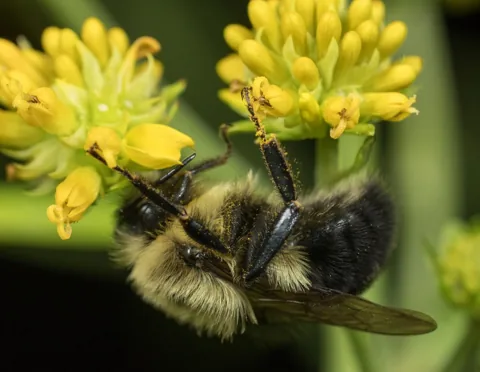 Common Eastern Bumble Bee
Bombus impatiens
Bumble bees are social bees that form annual colonies in soil cavities, old rodent burrows and similar voids; they are valuable pollinators and defend their nests only when disturbed.
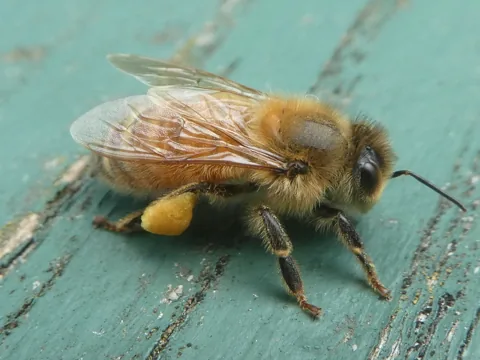 Western Honey Bee
Apis mellifera
Honey bees are important pollinators, but a colony that moves into a wall void or attic can become a stinging hazard. A swarm is temporary and usually best left alone, while an established colony in a building should be removed along with its comb.
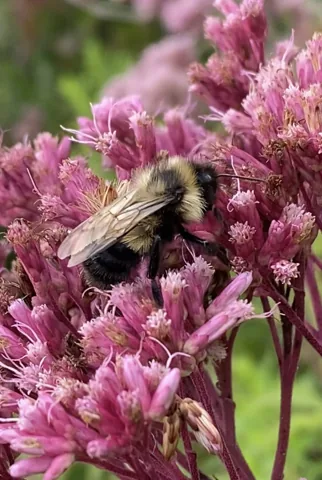 Rusty-patched bumble bee
Bombus affinis
The rusty patched bumble bee was once common across the northern part of eastern North America. The U.S. Fish and Wildlife Service listed it as endangered in 2017, making it the first federally protected bumble bee and the first bee on the endangered species list, and it now survives in low numbers in a small part of its former range.
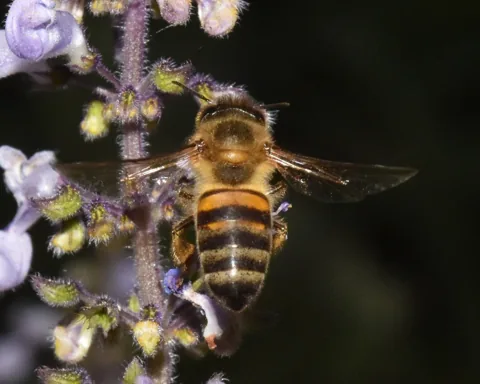 Africanized Honey Bee
Apis mellifera scutellata and its hybrids with European honey bees (Apis mellifera)
Africanized honey bees descend from African honey bees taken to Brazil in the 1950s that got into the wild and bred with European honey bees. They look like ordinary honey bees and carry the same venom, but colonies respond faster, in greater numbers and over a wider area when their nest is disturbed. UF/IFAS's Featured Creatures profile says the African subspecies was imported into Brazil in the late 1950s for a breeding program to make it gentler, which ended when the bees swarmed accidentally out of quarantine.
Side by side: bumble bee and honey bee
Each line gives the bumble bee first, then the honey bee.[7][5]
- Size: bumble bees are about 1/2 to 1 inch per Missouri, from less than 1/2 inch to 1 inch per Minnesota; Ohio State gives 1/3 to 1 3/8 inches across queens, males and the smaller workers. Honey bee workers are about 1/2 inch (Minnesota) or 1/2 to 5/8 inch (Missouri); drones and queens are larger.[5][7][2][6]
- Shape and color: bumble bees are stout and roundish, banded black and yellow, and some species have orange or red markings. Honey bees are golden brown with thin black stripes on the abdomen, and Penn State notes they are more slender than bumble bees.[2][7][5][3]
- Hair: a bumble bee always has some fuzz on the abdomen and looks fuzzy all over. A honey bee is fuzzy too, mostly on the thorax, which is covered in branched hairs; Missouri adds that honey bees are one of two kinds of bees with hair on their eyes.[5][4][7][6]
- Pollen baskets: both carry pollen in basket-like structures on the hind legs, so a loaded leg alone won't separate them.[3][5][6]
- Wings at rest: Minnesota Extension points out that a resting honey bee folds its wings flat over its abdomen.[7]
- Native or not: bumble bees are native, found across the temperate parts of North America, Europe and Asia. The honey bee is native to Africa, Asia and Europe and was brought to North America long ago; Missouri has both managed and wild colonies.[4][12][6]
- Nest site: bumble bees usually nest in cavities below ground, often old rodent burrows, or in compost piles and under objects on the ground. Honey bees nest in hollow, enclosed spaces such as tree cavities, beekeepers' hives and, now and then, the walls of a house, and Missouri notes they don't nest in the ground.[7][5][4][6]
- Inside the nest: bumble bees build wax pots and store pollen moistened with nectar in them. Honey bees build vertical sheets of six-sided wax cells, the familiar honeycomb.[2][7][6]
- Colony size: Ohio State says a bumble bee colony usually has fewer than 50 bees; Penn State says some species reach several hundred workers. Penn State says a honey bee colony in a wall can hold tens of thousands of bees and more than 100 pounds of honey.[2][4]
- Winter: the bumble bee colony dies with the first hard freeze, and only newly mated queens survive the winter, each alone. A honey bee colony lives through winter by clustering together for warmth and eating the honey it stored.[2][5][4][6]
- Season: bumble bee queens come out in spring (May in Ohio), and Minnesota says some common species finish by early August, the rest by September. For honey bees, Kentucky says swarms are common from late April through June.[2][7][1][4]
- Sting: bumble bee queens and workers can sting more than once and pull the stinger back out. A honey bee's stinger has tiny barbs that hook into skin; it tears out of the bee's abdomen with the venom sac attached, and the bee dies.[2][7][6][4]
- Temper: Penn State calls bumble bees docile and says they rarely cause problems, but Ohio State warns that workers will chase and sting repeatedly if a mower hits their nest. Honey bees sting to defend the nest or themselves, and a sting releases an alarm scent that draws more bees to help.[4][2]
- Status: the rusty patched bumble bee has been federally endangered since 2017, and Minnesota says one in three bumble bee species is in decline. Kentucky notes that concern about falling honey bee colony numbers has led many homeowners to look for ways to save colonies.[8][7][1]
Nests: in the ground, in a wall, or hanging from a branch
Bumble bee nests are hard to spot. Penn State says researchers can spend hours or days hunting for them, and Ohio State says a nest usually shows itself only by workers flying in and out of the entrance. Besides the ground, Minnesota lists trees, wall cavities, birdhouses and old bird nests, and Missouri adds brush piles and trash heaps. Ohio State's list of places queens check in spring includes old mattresses, straw or hay bales and cornhusks in corncribs.[4][2][7][5]
Honey bees in a house are a bigger job. Kentucky says scout bees usually pick a hollow tree, but often choose the wall voids of homes or buildings, and the comb may sit some distance from the gap the bees use to get in. Penn State adds that honey bees are drawn to spaces other honey bees used before, so an old nest site can attract a new colony.[1][4]
Minnesota notes that honey bee colonies aren't usually found in buildings, so a colony in a wall should be confirmed before anyone opens it up: catch a bee or get a clear photo and have it identified.[7]
A big ball of bees on a branch or bush is a honey bee swarm. Penn State explains that the old queen leaves with about half of the workers, and the group clusters for several hours or days while scouts look for a permanent home. Bumble bees don't start colonies this way; a single queen founds each nest in spring.[4][1][7]
Swarms are not dangerous in most cases, and Minnesota says they can usually be ignored because they will move on by themselves. Stay back and keep others away. Kentucky notes that bees become much more defensive once they settle into a permanent nest than they are as a swarm.[7][1]
How to confirm which bee you have
A few checks settle most cases, and the answer decides whether you wait, call a beekeeper or do something else.[7][4]
- Take a clear photo or catch one bee and have it identified before you decide what to do; Minnesota Extension recommends exactly this for any suspected honey bee nest indoors.[7]
- Look at the abdomen. Fuzz all over with black and yellow bands points to a bumble bee; a slimmer, golden brown body with thin dark stripes points to a honey bee. A big bee with a shiny, hairless abdomen is a carpenter bee.[5][7][4]
- Count the wings if it might be a fly. Penn State says bee mimics among the flies have two wings, while bees and wasps have four.[3]
- Watch where they go. Bumble bees mostly use holes in the ground, compost piles or birdhouses; honey bees in a house use a gap that leads into a wall void or attic.[7][2][1]
- Check the species before treating any bumble bee nest. Minnesota says to photograph the bee and make sure it isn't a rusty patched bumble bee, which is federally protected.[7][8]
Why the difference matters
Waiting works for bumble bees. The colony is annual and dies off by fall, so if you can steer around the nest until fall the problem ends on its own. A honey bee colony is perennial and can stay in the same spot for many years, so it won't leave on its own schedule.[7][4][6]
Killing honey bees in a wall leaves the comb behind. Kentucky warns that the wax may melt or be riddled by wax moth larvae, honey can seep through interior walls and leave a permanent stain, and bees from other colonies plus scavengers such as carpet beetles are drawn to the dead nest.[1]
Penn State says never to seal a live honey bee colony inside a wall: honey bees can chew through drywall and come out inside the home all at once. All comb and honey has to come out, because leftover nest material attracts future swarms and other insects.[4]
What to do for each
Minnesota Extension says honey bee and bumble bee nests are not usually a problem and should be preserved when possible. The steps below follow that order: leave, relocate, and treat only as a last resort.[7]
- Bumble bee nest away from foot traffic: leave it. Minnesota says most species won't attack unless you reach into the nest or step on it, and suggests a small fence around it to prevent accidents.[7]
- Bumble bee nest you want moved: Minnesota says live-trapping the bees, covering the entrance and moving the whole nest are not practical, and moved colonies often don't survive. Waiting for fall is the protective choice. Unless you have a federal permit it is illegal to harm a rusty patched bumble bee.[7][8]
- Honey bee swarm: leave it alone and keep people back. A beekeeper may be willing to collect it and take it away.[7][4]
- Honey bees living in a wall: call a beekeeper or a pest professional and ask whether they will remove the colony or can refer you to someone. Penn State says the whole colony can often be removed and rehomed in a hive, and recommends someone experienced with both bees and home construction.[4][7][1]
- If a honey bee colony can't be saved: Minnesota says insecticide treatment may be needed, ideally in early spring (March to April) when little honey is left, followed by removing the nest. Kentucky says not to keep comb or honey from a treated colony, and to seal the entry points after the repairs. Our bees in walls guide covers this step.[7][1]
If someone gets stung
MedlinePlus says bee venom can cause an allergic reaction in some people, and NIOSH notes that venom allergy can lead to anaphylaxis, which needs emergency care.[9][11]
- Get a honey bee stinger out fast by scraping across it with the edge of a credit card or another blunt, straight edge. MedlinePlus and NIOSH both warn against squeezing it or using tweezers, which can push more venom out of the sac. A bumble bee sting leaves nothing to remove.[9][10][11][7]
- For pain and swelling, MedlinePlus says to apply ice wrapped in a clean cloth for 10 minutes, then off for 10 minutes, and repeat.[9]
- Call 911 for trouble breathing, wheezing, throat tightness or trouble swallowing. Call poison control (1-800-222-1222) or an emergency room if the person is allergic or was stung inside the mouth or throat.[10][9]
- People with a known sting allergy should carry their prescribed epinephrine and know how to use it; NIOSH also advises a medical ID bracelet or necklace.[9][11]
- Pets: the Merck Veterinary Manual says stings on small animals are most often on the face and in the mouth, honey bee stingers can stay embedded and cause an abscess, and multiple stings can cause severe reactions through the whole body. Merck lists removing the stinger first, then pain control, a cool compress and supportive care; because of the severe effects it describes after multiple stings, call your veterinarian if a pet has been stung many times.[12]
Common questions
- Do bumble bees make honey?
- Some. Missouri says bumble bee adults feed pollen and honey to their young and may store some in empty nest cells, but the colony dies each fall, so there's no winter store like a honey bee colony keeps.[5][4][2]
- Can a bumble bee sting more than once?
- Yes. Bumble bee queens and workers can sting repeatedly because their stingers aren't barbed. Male bees can't sting at all.[2][7][3]
- Will the bumble bees come back to the same nest next year?
- The colony doesn't. Workers and males die with the first hard freeze, and each new queen spends the winter alone and picks her own nest site in spring.[2][7][4]
- Is a honey bee swarm dangerous?
- Usually not. Minnesota says swarms are temporary and move on by themselves, and Kentucky says bees are much more likely to sting once they settle into a permanent nest. Stay back, keep children and pets away, and call a beekeeper if you'd like it collected.[7][1]
- Could they be Africanized honey bees?
- In the southern US it's possible. The Merck Veterinary Manual says Africanized honey bees have spread into the southern United States and defend their hive much more aggressively. Stay well away from any honey bee nest that acts defensive.[12]
Photo credits
- Common Eastern Bumble Bee: Jesse Rorabaugh, public domain (CC0), via iNaturalist
- Western Honey Bee: (c) Doug Miller, some rights reserved (CC BY) — via iNaturalist, CC BY 4.0
- Rusty-patched bumble bee: Milwaukee County Parks - Natural Areas Program, public domain (CC0), via iNaturalist
- Africanized Honey Bee: (c) Sunčana Bradley, some rights reserved (CC BY) — via iNaturalist, CC BY 4.0
Sources
- University of Kentucky Entomology, “ENTFACT-606: Controlling Nuisance Honey Bees.” entomology.mgcafe.uky.edu/ef606 (accessed 2026-11-14)
- Ohio State University Extension, “HYG-2143: Bumble Bees and Solitary Bees & Wasps in Urban Landscapes.” ohioline.osu.edu/factsheet/HYG-2143-10 (accessed 2026-11-14)
- Penn State Extension, “Five-Step Decision Support: Nesting Bees and Wasps Near Homes.” extension.psu.edu/five-step-decision-support-nesting-bees-and-wasps-near-homes (accessed 2026-11-14)
- Missouri Department of Conservation, “Bumble Bees (field guide).” mdc.mo.gov/discover-nature/field-guide/bumble-bees (accessed 2026-11-14)
- Missouri Department of Conservation, “Honeybee (field guide).” mdc.mo.gov/discover-nature/field-guide/honeybee (accessed 2026-11-14)
- University of Minnesota Extension, “Wasps and bees.” extension.umn.edu/insects-infest-homes/wasps-and-bees (accessed 2026-11-14)
- U.S. Fish and Wildlife Service, “Rusty Patched Bumble Bee (Bombus affinis).” www.fws.gov/species/rusty-patched-bumble-bee-bombus-affinis (accessed 2026-11-14)
- MedlinePlus, U.S. National Library of Medicine, “Bee, wasp, hornet, or yellow jacket sting.” medlineplus.gov/ency/article/002847.htm (accessed 2026-11-14)
- MedlinePlus, U.S. National Library of Medicine, “Insect bites and stings.” medlineplus.gov/ency/article/000033.htm (accessed 2026-11-14)
- CDC National Institute for Occupational Safety and Health, “Insects and Scorpions at Work.” www.cdc.gov/niosh/outdoor-workers/about/insects-and-scorpions.html (accessed 2026-11-14)
- Merck Veterinary Manual, “Wasp, Bee, and Ant Stings to Animals.” www.merckvetmanual.com/toxicology/venomous-arthropods/hymenoptera (accessed 2026-11-14)