The short answer
- Look for hair. Honey bees look fuzzy, with a thorax covered in branched hairs. Yellowjackets look hard, shiny and nearly hairless.[11][12][13]
- Look at the color. Honey bees are amber to golden brown with thin dark stripes. Yellowjackets are bright yellow (or white) and black, with crisp, jagged bands and a yellow or white face.[11][1][8][13]
- Look at the hind legs. A foraging honey bee often carries a ball of yellow or orange pollen in the basket on each hind leg. Yellowjackets don't collect pollen.[1][2][13][4]
- Look at what it's doing. Honey bees work flowers and water. A striped insect working your hot dog, soda or trash can in late summer is almost always a yellowjacket.[11][8][12]
Profiles on this site
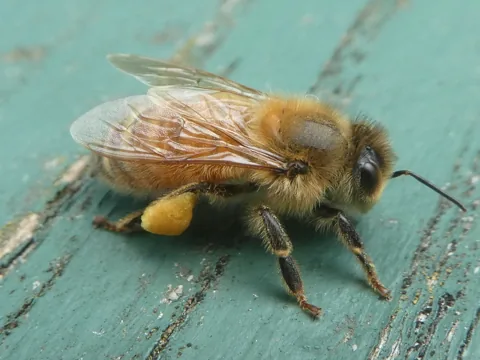 Western Honey Bee
Apis mellifera
Honey bees are important pollinators, but a colony that moves into a wall void or attic can become a stinging hazard. A swarm is temporary and usually best left alone, while an established colony in a building should be removed along with its comb.
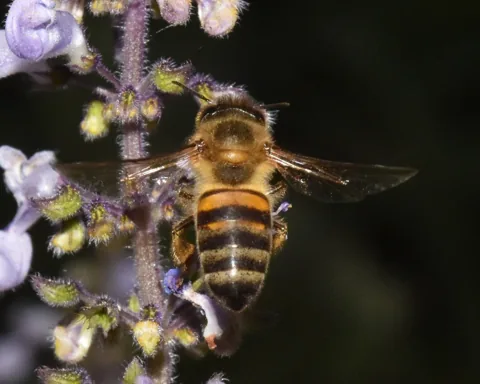 Africanized Honey Bee
Apis mellifera scutellata and its hybrids with European honey bees (Apis mellifera)
Africanized honey bees descend from African honey bees taken to Brazil in the 1950s that got into the wild and bred with European honey bees. They look like ordinary honey bees and carry the same venom, but colonies respond faster, in greater numbers and over a wider area when their nest is disturbed. UF/IFAS's Featured Creatures profile says the African subspecies was imported into Brazil in the late 1950s for a breeding program to make it gentler, which ended when the bees swarmed accidentally out of quarantine.
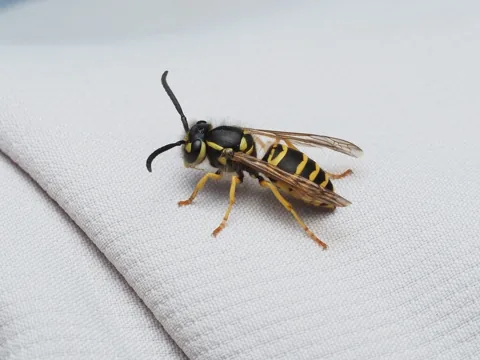 Eastern Yellowjacket
Vespula maculifrons
The eastern yellowjacket is a native, ground-nesting yellowjacket common across the eastern US in lawns, woodlands, pastures and parks; it defends its nest aggressively and can sting repeatedly.
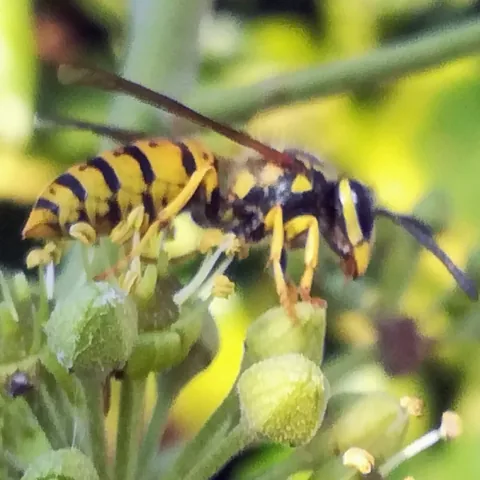 German Yellowjacket
Vespula germanica
The German yellowjacket is an invasive wasp from Eurasia that has spread across the northern US, displaces native yellowjackets and often nests in buildings.
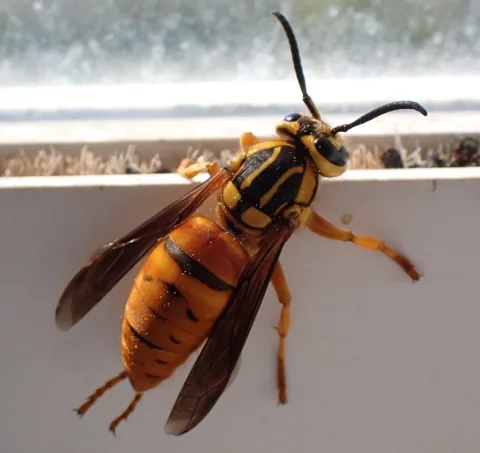 Southern Yellowjacket
Vespula squamosa
The southern yellowjacket is a native yellowjacket that normally nests in the ground. Its large, burnt-orange queens often start colonies by taking over eastern yellowjacket nests.
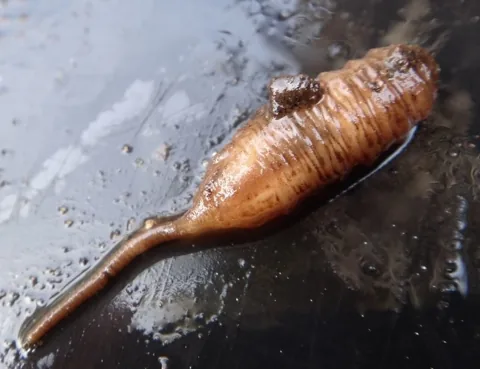 Drone Fly and Rat-Tailed Maggot
Eristalis tenax
Rat-tailed maggots, found at the edges of sewage lagoons, stagnant pools and drainage ditches, grow into drone flies: stingless hover flies that look like honey bees and visit flowers.
Side by side
These are the field marks extension entomologists use. Each line gives the honey bee first, then the yellowjacket.[11][3]
- Size: honey bee workers are about ½ inch long according to Minnesota Extension, or ½ to ⅝ inch according to the Missouri Department of Conservation; queens and drones are larger. Yellowjacket workers are about ½ inch in Missouri, Oregon State and Texas A&M descriptions; Minnesota Extension gives 3/8 to 5/8 inch, and UC IPM says up to about 1 inch.[11][2][13][12][4][8]
- Body surface: honey bees look fuzzy, especially on the thorax, and have hair even on their eyes. Yellowjackets have a hard, shiny body with few hairs and a more angular look.[11][2][12]
- Color: honey bees are amber-colored to dark brown, or golden brown with thin black stripes. Yellowjackets are black with sharply defined yellow or white markings; UC IPM describes the stripes as jagged and bright.[1][11][12][8]
- Face: Missouri's field guide notes that yellowjackets have yellow or white faces.[13]
- Waist: both have one, but the yellowjacket's narrow waist is barely visible from above, and its body looks slimmer and more angular than the robust honey bee.[8][12][1]
- Legs: a honey bee's hind leg is flattened into a pollen basket (corbicula), and foragers are often seen with pollen balls packed on. Yellowjackets have plain legs and are never seen carrying pollen.[1][11][2][4]
- Wings at rest: honey bee wings lie flat and unfolded over the abdomen. A resting yellowjacket folds its wings lengthwise into a narrow strip down its back.[11][13]
- Stinger: the honey bee's stinger is barbed. It stays in the skin with the venom sac attached, and the bee dies. Yellowjacket stingers are smooth, so one wasp can sting again and again.[2][9][16][8][13]
- Food: honey bees feed only on nectar and pollen from flowers, and visit bird baths and puddles for water. Yellowjackets get protein by hunting insects and scavenging meat, and take sugar from nectar, fruit and honeydew.[11][12]
- Nest material: honey bees build vertical sheets of six-sided wax cells. Yellowjackets build stacked horizontal combs of paper made from chewed wood fiber, wrapped in a paper envelope with one entrance hole.[2][11][4][8]
- Nest site: honey bees use hollow trees, wall voids, attics and beekeepers' boxes, and Missouri's field guide says they don't nest in the ground. Most yellowjackets nest underground, often starting in a rodent burrow, though some use wall voids or hang paper nests from eaves and branches.[2][7][8][13][4]
- Colony life: a honey bee colony is perennial; the workers and queen cluster together through winter on stored honey. A yellowjacket colony lasts one season. Only newly mated queens survive the winter, each alone, and the old nest isn't reused.[11][12]
- Colony size: UC IPM says yellowjacket colonies reach 1,500 to 15,000 wasps depending on the species. Penn State says honey bee colonies in walls are often 10 to 100 times larger than yellowjacket or hornet colonies.[8][10]
- Honey: honey bees make and store it. Yellowjackets take sugary liquids but don't store honey in the nest.[3][4][2]
The late-summer picnic test
Yellowjacket colonies keep growing through the summer. By late summer and fall, workers shift to scavenging and turn up at picnics and barbecues, around garbage cans, at outdoor pet food dishes and on fallen or overripe fruit. UC IPM notes that the western yellowjacket is the species often called the "meat bee."[8][12][11]
Honey bees usually aren't attracted to people's food, according to UC IPM, though they may come to sweets. Kentucky Extension says that in summer and fall, when fewer flowers bloom, honey bees and wasps can both rob sugary residue at trash cans and aluminum can recycling centers. So an insect on a soda can could be either one; an insect chewing on meat or tuna is a yellowjacket.[8][7]
Aerial-nesting yellowjackets such as the bald-faced hornet are the exception. UC IPM says they don't turn into scavengers at the end of the season, though they defend their nests hard.[8]
A ball of bees on a branch is a honey bee swarm
Only honey bees swarm. When a colony gets crowded it raises new queens, and the old queen leaves with a large share of the workers. Minnesota Extension says a swarm holds several hundred to several thousand workers, a few drones and one queen.[11][1]
The swarm settles in a cluster on a tree limb, shrub, fence post or the side of a building while scout bees look for a new home. Kentucky Extension says swarms are common from late April through June, and Minnesota says late spring and early summer; in Arizona, swarming starts in spring and can go on all year while flowers last.[7][11][1]
A cluster usually stays for an hour to a few days (Minnesota), moves within a day or so (Kentucky), or within 24 to 72 hours (Arizona). The bees fill up on honey before leaving and haven't yet built comb or raised brood, which is why swarms are generally gentle and unlikely to sting unless disturbed.[11][7][1]
A tip from Arizona Extension: bees in a swarm won't have pollen in their leg baskets and won't be streaming in and out of a hole. Bees going in and out of a cavity mean an established colony is inside, and established colonies are much more defensive than swarms.[1][7]
Yellowjackets never form a hanging cluster like this. A steady line of striped wasps flying in and out of a hole in the lawn or a gap in siding is a yellowjacket nest entrance.[8][13]
How to confirm which one you have
Watch from a distance instead of swatting. Wasps flying from a hole in the ground or a building point to a nest, and UC IPM advises not disturbing it.[8]
- Watch a forager on a flower or puddle: honey bees fly flower to flower and pack pollen on the hind legs; yellowjackets hunt along plants and hover at food.[1][11][12]
- Get a photo of the body side-on: fuzz and brown tones mean honey bee; bright, shiny yellow-and-black bands mean yellowjacket.[11][12][13]
- Find where they go. Bees disappearing into a hollow tree, wall or attic, often in large numbers, point to a honey bee colony. Wasps diving into a hole in the soil or an old rodent burrow point to yellowjackets.[2][7][8][13]
- Look at the nest material if it's exposed: waxy, honey-colored comb is honey bee; gray, papery layers are yellowjacket.[2][11][4]
- If you're still unsure, Penn State advises determining whether the insects are honey bees or something else before acting, because honey bees can be more difficult to manage than most other insects.[10]
Why getting it right matters
The answer decides who you call. Cornell IPM says a beekeeper can be called for a swarm or colony of honey bees in an accessible spot, while a pest management professional should handle large yellowjacket and hornet nests.[5]
Honey bees are managed for crop pollination and honey, and Minnesota Extension says honey bee nests should be preserved when possible. Oregon State says yellowjackets are useful too, as predators of pest insects and as scavengers, and should be controlled only when they pose a stinging hazard or are hurting bee colonies.[2][11][12]
A honey bee colony that is killed inside a wall leaves a bigger problem behind. Penn State says an old nest can hold hundreds of pounds of honey and wax comb, and that removing it matters more than with yellowjackets because the dead bees and comb can rot and ferment. Kentucky warns that untreated wax may melt or be riddled by wax moth larvae and leak.[10][7]
Yellowjacket nests die out on their own. In the Upper Midwest, Minnesota Extension says freezing temperatures kill the old queen and workers, and nests don't survive the winter even inside a building.[11]
Stinger behavior affects first aid. A honey bee leaves its barbed stinger in the skin, and it should come out right away. Yellowjackets keep their stinger and can sting repeatedly.[6][2][13]
What to do for each
Honey bee swarm: leave it alone if it isn't where people pass close by; it will usually move on by itself. Keep people back. If it's in a busy spot, a local beekeeper or beekeepers' association may collect it, and some beekeepers use swarms to start new hives.[11][1][7]
Honey bees living in a wall or attic: Kentucky Extension suggests the county extension office or even the local fire station for a list of beekeepers who remove bees from buildings, and advises agreeing beforehand on cleanup and repairs. Penn State notes these beekeepers are hard to find because the work takes both beekeeping and construction skill. The comb and honey need to come out, whoever does the job.[7][10]
Honey bees at trash or a recycling bin: clean up spilled syrup and soda, and use plastic liners and lids on trash cans.[7]
Yellowjackets at food: keep garbage in sealed cans and empty them often. Yellow lure traps around the edge of the property can cut down foraging near patios, and traps belong away from where people sit.[8]
Yellowjacket nest: don't disturb it. Cornell IPM says small nests can sometimes be knocked down early in the season, ideally at night, but large yellowjacket and hornet nests should go to a pest management professional.[8][5]
Don't plug a wall entrance right after bees are treated: Kentucky Extension warns this may force agitated bees into the living space. The linked removal guides cover the details.[7]
Stings: people and pets
MedlinePlus says bee, wasp, hornet and yellow jacket venom can cause an allergic reaction in some people. Swelling of the throat, lips, tongue or mouth, difficulty breathing and hives are signs of an allergic reaction, not of the venom itself. CDC's NIOSH says a severe reaction, anaphylaxis, can be life-threatening and needs emergency care right away.[6][14]
If a honey bee stinger is still in the skin, scrape it out with a blunt straight edge such as a credit card. MedlinePlus and NIOSH both warn against squeezing it or using tweezers, which can push more venom out of the sac. Then put a cloth-wrapped ice pack on the site, 10 minutes on and 10 minutes off.[6][15][14]
Call poison control or an emergency room if the person stung is allergic to the insect or was stung inside the mouth or throat. People with a known sting allergy should carry their prescribed epinephrine kit, and NIOSH advises a medical ID bracelet or necklace.[6][14]
If several insects attack at once, NIOSH advises running away. Stinging bees release a chemical that may draw in more bees. If just one insect is flying around, stay calm and still; swatting can make it sting.[14]
Pets: the Merck Veterinary Manual says stings in small animals are most common on the face and in the mouth, a honey bee stinger can stay embedded and cause an abscess, and multiple stings can cause severe local and whole-body reactions. Possible effects of many stings include collapse, seizures, bloody vomiting or diarrhea, and kidney and liver failure.[16]
Common questions
- Do honey bees die after they sting?
- Yes. The honey bee's stinger is barbed, so when the bee pulls away the stinger and venom sac tear out of her abdomen and she dies. Yellowjacket stingers aren't barbed, so they can sting more than once.[2][16][9]
- Are yellowjackets bees?
- No. Yellowjackets are social wasps in the genera Vespula and Dolichovespula. They build paper nests, feed their young on insects and scavenged meat, and don't collect pollen or make honey.[12][8][13][4]
- Why are there so many "bees" on my soda can in August?
- Most are yellowjackets, which turn to scavenging sweets and protein around people in late summer and fall. Honey bees can also rob sugary residue from trash and recycling bins when flowers are scarce. Check for fuzz and pollen on the legs.[8][11][7]
- Is a cluster of bees hanging from a branch dangerous?
- Usually not. Minnesota Extension says honey bee swarms aren't dangerous under most circumstances and will leave on their own; keep people back and call a beekeeper only if it's in a busy spot.[11][1]
- Can I tell a European honey bee from an Africanized one by looking?
- No. UC IPM says the two look the same. Africanized bees defend a larger area around the nest and respond faster and in greater numbers. Treat any honey bee colony with care.[9][6]
Photo credits
- Western Honey Bee: (c) Doug Miller, some rights reserved (CC BY) — via iNaturalist, CC BY 4.0
- Africanized Honey Bee: (c) Sunčana Bradley, some rights reserved (CC BY) — via iNaturalist, CC BY 4.0
- Eastern Yellowjacket: Brighton Lee, public domain (CC0), via iNaturalist
- German Yellowjacket: (c) Gianni Del Bufalo bygdb, some rights reserved (CC BY) — via iNaturalist, CC BY 4.0
- Southern Yellowjacket: (c) Cole Shoemaker, some rights reserved (CC BY) — via iNaturalist, CC BY 4.0
- Drone Fly and Rat-Tailed Maggot: (c) Wendy Bailey, some rights reserved (CC BY) — via iNaturalist, CC BY 4.0
Sources
- University of Arizona Cooperative Extension, “Wild Honey Bees in Community Environments: Identification, Biology, and Reducing Risks, AZ1846.” extension.arizona.edu/sites/extension.arizona.edu/files/pubs/az1846-2020.pdf (accessed 2026-11-14)
- Missouri Department of Conservation, “Honeybee (Field Guide).” mdc.mo.gov/discover-nature/field-guide/honeybee (accessed 2026-11-14)
- Mississippi State University Extension, “Honey bee vs. yellow jacket table.” extension.msstate.edu/honey-bee-vs-yellow-jacket-table (accessed 2026-11-14)
- Texas Apiary Inspection Service, Texas A&M AgriLife Research, “Yellow Jackets (Bee Identification).” txbeeinspection.tamu.edu/public/bee-identification/yellow-jackets/ (accessed 2026-11-14)
- Cornell University, New York State IPM Program, “Bees and Wasps (What's Bugging You?).” cals.cornell.edu/integrated-pest-management/outreach-education/whats-bugging-you/bees-and-wasps (accessed 2026-11-14)
- MedlinePlus Medical Encyclopedia (NIH/NLM), “Bee, wasp, hornet, or yellow jacket sting.” medlineplus.gov/ency/article/002847.htm (accessed 2026-11-14)
- University of Kentucky Entomology, “Controlling Nuisance Honey Bees, ENTFACT-606.” entomology.mgcafe.uky.edu/ef606 (accessed 2026-11-14)
- UC Statewide IPM Program, “Yellowjackets and Other Social Wasps.” ipm.ucanr.edu/home-and-landscape/yellowjackets-and-other-social-wasps/ (accessed 2026-11-14)
- UC Statewide IPM Program, “Bee and Wasp Stings.” ipm.ucanr.edu/home-and-landscape/bee-and-wasp-stings/ (accessed 2026-11-14)
- Penn State Extension, “Getting Rid of Paper Wasps, Yellowjackets, and Other Stinging Insects.” extension.psu.edu/getting-rid-of-paper-wasps-yellowjackets-and-other-stinging-insects (accessed 2026-11-14)
- University of Minnesota Extension, “Wasps and bees.” extension.umn.edu/insects-infest-homes/wasps-and-bees (accessed 2026-11-14)
- Oregon State University Extension, “Protecting honey bees from yellowjacket wasps, EM 9211.” extension.oregonstate.edu/catalog/em-9211-protecting-honey-bees-yellowjacket-wasps (accessed 2026-11-14)
- Missouri Department of Conservation, “Yellowjackets (Vespula Wasps) (Field Guide).” mdc.mo.gov/discover-nature/field-guide/yellowjackets-vespula-wasps (accessed 2026-11-14)
- CDC, National Institute for Occupational Safety and Health, “Insects and Scorpions (Outdoor Workers).” www.cdc.gov/niosh/outdoor-workers/about/insects-and-scorpions.html (accessed 2026-11-14)
- MedlinePlus Medical Encyclopedia (NIH/NLM), “Insect bites and stings.” medlineplus.gov/ency/article/000033.htm (accessed 2026-11-14)
- Merck Veterinary Manual, “Wasp, Bee, and Ant Stings to Animals.” www.merckvetmanual.com/toxicology/venomous-arthropods/hymenoptera (accessed 2026-11-14)