On this page
How to identify it
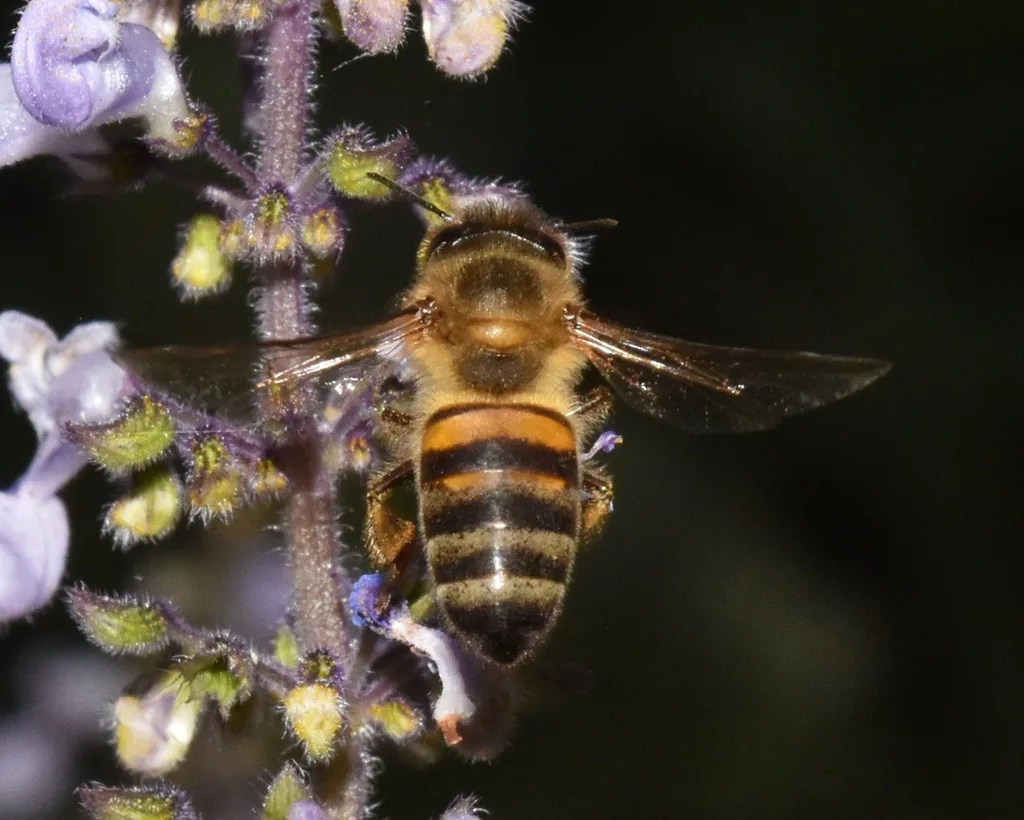
- You can't tell them from European honey bees by eye; the two look the same. Researchers separate them by measuring body parts or by genetic (mitochondrial DNA) tests, and the University of Arizona says only genetic testing can reveal the lineages in a colony. UF/IFAS adds that they are slightly smaller than European honey bees, that measuring wing veins and body parts (morphometry) remains the first round of identification for suspect colonies, and that hybrids often need genetic analysis.[3][6][7][5]
- Adults are robust, hairy, amber to dark brown bees with light and dark stripes on the abdomen. Workers, the smallest and most numerous adults, are the bees usually seen outside the nest.[7]
- The giveaway is behavior: a larger alarm zone around the nest, faster defense by more bees, and chasing of intruders over longer distances.[7][3][4]
- Around homes, wild colonies move into hollow-block walls, wall voids, attics and crawl spaces, in-ground irrigation boxes and water valve boxes, holes in the ground, hollow trees and rock crevices, and sometimes hang from tree branches. UF/IFAS says they accept much smaller cavities than European bees and have been found in water meter boxes, cement blocks, old tires, house eaves, barbecue grills and ground cavities, or hanging exposed from tree limbs; European colonies rarely use such spots.[7][8][5]
Look-alikes
| Look-alike | How to tell them apart |
|---|---|
| European honey bee | Looks the same and has the same venom. Neither kind is likely to sting while gathering nectar and pollen, but Africanized bees defend a larger area around the nest and respond faster and in greater numbers. UF/IFAS says European colonies may attack an intruder with no more than 10 to 20 bees, while African colonies may send hundreds, and that European bees prefer larger cavities such as tree hollows and chimneys.[3][7][5] |
| Yellowjacket | Smooth, hairless body with jagged yellow and black patterns, and it can sting more than once.[7] |
Where it lives
Africanized bees spread out from Brazil after reaching the wild in 1957 (a 2012 review dates the start of the spread to 1956) and were first confirmed in the U.S. near Hidalgo, Texas, on October 19, 1990. By 2004 USDA ARS listed southern California, Arizona, New Mexico, Nevada and Texas; the University of Arkansas reports they arrived in Arkansas in 2005; and a 2015 study found African mitochondrial types in samples from Texas, Florida, Arizona, New Mexico, California and Oklahoma. Sources disagree on what holds them back: an ARS researcher found that winter cold alone did not explain where they stopped and that rainfall over 55 inches spread evenly through the year was almost a complete barrier to their spread east, while a 2026 genomic study describes cold tolerance as the limit and found African-lineage genes moving north from Texas, Arizona and Florida. UF/IFAS's profile says that as of 2012 they had been found in Texas, California, New Mexico, Arizona, Oklahoma, Louisiana, Arkansas, Alabama and Florida; that they spread through South and Central America at 200 to 300 miles a year; and that they have not established beyond about 32 degrees latitude in the Southern Hemisphere and are found only below about 34 degrees in the Northern Hemisphere, apparently limited by climate.[1][2][9][6][10][5]
Biology and life cycle
European queens mate disproportionately with African drones, because Africanized colonies produce more drones, and some African traits, including defensiveness, are genetically dominant.[1]
Swarms also invade European colonies and replace the resident queen; ARS researchers have seen usurpation rates as high as 20 to 30 percent in Arizona.[1]
Whether they replace European bees or mix with them is not settled: in an ARS sampling program on a south Texas refuge, colonies turned over to mostly Africanized within 3 years, but from 1997 through 2001 the mix held at about 69 percent African queens and 31 percent European queens, a genetic mixture rather than a replacement.[1]
They swarm more often than European bees and sometimes abandon the nest entirely (absconding) under stress. A swarm usually moves on within 24 to 72 hours.[7][11]
In Arizona, all wild honey bees are considered Africanized to some extent; in San Diego County, a 2015 study found African mitochondria in 65 percent of foraging workers and 70 percent of feral hives sampled, but only 13 percent of managed hives.[7][6]
UF/IFAS says African colonies may swarm more than 10 times a year, compared with one to three times for European colonies, and they abandon the nest more often when food is scarce or the nest is disturbed repeatedly.[5]
UF/IFAS says African-type offspring, queens included, generally develop faster than European ones, so when a colony rears a new queen, one with an African genotype tends to emerge first and kill her sisters before they leave their cells. African colonies also raise more drones, so European queens are more likely to mate with African drones, and over time the colony becomes more African.[5]
UF/IFAS lists other differences: African colonies are more 'flighty' when disturbed, use more propolis, raise proportionally more drones, grow faster and store proportionally less honey. They are also more resistant than European bees to many honey bee pests and diseases, including Varroa mites, tracheal mites and small hive beetles, which favors their survival in the wild.[5]
Damage and signs
- Colonies in the wrong place cause sting incidents, defensive attacks, and structural damage and annoyance from foraging and nest building. People are much more likely to be stung once a colony is raising young. UF/IFAS adds that vibrations from power equipment, tractors and lawnmowers agitate them, and their nesting habits often put them close to people.[7][5]
- Wild honey bees outcompete many native bees for resources. UF/IFAS notes that keepers of European bees often see fewer resources for their colonies where African colonies are dense, and that African bees may have a substantial impact on native plants and animals, an impact that is rarely reported and largely not understood.[7][5]
- Mowers, trimmers, chain saws and other noisy equipment set off attacks, and pets and livestock that are penned or tied near a colony can't escape.[9][7]
Health risk
The danger is the number of stings, not stronger venom: physicians writing on Africanized bees note that the cumulative dose from many stings causes the harm, and even people who are not allergic can be poisoned by a large venom load. A review of mass stinging found that most deaths and serious cases from honey bees and wasps involve fewer than 10 stings and an allergic reaction, while mass attacks can damage muscles and kidneys; with supportive medical care most victims survive roughly 1,000 honey bee stings. People allergic to single stings may face anaphylaxis from multiple stings.[11][12][2][13]
Control
Prevention
Never shoot at, throw rocks at, pour gasoline on, burn or spray pesticides on a colony. Petroleum products, some pesticides, paint thinner, water, noise and vibration are all known to irritate honey bees.[8][7]
Check for bees before mowing, trimming or running power equipment, and keep pets and children indoors while you do.[9][7]
Don't tie, pen or tether animals near a known colony.[9]
Keep them out
Bee-proof the yard: fill wall holes 1/8 inch or larger, screen rainspouts, chimneys and water meter boxes, fill animal burrows and remove overturned pots. Don't seal openings bees are actively using. UF/IFAS also advises removing unnecessary debris and checking walls and eaves regularly for bee activity.[7][5]
When to call a professional
Have swarms or colonies near places people use removed by an experienced beekeeper or a pest management professional, and don't ignore small new colonies: they may be docile at first but become more defensive with age. UF/IFAS recommends watching for bees flying into or out of an area, which suggests a nest nearby, and staying away from swarms and nests.[7][8][5]
What to do if bees attack
Run away right away. Cover your head and face with your shirt or hands without slowing down, and get inside a building or car and close the doors.[8][7][14]
If there is no shelter, keep going at least 240 yards, about two football fields, or until the bees stop following. NIOSH notes a shaded area is better than an open one. UF/IFAS adds that running through tall grass or small trees helps disrupt the attacking bees.[7][14][5]
Don't swat or flail, and don't jump into water; the bees will wait for you to come up for air. UF/IFAS also warns against hiding in bushes, since the bees can stay defensive in the area for some time.[8][7][14][5]
If you can't move, crouch down, cover your head and face, and stay as still and calm as you can.[7]
Don't try to rescue someone without a bee suit and training; urge them to run or take shelter and call 911.[8]
Treating stings
Scrape stingers out with a fingernail or the edge of a card; don't squeeze them or use tweezers, which can push in more venom from the attached sac. Wash with soap and water and apply ice wrapped in a cloth.[4][14]
Call poison control (1-800-222-1222) or an emergency room if the person is allergic or was stung in the mouth or throat. Hives, swelling of the throat, lips or tongue, trouble breathing or collapse are signs of an allergic reaction, and people with a known allergy should carry prescribed epinephrine.[4]
After a mass stinging, get medical care even without allergy symptoms: large venom doses can cause muscle breakdown and kidney failure.[12][11][2]
Where the sources disagree
Gap size for bee-proofing: UF/IFAS says to close wall, chimney, electrical and plumbing gaps more than 30 mm wide with small-mesh hardware cloth or caulk, while the University of Arizona advises filling much smaller wall holes (see the bee-proofing step above).[5][7]
Where they occur: UF/IFAS's 2012 list includes Oklahoma, Louisiana, Arkansas, Alabama and Florida, which the 2004 USDA ARS list does not, and omits Nevada, which ARS listed.[5][1]
Common questions
- Are Africanized bee stings more venomous?
- No. An Africanized bee stings only once and has the same venom as a European honey bee. Physicians writing on these bees say it is the cumulative dose from many stings, not the venom of a single bee, that causes illness and death.[3][11]
- Is a swarm of Africanized bees dangerous?
- Bees in a swarm are generally docile but can sting if disturbed. Colonies become more protective once they settle in and start raising young.[7]
- Why did bees attack my dog?
- Defending bees target furry, dark-colored objects that resemble their natural enemies, bears and skunks, and penned or tied animals can't escape.[9]
- Can beekeepers keep Africanized bees?
- UF/IFAS says African bees pollinate crops and make honey like other honey bees, and beekeepers in South Africa and in Central and South America use them routinely, though keeping them has been discouraged in the U.S. Beekeepers working them keep one colony per hive stand, smoke colonies well before opening them, and wear full suits, gloves, boots and veils; white-faced veils help because the bees attack dark colors.[5]
Sources
- USDA Agricultural Research Service, “What's Buzzing with Africanized Honey Bees? (Agricultural Research, March 2004).” agresearchmag.ars.usda.gov/2004/mar/bees (accessed 2026-11-14)
- J Toxicol Environ Health B Crit Rev, via PubMed, “Historical perspective and human consequences of Africanized bee stings in the Americas (Ferreira et al. 2012).” pubmed.ncbi.nlm.nih.gov/22401177/ (accessed 2026-11-14). Cited from the PubMed abstract.
- UC Statewide IPM Program (UC IPM), “Pest Notes: Bee and Wasp Stings.” ipm.ucanr.edu/home-and-landscape/bee-and-wasp-stings/ (accessed 2026-11-14)
- MedlinePlus, U.S. National Library of Medicine, “Bee, wasp, hornet, or yellow jacket sting (Medical Encyclopedia).” medlineplus.gov/ency/article/002847.htm (accessed 2026-11-14)
- University of Florida/IFAS Extension (Featured Creatures), “African Honey Bee, Africanized Honey Bee, Killer Bee, Apis mellifera scutellata Lepeletier, EENY-429/IN790.” ask.ifas.ufl.edu/publication/IN790 (accessed 2026-11-14). Used for history, identification, behavior, biology and bee-proofing; its venom, sting-count and medical lines are not used.
- PLoS One, via PubMed Central, “Range and Frequency of Africanized Honey Bees in California (USA) (Kono & Kohn 2015).” pmc.ncbi.nlm.nih.gov/articles/PMC4567290/ (accessed 2026-11-14). Cited from the full text (PMC4567290).
- University of Arizona Cooperative Extension, “Wild Honey Bees in Community Environments: Identification, Biology, and Reducing Risks (AZ1846, July 2020).” extension.arizona.edu/publication/wild-honey-bees-community-environments-identification-biology-and-reducing-risks (accessed 2026-11-14)
- University of Arkansas System Division of Agriculture, Cooperative Extension Service, “Africanized Honey Bees: What You Should Know (FSA7068).” www.uaex.uada.edu/publications/PDF/FSA-7068.pdf (accessed 2026-11-14)
- University of Arkansas System Division of Agriculture, Cooperative Extension Service, “Africanized Honey Bees and Your Pets and Livestock (FSA7069).” www.uaex.uada.edu/publications/PDF/FSA-7069.pdf (accessed 2026-11-14)
- Ecology and Evolution, via PubMed Central, “Nationwide Tracking of A-Lineage Spread in Western Honey Bees (Fikere, Ryals, Paterson & Harpur 2026).” pmc.ncbi.nlm.nih.gov/articles/PMC13722957/ (accessed 2026-11-14). Cited from the abstract and full text (PMC13722957).
- West J Med, via PubMed, “What physicians should know about Africanized honeybees (Sherman 1995).” pubmed.ncbi.nlm.nih.gov/8553637/ (accessed 2026-11-14). Cited from the PubMed abstract.
- West J Med, via PubMed, “Mass envenomations by honey bees and wasps (Vetter, Visscher & Camazine 1999).” pubmed.ncbi.nlm.nih.gov/10344177/ (accessed 2026-11-14). Cited from the PubMed abstract.
- Arch Intern Med, via PubMed, “Significance of Africanized bees for public health. A review (Schumacher & Egen 1995).” pubmed.ncbi.nlm.nih.gov/7575061/ (accessed 2026-11-14). Cited from the PubMed abstract.
- Centers for Disease Control and Prevention, NIOSH, “Insects and Scorpions at Work (Outdoor Workers).” www.cdc.gov/niosh/outdoor-workers/about/insects-and-scorpions.html (accessed 2026-11-14)
- iNaturalist, “Apis mellifera scutellata taxon page (order and family).” www.inaturalist.org/taxa/121322 (accessed 2026-11-14)