On this page
How to identify it
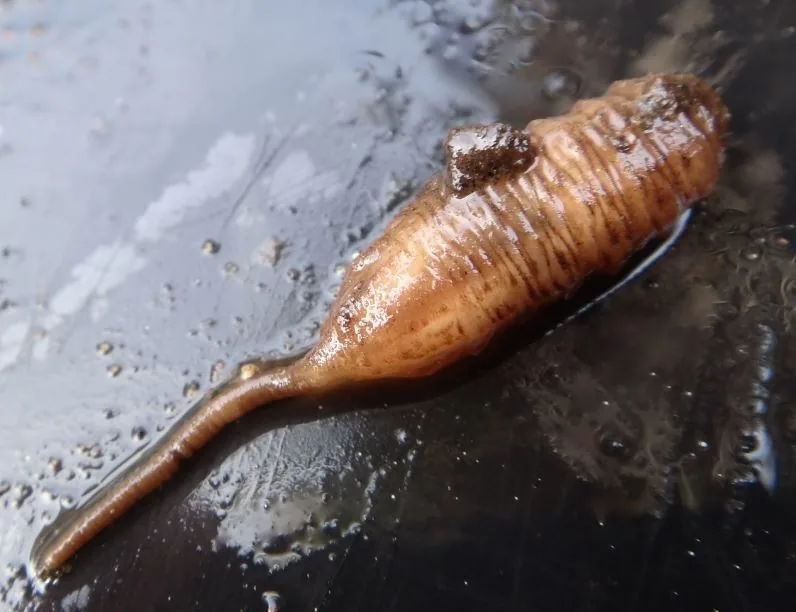
- The larva's 'tail' is a breathing tube at the rear end that can be several times as long as the body. A mature larva's body is about 3/4 inch long.[1][2]
- Adults are hairy, stout, black and brown flies about the size and color of a honey bee. Their large eyes make them look more like a male (drone) honey bee than a worker.[2][1]
- Larvae of Eristalis species have six pairs of distinct prolegs, fleshy leg-like bumps on the underside.[2]
- Like other hover flies, adults can hover in mid-air and change direction abruptly.[3][1]
- Males have lighter abdomens and smaller, narrower wings than females, according to a Serbian study of the species.[4]
- UF/IFAS says adults can be over half an inch long, with short brownish-yellow hairs on the thorax and first abdominal segment, a dark brown to black body, yellow-orange marks on the sides of the second abdominal segment and a narrow yellow-orange band across the third.[5]
- Males have large eyes that almost touch; females have smaller eyes set farther apart.[5]
- Eggs are white, elongate and sticky. The pupa looks like a shorter, thicker larva with two pairs of horn-like bumps on the thorax and the tail locked in a curve over its back.[5]
Look-alikes
| Look-alike | How to tell them apart |
|---|---|
| Honey bee | Bees have two pairs of wings and can sting; flies, including the drone fly, have one pair. The drone fly's very large eyes are another clue. UF/IFAS adds that drone flies lack the narrow waist between thorax and abdomen that honey bees have, and says the rat-tailed maggot is probably the source of Biblical writings about honey bees arising from dead animals, since drone flies can lay eggs in carcasses.[2][1][5] |
| Hover flies | The drone fly is one of the hover flies (family Syrphidae). Syrphids have a false vein, a vein-like streak between the third and fourth long veins of the wing, that sets them apart from nearly all other flies.[2][1] |
Where it lives
A fly with a worldwide distribution, found in temperate and continental climates across the globe, often close to people. UF/IFAS says it occurs on every continent except Antarctica and in the United States from Alaska south through California and Florida, and that it was introduced from Europe around 1875.[6][7][5]
Biology and life cycle
Larvae live in shallow water rich in organic matter, such as sewage lagoons, stagnant pools and drainage ditches. They stay near the edge, below the surface feeding on bacteria and decaying material, with the breathing tube pushed up to the air.[1][2]
Eristalis eggs are laid on or next to water. Full-grown maggots crawl out to pupate in nearby soil or other dry, sheltered spots.[2][1]
Adults feed on nectar, and females also eat pollen; pollen sticks to their bodies and is carried from flower to flower.[1][2]
Hover flies rank among the most important pollinators after bees and bumble bees. In a lab study, drone fly pupae reared at 17°C had the best adult emergence, the longest wings and the longest-lived adults.[7]
Ice anglers know the larvae as 'mousies', a bait for perch and other panfish.[1]
There are three larval stages and usually two to three generations a year. After mating, females lay clusters of about 20 eggs near dirty water, sewage or decomposing material; pupation happens just below the soil surface and lasts eight to 10 days.[5]
Adults are found from late March to early December, most often in September and October. Late-season females mate and overwinter, then lay 80 to 200 eggs in spring.[5]
Adults feed on nectar from daisies, chrysanthemums and asters and prefer yellow flowers, which makes them important pollinators of yellow-flowered crops. Males are territorial and may spend their whole lives in one patch.[5]
Damage and signs
- Larvae feed on decaying matter and microbes, not living plants. UC IPM notes that Eristalis larvae in liquid manure and sewage ponds can be a nuisance around farms and feedlots when many adults emerge or large numbers of mature larvae migrate to pupate.[2]
- When larvae migrate in massive numbers from manure lagoons and holding pits in summer, looking for dry places to pupate, they can contaminate livestock feed, short-circuit electrical boxes and gather in barn stalls and egg cartons.[5]
Health risk
Adults cannot sting or bite; hover flies that land on people are after moisture or salts on the skin. Rarely, people who swallow drone fly eggs or young larvae in contaminated food or water develop accidental intestinal myiasis. Case reports describe larvae passed in stool, sometimes with nonspecific digestive symptoms, and good recoveries.[3][8][6][9][4]
Control
Prevention
A 2026 case report of intestinal myiasis stresses food hygiene, since infection usually follows swallowing drone fly eggs.[6]
Keep them out
Physical barriers between lagoons and barns or coops keep migrating larvae out of buildings and confine pupation to a non-essential area.[5]
Sanitation
Rat-tailed maggots develop in shallow, stagnant water rich in feces or rotting material. Maggots found away from the water are usually full-grown larvae that crawled out to pupate in soil or another dry, sheltered spot.[1][2]
Keep manure lagoons and pits in good condition and don't let manure stick up through the water surface. UF/IFAS adds that agitating lagoons often by pumping, especially in warm summer months, can disrupt larval development.[5]
Biological control
Leave the adults alone: hover flies are pollinators and cannot sting or bite.[3][2]
Drone flies and people
Medical researchers list both adults and larvae as potential mechanical carriers of mycobacteria, and note that early-stage maggots cause accidental myiasis.[4]
Intestinal myiasis from this fly is rarely diagnosed anywhere in the world. In a French case, larvae developing in the lower bowel caused symptoms resembling ulcerative proctitis until four live larvae were passed and identified.[8][9]
Common questions
- What are the maggots with long tails in standing water?
- Most likely rat-tailed maggots, the larvae of the drone fly and related hover flies. The 'tail' is a breathing tube.[1][2]
- Is that bee a bee?
- Possibly a drone fly, a stingless fly that mimics a honey bee. Count the wings: flies have one pair, bees two.[2][1]
- Can rat-tailed maggots infect people?
- Only rarely and by accident, when eggs or larvae are swallowed with contaminated food or water. Reported cases of intestinal myiasis ended well.[8][6][9]
- Why are maggots crawling out of a manure lagoon?
- They are probably rat-tailed maggots leaving the water to pupate. UF/IFAS says larvae can migrate in massive numbers from manure lagoons and holding pits in summer as they look for dry pupation sites.[5]
Sources
- Mississippi State University Extension, “Bug's Eye View: Rat-tailed Maggot (Vol. 7, No. 2).” extension.msstate.edu/newsletters/bugs-eye-view/2021/rat-tailed-maggot-vol-7-no-2 (accessed 2026-11-11)
- University of California Statewide IPM Program, “Syrphids (Flower Flies, or Hover Flies), Natural Enemies Gallery.” ipm.ucanr.edu/natural-enemies/syrphids/ (accessed 2026-11-11)
- University of Kentucky Entomology, “Syrphid Flies: Overlooked Pollinating Insects (ENTFACT-710).” entomology.ca.uky.edu/ef710 (accessed 2026-11-11)
- Medical and Veterinary Entomology, via PubMed, “Temporal patterns of genetic and phenotypic variation in the epidemiologically important drone fly, Eristalis tenax (Francuski et al. 2011).” pubmed.ncbi.nlm.nih.gov/21414022/ (accessed 2026-11-11)
- University of Florida IFAS Extension (EDIS), “Drone Fly, Rat-Tailed Maggot, Eristalis tenax (Linnaeus), EENY 445/IN809 (M. Pfiester and P. E. Kaufman; Featured Creatures).” ask.ifas.ufl.edu/publication/IN809 (accessed 2026-11-14)
- Enfermedades Infecciosas y Microbiologia Clinica, via PubMed, “Human intestinal myiasis caused by Eristalis tenax (Rodriguez Barrio et al. 2026).” pubmed.ncbi.nlm.nih.gov/41967309/ (accessed 2026-11-11)
- Ecology and Evolution, via PubMed, “Temperature during pupal development affects hoverfly developmental time, adult life span, and wing length (Dankova et al. 2023).” pubmed.ncbi.nlm.nih.gov/37881229/ (accessed 2026-11-11)
- Tropical Parasitology, via PubMed, “Eristalis tenax intestinal myiasis: An electron microscope study (Tolba 2020).” pubmed.ncbi.nlm.nih.gov/32775291/ (accessed 2026-11-11)
- Pathogens and Global Health, via PubMed, “Gastrointestinal symptoms resembling ulcerative proctitis caused by larvae of the drone fly Eristalis tenax (Desoubeaux et al. 2014).” pubmed.ncbi.nlm.nih.gov/24766340/ (accessed 2026-11-11)
- iNaturalist, “Eristalis tenax taxon page (order and family).” www.inaturalist.org/taxa/55719 (accessed 2026-11-11)