On this page
How to identify it
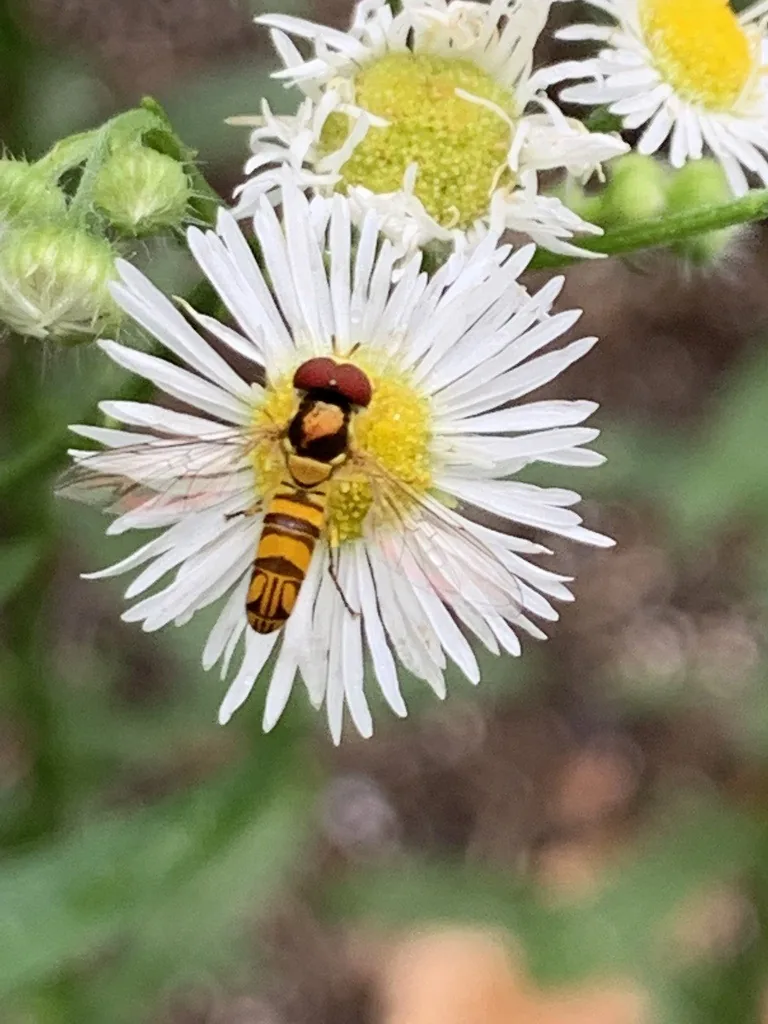
- Adults are 6 to 7 mm long, mainly yellow and black, with a narrow, parallel-sided body. The abdomen has yellow crossbands, and on the last two segments the yellow forms four lengthwise bands.[1]
- Larvae are 8 to 11 mm long, often green with two white lines running almost the whole length of the back, smooth and slightly see-through. The breathing tubes at the rear are long, fused at the base and spread sharply apart in a Y.[1]
- UF/IFAS adds the field marks: on the fourth and fifth abdominal segments, four lengthwise, oblique yellow stripes or spots, and a yellow face without a complete middle stripe. The male's eyes meet on top of the head; the female's are separated.[7]
- Like other hover flies it can hover or fly backward. Adults visit flowers for nectar and are often seen around aphid colonies.[7]
- Eggs are creamy white, sculptured and about 0.84 mm long, laid singly on a leaf or twig with aphids. The puparium is green at first and averages 5.25 mm long.[7]
Look-alikes
| Look-alike | How to tell them apart |
|---|---|
| Other hover flies | Many hover flies are yellow and black. In this species look for the four lengthwise yellow bands on the last two abdominal segments; its larvae have Y-shaped breathing tubes.[1] |
| Allograpta exotica | Another Allograpta hover fly, uncommon in Florida, whose larvae are almost indistinguishable from those of the oblique streaktail.[7] |
Where it lives
Found in most of the continental United States, from Washington to Maine and into Quebec, south to California and Florida; also in Hawaii, Bermuda, Mexico and parts of tropical America, including the West Indies. Recorded in North American crop studies, including California broccoli and lettuce fields, Michigan soybean fields and Quebec lettuce fields.[7][1][3][2][4]
Biology and life cycle
At temperatures mimicking an average summer in Hollister, California, laboratory-reared oblique streaktails took about 22 days from egg to adult.[1]
Larvae are heavy aphid eaters: in a laboratory study each ate an average of 22 lettuce aphids a day and 228 over its development.[1]
Prey recorded in field studies includes the lettuce aphid in California and the soybean aphid in Michigan.[3][2][1]
Adults visit flowers and have been seen feeding on sweet alyssum, fennel, buckwheat and phacelia.[1]
In Michigan soybean fields it was one of the most numerous predatory flies feeding on soybean aphid, most abundant while the soybeans were still growing leaves and stems. On California's Central Coast it made up 10% of the syrphid flies reared from organic romaine lettuce.[2][3]
In Florida adults occur all year in the north, where long series have been taken at Gainesville in mid-February, but they are much more common in spring and summer; in southern Florida they are often abundant even in winter.[7]
The life cycle takes as little as three weeks in summer and up to nine weeks in winter. In southern California eggs hatched in two to three days in summer and within eight days in winter, and the pupal stage took eight to ten days in summer and 18 to 33 days in winter.[7]
Older studies summarized by UF/IFAS recorded single larvae eating 242, 270 and 265 aphids (an average of 17 a day), and another study an average of 34 aphids a day.[7]
The larvae feed mainly on aphids attacking citrus, subtropical fruit trees, grains, corn, alfalfa, cotton, grapes, lettuce and other vegetables, ornamentals and wild plants; whiteflies have also been reported as prey.[7]
Larvae, and occasionally pupae, are heavily parasitized by small wasps, in some years above 50%.[7]
Damage and signs
Health risk
The sources describe it only as a beneficial aphid predator and mention no bite, sting or other risk to people.[1][3]
Control
Prevention
No control is needed: it is a beneficial aphid predator. UC IPM lists syrphid fly larvae among the natural enemies to look for before treating aphids.[1][5]
Biological control
Organic lettuce growers on California's Central Coast rely on native syrphid flies like this one to keep lettuce aphids in check and use habitat manipulation to help them. In a Quebec study of sweet alyssum flower strips in lettuce fields, the oblique streaktail was among the aphid-eating syrphid flies collected, and the authors concluded that alyssum flowers can attract natural aphid predators.[3][4]
Where the sources disagree
Larva length: UF/IFAS gives 8 to 9 mm for a full-grown larva; UC Santa Cruz gives 8-11mm.[7][1]
Aphids eaten: UC Santa Cruz reports an average of 22 lettuce aphids a day and 228 per larva in a laboratory study; older studies summarized by UF/IFAS recorded 242 to 270 per larva and averages of 17 or 34 a day.[1][7]
Common questions
- Is this little yellow-and-black fly a bee?
- No. It is a hover fly (flower fly), one of the bee-mimicking flies whose larvae eat aphids.[1]
- What do oblique streaktail larvae eat?
- Aphids. Field studies have recorded it on lettuce aphid and soybean aphid, and in a laboratory study a larva ate an average of 228 lettuce aphids while it grew.[3][2][1]
- How can I attract hover flies to my garden?
- Flowering plants can help. Adults have been seen feeding on sweet alyssum, fennel, buckwheat and phacelia, and a Quebec study found that sweet alyssum strips in lettuce fields can attract aphid-eating syrphid flies; this species was among those collected.[1][4]
- Is this a fruit fly?
- No. UF/IFAS notes it is one of the flies most often mistaken for a harmful fruit fly in Florida, but it is a hover fly whose larvae eat aphids.[7]
Sources
- University of California, Santa Cruz, Department of Environmental Studies, “Beneficial and Pest Larval Species Common to Broccoli on the California Central Coast (Nieto, Bryer, Slay, Shennan, Muramoto and Honda, September 2015).” bpb-us-e1.wpmucdn.com/sites.ucsc.edu/dist/0/249/files/2015/10/SYRPHID-FLYER.pdf (accessed 2026-11-14)
- Journal of Economic Entomology (via NCBI PubMed), “Seasonal abundance of resident parasitoids and predatory flies and corresponding soybean aphid densities (T. Noma and M. J. Brewer; Journal of Economic Entomology 101(2): 278-287, 2008; abstract).” pubmed.ncbi.nlm.nih.gov/18459389/ (accessed 2026-11-12)
- Journal of Economic Entomology (via NCBI PubMed), “A survey of syrphid predators of Nasonovia ribisnigri in organic lettuce on the central coast of California (H. A. Smith and W. E. Chaney; Journal of Economic Entomology 100(1): 39-48, 2007; abstract).” pubmed.ncbi.nlm.nih.gov/17370807/ (accessed 2026-11-12)
- Ecology and Evolution (via NCBI PubMed), “Syrphid diversity in sweet alyssum flower strips in Quebec's lettuce fields (M. Kalboussi et al.; Ecology and Evolution 15(9): e72145, 2025; abstract).” pubmed.ncbi.nlm.nih.gov/40950790/ (accessed 2026-11-12)
- University of California Statewide IPM Program, “Aphids (Pest Notes).” ipm.ucanr.edu/home-and-landscape/aphids/ (accessed 2026-11-12)
- iNaturalist, “Allograpta obliqua taxon page (order and family).” www.inaturalist.org/taxa/118968 (accessed 2026-11-09)
- University of Florida IFAS Extension (EDIS, Featured Creatures), “A Hover Fly, Allograpta obliqua (Say), EENY-185 (H. V. Weems).” ask.ifas.ufl.edu/publication/IN342 (accessed 2026-11-14)