On this page
How to identify it
- Adults are delicate, mosquito-like flies about 2 to 3 mm long, with long legs and long antennae curled back over the body at rest.[1][3][4]
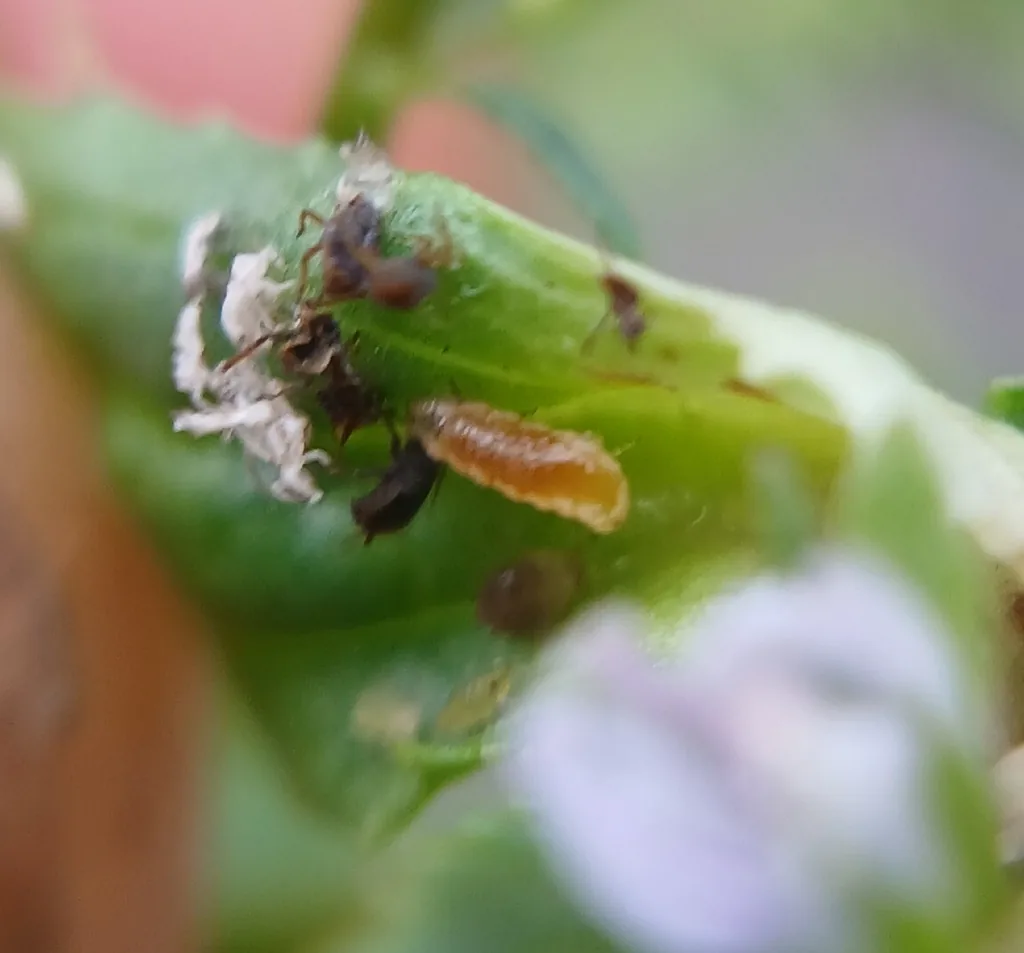
- Larvae are orange, red or yellowish maggots up to about 1/8 inch long that taper toward the head; NC State says the color depends on diet.[1][3]
- Eggs are tiny, oval and orange to reddish, laid in small groups among aphids.[1][3]
- Aphids killed by the larvae shrivel into empty skins; NC State says a blackened, sunken shell often stays stuck to the leaf.[1][3]
Look-alikes
| Look-alike | How to tell them apart |
|---|---|
| Fungus gnats | Fungus gnat adults have a distinct Y-shaped vein near each wing tip; aphid midges have only a faint forked vein.[1] |
Where it lives
Common on apple, pear, garden and vegetable crops and ornamental shrubs, and used in greenhouses. In California it occurs mostly near the coast and on low plants watered overhead.[1][3][5]
Biology and life cycle
Each female lays about 70 eggs during a life of one to two weeks, and NC State says eggs hatch in two to four days.[1][3]
Each larva eats about 3 to 50 aphids a day for roughly a week, then usually drops to the ground to pupate.[1]
Egg to adult takes about three weeks at 72°F, with up to six generations a year outdoors.[1]
They stop reproducing when days fall below about 16 hours, and short days and cold trigger a winter rest. They overwinter as mature larvae in cocoons.[1][5][3]
Adults are active at night, are rarely seen, and feed on honeydew; without honeydew females lay few eggs.[1][5]
Damage and signs
Health risk
Aphid midge adults take only liquids such as honeydew, and the larvae feed on aphids; UC IPM, NC State and UMass describe them only as predators and note no health concern for people.[1][3][5]
Control
Prevention
Avoid broad-spectrum, persistent insecticides and miticides; Washington State notes that occasional use of some narrow-spectrum products fits better with beneficial insects.[1][4]
Biological control
Mature larvae drop to the soil to pupate, so UMass warns the midge may do less well in greenhouses with concrete floors. Adults prefer dark, humid spots low in the plant canopy.[5][1]
Aphidoletes aphidimyza is sold as pupae. UMass suggests releasing it early in the morning or in the evening near aphid colonies, notes it can be used alongside aphid parasitoids, and says it works best in summer.[1][5]
Common questions
- What are the tiny orange maggots among my aphids?
- They're likely aphid midge larvae. They grip an aphid's leg joint, inject a paralyzing toxin and suck out its body fluids.[1][5][3]
- Why do aphid midges fade out in late summer?
- Short days and cold trigger a resting stage; UC IPM says they stop reproducing when daylength drops below about 16 hours.[1][5]
Sources
- University of California Statewide IPM Program, “Aphid Midge (Natural Enemies Gallery).” ipm.ucanr.edu/natural-enemies/aphid-midge/ (accessed 2026-11-12)
- iNaturalist, “Aphidoletes aphidimyza taxon page (order and family).” www.inaturalist.org/taxa/410619 (accessed 2026-11-12)
- NC State Extension, “Aphid Predatory Midge.” content.ces.ncsu.edu/aphid-predatory-midge (accessed 2026-11-12)
- Washington State University Extension, “Predatory Flies: Predatory Midges (Hortsense).” hortsense.cahnrs.wsu.edu/fact-sheet/predatory-flies-predatory-midges/ (accessed 2026-11-12)
- UMass Amherst Center for Agriculture, Food, and the Environment, “Aphids on Greenhouse Crops.” www.umass.edu/agriculture-food-environment/greenhouse-floriculture/fact-sheets/aphids-on-greenhouse-crops (accessed 2026-11-12)