The short answer
- Watch it fly. Paper wasps let their long legs dangle below the body in flight; yellowjackets hold their legs tucked against the body.[7][4]
- Look at the waist and build. Paper wasps are slender with a distinct thin waist. Yellowjackets are stockier, with a very short waist that is barely visible.[3][7]
- Look at the nest. Paper wasps hang a single open comb shaped like an upside-down umbrella, with the cells visible from below. Yellowjacket and hornet nests are wrapped in a gray or brown paper envelope with an entrance hole, usually in the ground or a wall for yellowjackets, a tree or eave for bald-faced hornets, and a hollow tree or wall void for European hornets.[7][4][13][9]
- Check size and color. A wasp about an inch long with a reddish-brown head and thorax and a yellow, banded abdomen is a European hornet. A black wasp with ivory-white marks on the face and the tip of the abdomen is a bald-faced hornet. Bright yellow and black with a stubby waist is a yellowjacket.[6][9][15][4]
Yellowjackets, paper wasps and hornets on this site
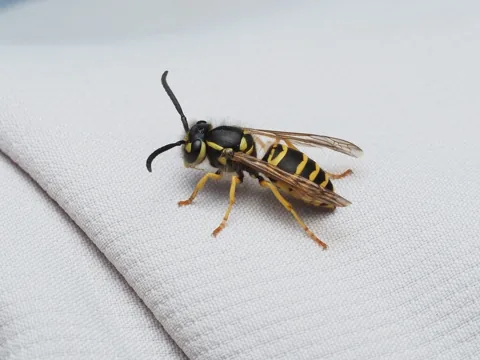 Eastern Yellowjacket
Vespula maculifrons
The eastern yellowjacket is a native, ground-nesting yellowjacket common across the eastern US in lawns, woodlands, pastures and parks; it defends its nest aggressively and can sting repeatedly.
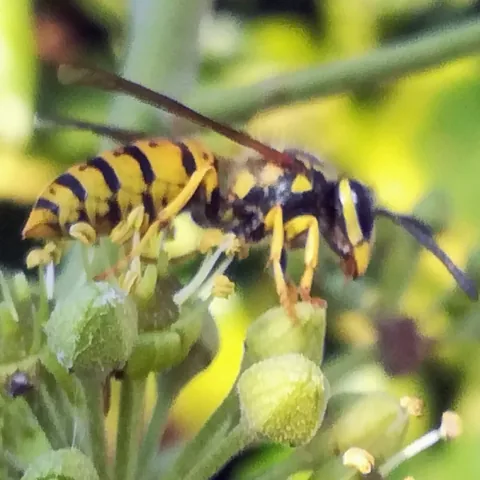 German Yellowjacket
Vespula germanica
The German yellowjacket is an invasive wasp from Eurasia that has spread across the northern US, displaces native yellowjackets and often nests in buildings.
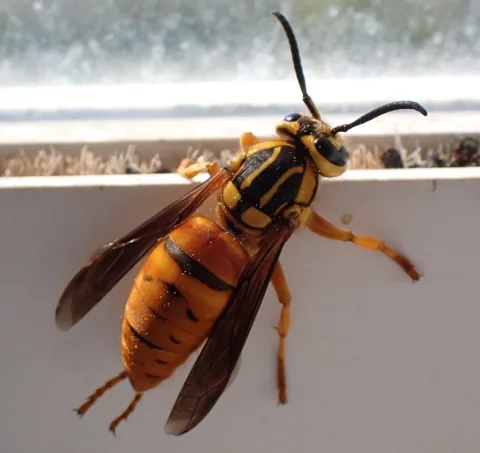 Southern Yellowjacket
Vespula squamosa
The southern yellowjacket is a native yellowjacket that normally nests in the ground. Its large, burnt-orange queens often start colonies by taking over eastern yellowjacket nests.
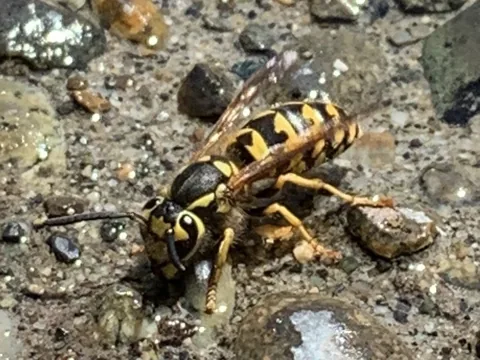 Western Yellowjacket
Vespula pensylvanica
Yellowjackets are social wasps that nest mostly in the ground and in wall voids, defend their nests vigorously, and become persistent scavengers at picnics and garbage cans in late summer and fall.
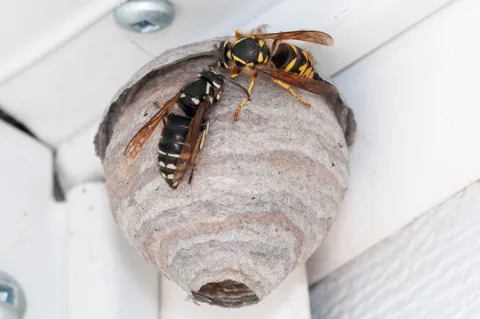 Aerial yellowjacket
Dolichovespula arenaria
The aerial yellowjacket is a black-and-yellow social wasp that builds its enclosed paper nest above ground: in shrubs and trees, under eaves and on outbuildings. It hunts live prey instead of raiding picnics, but it defends its nest fiercely and sometimes bites and stings at the same time.
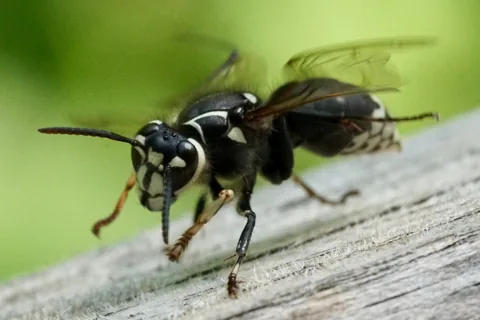 Bald-faced Hornet
Dolichovespula maculata
The bald-faced hornet is a large black-and-white aerial yellowjacket that builds gray, football-shaped paper nests in trees, shrubs and on buildings and defends them aggressively.
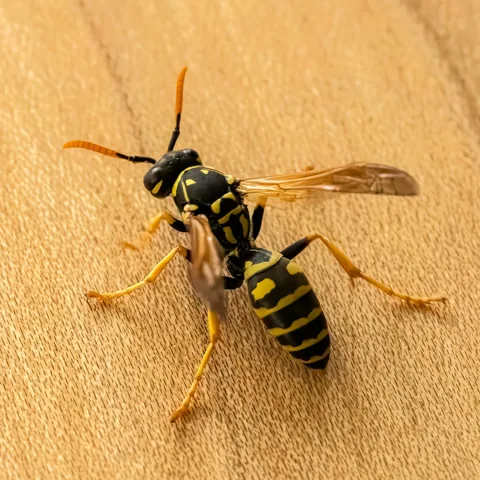 European Paper Wasp
Polistes dominula
Paper wasps hang open, umbrella-shaped paper nests under eaves and in sheltered spots; they are much less defensive than yellowjackets and rarely sting unless a nest is disturbed.
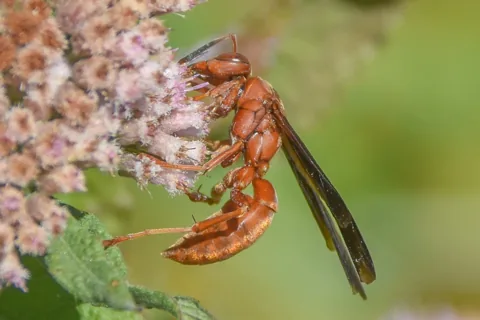 Red Wasp
Polistes carolina
The red wasp (Polistes carolina) is a paper wasp with an almost entirely rust-red body that builds open, umbrella-shaped paper nests under roofs and other overhangs. Paper wasps are not aggressive but will sting to defend the nest. UF/IFAS Featured Creatures calls it not particularly aggressive and says it typically stings only when threatened.
 Guinea Paper Wasp
Polistes exclamans
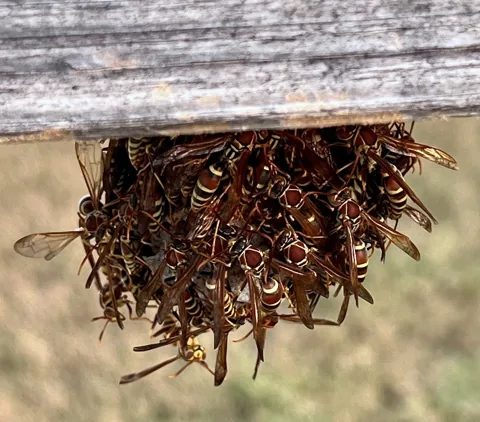
The guinea paper wasp is a small paper wasp, yellow with brown bands, that hangs single open combs in sheltered spots like eaves, grills, gates and shrubs; it is not very aggressive until its nest is jarred.
 European Hornet
Vespa crabro
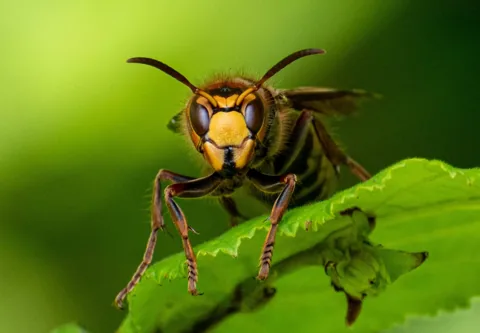
The European hornet is a large wasp introduced from Europe and first reported in the United States in 1840. It is now widespread in the East and is the only true hornet (genus Vespa) established in North America.
 Eastern Cicada Killer
Sphecius speciosus
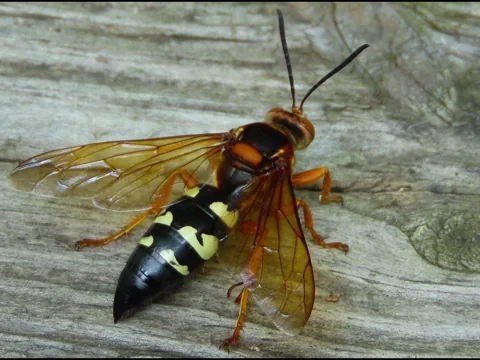
Cicada killers are very large solitary wasps seen mostly in July and August. Females dig burrows and stock them with annual cicadas. They look alarming, but the Missouri Department of Conservation calls them virtually harmless unless handled roughly, and Kentucky says they aren't a stinging hazard unless directly disturbed.
What the names mean
UC IPM uses "yellowjacket" for wasps in two genera, Vespula and Dolichovespula. Most Vespula species nest in the ground, while Dolichovespula includes the aerial nesters that hang paper nests from eaves and tree limbs.[3]
The bald-faced hornet (Dolichovespula maculata) is one of those aerial yellowjackets. Clemson and Penn State both say it is not a true hornet, despite the name.[12][5]
True hornets belong to the genus Vespa. The European hornet (Vespa crabro), introduced from Europe and first reported in the eastern United States in 1840, is the one most people meet. Ohio State notes that a second true hornet, the yellow-legged hornet (Vespa velutina), was confirmed in Georgia in August 2023.[13][9]
Paper wasps are the genus Polistes. The European paper wasp (Polistes dominula) is black and yellow and is often mistaken for a yellowjacket, while most native paper wasps are brown, black or dark red with yellow or red markings.[7][4]
Side by side
Sources give slightly different lengths, so the ranges below show each publisher's figure.[4][3]
- Size, yellowjackets: workers 3/8 to 5/8 inch (Minnesota), about 1/2 inch with 3/4-inch queens (Ohio State), or 1/2 to 1 inch (UC IPM).[4][10][3]
- Size, paper wasps: 5/8 to 3/4 inch for the most common species (Clemson); 1/2 to 1 inch (Minnesota and Missouri Department of Conservation).[11][4][14]
- Size, bald-faced hornet: workers 1/2 to 3/4 inch (Missouri), about 3/4 inch on average (Clemson) or about 7/8 inch (Minnesota). Clemson calls them extremely large compared with other yellowjackets.[15][12][4]
- Size, European hornet: workers up to about 1 inch; queens up to 1.3 inches (Penn State) or about 1.5 inches (Kentucky). Penn State counts them among the largest wasps where they occur.[6][2]
- Color, yellowjackets: bright yellow and black, with lines, spots, triangles or diamonds on the abdomen that differ by species. The body is hard, shiny and nearly hairless.[4][10]
- Color, paper wasps: usually brown with yellowish markings in Minnesota's description; Western species run golden brown or darker with large yellow or red patches. The European paper wasp is black and yellow and has orange-tipped antennae, where a yellowjacket's antennae are all black.[4][3][7]
- Color, bald-faced hornet: mostly black with white or ivory markings on the face, thorax and near the tip of the abdomen. It has no yellow.[15][12]
- Color, European hornet: reddish-brown thorax and top of the head, yellow face, brownish wings, and a yellow abdomen whose dark bands carry teardrop-shaped extensions.[9][6]
- Shape and flight: paper wasps are slender, long-legged and narrow-waisted, and their legs dangle in flight. Yellowjackets have a very short, narrow waist and fly with legs held close. At rest, yellowjackets fold their wings into a narrow strip along the abdomen.[3][7][4]
- Nest, paper wasps: one comb of open cells with no envelope, hung by a single stalk under eaves, porch ceilings, door frames, attic rafters or tree branches. Nests rarely grow bigger than an outstretched hand.[4][14][11][3]
- Nest, yellowjackets: several tiers of comb inside a paper envelope with a single entrance, usually in an old rodent burrow or other cavity in the ground, and sometimes in wall voids, attics, crawlspaces, stone walls or behind siding.[3][1][10]
- Nest, bald-faced hornet: a large gray paper nest shaped like a bloated football or egg, hung in a tree or shrub or on a building, with the entrance near the bottom. Clemson reports nests as large as 14 inches across and over 23 inches long.[1][12][3]
- Nest, European hornet: light brown paper inside a cavity, usually a hollow tree with an entrance 6 feet or more off the ground, and also attics, barns, garages, wall voids and window shutters. Penn State notes nests can be up to 30 feet high.[9][6]
- Colony size: paper wasps 15 to 200 (UC IPM) or at most about 100 (Minnesota); yellowjackets 1,500 to 15,000 depending on species; European hornets 200 to 400 workers at the mid-September peak, occasionally up to 1,000.[3][4][6][16]
- Food: all three hunt insects for their young. Yellowjackets are the ones that scavenge at picnics and trash in late summer; bald-faced hornets do not turn to scavenging. European hornets feed on fallen fruit, strip bark for sap and may visit garbage and picnic areas in late summer and fall.[3][1][15][9][16]
- Temper near the nest: paper wasps are rarely aggressive and sting mostly when a nest is bumped. Yellowjackets and bald-faced hornets defend their nests hard; Kentucky calls yellowjackets arguably the most dangerous stinging insects in the United States.[3][11][1][12]
- Night activity: the European hornet is the one that flies after dark. It comes to lit windows and porch lights, and Penn State calls it the only nocturnal wasp in Pennsylvania.[6][9][16]
Season: when you see each one
All three start fresh colonies each spring from a single overwintered queen (paper wasps sometimes from a few), and the colony dies in late fall or winter. Only new, mated queens survive, tucked under bark, in logs or inside building walls. Old nests are not reused.[5][4][14][10]
Yellowjacket queens come out in April and early May in Ohio. By late summer and early fall the colonies are at full size, insect prey is scarce, and foraging workers swarm sweet drinks and food.[10][1]
European hornet queens appear around late April or early May in Kentucky and sometimes wander indoors looking for a nest site. Nests peak in mid-September, and hornets strip bark from lilac, birch and other shrubs in late summer and fall.[2][6][9]
Bald-faced hornet nests often go unnoticed in trees and shrubs until the leaves drop in fall, when the gray paper ball shows.[12][15]
Penn State's rule of thumb: a nest found in fall will die on its own soon, while a small nest found in May or June can grow into a problem by August or September.[5]
How to confirm which one you have
Watch from a distance during the day. Stinging insects usually use one busy flight path into and out of the nest, so following it shows where the nest is and what shape it has.[5]
Decide what kind of nest it is: exposed, or hidden underground, in a wall void or in another cavity. If you can see it, note whether the comb is open or covered by a paper envelope. That one check separates paper wasps (open comb) from yellowjackets and hornets (enveloped).[5][7]
Look for other things that build in the ground. Missouri lists solitary wasps such as the eastern cicada killer, great golden digger wasp and sand wasps that dig single tunnels; these females work alone and are not the social yellowjackets.[13]
A big wasp is not always a hornet. Ohio State separates the cicada killer from the European hornet by its black abdomen with yellow splotches, reddish eyes, amber wings and slimmer body. Penn State notes the European hornet is the species most often mistaken for the Asian giant hornet, which has only been found in Washington State and nearby British Columbia.[9][6]
For an expert ID, take the insect out of the jar or bag before photographing it, and use good light, a contrasting background and a coin or ruler for scale. Hard-bodied insects such as wasps can be mailed wrapped in tissue in a crush-proof container.[17]
Why the difference matters
Treatment depends on the nest, not just the insect. Penn State sorts nests into small exposed nests (paper wasps and young aerial yellowjacket or bald-faced hornet nests), large exposed nests (mostly bald-faced hornets, whose many-layered, somewhat water-repellent envelope makes treatment harder), and nests underground or inside structures.[5]
Kentucky calls hornets far more difficult and dangerous to control than paper wasps, and says that dealing with a yellowjacket nest usually calls for a professional, especially when a ladder is involved.[1]
European hornets fly at night, so treating their nest after dark, the usual advice for other wasps, still carries a sting risk.[9][5]
Never block the entrance of a nest inside a wall. Hornets and yellowjackets that can't get out may chew through drywall or interior wall coverings into the living space, and Ohio State warns that disturbed yellowjackets in a plugged wall nest may come into the house.[9][6][10]
What to do about each one
- Paper wasps: a nest away from doors and paths can be left; the colony dies after the first hard frost. Small open nests are among the easiest to eliminate, and a queen's starter nest in spring can be knocked down before workers hatch. Remove the old nest afterward and screen or seal the voids they keep using.[11][7][5]
- Yellowjackets: cover food and drinks, keep trash cans tightly closed, and leave a ground nest alone if it is away from mowed lawns, doors and play areas. A nest in a wall or attic, or one that needs a ladder, is a job for a professional; never plug its entrance.[3][10][8][1]
- Bald-faced hornets: if the nest is not threatening anyone, leave it for winter to kill. If it has to go, Clemson advises seriously considering a professional, and any treatment should happen at night when the hornets are in the nest.[12][1]
- European hornets: wait for the first hard frost or two, pick up fallen fruit and switch off porch and flood lights near the nest. In spring, seal gaps around pipes, vents and rooflines before queens move in. A nest in a hollow tree or high wall void may be out of reach and need a professional.[6][9]
- For any nest you decide to treat, plan by day, treat at night, wear protective clothing and follow the product label. Our nest removal guide covers each nest type step by step.[5][1]
Stings: people and pets
Yellowjackets, paper wasps and hornets have stingers without barbs and can sting more than once, unlike honey bees.[20][10][3]
Most stings cause pain and swelling at the site. A wrapped ice pack, 10 minutes on and 10 minutes off, helps. Watch for signs of infection over the next few days.[18][19]
Call 911 if a stung person has trouble breathing, swelling of the face or mouth, or throat tightness or trouble swallowing. Anaphylaxis can develop quickly and needs emergency care. People with a history of severe reactions should carry epinephrine as prescribed.[18][19]
Dogs and cats are stung most often on the face and in the mouth. Many stings at once can cause severe reactions in pets, including collapse, seizures and organ damage, Veterinarians treat severe reactions with IV fluids, corticosteroids, epinephrine and antihistamines, so call your vet if a pet has many stings or a swelling face.[20]
Common questions
- Is a bald-faced hornet a hornet or a yellowjacket?
- A yellowjacket. It is an aerial-nesting yellowjacket in the genus Dolichovespula, named for its white face. True hornets are in the genus Vespa.[12][5][13]
- What is the quickest way to tell a paper wasp from a yellowjacket?
- Watch it fly. A paper wasp's long legs hang down in flight, while a yellowjacket tucks its legs in. Paper wasps also have a thinner waist.[7][4]
- Are hornets more aggressive than yellowjackets?
- Not as a rule. Bald-faced hornets (really yellowjackets) and ground-nesting yellowjackets both defend their nests hard. Bald-faced hornets do not scavenge at picnics, and Missouri says their foragers are not aggressive away from the nest.[3][15][1]
- Why is a big wasp flying at my porch light at night?
- It is probably a European hornet, one of the few wasps that fly at night. Turning off lights near the nest helps.[9][6]
- Which ones build nests in the ground?
- Most yellowjackets, including the eastern and southern yellowjackets, which use old rodent burrows and other cavities. Paper wasps and bald-faced hornets build above ground, and European hornets choose hollow trees and wall voids.[13][3][9]
- Will they reuse the nest next year?
- No. Paper wasp, yellowjacket and hornet nests last one season; only new queens survive the winter, away from the old nest.[4][14][9]
Photo credits
- Eastern Yellowjacket: Brighton Lee, public domain (CC0), via iNaturalist
- German Yellowjacket: (c) Gianni Del Bufalo bygdb, some rights reserved (CC BY) — via iNaturalist, CC BY 4.0
- Southern Yellowjacket: (c) Cole Shoemaker, some rights reserved (CC BY) — via iNaturalist, CC BY 4.0
- Western Yellowjacket: (c) eebee, some rights reserved (CC BY) — via iNaturalist, CC BY 4.0
- Aerial yellowjacket: (c) Chris O'Donoghue, some rights reserved (CC BY) — via iNaturalist, CC BY 4.0
- Bald-faced Hornet: (c) Amy Schnebelin, some rights reserved (CC BY) — via iNaturalist, CC BY 4.0
- European Paper Wasp: (c) Andrew McKinlay, some rights reserved (CC BY) — via iNaturalist, CC BY 4.0
- Red Wasp: (c) Jay Pruett, some rights reserved (CC BY) — via iNaturalist, CC BY 4.0
- Guinea Paper Wasp: (c) Sue Ann Kendall, some rights reserved (CC BY) — via iNaturalist, CC BY 4.0
- European Hornet: (c) Михаил Малышев, some rights reserved (CC BY) — via iNaturalist, CC BY 4.0
- Eastern Cicada Killer: (c) Steve Kerr, some rights reserved (CC BY) — via iNaturalist, CC BY 4.0
Sources
- University of Kentucky Entomology, “ENTFACT-620: Controlling Wasps, Hornets, and Yellowjackets.” entomology.mgcafe.uky.edu/ef620 (accessed 2026-11-14)
- University of Kentucky Entomology, “European Hornet in Kentucky (ENTFACT-600).” entomology.ca.uky.edu/ef600 (accessed 2026-11-14)
- University of California Statewide IPM Program, “Yellowjackets and Other Social Wasps (Home and Landscape).” ipm.ucanr.edu/home-and-landscape/yellowjackets-and-other-social-wasps/ (accessed 2026-11-14)
- University of Minnesota Extension, “Wasps and bees.” extension.umn.edu/insects-infest-homes/wasps-and-bees (accessed 2026-11-14)
- Penn State Extension, “Getting Rid of Paper Wasps, Yellowjackets, and Other Stinging Insects.” extension.psu.edu/getting-rid-of-paper-wasps-yellowjackets-and-other-stinging-insects (accessed 2026-11-14)
- Penn State Extension, “European Hornet.” extension.psu.edu/european-hornet (accessed 2026-11-14)
- Penn State Extension, “European Paper Wasp.” extension.psu.edu/european-paper-wasp (accessed 2026-11-14)
- Penn State Extension, “Eastern Yellowjacket.” extension.psu.edu/eastern-yellowjacket (accessed 2026-11-14)
- Ohio State University Extension, “European Hornets and Look-Alikes (ENT-0102).” ohioline.osu.edu/factsheet/ent-0102 (accessed 2026-11-14)
- Ohio State University Extension, “Yellowjackets (HYG-2075).” ohioline.osu.edu/factsheet/hyg-2075 (accessed 2026-11-14)
- Clemson Cooperative Extension, Home & Garden Information Center, “Paper Wasps.” hgic.clemson.edu/factsheet/paper-wasps/ (accessed 2026-11-14)
- Clemson Cooperative Extension, Home & Garden Information Center, “Baldfaced Hornets.” hgic.clemson.edu/factsheet/baldfaced-hornets/ (accessed 2026-11-14)
- Missouri Department of Conservation, “Yellowjackets (Vespula Wasps).” mdc.mo.gov/discover-nature/field-guide/yellowjackets-vespula-wasps (accessed 2026-11-14)
- Missouri Department of Conservation, “Paper Wasps.” mdc.mo.gov/discover-nature/field-guide/paper-wasps (accessed 2026-11-14)
- Missouri Department of Conservation, “Bald-Faced Hornet.” mdc.mo.gov/discover-nature/field-guide/bald-faced-hornet (accessed 2026-11-14)
- Missouri Department of Conservation, “European Hornet.” mdc.mo.gov/discover-nature/field-guide/european-hornet (accessed 2026-11-14)
- Mississippi State University Extension, “Insect Identification.” extension.msstate.edu/insects/insect-identification (accessed 2026-11-14)
- MedlinePlus, U.S. National Library of Medicine, “Insect bites and stings (Medical Encyclopedia).” medlineplus.gov/ency/article/000033.htm (accessed 2026-11-14)
- CDC, National Institute for Occupational Safety and Health, “Insects and Scorpions at Work.” www.cdc.gov/niosh/outdoor-workers/about/insects-and-scorpions.html (accessed 2026-11-14)
- Merck Veterinary Manual, “Wasp, Bee, and Ant Stings to Animals.” www.merckvetmanual.com/toxicology/venomous-arthropods/hymenoptera (accessed 2026-11-14)