The short answer
- Nest material: paper wasps chew wood fibers into paper and hang a single layer of open, downward-facing cells from one stalk, with no outer cover. Mud daubers build with mud: lumps, blobs or rows of tubes stuck to walls and ceilings.[2][1][7][12]
- Colony or loner: a paper wasp nest is a colony of a queen and her worker daughters. A mud dauber nest is built and stocked by a single female, with no workers.[2][6][13]
- Sting risk: paper wasp workers defend the nest and will sting if it is bumped. Mud daubers don't defend their nests and rarely sting unless handled.[2][1][12][7]
- What they carry: paper wasps hunt caterpillars for their young. Mud daubers pack their mud cells with paralyzed spiders.[2][1][6][7]
Wasps on this page
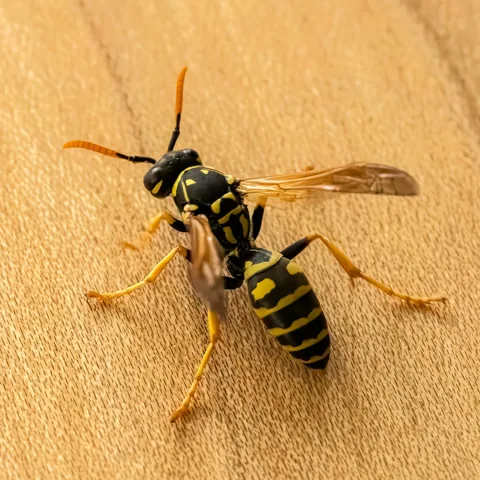 European Paper Wasp
Polistes dominula
Paper wasps hang open, umbrella-shaped paper nests under eaves and in sheltered spots; they are much less defensive than yellowjackets and rarely sting unless a nest is disturbed.
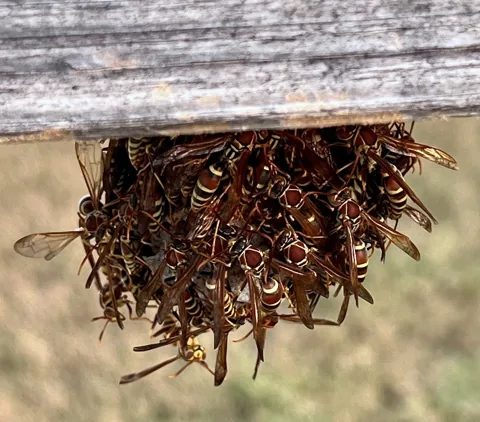 Guinea Paper Wasp
Polistes exclamans
The guinea paper wasp is a small paper wasp, yellow with brown bands, that hangs single open combs in sheltered spots like eaves, grills, gates and shrubs; it is not very aggressive until its nest is jarred.
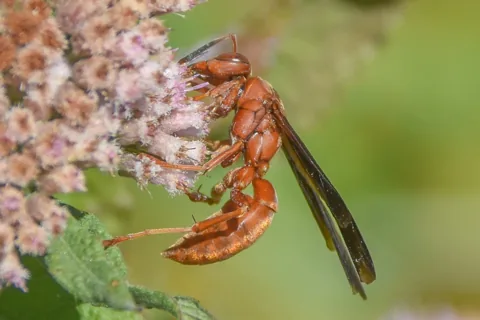 Red Wasp
Polistes carolina
The red wasp (Polistes carolina) is a paper wasp with an almost entirely rust-red body that builds open, umbrella-shaped paper nests under roofs and other overhangs. Paper wasps are not aggressive but will sting to defend the nest. UF/IFAS Featured Creatures calls it not particularly aggressive and says it typically stings only when threatened.
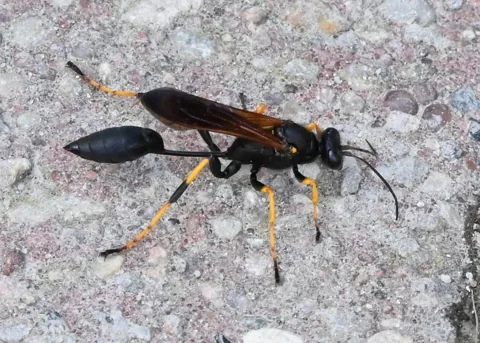 Black and Yellow Mud Dauber
Sceliphron caementarium
Mud daubers are solitary wasps that build mud nests on walls, ceilings, eaves and equipment and stock them with paralyzed spiders. They don't defend their nests and rarely sting.
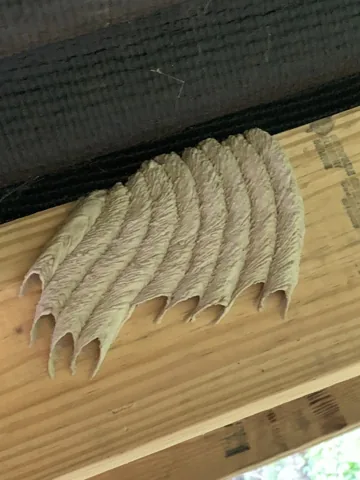 Organ pipe mud dauber
Trypoxylon politum
The organ pipe mud dauber is a black, solitary wasp that builds long mud tubes side by side on walls, eaves and equipment, so the finished nest looks like the pipes of an organ. Females stock the tubes with paralyzed orb weaver spiders, and the male stays at the nest to guard it.
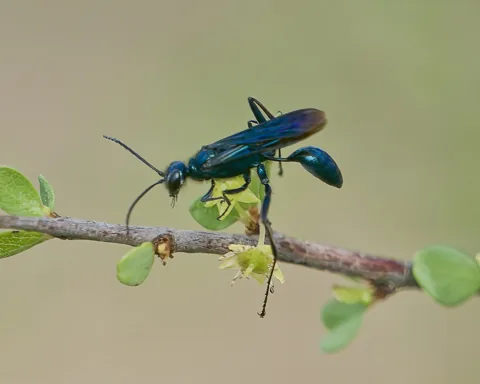 Common blue mud dauber
Chalybion californicum
The common blue mud dauber is a shiny metallic blue wasp with a thread-like waist that hunts spiders, especially black widows, to feed its young. It is solitary, doesn't defend its nest and stings people only if handled roughly, so it is mostly harmless and even helpful. If a nest is in the way, scrape it off with a putty knife; sprays are rarely needed.
Side by side
Who they are: paper wasps are the genus Polistes, social wasps; Missouri counts about 24 species in North America north of Mexico. "Mud dauber" is a name for several solitary wasps that build with mud. The three common ones are the black and yellow mud dauber (Sceliphron caementarium), the blue mud dauber (Chalybion californicum) and the organ pipe mud dauber (Trypoxylon politum).[2][6][7]
- Size: paper wasps are 1/2 to 1 inch long per Minnesota and Missouri; Clemson gives the most common ones as 5/8 to 3/4 inch. Mud daubers run about 1/2 inch to a little over an inch (Clemson; Missouri says 1/2 to 1 inch).[3][2][1][6][7]
- Color, paper wasps: black or brown, often with rusty or yellowish markings; a few species have reddish markings. The invasive European paper wasp is black and yellow like a yellowjacket and has orange-tipped antennae.[2][1][5][4]
- Color, mud daubers: the black and yellow mud dauber (also called the yellow-legged mud dauber) is black and yellow. The blue mud dauber is metallic blue, blue-green or blackish. The organ pipe mud dauber is black with blue wings and white "stockings" on its hind legs. Clemson notes mud daubers often have bright, metallic colors.[7][12][10][6]
- Body and waist: both are slender with narrow waists, so the waist alone won't settle it. Paper wasps are long-legged and their legs dangle below the body in flight. Mud daubers have a narrow, thread-like waist, the petiole between the thorax and abdomen.[3][2][5][6][7]
- Nest material, paper wasps: wood fibers scraped from weathered boards, fences or branches and chewed with saliva into paper. The nest is tan and papery.[2][1][5]
- Nest material, mud daubers: mud. Most females carry mud balls from the edge of a puddle; a cell takes about an hour to build. The blue mud dauber doesn't carry mud; it brings water to an old mud dauber nest and reworks it.[7][10]
- Nest shape, paper wasps: an umbrella-shaped comb, one layer of six-sided cells side by side and facing down, hung by a single stalk, with no outer covering. You can see into the cells from below.[2][1][5]
- Nest shape, black and yellow mud dauber: cells built side by side or on top of each other into a rounded lump about the size of a lemon or a fist, which Missouri says can hold as many as 25 cells. Mississippi State describes it as blocky, a couple of inches long and usually horizontal.[7][8]
- Nest shape, organ pipe mud dauber: vertical, parallel mud tubes that look like a pipe organ, up to six or more inches long, usually on smooth vertical surfaces. Blue mud dauber nests are irregular, lumpy reworked nests of the other two.[7][8][9]
- Where you find the nest, paper wasps: under eaves, porch ceilings, window and door frames, roof overhangs, attic rafters, decks and railings, and in shrubs. Kentucky adds behind shutters and inside porch lights, grills and mailboxes.[1][5]
- Where you find the nest, mud daubers: eaves and sides of buildings, barns, garages, attics, patios and bridges, plus covered parts of cars, boats and equipment. Clemson says many fill round openings in equipment and lawn furniture.[7][8][6]
- Social or solitary: a paper wasp colony is started in spring by one or a few overwintered queens, and her daughters work the nest. Mud daubers are not social; one female builds and stocks each nest, though many females may nest in the same area.[2][1][6][13]
- Temper: paper wasp workers defend the nest, though wasps foraging away from it are usually not aggressive. UC IPM calls paper wasps much less defensive than yellowjackets. Mud daubers don't defend their nests and Missouri says they sting people only if mishandled; Minnesota says solitary wasps are not aggressive toward people and rarely sting.[2][12][7][11]
- Prey: paper wasps feed caterpillars to their young. Mud daubers stock each cell with paralyzed spiders: black and yellow mud daubers favor crab spiders and other small, colorful species, blue mud daubers take many black widows, and organ pipe mud daubers mostly orb weavers. Adults of both drink nectar.[2][1][13][7][8][9]
- Season and winter: paper wasp colonies die in late fall; only mated queens survive, under bark or inside walls, and old nests are very rarely reused. Mud daubers spend the winter as immatures inside the mud cells, and some species repair and reuse old nests. Minnesota says thread-waisted and digger wasps are most often seen June through August; Missouri gives the black and yellow mud dauber two generations each summer and the organ pipe one or two.[2][1][7][6][11]
- Damage: paper wasps scrape wood from houses for nest paper and can feed on fruit. Mud dauber mud can stain walls and ceilings, and a nest in an idle machine can cause mechanical damage when it is next used.[1][8]
How to confirm which one you have
Look at the nest first. Open paper cells you can see into from below mean paper wasps. Hard mud, whether a lump, a blob or a row of tubes, means mud daubers.[2][5][7]
- Count the wasps. Several wasps sitting on one nest point to a paper wasp colony. One wasp coming and going from a mud nest points to a mud dauber; Penn State says nests made of mud are probably the work of solitary wasps. One catch: Penn State notes a newly started paper wasp nest in spring may have no workers yet, only the queen.[2][6][13]
- Watch what it carries. Missouri says mud daubers are easy to identify when you see them building their nests, and you may hear their buzzy "singing" as they work mud. A wasp hauling a spider fits a mud dauber; one chewing wood off a fence fits a paper wasp.[7][9][2]
- Watch it fly. Paper wasps let their long legs dangle in flight.[2][3][4]
- Read an old mud nest. A round hole in the side of a cell means a young wasp has already chewed its way out.[6][8]
- Rule out the other mud builders. Missouri says spider wasps also hunt spiders around eaves and foundations but have spinier legs, long hind legs that dangle in flight, and are often seen dragging a spider on the ground. Potter and mason wasps lack the long narrow waist and build mud nests shaped like little round pots or jugs.[7]
Why the difference matters
The sting risk is different. A paper wasp nest has workers that will defend it, and people are often stung after bumping into a nest hidden in a bush or around the house. Penn State says solitary wasps that build mud nests don't cooperate to defend their nest sites, so the sting risk stays low even where many nest together.[2][1][13]
- Paper wasp nests near doors, windows or busy paths are the ones worth dealing with. UC IPM says paper wasp nests shouldn't need treatment unless they are near people, and Clemson says nests away from buildings can be left to feed on garden pests.[12][1]
- Mud daubers are usually tolerated or simply scraped off. Clemson says chemical control may be needed when someone has a known sting allergy or large numbers are in high-traffic areas.[6][7][13]
- Both do some good. Paper wasps hunt caterpillars, many of them garden pests. Mud daubers hunt spiders, and Missouri says the blue mud dauber specializes in black widows and reuses old mud dauber nests.[2][1][7]
What to do about each
Paper wasps late in the season: Clemson says most die by the first hard frost, so workers found late in the year may not need treatment.[1]
- Paper wasp nest you can't live with: Clemson advises spraying the nest directly with an aerosol labeled for wasps and hornets that reaches up to 20 feet, in early evening when the wasps are on the nest, without a flashlight and not standing directly under it, wearing long sleeves, long pants and a hat. Kentucky says paper wasps can be treated during the day as long as you don't stand under the nest. Follow the product label.[1][5]
- After a paper wasp nest is gone: remove it, screen openings into attics and voids, and repaint or varnish surfaces so nests attach poorly. Keep shrubs trimmed and thinned.[1]
- Mud dauber nests: in winter UC IPM says they can be removed without spraying. For active nests, Penn State says adults can be swatted or vacuumed and the mud scraped off; then seal holes with caulk.[12][13]
- Fewer mud daubers next year: Clemson suggests removing spider webs from corners and crevices, caulking cracks where spiders hide, screening or caulking openings into buildings and knocking down nests by hand. Missouri suggests letting them nest where you can tolerate them.[6][7]
- Check idle equipment, lawn furniture and covered vehicles or boats before use, since mud daubers fill round openings and a nest in the wrong place can damage a machine.[6][8]
Stings
MedlinePlus says stings from bees, wasps and hornets are most often painful, and that most deaths from insect bites are due to an allergic reaction to the venom rather than the toxins in it.[14]
- Get emergency help for signs of a severe allergic reaction: face or mouth swelling, trouble breathing or wheezing, or throat tightness. MedlinePlus says to call 911 and check breathing; CDC's NIOSH says anaphylaxis needs immediate emergency care.[14][15]
- People with a history of severe reactions to stings should carry an epinephrine auto-injector (EpiPen) and wear medical ID, NIOSH advises.[15]
- If a wasp lands on you, don't swat or run; wait for it to leave or gently brush it away. Avoid quick, jerky movements near nests.[15][14]
Common questions
- Do mud daubers sting?
- They can, but rarely. Missouri says females sting people only if handled roughly, and UC IPM says they don't defend their nests.[7][12]
- Is a mud nest on my porch a paper wasp nest?
- No. Paper wasp nests are paper, not mud. Mud lumps or tubes are mud dauber work; little round mud pots are potter wasps.[2][7]
- Why does an old mud nest have holes in it?
- A young wasp chews a hole through the cell wall when it finishes developing, so holes mean those cells are empty.[6][8]
- Do paper wasps reuse last year's nest?
- Very rarely. New paper wasp nests are begun from scratch each spring, while some mud daubers do repair and reuse old mud nests.[2][6][7]
Photo credits
- European Paper Wasp: (c) Andrew McKinlay, some rights reserved (CC BY) — via iNaturalist, CC BY 4.0
- Guinea Paper Wasp: (c) Sue Ann Kendall, some rights reserved (CC BY) — via iNaturalist, CC BY 4.0
- Red Wasp: (c) Jay Pruett, some rights reserved (CC BY) — via iNaturalist, CC BY 4.0
- Black and Yellow Mud Dauber: (c) Maciej Boenisch, some rights reserved (CC BY) — via iNaturalist, CC BY 4.0
- Organ pipe mud dauber: (c) Jeff Clark, some rights reserved (CC BY) — via iNaturalist, CC BY 4.0
- Common blue mud dauber: (c) Bill Levine, some rights reserved (CC BY) — via iNaturalist, CC BY 4.0
Sources
- Clemson Cooperative Extension Home & Garden Information Center, “Paper Wasps (HGIC 2481).” hgic.clemson.edu/factsheet/paper-wasps/ (accessed 2026-11-14)
- Missouri Department of Conservation, “Paper Wasps.” mdc.mo.gov/discover-nature/field-guide/paper-wasps (accessed 2026-11-14)
- University of Minnesota Extension, “Wasps and bees.” extension.umn.edu/insects-infest-homes/wasps-and-bees (accessed 2026-11-14)
- Penn State Extension, “European Paper Wasp.” extension.psu.edu/european-paper-wasp (accessed 2026-11-14)
- University of Kentucky Entomology, “ENTFACT-620: Controlling Wasps, Hornets, and Yellowjackets.” entomology.mgcafe.uky.edu/ef620 (accessed 2026-11-14)
- Clemson Cooperative Extension Home & Garden Information Center, “Mud Daubers: Identification, Habits, and Control.” hgic.clemson.edu/factsheet/mud-daubers/ (accessed 2026-11-14)
- Missouri Department of Conservation, “Mud Daubers.” mdc.mo.gov/discover-nature/field-guide/mud-daubers (accessed 2026-11-14)
- Mississippi State University Extension, “Organ Pipe Mud Dauber (Bug's Eye View, Vol. 6, No. 20).” extension.msstate.edu/newsletters/bugs-eye-view/2020/organ-pipe-mud-dauber-vol-6-no-20 (accessed 2026-11-14)
- University of Arkansas Arthropod Museum, “Organ-pipe mud-daubers.” arthropod.uark.edu/?p=27756 (accessed 2026-11-14)
- Animal Diversity Web, University of Michigan Museum of Zoology, “Chalybion californicum.” animaldiversity.org/accounts/Chalybion_californicum/ (accessed 2026-11-14)
- University of Minnesota Extension, “Solitary wasps.” extension.umn.edu/yard-and-garden-insects/solitary-wasps (accessed 2026-11-14)
- Penn State Extension, “Getting Rid of Paper Wasps, Yellowjackets, and Other Stinging Insects.” extension.psu.edu/getting-rid-of-paper-wasps-yellowjackets-and-other-stinging-insects (accessed 2026-11-14)
- MedlinePlus, U.S. National Library of Medicine, “Insect bites and stings.” medlineplus.gov/ency/article/000033.htm (accessed 2026-11-14)
- CDC National Institute for Occupational Safety and Health, “Insects and Scorpions at Work.” www.cdc.gov/niosh/outdoor-workers/about/insects-and-scorpions.html (accessed 2026-11-14)