On this page
How to identify it
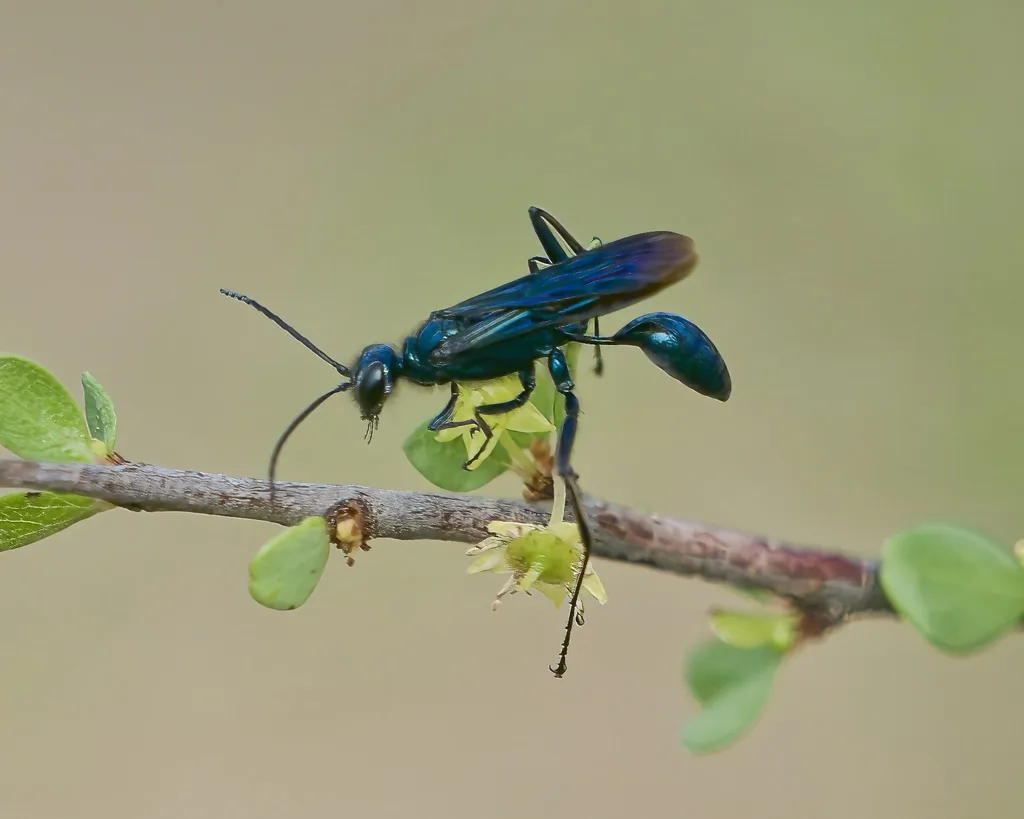
- The body is metallic blue, blue-green or blackish, and the wings are tinted the same color as the body. The antennae and legs are black.[2][1][3]
- Like other mud daubers it has a long, narrow, thread-like waist between the thorax and abdomen. Mud daubers in general run from about 1/2 inch to a little over 1 inch long; University of Minnesota Extension calls this one about an inch long, and Animal Diversity Web gives males 9mm to 13mm and larger females 20mm to 23mm.[4][3][2]
- Its nests look messy: irregular clumps with an uneven, lumpy or blobby surface, usually built on top of an older nest made by another mud dauber.[1]
Look-alikes
| Look-alike | How to tell them apart |
|---|---|
| Black and yellow mud dauber | Black with yellow markings and yellow legs. It carries its own mud and builds a rounded, lump-shaped nest about the size of a lemon or fist, which the blue mud dauber often takes over later.[1] |
| Organ pipe mud dauber | Black with blue wings and white 'stockings' on the hind legs. It builds neat, vertical rows of parallel mud tubes that look like a pipe organ.[1] |
| Blue-black spider wasps | Many spider wasps are also bluish black and hunt spiders around eaves and foundations. They have spinier legs with extra-long hind legs that dangle in flight, and they are often seen dragging a spider across the ground.[1] |
Where it lives
It occurs throughout North America, from southern Canada to northern Mexico. Clemson Extension lists it as one of the three common mud daubers in South Carolina, the Missouri Department of Conservation counts it among three especially common in Missouri, and University of Minnesota Extension describes it in Minnesota.[2][4][1][3]
Biology and life cycle
The female doesn't gather mud the way the black and yellow mud dauber does. The Missouri Department of Conservation and Animal Diversity Web say she brings water to an abandoned mud nest and reworks it; University of Minnesota Extension describes her carrying water to soil near the nest to make mud.[1][2][3]
Sometimes she takes over a nest before its builder has finished with it. She throws out the original larvae and their spiders and restocks the cells with spiders she has caught and her own eggs.[1]
Each cell gets paralyzed spiders and a single egg before it is sealed with mud. Prey includes orb weavers and comb-footed spiders, often black widows. Some females have been seen landing on an orb web and luring the spider out of its retreat.[2][1]
In a study of attacks on common house spiders, small spiders fled while medium and large ones fought back; the wasps mostly approached small spiders but caught big ones just as successfully.[5]
The larva feeds on the stored spiders and pupates in a thin silk cocoon inside the cell. Young wasps spend the winter in the nest and come out as adults the next spring.[2][1]
It can have several generations in a year. Adults drink flower nectar, and groups of adults sometimes shelter together at night or in bad weather.[1][2]
Damage and signs
Health risk
It is not aggressive and stings only to paralyze prey; a female will sting a person only if she is provoked or handled roughly. MedlinePlus notes wasp stings are most often painful, and that a few people have severe, life-threatening allergic reactions; call 911 for face or mouth swelling, throat tightness or trouble breathing or swallowing.[1][2][3][6]
Control
Prevention
No control is usually needed. The Missouri Department of Conservation and University of Minnesota Extension consider mud daubers beneficial, and this one specializes in spiders such as black widows.[1][3]
Keep them out
Screen or caulk openings that would let mud daubers into buildings, and caulk or plaster cracks where spiders hide. Removing webs from corners and crevices also makes an area less attractive.[4]
Traps and physical control
Where a nest is in the way, scrape it off with a putty knife; because they don't defend their nests there is little risk of stings, and Clemson notes removal may discourage mud daubers and reduce later generations.[3][4]
Pesticides
Clemson reserves insecticide for people with a known sting allergy or for large numbers in busy walkways. Wasp sprays that shoot a stream up to about 20 feet let you treat a nest from a distance, ideally in late evening or early morning when the insects are less active.[4]
Common questions
- Do blue mud daubers really eat black widows?
- The adults drink nectar, but females hunt spiders to feed their young, and black widows are a large share of their prey. They also take orb weavers and other comb-footed spiders.[1][2]
- Will a blue mud dauber sting me?
- It's unlikely. It is solitary, doesn't defend its nest, and stings people only when provoked or handled roughly.[1][2][3]
- Why does the nest look like a lumpy mess?
- The blue mud dauber doesn't build from scratch. It wets an old nest left by another mud dauber and reworks it, so the finished nest has an irregular, blobby surface.[1][3]
- What should I do if I'm stung?
- MedlinePlus advises washing the site with soap and water and applying ice wrapped in a washcloth, 10 minutes on and 10 minutes off. Anyone who has had a severe, bodywide reaction should see an allergist.[6]
- Should I knock down mud dauber nests?
- Only if they bother you. Scraping them off with a putty knife is safe because mud daubers don't guard their nests, and removal may discourage them from returning.[3][4]
Sources
- Missouri Department of Conservation, “Mud Daubers (Field Guide).” mdc.mo.gov/discover-nature/field-guide/mud-daubers (accessed 2026-11-12)
- Animal Diversity Web, University of Michigan Museum of Zoology, “Chalybion californicum (A. Eulberg, author; C. Johansson, editor).” animaldiversity.org/accounts/Chalybion_californicum/ (accessed 2026-11-12)
- University of Minnesota Extension, “Solitary wasps.” extension.umn.edu/yard-and-garden-insects/solitary-wasps (accessed 2026-11-12)
- Clemson Cooperative Extension Home & Garden Information Center, “Mud Daubers: Identification, Habits, and Control (HGIC 2512).” hgic.clemson.edu/factsheet/mud-daubers/ (accessed 2026-11-12)
- Environmental Entomology 41(6), 2012 (Uma & Weiss), via PubMed, “Flee or fight: ontogenetic changes in the behavior of cobweb spiders in encounters with spider-hunting wasps.” pubmed.ncbi.nlm.nih.gov/23321095/ (accessed 2026-11-12)
- NIH National Library of Medicine, MedlinePlus, “Insect bites and stings (Medical Encyclopedia).” medlineplus.gov/ency/article/000033.htm (accessed 2026-11-12)
- iNaturalist, “Chalybion californicum taxon page (order and family).” www.inaturalist.org/taxa/133790 (accessed 2026-11-10)