On this page
How to identify it
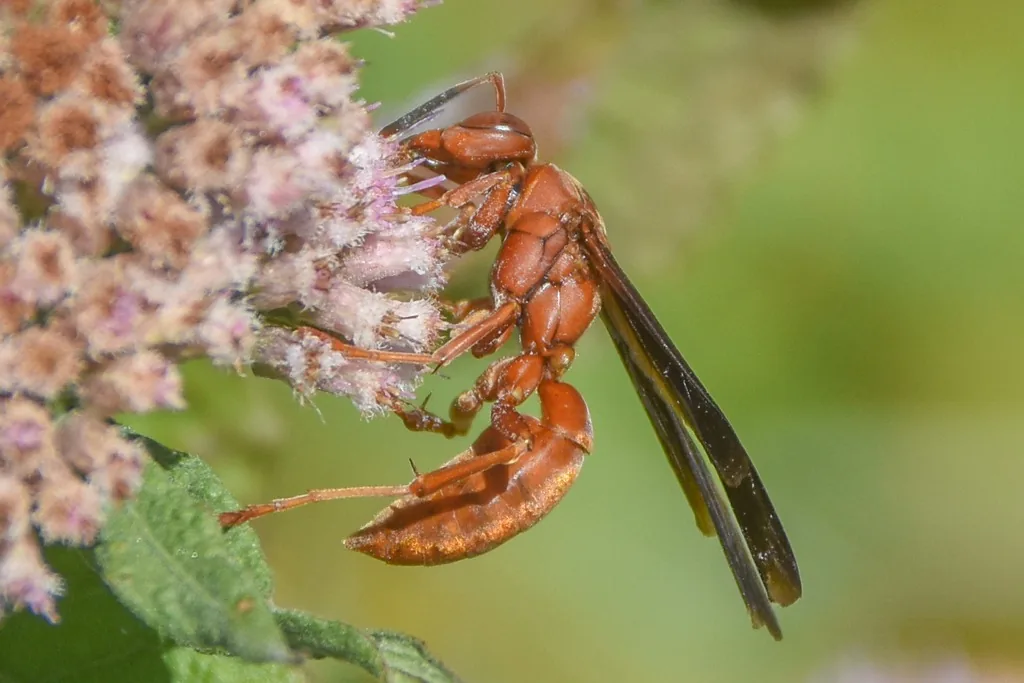
- The body is almost entirely reddish-brown (ferruginous), sometimes with small black marks around the simple eyes on top of the head and on the thorax, and very little yellow. UF/IFAS notes that color varies, with possible yellow marks on the jaws, face and legs, and says close inspection of body structures and behavior is more reliable than color for naming one in the field.[1][4]
- Fore wings are 15.0 to 20.5 mm long. Like other paper wasps it looks like a slender yellow jacket and flies with its legs dangling. UF/IFAS gives the same forewing length, 15 to 20.5 mm, for both sexes and describes paper wasps as elongate and slender with a spindle-shaped abdomen.[1][3][4]
- The nest is a single comb of six-sided paper cells facing downward, hung from one stalk, with no outer covering.[3][2]
- Males usually show sharper black or sepia marks on the front and middle thighs and on the underside of the abdomen than females, and most have a face plate (clypeus) shading from yellow to rust.[4]
Look-alikes
| Look-alike | How to tell them apart |
|---|---|
| Polistes perplexus | The only other almost entirely rust-red paper wasp in the East and very hard to tell apart; females of P. perplexus have silvery hair across the cheek and the area below the eye, which is mostly bare in P. carolina. It tends to nest in more sheltered spots such as hollow trees and storage buildings. UF/IFAS adds that males of P. perplexus have coarser crosswise ridges on the rear of the thorax, and P. carolina tends to have more black marks on the thorax.[1][5][4] |
| Polistes metricus | Its thorax is mostly reddish, but its abdomen is mostly black. UF/IFAS says P. metricus is sometimes confused with the two rust-red species but has more black, especially on the thorax and legs.[6][7][4] |
| European paper wasp | Most common paper wasps are brownish with yellow markings rather than all red.[2] |
| Other 'red wasps' | Common names vary. Mississippi State Extension calls Polistes metricus and P. annularis the red wasps (dark red with black abdomens) and groups P. carolina and P. perplexus as orange paper wasps with burnt-orange bodies and black wings.[7] |
Where it lives
Eastern United States from New York, Pennsylvania and Ohio south to Florida and west to Illinois, Kansas, Arkansas and eastern Texas. It has been introduced to Bermuda, and a few have turned up in Ontario without becoming established. UF/IFAS gives the same range and says the wasps are commonly found in woodlands from summer through fall.[1][4]
Biology and life cycle
Only fertilized queens survive the winter, sheltering under bark or in cracks and wall voids. In spring one or a few queens start a nest; where several cooperate, one becomes dominant and the rest work for her. UF/IFAS adds that subordinate sisters hold back their own egg development; if the founding queen dies, one of them can take over, apparently in order of arrival at the nest, and she develops working ovaries within a month.[2][3][4]
Workers chew wood fiber scraped from weathered boards, fences and branches into paper. Adults drink nectar and fruit juice, and they feed the larvae caterpillars and leaf beetle larvae; one report describes an attack on a cicada. UF/IFAS lists caterpillars, cicadas and beetle larvae as prey and says workers also collect water.[3][2][1][4]
Workers are produced first; males and new queens appear in mid- to late summer, and the rest of the colony dies with freezing weather in late fall.[3][2]
Nests are built in fairly exposed spots such as under the roofs of buildings and porch ceilings, eaves, window and door frames, and even in old tires. UF/IFAS says the comb hangs from a short stalk on the sheltered underside of an overhang, with the cells facing down so the larvae grow head-down.[1][2][4]
Colonies are headed by one egg-laying queen and run by smaller female workers without functional ovaries; UF/IFAS says the most successful nests yield hundreds of offspring.[4]
The queen mates once and stores the sperm. Later in the season she lays unfertilized eggs that become males and well-fed fertilized eggs that become future queens; males mate with future queens from other nests, rarely their own, then die, and only the young queens overwinter. In subtropical and tropical areas colonies can keep a nest going for several seasons.[4]
Damage and signs
- Paper wasps feed many garden pests to their young, especially caterpillars, so MDC counts them among the most beneficial insects. UF/IFAS says gardeners and farm workers consider P. carolina beneficial because it pollinates while feeding on nectar and preys on caterpillars, cicadas and beetle larvae.[3][2][4]
- They scrape wood from fences, benches and houses for nest paper, and Clemson notes they also feed on fruit, spoiling its appearance.[2][3]
Health risk
Paper wasps sting when they feel the nest is threatened; many stings happen when someone bumps into a hidden nest, and wasps foraging away from the nest are usually not aggressive. For a sting, wash the site with soap and water and apply ice. People allergic to venom can go into anaphylaxis: call 911 for trouble breathing, wheezing, throat tightness, or swelling of the face or mouth.[2][3][8][9]
Control
Prevention
Leave nests away from buildings alone so the wasps keep hunting garden pests. Most paper wasps die at the first hard frost, so workers seen late in the year may not need treatment.[2][3]
People who often work near wasps can wear long sleeves, long pants, gloves and a beekeeping veil, UF/IFAS suggests.[4]
Keep them out
Screen openings and vents, give surfaces where nests keep appearing a fresh coat of paint or varnish, and keep shrubs trimmed and thinned.[2]
Traps and physical control
Remove the nest after the wasps are dead to discourage new nests in the same spot.[2]
If a nest has just been started by a lone queen, UF/IFAS says spraying may be unnecessary: knock the nest down with a broom and she will likely nest somewhere else. Single wasps can be swatted or vacuumed.[4]
Pesticides
For a nest near the house, spray it directly with an aerosol labeled for wasps and hornets, following the label. Treat in the early evening when all the wasps are on the nest, and don't shine a flashlight on it, which can draw them toward the light. UF/IFAS also says to treat in the evening, when the wasps are inactive, and not to use spray insecticides near open flames.[2][4]
Where sources disagree
Nest sites: older accounts say this wasp nests in hollow trees, but the Canadian Journal of Arthropod Identification atlas says those reports apparently refer to the look-alike P. perplexus, and that P. carolina nests in more exposed places. UF/IFAS still lists tree hollows, along with house eaves, among paper wasp nest sites.[1][5][4]
Which wasp is the red wasp: this page follows the name used for P. carolina, but Mississippi State applies "red wasp" to P. metricus and P. annularis.[7][1]
Common questions
- Are red wasps aggressive?
- Not usually. Paper wasps sting mainly when the nest is threatened, and those foraging away from it are rarely aggressive. UF/IFAS calls P. carolina not particularly aggressive.[2][3][4]
- When is the best time to remove a red wasp nest?
- In the early evening, when all the wasps are back on the nest. UF/IFAS also recommends evening, when the wasps are inactive.[2][4]
- Are red wasps good for the garden?
- Mostly, yes. They feed caterpillars and other garden pests to their larvae, though they also nibble fruit.[3][2][1]
- What should I do if a red wasp stings me?
- Wash the sting with soap and water and put ice on it, and have someone watch for an allergic reaction. Call 911 for trouble breathing or swelling of the face, mouth or throat.[8][9]
- Should I spray a small new nest?
- Often there's no need. UF/IFAS says a nest just started by a single queen can be knocked down with a broom, and she will likely start over elsewhere.[4]
Sources
- Canadian Journal of Arthropod Identification, “Polistes carolina species account, in Buck, Marshall and Cheung (2008), Identification Atlas of the Vespidae of the northeastern Nearctic region, Canadian Journal of Arthropod Identification 5.” cjai.biologicalsurvey.ca/bmc_05/72p_carolina.html (accessed 2026-11-14)
- Clemson Cooperative Extension Home & Garden Information Center, “Paper Wasps, HGIC 2481.” hgic.clemson.edu/factsheet/paper-wasps/ (accessed 2026-11-14)
- Missouri Department of Conservation, “Paper Wasps (Field Guide).” mdc.mo.gov/discover-nature/field-guide/paper-wasps (accessed 2026-11-14)
- University of Florida/IFAS Extension (Featured Creatures), “Paper Wasp, Red Wasp (Suggested Common Names), Polistes carolina (L.), EENY-640/IN1112.” ask.ifas.ufl.edu/publication/IN1112 (accessed 2026-11-14)
- Canadian Journal of Arthropod Identification, “Polistes perplexus species account, in Buck, Marshall and Cheung (2008), Identification Atlas of the Vespidae of the northeastern Nearctic region, Canadian Journal of Arthropod Identification 5.” cjai.biologicalsurvey.ca/bmc_05/79p_perplexus.html (accessed 2026-11-14)
- Canadian Journal of Arthropod Identification, “Polistes metricus species account, in Buck, Marshall and Cheung (2008), Identification Atlas of the Vespidae of the northeastern Nearctic region, Canadian Journal of Arthropod Identification 5.” cjai.biologicalsurvey.ca/bmc_05/78p_metricus.html (accessed 2026-11-14)
- Mississippi State University Extension, “Bug-Wise No. 7: Paper Wasps (August 13, 2012).” extension.msstate.edu/sites/default/files/newsletter/bw07.pdf (accessed 2026-11-14)
- U.S. Centers for Disease Control and Prevention, “Insects and Scorpions at Work (NIOSH).” www.cdc.gov/niosh/outdoor-workers/about/insects-and-scorpions.html (accessed 2026-11-14)
- MedlinePlus, U.S. National Library of Medicine, “Insect bites and stings (Medical Encyclopedia).” medlineplus.gov/ency/article/000033.htm (accessed 2026-11-14)
- iNaturalist, “Polistes carolina taxon page (order and family).” www.inaturalist.org/taxa/121792 (accessed 2026-11-14)