On this page
How to identify it
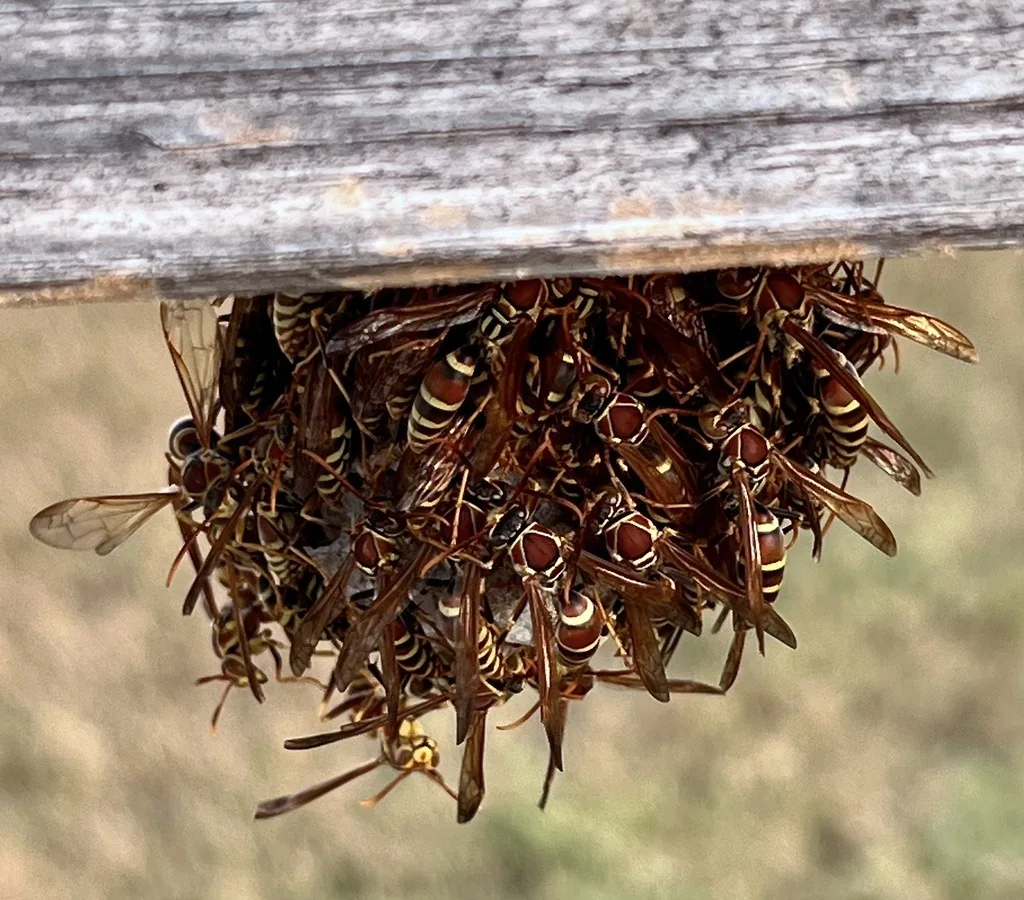
- Somewhat smaller than other paper wasps and yellow with brown bands; it is often mistaken for a yellowjacket.[2]
- Like other paper wasps it looks like a skinny yellowjacket and flies with its legs dangling; paper wasps are 1/2 to 1 inch long.[3]
- The nest is a single, umbrella-shaped layer of downward-facing paper cells on one stalk, with no outer covering.[2][3]
- Unlike yellowjacket and hornet queens, a paper wasp queen is not much larger than her workers.[4]
Look-alikes
| Look-alike | How to tell them apart |
|---|---|
| Yellowjackets | Yellowjackets are yellow with black bands and nest in the ground or in cavities, with a single entrance; Guinea wasps are yellow with brown bands and build open, aerial nests.[2][5] |
| Red wasps | Larger paper wasps; Mississippi State uses 'red wasp' for the dark red Polistes metricus and P. annularis, whose nests can be as big as a straw hat.[2] |
| Orange paper wasps | Large, burnt-orange wasps with black wings (Polistes perplexus and P. carolina) that often nest inside wall voids.[2] |
Where it lives
Mississippi State calls it one of the more common paper wasps in the Southeast and the most common in Mississippi. GBIF holds about 20,000 US records since 1990 from 25 states, counting the District of Columbia, most from Texas, California and North Carolina.[1][2][10]
Biology and life cycle
Mated females overwinter and start new nests each spring, usually in April; nests are rarely reused.[2][3]
Early-season queens may share a new nest, but by midsummer there is usually only one egg-laying queen. New nests are built every year, often in the same general area as the year before.[4][3]
A nest with two or three wasps in early May can hold dozens of workers by August.[1][2]
Texas A&M says a typical mature paper wasp nest holds 20 to 30 adults and rarely more than 200 cells.[4]
Workers feed caterpillars to the larvae; adults drink nectar and fruit juice.[2][3]
Males and new queens are produced in mid- to late summer. In late fall all but the mated queens die, and the queens spend the winter in protected spots.[3][4]
In wind-tunnel tests by USDA researchers, Guinea paper wasp males flew upwind toward unmated females and their extracts, and females were drawn to extracts of males, evidence that both sexes use sex attractants.[9]
In fall, overwintering females can gather by the hundreds in attics and wall voids; they are not nesting and are seldom aggressive.[2]
Damage and signs
Health risk
Guinea wasps tolerate a lot but react quickly once the nest is jarred, and a late-summer nest means many more stings than a spring one. A wasp sting is usually painful and can be cared for at home, but people allergic to the venom can have anaphylaxis, a severe, potentially life-threatening reaction that needs emergency care. Its venom is a recognized allergen: in tests with blood serum from people allergic to it, the venom's phospholipase bound allergy antibodies most strongly.[1][2][6][7][8]
Control
Prevention
Before moving rarely used items or pruning shrubs, shake them with a long tool, step back and watch for wasps.[1][2]
Leave nests in out-of-the-way places; paper wasps are beneficial caterpillar hunters.[2][3]
Mississippi State advises that people who are especially sensitive or allergic to wasp stings let someone else handle nests; CDC NIOSH notes that people allergic to venom can have life-threatening reactions.[2][6]
Keep them out
Seal the building before fall to keep overwintering wasps out of attics; if they are already inside, wait for them to leave in spring before sealing outside cracks.[2]
Pesticides
Treat nests that must go while they are small, using an aerosol wasp and hornet spray: approach quietly and soak the whole nest with a three- to five-second burst, wearing protective clothing, ideally at night when wasps are less likely to fly. Texas A&M suggests spraying from a safe distance early in the morning or just before dark, then scraping off the nest and cleaning the spot.[1][2][5]
Where sources disagree
Size: Texas A&M gives 3/4 to 1 inch for paper wasps and the Missouri Department of Conservation 1/2 to 1 inch; Mississippi State says Guinea wasps are somewhat smaller than other paper wasps.[4][3][2]
Aggression: the Missouri Department of Conservation calls paper wasps relatively nonaggressive and says foragers away from the nest usually are not aggressive; Texas A&M AgriLife says they can be aggressive when the nest is disturbed, and Mississippi State says Guinea wasps react quickly and viciously once it is jarred.[3][5][1]
Common questions
- What are the small brown-and-yellow wasps nesting in my grill?
- Often guinea paper wasps.[1][2]
- Are they yellowjackets?
- No; yellowjackets nest in the ground and have black bands.[2]
- Why are there wasps in my attic in winter?
- Overwintering paper wasp females gather in attics and voids; they leave in spring.[2]
- Are guinea wasps aggressive?
- Not overly, until the nest is jarred.[1]
- What should I do if I'm stung?
- Wash the sting with soap and water and put ice wrapped in a cloth on it, 10 minutes on and 10 minutes off. Call 911 for trouble breathing or wheezing, swelling of the face or mouth, throat tightness or trouble swallowing, weakness, or turning blue.[7][6]
Sources
- Mississippi State University Extension (Bug's Eye View), “Guinea Wasps, Bug's Eye View Vol. 8, No. 17.” extension.msstate.edu/newsletters/bugs-eye-view/2022/guinea-wasps-vol-8-no-17 (accessed 2026-11-11)
- Mississippi State University Extension, “Bug-Wise No. 7: Paper Wasps (August 13, 2012).” extension.msstate.edu/sites/default/files/newsletter/bw07.pdf (accessed 2026-11-11)
- Missouri Department of Conservation, “Paper Wasps (Field Guide).” mdc.mo.gov/discover-nature/field-guide/paper-wasps (accessed 2026-11-11)
- Texas A&M AgriLife Extension, “Paper Wasps, Yellowjackets and Solitary Wasps (E-239).” extensionentomology.tamu.edu/wp-content/uploads/sites/3/2010/05/E239-Paper-wasps-Yellowjackets-and-solitary-wasps-1.pdf (accessed 2026-11-11)
- Texas A&M AgriLife Extension (Insects in the City), “Fascinating facts about wasps, hornets: How to get along with these beneficial bugs.” citybugs.tamu.edu/2021/06/28/fascinating-facts-about-wasps-hornets-how-to-get-along-with-these-beneficial-bugs/ (accessed 2026-11-11)
- Centers for Disease Control and Prevention, NIOSH, “Insects and Scorpions at Work.” www.cdc.gov/niosh/outdoor-workers/about/insects-and-scorpions.html (accessed 2026-11-11)
- MedlinePlus, U.S. National Library of Medicine, “Insect bites and stings (Medical Encyclopedia).” medlineplus.gov/ency/article/000033.htm (accessed 2026-11-11)
- Journal of Allergy and Clinical Immunology, via PubMed, “Allergens in Hymenoptera venom XIV: IgE binding activities of venom proteins from three species of vespids (Hoffman 1985).” pubmed.ncbi.nlm.nih.gov/3989146/ (accessed 2026-11-11). Cited from the PubMed abstract.
- Journal of Chemical Ecology, via PubMed, “Sex attraction in paper wasp, Polistes exclamans, in a wind tunnel (Reed and Landolt 1990).” pubmed.ncbi.nlm.nih.gov/24263727/ (accessed 2026-11-11). Cited from the PubMed abstract.
- Global Biodiversity Information Facility (GBIF), “Polistes exclamans: US occurrence records since 1990 by state (GBIF occurrence search API).” api.gbif.org/v1/occurrence/search?taxonKey=1310760&country=US&hasGeospatialIssue=false&occurrenceStatus=PRESENT&year=1990%2C2026&facet=stateProvince&facetLimit=400&limit=0 (accessed 2026-11-11). State counts are records reported (iNaturalist research-grade, museum specimens, surveys), not abundance.
- iNaturalist, “Polistes exclamans taxon page (order and family).” www.inaturalist.org/taxa/133791 (accessed 2026-11-11)