The short answer
- Most likely it's a queen paper wasp or yellowjacket that crept into your walls, attic or siding in the fall. University of Minnesota says queens shelter in buildings until it is warm enough to become active, and Missouri Department of Conservation says a warm spell in winter can wake them, which is why a wasp shows up indoors on a warm day.[1][5]
- It isn't coming from a nest. University of Minnesota says wasps seen indoors at this time of year come from a shelter, not an active nest, and that in the Upper Midwest yellowjacket and paper wasp nests do not survive the winter, even inside a building.[1]
- It can still sting if you grab it or press it against your skin. Penn State says wasps defend themselves by stinging if they are trapped or crushed against the skin.[7]
- First steps: swat it, crush it, vacuum it, or catch it in a jar and put it outside. University of Minnesota lists removing, crushing or catching and releasing; Nebraska Extension says to use a fly swatter and not to use wasp spray inside.[1][3]
Profiles on this site
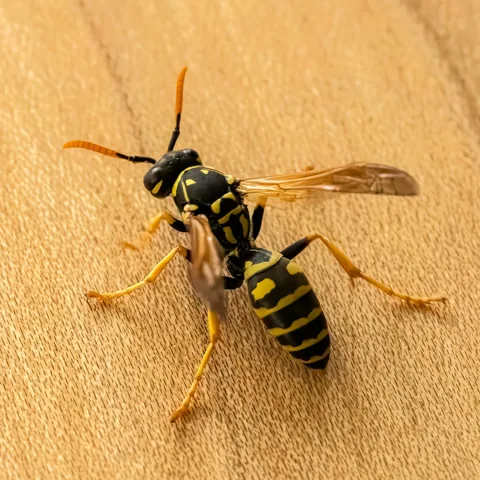 European Paper Wasp
Polistes dominula
Paper wasps hang open, umbrella-shaped paper nests under eaves and in sheltered spots; they are much less defensive than yellowjackets and rarely sting unless a nest is disturbed.
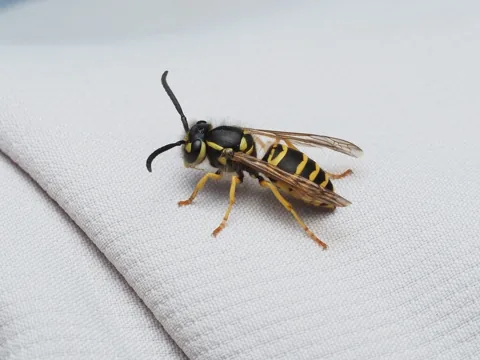 Eastern Yellowjacket
Vespula maculifrons
The eastern yellowjacket is a native, ground-nesting yellowjacket common across the eastern US in lawns, woodlands, pastures and parks; it defends its nest aggressively and can sting repeatedly.
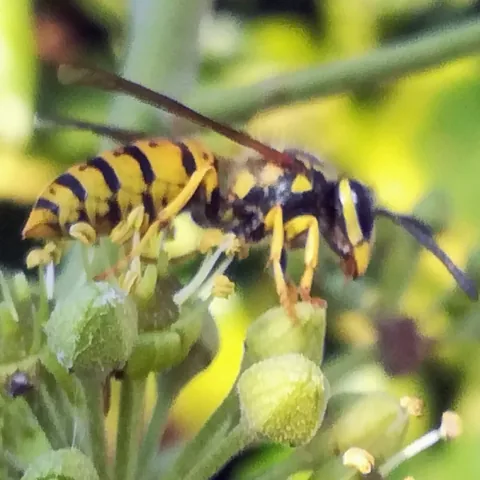 German Yellowjacket
Vespula germanica
The German yellowjacket is an invasive wasp from Eurasia that has spread across the northern US, displaces native yellowjackets and often nests in buildings.
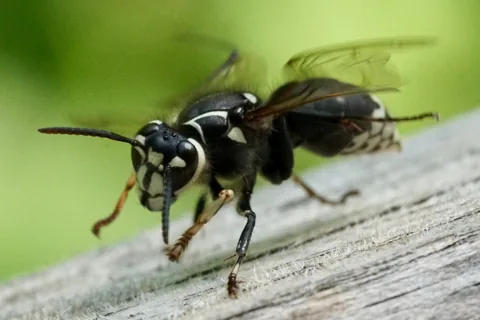 Bald-faced Hornet
Dolichovespula maculata
The bald-faced hornet is a large black-and-white aerial yellowjacket that builds gray, football-shaped paper nests in trees, shrubs and on buildings and defends them aggressively.
What the wasp could be
Indoor wasps in winter and early spring are almost always queens of the social wasps. Only mated queens survive the winter; the workers and the old queen die when it freezes, according to University of Minnesota and Missouri Department of Conservation. Our yellowjackets vs wasps vs hornets page has the full side-by-side; the quick field marks are below.[1][5]
- Paper wasps: slender, with long legs that dangle beneath the body in flight, 1/2 to 1 inch long, generally brown with yellowish markings (University of Minnesota; Missouri gives the same ½–1 inch length). University of Minnesota says paper wasp queens spend the winter in groups, so several can turn up together.[1][5]
- European paper wasps: black and yellow, so often mistaken for yellowjackets. Penn State says they are larger than yellowjackets, with a thinner waist and orange-tipped antennae; Washington State University calls them the only paper wasp with bright orange antennae. Penn State lists behind siding, wall voids and attics among their overwintering spots.[6][8]
- Yellowjacket queens: 3/8 to 5/8 inch long, bright yellow with black lines, spots, triangles or diamonds on the abdomen, with a hard, shiny body (University of Minnesota). Penn State notes paper wasps have a thinner waist and abdomen than yellowjackets. University of Minnesota says yellowjacket queens spend the winter alone.[1][6]
- Where they hid: University of Minnesota lists loose tree bark, old stumps and buildings, such as under siding. Missouri Department of Conservation names inside building walls, and Penn State adds wall voids and attics.[1][5][6]
Is one wasp a sign of more?
In winter, usually not a nest. University of Minnesota says the queens stay in their shelters until it is warm enough, then emerge in late winter or early spring; UC IPM says queens emerge then to feed and start new nests outdoors. You may see a few more on sunny days until that shelter empties out, but they are not building a colony in your living space.[1][2]
A live yellowjacket nest in a wall is a different case. Connecticut Agricultural Experiment Station says yellowjackets flying inside the home during the fall may indicate a nest in a nearby wall cavity, drawn by warmer indoor temperatures. University of Minnesota says yellowjackets can nest in attics and wall voids.[4][1]
- Yellowjackets flying around indoors in the fall, rather than one sluggish wasp in midwinter. Connecticut Agricultural Experiment Station says workers are drawn to the warmer indoor temperatures as the weather cools.[4]
- Wasps going in and out of one gap on the outside wall in warm weather. Penn State says to identify the nest entrance or entrances and, if the insects are entering a building, to find their entry inside too.[7]
- A warm spot on the wall. Penn State says the colony generates heat, so an infrared camera or laser thermometer may help locate it.[7]
- In cold-winter areas even a wall nest dies off. University of Minnesota says freezing temperatures kill the old queen and workers, and Penn State says nests found in the fall will naturally perish soon anyway.[1][7]
Safety first
A drowsy queen is a low risk if you don't handle it. Penn State says wasps sting when trapped or crushed against the skin, and University of Minnesota says yellowjackets and paper wasps can sting more than once because the stinger is not left in the skin.[7][1]
- If someone is stung: CDC NIOSH says to have someone stay with them to watch for an allergic reaction, wash the site with soap and water, and apply ice to reduce swelling. MedlinePlus says to place ice wrapped in a clean cloth on the sting for 10 minutes and then off for 10 minutes.[10][11]
- Wasps usually leave no stinger, but if one is there, NIOSH says to scrape a fingernail or wipe gauze over the area and never squeeze it or use tweezers.[10][1]
- Get emergency help for an allergic reaction. MedlinePlus lists swelling in the throat, lips, tongue and mouth and difficulty breathing among sting symptoms caused by allergy, and its anaphylaxis page adds coughing, wheezing and hives. NIOSH says anaphylaxis requires immediate emergency care. Call 911, or Poison Control at 1-800-222-1222 for questions (MedlinePlus).[11][12][10]
- People with a known severe sting allergy should carry their prescribed epinephrine kit, which MedlinePlus says requires a prescription, and NIOSH advises a medical ID bracelet or necklace. University of Minnesota says not to manage a nest yourself if you are allergic to stings.[11][10][1]
How to confirm what it is
The season does most of the work: a single slow wasp in winter or early spring fits an overwintering queen, while yellowjackets flying indoors in the fall can point to a nest (University of Minnesota; Connecticut Agricultural Experiment Station).[1][4]
- Catch it in a jar to look closely: long dangling legs and a slender waist mean paper wasp; orange-tipped antennae mean European paper wasp; a bright yellow body with black markings and a thicker waist means yellowjacket (University of Minnesota, Penn State).[1][6]
- Note where they show up. Several turning up in the same room points to a shelter spot nearby; Penn State lists wall voids and attics as overwintering sites, and University of Minnesota says paper wasp queens overwinter in groups.[6][1]
- Check that it's a wasp at all. University of Minnesota describes bees as fuzzy, while yellowjackets have a hard, shiny body with few hairs; our bugs that look like bees and wasps page covers other look-alikes.[1]
What to do next
For winter queens, simple removal is enough. Nebraska Extension says to use a fly swatter on a wasp that gets inside and not to use wasp spray inside, and that spraying the air or a single wasp is not the solution. University of Minnesota says you can remove or crush them, or catch them and release them outdoors.[3][1]
- Swat, vacuum or jar it. Penn State lists swatting and collecting with a vacuum as ways to kill nuisance wasps.[7][3]
- Don't seal a live wall nest from the inside or the outside. Nebraska Extension says not to seal the hole before treatment because the wasps will find another way out, likely into the house, and University of Minnesota says not to seal the opening until all the yellowjackets are dead. Penn State says to seal or treat the interior entry before the exterior one so the colony isn't pushed indoors.[3][1][7]
- Seal gaps once the season is over. Because queens shelter behind siding, in wall voids and in attics, the steps Penn State gives to limit nest sites also help: repair holes in walls, caulk cracks in soffits and eaves, and screen vents and louvers. Our winter pests in the house page covers fall sealing for all overwintering insects.[6][1]
- Knock down empty nests in late fall. Cornell's NYS IPM program says most colonies have disbanded by then, workers rarely survive the winter, and abandoned nests can be vacuumed up or knocked down. University of Minnesota says old nests are not reused.[9][1]
- For an outdoor nest next season, see our wasp nest removal guide; for paper wasps vs mud daubers, see that page.[1]
When to call a pro
Most winter wasps need no pro. Call one when there is a nest inside the structure.[1][4]
- A yellowjacket nest in a wall void, attic or concrete blocks. University of Minnesota says hidden nests in buildings are much more challenging and usually best left to a pest management professional; Connecticut Agricultural Experiment Station also advises a professional for hard-to-reach nests in buildings.[1][4]
- Anyone in the home is allergic to stings (University of Minnesota).[1]
- After a wall nest is killed. Penn State says dead nests left in walls can draw carpet beetles and, if large, rot and cause odors or staining, and that the colony may have chewed away insulation; it advises opening the void, removing the nest and repairing the damage. Penn State also warns that foam or liquid insecticides can damage wood, drywall or electrical components.[7]
Common questions
- Why are wasps in my house in February?
- Missouri Department of Conservation says mated queens spend the winter in sheltered places such as inside building walls and that a warm spell can make them active again, which is why you might see one flying on a warm winter day. University of Minnesota says they emerge in late winter or early spring.[5][1]
- Is there a wasp nest in my house?
- Probably not, if it's winter. University of Minnesota says wasps indoors at this time come from a shelter, not an active nest. Yellowjackets flying indoors in the fall are different: Connecticut Agricultural Experiment Station says that can point to a nest in a nearby wall cavity.[1][4]
- Should I spray the house?
- No. Nebraska Extension says not to use wasp spray inside and to use a fly swatter; University of Minnesota says you can simply remove, crush or release them.[3][1]
- Will they build a nest inside?
- Queens start new nests in spring once it warms up (UC IPM, University of Minnesota). Paper wasps usually build under overhangs, while yellowjackets can use wall voids and attics, so sealing gaps in fall and watching for traffic at one hole in spring is the best defense.[2][1][6]
Photo credits
- European Paper Wasp: (c) Andrew McKinlay, some rights reserved (CC BY) — via iNaturalist, CC BY 4.0
- Eastern Yellowjacket: Brighton Lee, public domain (CC0), via iNaturalist
- German Yellowjacket: (c) Gianni Del Bufalo bygdb, some rights reserved (CC BY) — via iNaturalist, CC BY 4.0
- Bald-faced Hornet: (c) Amy Schnebelin, some rights reserved (CC BY) — via iNaturalist, CC BY 4.0
Sources
- University of Minnesota Extension, “Wasps and bees.” extension.umn.edu/insects-infest-homes/wasps-and-bees (accessed 2026-11-14)
- University of California Statewide IPM Program, “Yellowjackets and Other Social Wasps (Pest Notes).” ipm.ucanr.edu/home-and-landscape/yellowjackets-and-other-social-wasps/ (accessed 2026-11-14)
- University of Nebraska-Lincoln Extension (Horticulture, Landscape, and Environmental Systems), “Paper wasps and Yellowjackets.” hles.unl.edu/insects/urban-entomology/wasps/ (accessed 2026-11-14)
- Connecticut Agricultural Experiment Station, “Yellowjackets (Family Vespidae) fact sheet (G. E. Ridge).” portal.ct.gov/-/media/caes/documents/publications/fact_sheets/entomology/yellowjackets_vespidae.pdf (accessed 2026-11-14)
- Missouri Department of Conservation, “Paper Wasps (Field Guide).” mdc.mo.gov/discover-nature/field-guide/paper-wasps (accessed 2026-11-14)
- Penn State Extension, “European Paper Wasp.” extension.psu.edu/european-paper-wasp (accessed 2026-11-14)
- Penn State Extension, “Getting Rid of Paper Wasps, Yellowjackets, and Other Stinging Insects.” extension.psu.edu/getting-rid-of-paper-wasps-yellowjackets-and-other-stinging-insects (accessed 2026-11-14)
- Washington State University Extension, “Vespidae: Paper Wasps, Yellowjackets, Hornets and Potter Wasps (Hortsense).” hortsense.cahnrs.wsu.edu/fact-sheet/vespidae-paper-wasps-yellowjackets-hornets-and-potter-wasps/ (accessed 2026-11-14)
- New York State Integrated Pest Management Program, Cornell University, “Deal with “Empty Nester” Wasps Now — Prevent Problems Next Year (Think IPM blog).” blogs.cornell.edu/nysipm/?p=800 (accessed 2026-11-14)
- CDC, National Institute for Occupational Safety and Health, “Insects and Scorpions at Work.” www.cdc.gov/niosh/outdoor-workers/about/insects-and-scorpions.html (accessed 2026-11-14)
- MedlinePlus (U.S. National Library of Medicine), “Bee, wasp, hornet, or yellow jacket sting (Medical Encyclopedia).” medlineplus.gov/ency/article/002847.htm (accessed 2026-11-14)
- MedlinePlus (U.S. National Library of Medicine), “Anaphylaxis (Medical Encyclopedia).” medlineplus.gov/ency/article/000844.htm (accessed 2026-11-14)