The short answer
- Check where you are. The northern giant hornet has been found in North America only in Washington State and British Columbia, and it was declared eradicated from the United States in 2024. A huge wasp in the East or Midwest is almost always a European hornet or a cicada killer.[6][9][3][5]
- Look at the head. The northern giant hornet has a large, all yellow-orange head with prominent dark eyes. The European hornet has a yellow face with a reddish-brown top of the head; the cicada killer has a dark orange head and thorax.[2][4][5][8]
- Look at the stripes. European hornet stripes have tear-drop shapes trailing toward the rear, which the northern giant hornet lacks. A cicada killer's abdomen is mostly black with three light-yellow stripes.[5][6][8]
- If it has yellow tips on dark legs and a mostly dark body, think yellow-legged hornet (Vespa velutina), a different invasive hornet found in Georgia, South Carolina and North Carolina. Report it to your state agriculture department.[13][12][2][15]
Profiles on this site
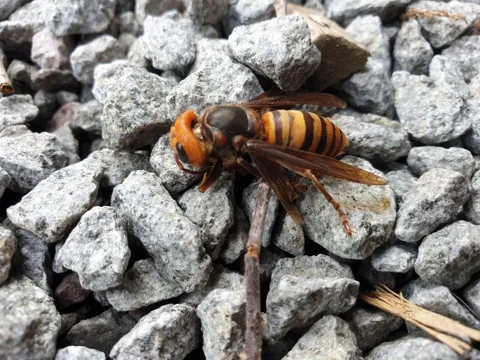 Northern Giant Hornet
Vespa mandarinia
The northern giant hornet is the world's largest hornet. It was first found in the United States near Blaine, Washington, in December 2019, and WSDA and USDA have since declared it eradicated from Washington and the United States.
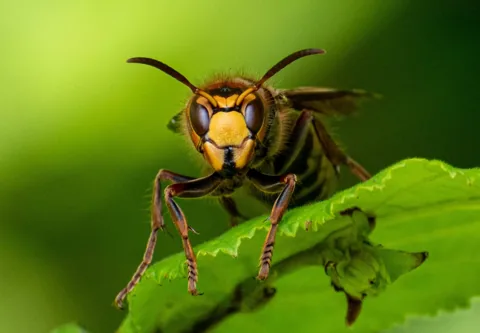 European Hornet
Vespa crabro
The European hornet is a large wasp introduced from Europe and first reported in the United States in 1840. It is now widespread in the East and is the only true hornet (genus Vespa) established in North America.
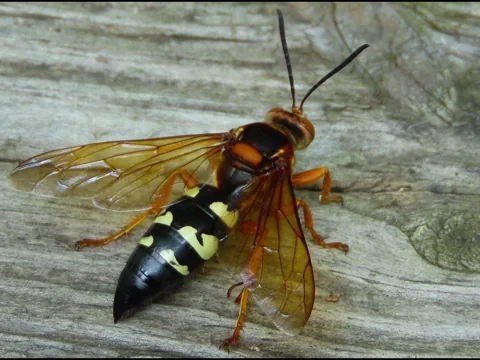 Eastern Cicada Killer
Sphecius speciosus
Cicada killers are very large solitary wasps seen mostly in July and August. Females dig burrows and stock them with annual cicadas. They look alarming, but the Missouri Department of Conservation calls them virtually harmless unless handled roughly, and Kentucky says they aren't a stinging hazard unless directly disturbed.
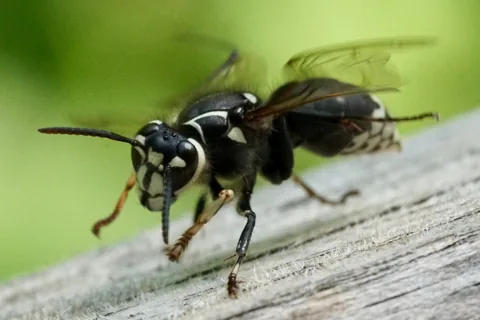 Bald-faced Hornet
Dolichovespula maculata
The bald-faced hornet is a large black-and-white aerial yellowjacket that builds gray, football-shaped paper nests in trees, shrubs and on buildings and defends them aggressively.
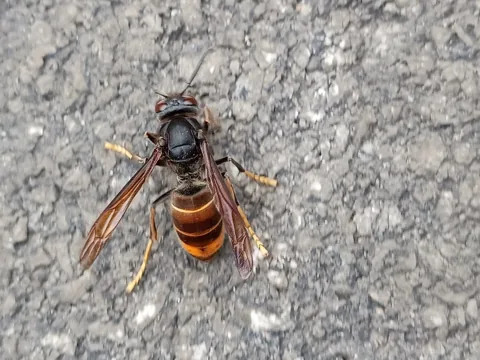 Yellow-Legged Hornet
Vespa velutina
The yellow-legged hornet (Vespa velutina) is an invasive hornet from Southeast Asia that preys on honey bees and other insects. It was first detected near Savannah, Georgia, in August 2023, and state and federal teams in Georgia, South Carolina and North Carolina are trapping it and destroying its nests.
Side by side
These are the field marks state agriculture departments and extension entomologists use. Sizes differ a little between sources, so each is given with its publisher.[2][6]
- Northern giant hornet (Vespa mandarinia): usually 1.5 to 2 inches long (WSDA), adults nearly 2 inches (Pacific Northwest handbook). Large yellow-orange head with prominent black eyes, black thorax, black and yellow or orange striped abdomen. Nests usually in the ground; all nests found in Washington were in cavities of alder trees.[2][4]
- European hornet (Vespa crabro): 1 to 1.5 inches long. Reddish-brown thorax and top of the head, yellow face, brown-tinted wings, yellow and black banded abdomen with tear-drop marks. Nests in cavities such as hollow trees, attics, barns and wall voids, usually 6 feet or more off the ground. One of the few hornets that flies at night and comes to lit windows.[5][7][6]
- Eastern cicada killer (Sphecius speciosus): females 1.5 to nearly 2 inches, males up to 1.5 inches. Dark orange head and thorax, black abdomen with three light-yellow stripes, orange-tinged legs and wings. A solitary wasp that digs burrows in loose soil and leaves piles of sand at the entrance. Seen mostly in July and August.[8][9][6]
- Bald-faced hornet (Dolichovespula maculata): about an inch long by WSDA's measure; Missouri gives half to three-quarters of an inch for workers. Mostly black with white or ivory markings, not yellow. Builds a gray, football-shaped paper nest hanging in trees, shrubs or on buildings.[2][10][11][12]
- Yellow-legged hornet (Vespa velutina): workers about three-quarters of an inch to 1 inch (WSDA, USDA APHIS); Penn State gives queens 20 to 32 mm (0.78 to 1.26 inches). Black head with a yellow face, black thorax, dark legs with yellow ends, and a mostly dark abdomen whose rear segments are yellow; WSDA singles out the yellow-orange fourth segment. Builds egg-shaped paper nests above ground, often high in trees.[2][13][12][14]
- Eye position (needs a close photo): Penn State says the European hornet has a smaller gap between the rear of the eye and the rear of the head, and the northern giant hornet a larger one.[6]
- Colony type: the hornets and the bald-faced hornet are social and build paper nests. The cicada killer is solitary; each female digs her own burrow, though many may nest in the same patch of soil.[6][10][8]
Where each one lives now
Northern giant hornet: WSDA verified the first two U.S. reports near Blaine, Washington, in December 2019. WSDA found and eradicated four nests in Whatcom County by the end of 2021, detected no hornets from 2022 through 2024, and declared it eradicated at the end of 2024. WSDA and USDA announced its eradication from the United States after three years without confirmed detections.[3][1][4]
Missouri's conservation department and Ohio State repeat that status: as of December 2024 it was declared eradicated from the United States, and it has not been confirmed anywhere else in the country. Ohio State adds that this does not mean people should be complacent.[9][5]
- Yellow-legged hornet: first detected in the United States near Savannah, Georgia, in August 2023, and in South Carolina later that year. USDA APHIS lists detections in Georgia, South Carolina and North Carolina, with trapping, surveys and nest removal ongoing.[14][1][13][16]
- By county: North Carolina's agriculture department lists Chatham, Bryan, Effingham and Liberty Counties in Georgia, Beaufort, Colleton, Charleston, Dorchester, Jasper and York Counties in South Carolina, and, as of August 2026, Union and Guilford counties in North Carolina.[15]
- WSDA also reports a live yellow-legged hornet photographed by one of its grain inspectors at the Port of Vancouver, Washington.[1]
- European hornet: introduced from Europe and first reported in the eastern United States in 1840; now common across most of eastern North America and naturalized there.[5][6]
- Cicada killer and bald-faced hornet: native and widespread. Missouri calls the cicada killer not aggressive to people and virtually harmless unless handled roughly.[9][10][12]
How to confirm what you saw
Take a photo only if you can do it safely, and note the exact location. Photos help experts confirm sightings. If the insect is dead, a close view of the head, the legs and the abdomen shows the marks above.[13][14][4]
Watch what it does. A big wasp hovering at eye level over a lawn with sand piles nearby is almost certainly a male cicada killer, which has no stinger. A hornet coming to a lit window at night in the East is likely a European hornet.[8][9][5]
- Signs at beehives: invasive hornets leave piles of dead bees, most of them headless, outside the hive. The yellow-legged hornet hovers near hive entrances to catch returning bees, a behavior called hawking.[2][4][16][12]
- Look at the nest: an underground or tree-cavity colony fits the northern giant hornet or European hornet; a gray, hanging football-shaped nest fits the bald-faced hornet; an egg-shaped nest high in a tree in Georgia or the Carolinas should be reported as a possible yellow-legged hornet.[2][5][11][13]
- Penn State notes that bald-faced hornets are extremely common, so look at the wasps themselves before assuming an egg-shaped paper nest belongs to yellow-legged hornets.[12]
How to report a suspected invasive hornet
Report to your state department of agriculture or local extension office. WSDA runs an online form for sightings in Washington and asks people elsewhere to contact their own state or province agriculture department.[1][4]
Georgia, South Carolina and North Carolina have online reporting forms for yellow-legged hornets. Report sightings right away; early reports help responders find and remove nests before the hornet spreads.[13][14][15]
Why the difference matters
The invasive hornets are a threat to honey bees: a few can destroy a hive in a matter of hours, then take the brood to feed their own young. That is why states respond to every confirmed report. The European hornet is not as aggressive toward hives, Ohio State says.[1][5][13]
- Nests are handled differently too. USDA APHIS says only state or federal responders should remove or treat a yellow-legged hornet nest; removing it yourself is dangerous and could spread the hornet if the queen escapes. The Pacific Northwest handbook says not to attempt to remove a suspected northern giant hornet colony. Native wasp nests that are a problem can be handled as ordinary wasp nests, often best by a professional.[13][4][7][11]
Stings
Most stings from bees, wasps and hornets can be treated at home, but people who are allergic to venom can have anaphylaxis, a severe and potentially life-threatening reaction that needs emergency care.[18][17]
A 2022 medical review notes that some Asian hornet species reaching the Americas and Europe have been associated with human deaths and acute kidney injury, and that Vespa mandarinia and Vespa velutina were among the species causing hospitalization in a large series of sting patients in Asia.[19]
- Call 911 for swelling of the face or mouth, throat tightness or trouble swallowing, or difficulty breathing after a sting.[18]
- If attacked by several stinging insects at once, run to get away from them; if a single insect is flying around, stay calm and still, since swatting may cause it to sting.[17]
- For an ordinary sting, put ice wrapped in a washcloth on the site for 10 minutes, then off for 10 minutes, and repeat; watch for signs of infection over the next several days.[18]
What to do for each
Here are the first steps for each look-alike. The linked guides go into more detail.[13][7]
- Suspected northern giant or yellow-legged hornet: keep your distance, do not disturb the hornet or nest, photograph it only if safe, and report it to your state agriculture department.[13][4][1]
- European hornet: unless it is a nuisance or the nest is in a dangerous spot, Kentucky advises leaving it alone; nests in or near the home are best handled by a pest control professional. Turning off lights or drawing the blinds can stop hornets from gathering at lit windows at night.[7][5]
- Cicada killer: not considered a stinging hazard unless directly disturbed; females reserve their sting for cicadas.[8][9]
- Bald-faced hornet: nests are often high enough to pose little problem. If a nest must go, Kentucky calls hornet nests more difficult and dangerous to control than paper wasp nests and says it is often best to call a professional.[10][11]
Common questions
- Are murder hornets still in the United States?
- No confirmed ones. WSDA and USDA declared the northern giant hornet (the so-called murder hornet) eradicated from the United States at the end of 2024, after no detections from 2022 through 2024.[3][1][9]
- Is the big hornet in my yard a northern giant hornet?
- Almost certainly not outside the Pacific Northwest. Penn State says the European hornet is the species most often mistaken for it in eastern North America, and the cicada killer is the other common candidate.[6][5][9]
- What is the difference between the northern giant hornet and the yellow-legged hornet?
- The northern giant hornet is 1.5 to 2 inches long with a big yellow-orange head. The yellow-legged hornet is smaller, about three-quarters of an inch to 1 inch, mostly dark with yellow ends on its legs, and it is the invasive hornet now being tracked in Georgia and the Carolinas.[2][13][15]
- Can a cicada killer sting?
- Only females have a stinger, and unless handled roughly they keep it for the cicadas they hunt. Males have a false stinger and cannot sting.[8][9]
Photo credits
- Northern Giant Hornet: (c) Lek Khauv, some rights reserved (CC BY) — via iNaturalist, CC BY 4.0
- European Hornet: (c) Михаил Малышев, some rights reserved (CC BY) — via iNaturalist, CC BY 4.0
- Eastern Cicada Killer: (c) Steve Kerr, some rights reserved (CC BY) — via iNaturalist, CC BY 4.0
- Bald-faced Hornet: (c) Amy Schnebelin, some rights reserved (CC BY) — via iNaturalist, CC BY 4.0
- Yellow-Legged Hornet: (c) Javier Sánchez Álvarez, some rights reserved (CC BY) — via iNaturalist, CC BY 4.0
Sources
- Washington State Department of Agriculture, “Hornets (invasive hornets).” agr.wa.gov/departments/insects-pests-and-weeds/insects/hornets (accessed 2026-11-14)
- Washington State Department of Agriculture, “Invasive hornet identification.” agr.wa.gov/departments/insects-pests-and-weeds/insects/hornets/identification (accessed 2026-11-14)
- Washington State Department of Agriculture, “Northern giant hornet.” agr.wa.gov/departments/insects-pests-and-weeds/insects/hornets/faq-s/northern-giant-hornet (accessed 2026-11-14)
- Pacific Northwest Pest Management Handbooks (OSU, WSU, University of Idaho), “Northern giant hornet (Pacific Northwest Insect Management Handbook).” pnwhandbooks.org/insect/emerging-insect-pests/ongoing-eradication-programs/northern-giant-hornet (accessed 2026-11-14)
- Ohio State University Extension (Ohioline), “European Hornets and Look-Alikes.” ohioline.osu.edu/factsheet/ent-0102 (accessed 2026-11-14)
- Penn State Extension, “European Hornet.” extension.psu.edu/european-hornet (accessed 2026-11-14)
- University of Kentucky Entomology, “European Hornet in Kentucky.” entomology.ca.uky.edu/ef600 (accessed 2026-11-14)
- University of Kentucky Entomology, “ENTFACT-004: Cicada Killer Wasps.” entomology.mgcafe.uky.edu/ef004 (accessed 2026-11-14)
- Missouri Department of Conservation, “Eastern Cicada-Killer Wasp.” mdc.mo.gov/discover-nature/field-guide/eastern-cicada-killer (accessed 2026-11-14)
- Missouri Department of Conservation, “Bald-Faced Hornet.” mdc.mo.gov/discover-nature/field-guide/bald-faced-hornet (accessed 2026-11-14)
- University of Kentucky Entomology, “Controlling Wasps, Hornets, and Yellowjackets.” entomology.mgcafe.uky.edu/ef620 (accessed 2026-11-14)
- Penn State Extension, “Yellow-Legged Hornet.” extension.psu.edu/yellow-legged-hornet (accessed 2026-11-14)
- USDA Animal and Plant Health Inspection Service, “Yellow-Legged Hornet.” www.aphis.usda.gov/plant-pests-diseases/yellow-legged-hornet (accessed 2026-11-14)
- Georgia Department of Agriculture, “Yellow-Legged Hornet.” agr.georgia.gov/yellow-legged-hornet (accessed 2026-11-14)
- North Carolina Department of Agriculture and Consumer Services, “Plant Industry - Yellow-Legged Hornet.” www.ncagr.gov/YLH (accessed 2026-11-14)
- Clemson University Regulatory Services, “July 2026 Yellow-Legged Hornet Update: Report Nests.” blogs.clemson.edu/regulatory/july-2026-yellow-legged-hornet-update-report-nests/ (accessed 2026-11-14)
- CDC National Institute for Occupational Safety and Health, “Insects and Scorpions at Work.” www.cdc.gov/niosh/outdoor-workers/about/insects-and-scorpions.html (accessed 2026-11-14)
- MedlinePlus (U.S. National Library of Medicine), “Insect bites and stings.” medlineplus.gov/ency/article/000033.htm (accessed 2026-11-14)
- Clinical Kidney Journal (PubMed 35892025), “Wasp stings and plasma exchange (Carriazo and Ortiz, Clin Kidney J 2022).” pubmed.ncbi.nlm.nih.gov/35892025/ (accessed 2026-11-14)